

Key Takeaways
- BVI companies are excluded from most formal double tax treaty networks, forcing shareholders and counterparties to absorb withholding tax costs that treaty-resident structures would otherwise eliminate.
- Under the BOSS Act and related economic substance rules, certain BVI entities must now demonstrate genuine local activity, adding compliance overhead that many founders did not anticipate when selecting the jurisdiction.
- The BVI's standing on FATF, OECD, and EU non-cooperative jurisdiction watchlists has caused a measurable number of correspondent banks and institutional lenders to decline account applications from BVI-incorporated companies outright.
- Although the BVI Business Companies Act provides a flexible corporate framework, courts in civil law jurisdictions and several emerging markets do not readily enforce BVI judgments or corporate resolutions, creating transactional friction for cross-border operations.
British Virgin Islands incorporation operates under a regulatory framework that has faced increasing international scrutiny, particularly from bodies such as the FATF, OECD, and the EU's list of non-cooperative jurisdictions for tax purposes.
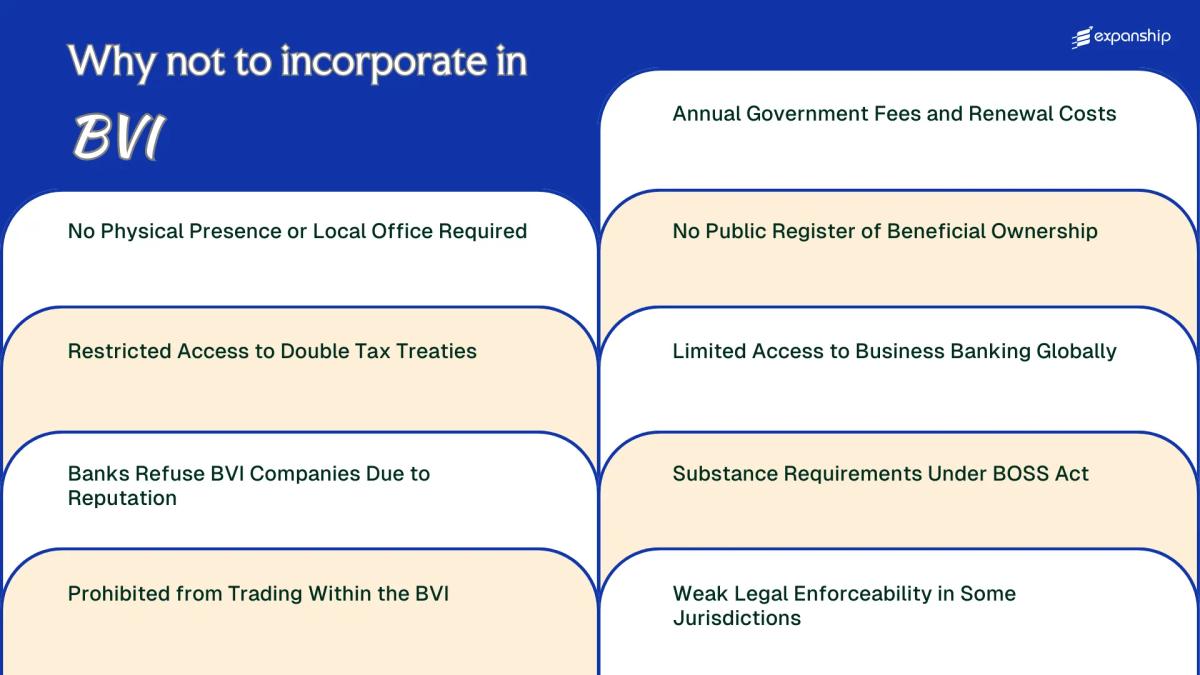
The disadvantages of incorporating in BVI span several categories — from banking access and tax treaty limitations to substance obligations and cross-border enforceability — each carrying different weight depending on your industry and operational model.
Not every drawback will apply to every business. A holding company with no active trading operations faces a different set of constraints than a firm conducting client-facing services or seeking institutional banking relationships.
The BVI Business Companies Act governs the primary corporate vehicle used by foreign investors, and its provisions shape many of the compliance considerations covered in this article.
Foreign entrepreneurs, fund managers, and investors structuring cross-border holdings are most likely to encounter the friction points discussed here.
No Physical Presence or Local Office Required
The BVI company no physical presence requirement is often cited as an advantage during incorporation, but the structural implications of this flexibility create real operational and reputational consequences for foreign business owners.
No Registered Office Obligation Beyond a Licensed Agent
Under the BVI Business Companies Act 2004, every BVI entity must maintain a registered agent and registered office address within the territory, but this is a purely administrative requirement fulfilled by a licensed service provider. Your business has no obligation to operate from, lease space in, or station personnel in the jurisdiction. This means the firm exists legally without any genuine commercial footprint, which is precisely what makes it difficult to demonstrate operational reality to banks, tax authorities, and counterparties abroad.
Why Absence of Presence Becomes a Liability
Jurisdictions applying OECD-aligned economic substance tests routinely flag entities with no local activity as high-risk. Foreign revenue authorities, particularly in the EU and UK, may disregard the BVI structure entirely and attribute income to the jurisdiction where management decisions are actually made.
The absence of a physical base is not a neutral fact. It directly undermines the firm's credibility in commercial negotiations and compliance reviews.
Without demonstrable economic substance, your BVI company may be reclassified as a tax resident in your home jurisdiction, exposing you to domestic corporate tax liabilities.
Restricted Access to Double Tax Treaties
BVI restricted access to tax treaties is one of the more consequential structural limitations of incorporating there. The territory has not signed any comprehensive double taxation agreements with major economies, meaning income earned through a BVI entity can be taxed at source in the paying country without any treaty-based relief available.
This matters most when your business receives dividends, royalties, or interest from countries that apply withholding tax to outbound payments. Without a treaty in place, the paying country applies its domestic withholding rate in full.
Practical burdens this creates for your business include:
- Dividends paid from a European subsidiary to a BVI holding company may attract withholding tax rates of 15% to 25%, with no treaty mechanism to reduce them
- Royalty income received from jurisdictions like Germany or France is subject to full domestic withholding, increasing the effective cost of holding intellectual property through a BVI firm
- You cannot claim treaty-based permanent establishment protections, leaving your entity exposed to broader tax assertions in operating countries
A Hong Kong or Singapore holding company, by contrast, offers access to extensive treaty networks that materially reduce these withholding costs. Some jurisdictions do grant partial relief through domestic exemptions, but that falls outside treaty entitlement entirely.
 BVI
BVI Company Incorporation in the British Virgin Islands
Set up your BVI business entity with full guidance on structure, compliance, and filing requirements across the incorporation process.
Banks Refuse BVI Companies Due to Reputation
Banks refusing BVI companies is one of the most immediate operational problems foreign owners encounter after incorporation. The BVI's longstanding status as a secrecy-friendly offshore centre has placed it on the high-risk watch lists maintained by major international banks, making routine account opening a serious obstacle rather than a formality.
Correspondent banks in the United States, United Kingdom, and the European Union classify BVI-incorporated entities as elevated due-diligence subjects under their own anti-money laundering frameworks. Your firm may be structurally compliant with BVI law and still face rejection, because the decision sits with the bank's internal risk policy, not with any local regulator.
| Barrier | Specific Restriction |
|---|---|
| Enhanced Due Diligence (EDD) | Required by default for BVI entities under most EU and UK bank AML policies |
| Account opening rejection rate | Significantly higher than for companies in comparable EU or UK jurisdictions |
| Minimum deposit requirements | Some offshore-friendly banks impose USD 10,000–50,000 minimums for BVI entities |
| Document burden | Typically requires UBO declarations, source-of-funds proof, and business plan beyond standard KYC |
Even banks in jurisdictions that accept offshore structures often require extensive documentation under the Financial Action Task Force's guidance on high-risk third countries. The BVI's grey-listing by the EU in 2022 compounded this, reinforcing negative risk classifications that had already hardened after the Panama Papers and Pandora Papers disclosures.
Accounts are sometimes available through smaller private banks or EMIs, but these carry higher fees and reduced functionality compared to mainstream commercial banking.
Prohibited from Trading Within the BVI
A BVI company prohibited from local trading is not simply a minor operational footnote. It is a structural constraint embedded directly in the BVI Business Companies Act 2004, administered by the BVI Financial Services Commission.
Under this legislation, a BVI Business Company (BC) cannot carry on business with persons resident in the BVI, own real property in the territory, or provide services to local clients. The entity is incorporated for offshore use only.
This creates a clear operational ceiling for your business. If your actual clients, customers, or counterparties happen to be based in the BVI, the structure becomes legally unusable for that activity.
- BVI BCs are prohibited from trading with BVI-resident persons or entities
- Ownership of real property located within the BVI is not permitted for a BC
- Local business activity requires a separate domestic licence, governed by different legislation
- The prohibition is statutory, not discretionary; no exemption process exists for standard BCs
- Breaching domestic trading restrictions exposes the entity to regulatory action by the FSC
The restriction applies universally, regardless of the industry or the volume of intended local activity.
A BVI Business Company cannot legally invoice a BVI-based client, even if that client is a foreign-owned subsidiary physically operating on the island.
Annual Government Fees and Renewal Costs
BVI annual government fees drawbacks extend beyond the initial setup cost, creating a recurring financial obligation that persists regardless of whether your company generates any revenue.
The Fee Structure Imposed by the BVI FSC
Under the Business Companies Act, 2004, all BVI Business Companies must pay an annual government fee to the Financial Services Commission to maintain their standing. The fee is tiered: companies authorised to issue up to 50,000 shares pay USD 450 per year, while those authorised to issue more pay USD 1,200 annually.
This structure means a dormant or inactive entity still carries a mandatory annual cost with no exemption for non-trading companies.
Why Renewal Costs Create a Disproportionate Burden
British Virgin Islands company renewal costs are compounded by registered agent fees, which are a separate, non-negotiable requirement under the same Act. For a foreign owner holding the entity for long-term asset structuring rather than active operations, these combined recurring charges accumulate without any proportional benefit.
Late payment triggers penalties and, ultimately, the company being struck off the register, meaning the cost of non-compliance exceeds the fee itself.
BVI Managing Ongoing Compliance Costs for Your BVI Entity
Understand the full scope of annual obligations facing your BVI Business Company and get structured guidance on managing them efficiently.
No Public Register of Beneficial Ownership
There is no public beneficial ownership register in the BVI, meaning third parties — including prospective business partners and counterparties — cannot independently verify who owns or controls a BVI company. Ownership information is held within the BOSS (Beneficial Ownership Secure Search) system, accessible only to authorized Virgin Islands authorities.
- The BOSS Act restricts ownership data to requests from competent authorities, so your counterparties have no independent means of verifying the entity they are contracting with.
- Opacity in ownership structures increases due diligence friction with banks and institutional partners, who routinely treat undisclosed beneficial ownership as a compliance red flag.
- Foreign courts and regulators in jurisdictions with mandatory public registers may treat the absence of verifiable ownership disclosure as grounds to scrutinize or reject your entity.
- BOSS Act limitations mean that even beneficial ownership data shared internationally depends on inter-authority cooperation, creating delays when formal ownership verification is required under foreign proceedings.
Limited Access to Business Banking Globally
BVI company global banking access problems are among the most operationally disruptive issues foreign owners face after incorporation. The jurisdiction appears on multiple international watchlists and grey-list assessments, which causes compliance departments at major banks to apply blanket restrictions to BVI-registered entities before any individual review takes place.
Most tier-one banks in the United States, United Kingdom, Singapore, and the EU will decline to open accounts for offshore companies incorporated in the British Virgin Islands. Where an account is approved, it typically requires extensive due diligence documentation, a lengthy review period, and often a pre-existing banking relationship.
Your business may also find that payment processors, merchant account providers, and fintech platforms impose similar restrictions, limiting not just deposits but the ability to receive client payments at all.
- Many banks require physical substance evidence before onboarding a BVI entity
- Correspondent banking restrictions can block international transfers even when a local account exists
- Some private banks accept BVI structures only for high-net-worth clients above defined asset thresholds
A foreign business owner operating a BVI company with no existing banking relationship could spend six to twelve months across multiple bank applications before securing a functional account, with no guarantee of approval at any tier-one institution.
Substance Requirements Under BOSS Act
The Business Companies (Substance) Act, or BOSS Act, introduced economic substance rules that create direct compliance obligations for certain BVI-registered entities. For foreign business owners, the BVI substance requirements BOSS Act risks are most acute when the company conducts a "relevant activity," which includes banking, insurance, fund management, finance and leasing, headquarters operations, shipping, holding companies, intellectual property, and distribution and service centre businesses.
If your entity falls into one of these categories, it must demonstrate adequate physical substance on the island. That means directing and managing the business from the territory, employing qualified staff locally, and incurring appropriate operating expenditure there, all of which generate recurring costs that most offshore structures were specifically designed to avoid.
Oversight and enforcement sit with the International Tax Authority (ITA), which collects substance information through annual filings. Failure to satisfy the test can result in financial penalties, automatic exchange of information with your home jurisdiction's tax authority, and ultimately the company being struck off the register.
British Virgin Islands economic substance challenges are compounded by the fact that the BOSS Act applies regardless of where the entity's owners or directors are resident, so the obligation cannot be sidestepped through non-resident management alone.
If your BVI company conducts any of the nine relevant activities defined under the BOSS Act, you are legally required to meet the economic substance test on the island itself, and non-compliance triggers mandatory disclosure to foreign tax authorities.
Weak Legal Enforceability in Some Jurisdictions
BVI company legal enforceability risks surface most acutely when you attempt to use a BVI entity in litigation or contract disputes outside the territory. Courts in civil law countries, and several common law jurisdictions, have historically shown reluctance to give full effect to BVI corporate structures, particularly where beneficial ownership is opaque.
A BVI Business Company registered under the BVI Business Companies Act 2004 carries no inherent recognition guarantee in foreign courts. Judges in jurisdictions such as China, Russia, or parts of the Middle East may treat the entity with heightened suspicion, creating procedural delays or outright refusal to enforce judgments.
Enforcing a foreign arbitral award against a BVI-registered counterparty also adds layers of complexity. The territory is a signatory to the New York Convention, which technically supports enforcement, but the practical reality in non-cooperative jurisdictions means that recognition can stall indefinitely.
Overcoming the Drawbacks of BVI Incorporation
Overcoming the drawbacks of BVI incorporation does not follow a single formula. Each structural challenge requires a targeted response grounded in the jurisdiction's actual regulatory requirements.
- Register economic substance activity with the BVI Financial Services Commission if your entity falls within a relevant sector under the Economic Substance (Companies and Limited Partnerships) Act, 2018.
- Open banking relationships through jurisdictions with stronger correspondent banking acceptance rather than relying solely on BVI-registered entity credentials.
- Structure holding arrangements so that operating subsidiaries sit in treaty-network jurisdictions, reducing exposure to the BVI's limited double tax treaty access.
- Appoint a licensed registered agent in the BVI, as required under the BVI Business Companies Act, 2004, to maintain good standing and meet annual renewal obligations.
- Use contractual choice-of-law clauses to specify a jurisdiction with stronger enforceability where cross-border agreements are involved.
These steps address specific compliance gaps rather than eliminate the underlying structural limitations. The BVI's regulatory framework, overseen by the Financial Services Commission, continues to evolve, and mitigation approaches must be reviewed against current legislative requirements.
BVI Still a Viable Offshore Option
The BVI remains a credible offshore incorporation destination despite the disadvantages outlined in this blog. The jurisdiction's legislative framework under the BVI Business Companies Act 2004, its established court system, and its volume of active registered entities confirm that structural demand persists. For businesses whose activities align with what the territory permits and whose banking relationships can accommodate the reputational friction, BVI offshore company incorporation remains a functional choice.
| Pro | Con |
|---|---|
| No physical presence or local office required, reducing operational overhead | BVI-registered entities are prohibited from conducting business within the territory itself |
| No public register of beneficial ownership, preserving owner privacy under current rules | Global banking access is materially restricted due to compliance concerns over BVI-registered firms |
| Government fees are fixed and predictable, with annual renewal costs that remain relatively low | Double tax treaty access is limited, exposing cross-border income flows to higher withholding tax rates |
| The BVI Business Companies Act provides a well-developed statutory framework | Some foreign courts do not readily enforce judgments or structures originating from offshore jurisdictions |
| Substance requirements under the BOSS Act are limited to certain business types | Economic substance rules require qualifying entities to demonstrate genuine activity, adding compliance obligations |
BVI Compliance Services for BVI Companies
Maintain good standing and meet your annual obligations under the BVI Business Companies Act, including registered agent requirements, economic substance filings, and beneficial ownership reporting.
Conclusion
The BVI company cons and limitations summary is straightforward: this jurisdiction offers genuine structural utility for holding companies, international trading vehicles, and asset protection arrangements, but it carries documented trade-offs that affect operational viability. Banking access remains the most disruptive constraint in practice, with correspondent banking de-risking reducing options across multiple regions. Restricted treaty access and the substance requirements introduced under the BOSS Act add compliance overhead that many founders underestimate at incorporation. Knowing these limitations before structuring through a British Virgin Islands entity allows for more accurate cost modelling and jurisdiction selection.
Expanship's BVI Incorporation Services
From managing substance obligations under the BVI's Economic Substance Act to addressing the reputational scrutiny that affects BVI banking access, the compliance burden of maintaining a BVI entity is real. Expanship BVI incorporation services are designed to reduce that operational weight, helping you stay on top of the specific regulatory and administrative demands this jurisdiction places on business owners.
Beyond initial registration, Expanship's service scope covers the full lifecycle of your BVI company.
- Your company is registered with the BVI Financial Services Commission, with all formation documents prepared accurately.
- A licensed registered agent and registered office address are provided to satisfy statutory requirements.
- Government filings are handled directly, with ongoing liaison with the relevant regulatory authorities.
- Post-incorporation compliance is managed to keep your entity in good standing year after year.
- Banking introductions are facilitated to support your search for a suitable financial institution.
- Tax registration and coordination with local authorities are handled where applicable.
Reach out to Expanship BVI to discuss your incorporation requirements.
Frequently Asked Questions (FAQ)
The Beneficial Ownership Secure Search System Act applies to all companies incorporated in the BVI, without exception for company type or activity. Every entity must maintain an up-to-date beneficial ownership record filed with a registered agent, who in turn submits that data to the central BOSS system overseen by the BVI Financial Investigation Agency. Failure to keep this record current exposes the company and its registered agent to regulatory penalties under BVI law.
A BVI company that fails to pay its annual government fee will be struck off the Register of Companies maintained by the BVI Registry of Corporate Affairs. Once struck off, the entity loses its legal standing, meaning it cannot execute contracts, hold assets, or initiate legal proceedings. Restoration is possible but involves back fees, penalties, and a formal application process that adds time and cost.
The annual government fee for most standard BVI Business Companies with up to 50,000 authorized shares is USD 550, due each year on the anniversary of incorporation. On top of that, registered agent fees typically range from USD 400 to over USD 1,000 annually depending on the service provider and any additional compliance services required. Unlike some other offshore jurisdictions, the BVI does not impose corporate income tax, but the fixed government fees apply regardless of whether the company conducts any business.
The BVI's position is among the most limited of any offshore center, with effectively no active comprehensive double tax treaties available to BVI Business Companies. Jurisdictions such as Hong Kong, Singapore, or even the Cayman Islands offer more treaty access or at least participation in certain information exchange arrangements that facilitate tax planning. For a holding structure that depends on withholding tax relief on dividends, interest, or royalties, this absence is a structural disadvantage that no amount of corporate planning within the BVI can remedy.
A BVI Business Company incorporated under the BVI Business Companies Act 2004 is prohibited from carrying on business with persons resident in the BVI. This restriction exists specifically because the BVI offshore structure is designed for cross-border use, not domestic commerce. If you intend to operate locally within the territory, a different class of license or a domestic company structure would be required.
Non-compliance with the BOSS Act can result in the BVI Financial Investigation Agency imposing fines on both the company and its registered agent. The registered agent bears direct responsibility for filing accurate and timely beneficial ownership data, which means an agent may resign rather than risk sanctions, leaving your company without a compliant local representative. Persistent non-compliance can ultimately contribute to strike-off proceedings against the entity.
Enforcement of BVI-issued judgments or contracts structured through a BVI entity varies considerably by country. Civil law jurisdictions in continental Europe, parts of Latin America, and certain Asian markets do not automatically recognize BVI court judgments, and counterparties in those markets sometimes resist signing contracts governed by BVI law precisely because local courts may not give it effect. This creates a practical risk for businesses that need contractual disputes resolved quickly and predictably in the jurisdiction where their customers or assets are located.
Legal Disclaimer
The information provided in this article is for general informational purposes only and does not constitute legal, tax, or professional advice. While we strive to ensure the accuracy and timeliness of the content, laws and regulations are subject to change, and the application of laws can vary widely based on specific facts and circumstances.
Readers should not act upon this information without seeking professional counsel tailored to their individual situation. Expanship and its authors disclaim any liability for actions taken or not taken based on the content of this article.
For specific advice regarding your business setup, compliance requirements, or any legal matters, please consult with qualified legal and tax professionals in the relevant jurisdiction.