
Key Takeaways
- Every BVI company must appoint a licensed registered agent from the outset, as this is a statutory requirement under the BVI Business Companies Act rather than an optional administrative step.
- Beneficial ownership information must be recorded and maintained in compliance with the Beneficial Ownership Secure Search System Act, with the BVI Financial Services Commission holding oversight authority over this obligation.
- The Registry of Corporate Affairs, operating under the BVI Business Companies Act 2004, serves as the central body through which all company formation filings must be processed and validated.
- Director and shareholder appointments, share capital structuring, and KYC documentation each carry distinct compliance conditions that vary depending on the entity type and the profile of the investor involved.
Company formation in the British Virgin Islands is governed by the BVI Business Companies Act (as amended), with oversight from the BVI Financial Services Commission (FSC) and day-to-day registration handled through licensed registered agents.
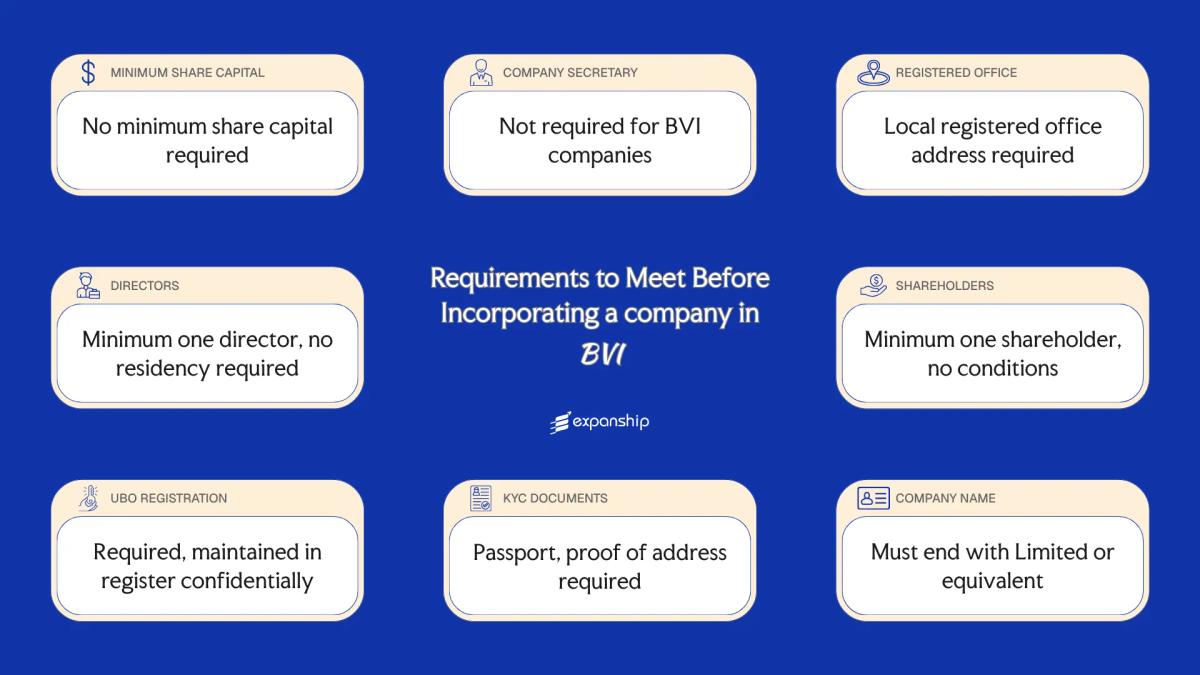
Meeting the BVI company incorporation requirements spans several structural and compliance categories, each carrying distinct obligations depending on how your entity is structured.
Failure to satisfy these British Virgin Islands company formation requirements results in rejection of the application or, where deficiencies emerge post-incorporation, potential suspension or strike-off by the FSC.
Specific requirements may differ based on the entity type selected, the industry in which your business operates, and your individual investor profile.
This article is most relevant to foreign entrepreneurs, holding company operators, and fund sponsors who are beginning the process of evaluating BVI business registration requirements for the first time.
Minimum Share Capital Requirements in British Virgin Islands
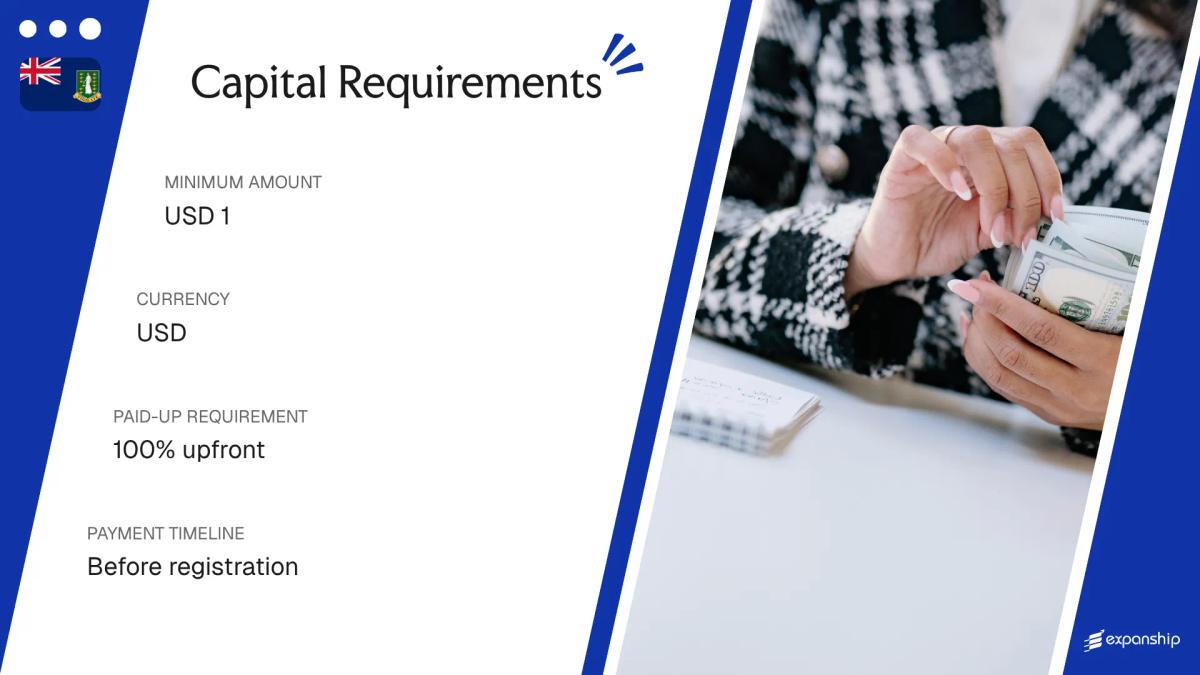
Under the BVI Business Companies Act, 2004 (as amended), there are no BVI minimum share capital requirements in the traditional sense. The Registry of Corporate Affairs does not require proof of capital deposit at the point of incorporation.
Authorized share capital is still a required component of the company's constitutional documents, specifically the Memorandum of Association. BVI authorized share capital regulations tie the annual government fee to the number of shares a company is authorized to issue, making the capital structure a live compliance factor rather than a one-time formality.
| Parameter | Detail |
|---|---|
| Minimum Authorized Share Capital | No statutory minimum |
| Maximum Authorized Share Capital | No statutory maximum |
| Minimum Paid-Up Capital | No statutory requirement |
| Paid-Up Requirement at Incorporation | No statutory requirement |
| Accepted Currency | Any currency |
| Accepted Forms of Contribution | Cash, property, services, or other consideration permitted under the BVI Business Companies Act, 2004 |
| Timeframe to Deposit Capital | No statutory timeframe |
No minimum share capital does not mean authorized share capital is optional. Your Memorandum of Association must state the maximum number of shares the company is authorized to issue, as this figure directly determines the annual government fee payable to the Registry of Corporate Affairs.
Registered Agent Requirements in British Virgin Islands
Under the BVI Business Companies Act 2004, every company incorporated in the British Virgin Islands must appoint a registered agent at all times. This is not optional — operating without one places the company in breach of its statutory obligations.
The registered agent bears responsibility for maintaining the company's records, filing certain statutory documents with the BVI Registry of Corporate Affairs, and acting as the official point of contact for regulatory correspondence.
Qualification criteria for serving as a registered agent:
- Must hold a valid licence issued under the BVI Financial Services Commission.
- Only persons or entities physically located in the British Virgin Islands are eligible.
- Corporate entities may act as registered agents if they hold the appropriate FSC licence.
- Individuals may qualify, but in practice the role is almost exclusively held by licensed corporate service providers.
- Agents must comply with ongoing obligations under the Anti-Money Laundering and Terrorist Financing Code of Practice.
 BVI
BVI Incorporate a Company in the British Virgin Islands
Set up your BVI business entity with full statutory compliance, from registered agent appointment to Registry filing.
Registered Office Requirements in British Virgin Islands
Under the British Virgin Islands registered office requirements, every company incorporated under the BVI Business Companies Act, 2004 must maintain a registered office within the territory at all times. Failure to comply can result in the Registrar of Corporate Affairs striking the company off the register.
- A physical address within the British Virgin Islands is required; a P.O. box alone does not satisfy this obligation.
- Virtual office addresses are not independently sufficient unless they correspond to a genuine physical location maintained by a licensed registered agent.
- The address must be locally based; overseas addresses do not meet BVI company registered office obligations under the Business Companies Act.
- No ownership or lease agreement in your name is required, as the address is typically provided through your licensed registered agent's office.
- The registered office address is recorded with the Registry of Corporate Affairs but is not always publicly searchable in full detail through standard registry access.
- Any change to the registered office address must be formally notified to the Registrar, and the company's register of members and other statutory records must reflect the updated address promptly.
Director Requirements in British Virgin Islands
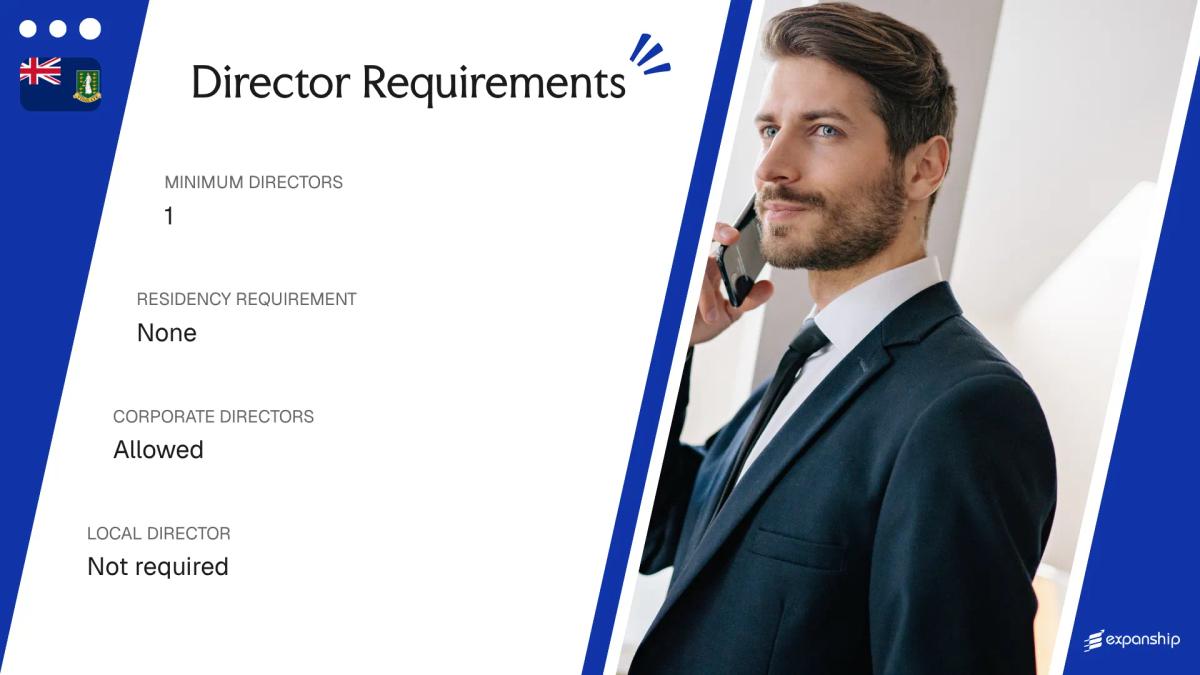
Under the BVI Business Companies Act, 2004, directors assume statutory duties of care, diligence, and honesty upon appointment, with personal liability attaching where they act contrary to the company's interests or breach fiduciary obligations. Meeting BVI director requirements at incorporation is therefore a matter of legal compliance, not merely administrative formality.
| Parameter | Detail |
|---|---|
| Minimum Number of Directors | One director is required. |
| Maximum Number of Directors | No statutory maximum is prescribed. |
| Local/Resident Director Required | No local or resident director is required. |
| Nationality Restrictions | No nationality restrictions apply. |
| Minimum Age Requirement | Directors must be at least 18 years of age. |
| Corporate Directors Permitted | Yes, corporate directors are permitted under the BVI Business Companies Act, 2004. |
| Director Must Be a Shareholder | No, a director is not required to hold shares in the company. |
| Publicly Listed on Registry | Director details are not publicly accessible; they are held on the company's register of directors and filed with the registered agent. |
| Disqualification Conditions | A person is disqualified from serving as director if declared bankrupt or convicted of a relevant offence involving dishonesty or fraud. |
Despite BVI companies being widely used for international structuring, the register of directors is not publicly accessible through the BVI Registry — it is maintained privately with the registered agent, meaning director identities remain shielded from public search.
Shareholder Requirements in British Virgin Islands
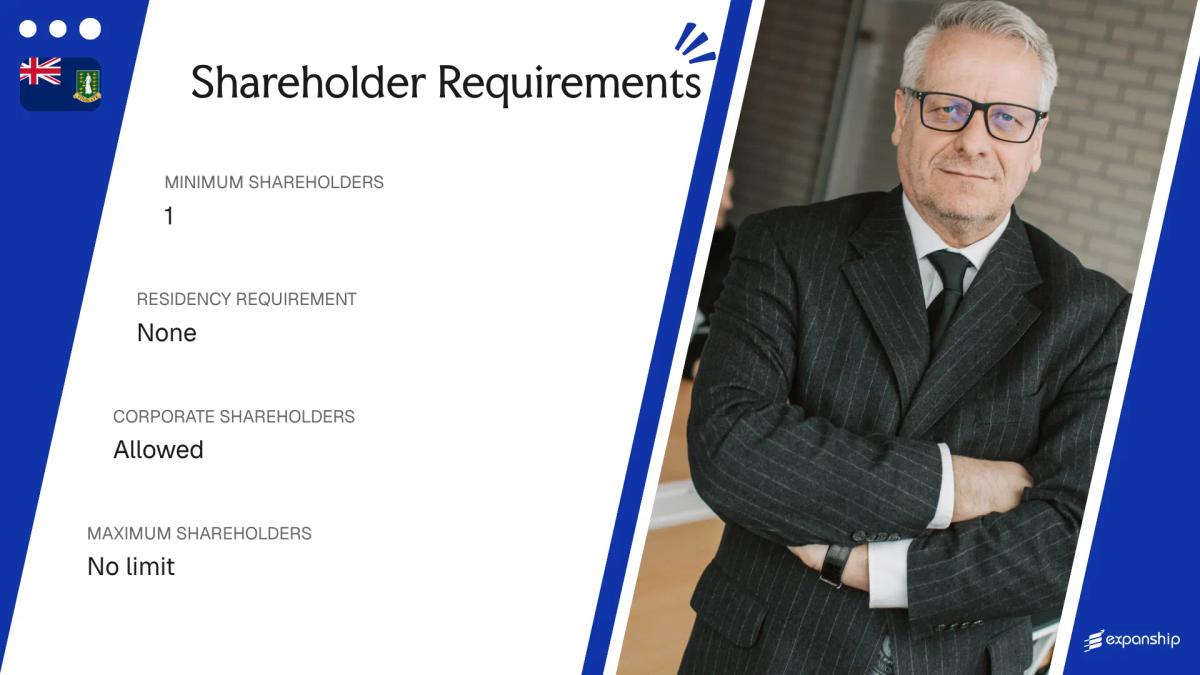
Under the BVI Business Companies Act, 2004, a BVI company requires a minimum of one shareholder. No statutory maximum applies, allowing structures ranging from a sole shareholder entity to widely held companies.
Nationality and Residency Restrictions
BVI company shareholder rules impose no nationality or residency requirements on shareholders. Foreign nationals and non-residents may hold shares without restriction, and there is no cap on foreign ownership percentage.
Corporate Shareholders
Corporate entities are permitted to act as shareholders in a BVI-incorporated business. No special conditions are attached solely on the basis that the shareholder is a legal entity rather than a natural person.
Shareholder Liability
Shareholder liability is limited to the amount unpaid on their shares. British Virgin Islands share ownership requirements do not create circumstances under which ordinary shareholders bear liability beyond their capital contribution.
Register of Shareholders
A register of members must be maintained under the BVI Business Companies Act, 2004. This register is not publicly accessible and must be kept either at the registered office or at another location disclosed to the registered agent, with updates recorded as ownership changes occur.
BVI Shareholder Structuring Support for Your BVI Incorporation
Get guidance on meeting shareholder obligations when setting up a company in the British Virgin Islands.
UBO / Beneficial Ownership Registration Requirements in British Virgin Islands
Under the Beneficial Ownership Secure Search System Act, 2017 (BOSS Act), BVI beneficial ownership registration requirements apply to all companies incorporated under the Business Companies Act, 2004. A beneficial owner is defined as any individual who ultimately owns or controls 25% or more of the shares or voting rights, or otherwise exercises control over the entity.
- Appoint a licensed registered agent in the BVI, who is responsible for collecting and submitting beneficial ownership data.
- Submit beneficial ownership information to the BOSS system, operated by the BVI Financial Investigation Agency (FIA), through your registered agent.
- Provide each beneficial owner's full legal name, date of birth, nationality, residential address, and nature of ownership interest.
- Update the BOSS system within 15 days of any change to beneficial ownership information.
| Parameter | Detail |
|---|---|
| Ownership Threshold for UBO Status | 25% of shares, voting rights, or equivalent control |
| Filing Authority | BVI Financial Investigation Agency via the BOSS system |
| Disclosure Deadline at Incorporation | Within 30 days of incorporation |
| Publicly Accessible Register | No |
| Penalties for Non-Disclosure | Civil and criminal penalties under the BOSS Act, including fines |
| Ongoing Update Obligation | Within 15 days of any change |
KYC / Document Requirements in British Virgin Islands
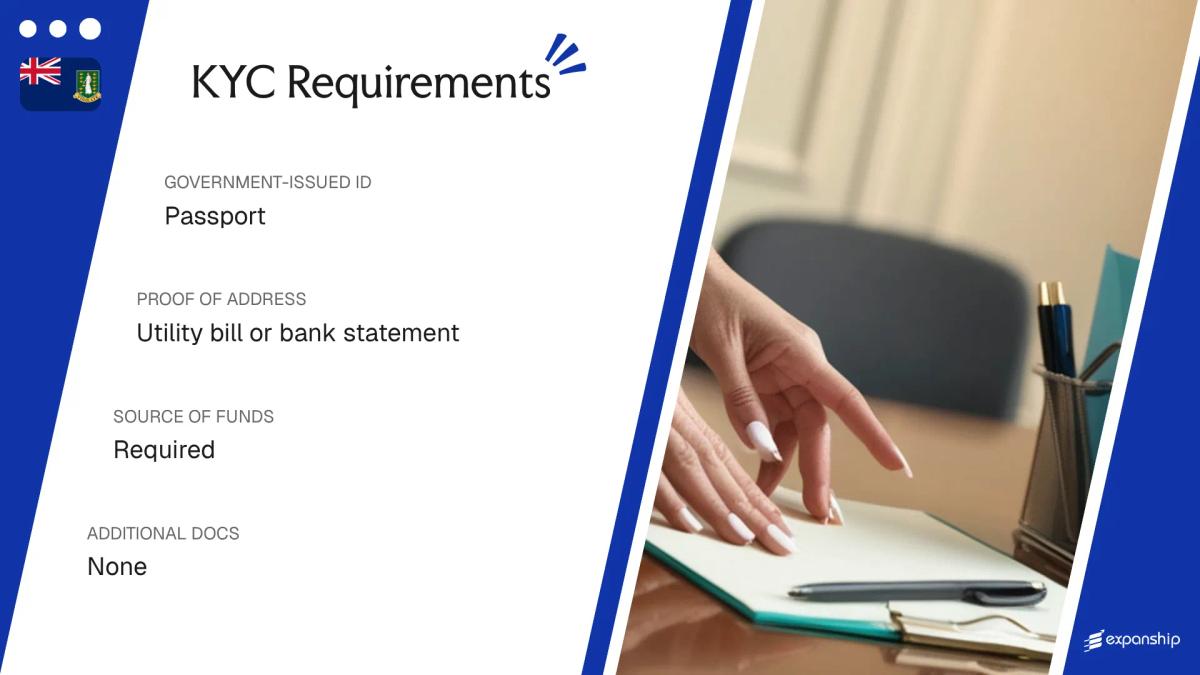
BVI KYC document requirements are governed by the Anti-Money Laundering Regulations (AMLR) and enforced through the Financial Investigation Agency, the jurisdiction's designated financial intelligence unit. Registered agents are obligated to collect and verify these documents before completing any company formation.
Individual / Personal Documents
- Valid government-issued photo ID (passport preferred)
- Proof of residential address dated within three months, such as a utility bill or bank statement
- Completed KYC declaration or personal information form as required by your registered agent
- A recent passport-sized photograph may be requested depending on the agent's internal policy
Corporate Documents
- Certificate of incorporation or equivalent constitutive document from the parent entity's home jurisdiction
- Constitutional documents, including articles of association or memorandum
- Register of directors and register of members from the corporate shareholder or director
- Proof of registered office address for the corporate entity
Source of Funds Documentation
- Recent bank statements covering the preceding three to six months
- Audited financial statements where the entity has trading history
- A signed source of wealth declaration from each beneficial owner
Notarisation and Apostille Requirements
- Documents originating outside the BVI generally require notarisation by a qualified notary public
- Apostille certification is required for documents from Hague Convention member states
- Official certified translation is required for any document not in English
Incomplete or unverified source of funds documentation is among the most common causes of incorporation delays under BVI registered agent compliance reviews.
Company Name Requirements in British Virgin Islands
BVI company name requirements are assessed by the registry at the point of incorporation, with proposed names evaluated for availability, distinctiveness, and suitability before registration is confirmed. Names that are identical or closely similar to existing registered entities will not be accepted.
Every company must include an approved legal suffix such as "Limited", "Ltd.", "Incorporated", "Inc.", "Corporation", or "Corp." as part of its registered name. No minimum or maximum character count is prescribed by statute, though names must be expressed in Roman script.
Certain words are outright prohibited, while others — such as "Bank", "Insurance", "Trust", or "Royal" — require prior consent from the relevant regulatory authority before use. Words implying government affiliation or that are considered offensive are also disallowed.
Name reservation is available and can be applied for through the registry prior to formal incorporation. A reserved name is typically held for a fixed period, giving your business time to complete the incorporation process without losing the proposed name to a competing application.
BVI Compliance Services for Companies in the British Virgin Islands
Maintain your BVI entity in good standing with ongoing compliance support, including annual filings, registered agent coordination, and regulatory reporting.
Conclusion
The incorporation requirements British Virgin Islands imposes on foreign investors are governed primarily by the BVI Business Companies Act, 2004, administered through the Registry of Corporate Affairs. Registered agent appointment and beneficial ownership disclosure under the Beneficial Ownership Secure Search System Act stand out as particularly consequential obligations. Once these requirements are understood, the practical next step is working with a licensed BVI registered agent to prepare and submit the necessary documentation, after which ongoing compliance obligations under the Act take effect.
Expanship's Corporate Services for British Virgin Islands Expansion
Expanship's BVI company incorporation compliance services cover the full scope of what the Financial Services Commission and the BVI Business Companies Act require from foreign founders. From appointing a licensed registered agent to maintaining accurate beneficial ownership records in the Beneficial Ownership Secure Search System, the operational requirements here are specific and ongoing. Expanship reduces the burden of managing those requirements directly, so your business can focus on substance rather than administration.
Our British Virgin Islands corporate formation services span each stage of setup and maintenance:
- We prepare and file all incorporation documents with the Registry of Corporate Affairs on your behalf.
- We provide a licensed registered agent and registered office address in the BVI.
- Our team liaises directly with relevant government bodies and regulatory authorities throughout the process.
- We manage your post-incorporation compliance obligations, including annual filings and record-keeping requirements.
- We facilitate introductions to banking partners familiar with BVI-incorporated entities.
- We handle tax registration and coordinate with local authorities where applicable.
Reach out to Expanship BVI to discuss your incorporation requirements.
Frequently Asked Questions (FAQ)
The beneficial ownership information held in the BVI's Beneficial Ownership Secure Search System (BOSS) is not publicly accessible but is available to competent authorities, including the Financial Investigation Agency, upon request. Access is granted for the purposes of anti-money laundering investigations, tax information exchange, and regulatory oversight, meaning the register functions as a law enforcement tool rather than a public disclosure mechanism. The firm or individual holding BOSS access rights is typically your licensed registered agent.
Yes, a BVI Business Company can be formed with one individual serving as both the sole director and sole shareholder. The BVI Business Companies Act, 2004 imposes no requirement for separate persons to fill these roles, and there is no minimum number of shareholders beyond one. This structure is common in single-owner international holding arrangements.
Failure to keep beneficial ownership information current in the BOSS system is a breach of BVI regulatory requirements and can result in financial penalties imposed on the company and, in some cases, on the registered agent responsible for submitting the data. The severity of the penalty depends on the duration and nature of the non-compliance. Persistent failures can also trigger suspension or strike-off proceedings against the entity.
No minimum paid-up capital is required before a BVI Business Company commences operations. The standard authorised share capital used at incorporation is typically USD 50,000, which determines the annual government fee, but shares do not need to be fully paid up for the company to be active. The authorised capital figure is a structural parameter, not a liquidity or operational prerequisite.
A BVI Business Company may appoint a corporate entity as a director without restriction on nationality or jurisdiction of incorporation. The appointed corporate director must itself be in good standing, and its appointment must be recorded in the company's register of directors, which is maintained at the registered office. No requirement exists under the BVI Business Companies Act, 2004 for a minimum number of natural persons on the board alongside a corporate director.
When a shareholder is a corporate entity, the KYC requirements extend to that entity's own documentation, including its certificate of incorporation, constitutional documents, register of directors and shareholders, and proof of registered address. In addition, the beneficial owners behind the corporate shareholder must be identified and verified, meaning the KYC chain traces through to the natural persons ultimately in control. The registered agent in the BVI is responsible for collecting and verifying this information before incorporation proceeds.
Legal Disclaimer
The information provided in this article is for general informational purposes only and does not constitute legal, tax, or professional advice. While we strive to ensure the accuracy and timeliness of the content, laws and regulations are subject to change, and the application of laws can vary widely based on specific facts and circumstances.
Readers should not act upon this information without seeking professional counsel tailored to their individual situation. Expanship and its authors disclaim any liability for actions taken or not taken based on the content of this article.
For specific advice regarding your business setup, compliance requirements, or any legal matters, please consult with qualified legal and tax professionals in the relevant jurisdiction.