

Key Takeaways
- The Bahamas' placement on the FATF grey list has materially increased due diligence burdens for Bahamian IBCs, as correspondent banks and financial institutions in third countries apply heightened scrutiny to transactions involving grey-listed jurisdictions.
- Entities incorporated under the International Business Companies Act face severely constrained banking options, with many major international banks declining to open accounts for Bahamian IBCs regardless of the underlying business activity.
- With fewer than 10 active double tax treaties in force, Bahamian IBCs cannot access the withholding tax reductions and income exemptions available to companies structured in treaty-dense jurisdictions such as the Netherlands or Singapore.
- Substance requirements under the Bahamas Financial Services Board guidelines impose operational obligations on IBCs that go beyond mere registration, meaning non-resident owners must demonstrate genuine economic activity rather than maintaining a shell presence.
The Bahamas operates under an evolving regulatory framework, shaped significantly by international pressure from bodies such as the Financial Action Task Force (FATF) and the OECD. The disadvantages of incorporating in Bahamas span several distinct areas, from banking access to compliance obligations under local legislation.
Not every disadvantage will apply equally to your situation. The business type, ownership structure, and intended use of the entity all affect which limitations carry the most practical weight.
This article is most relevant to foreign investors and non-resident business owners considering an International Business Company (IBC) under the Companies Act. The drawbacks covered here range across regulatory, financial, and operational dimensions. Understanding them at the outset allows you to assess whether the IBC structure fits your actual requirements before committing to formation.
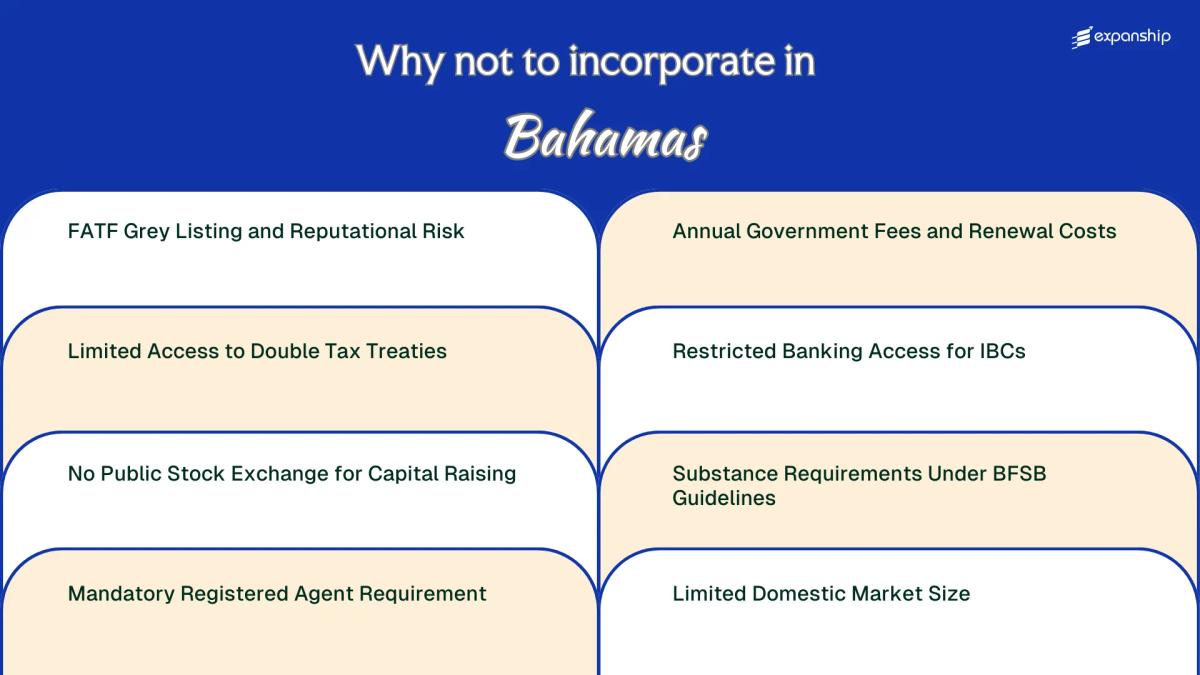
FATF Grey Listing and Reputational Risk
Removed from the FATF grey list in 2020, the jurisdiction has not fully escaped the reputational consequences that followed its 2018 listing. Bahamas FATF grey listing risks continue to affect how international banks, payment processors, and institutional counterparties assess entities incorporated there.
Correspondent Banking and Transaction Scrutiny
Foreign banks applying enhanced due diligence to Bahamian-registered entities often impose additional documentation requirements or decline relationships outright. Your business may face account rejections or transaction delays that do not apply to companies incorporated in jurisdictions with cleaner compliance histories, regardless of your firm's actual risk profile.
A single grey listing period can produce long-lasting offshore reputational risk, particularly with European and North American financial institutions that maintain their own internal country-risk matrices updated independently of FATF decisions.
Regulatory Perception Among Institutional Partners
Institutional investors, regulated fund administrators, and licensed financial counterparties frequently conduct jurisdiction-level due diligence. An entity registered under the International Business Companies Act 2000 may face heightened scrutiny or outright exclusion from certain fund structures or partnership agreements.
This perception problem is structural. The Financial Intelligence Unit of the Bahamas and the Securities Commission of the Bahamas have strengthened AML frameworks, but institutional risk policies often lag behind regulatory improvements by several years.
Even after formal removal from grey list status, your Bahamian entity may still be treated as elevated-risk by correspondent banks and institutional partners operating under their own internal compliance thresholds.
Limited Access to Double Tax Treaties
Bahamas double tax treaty limitations stem from a deliberate policy choice. The country has not entered into any comprehensive double tax treaties with major economies, meaning income earned through a Bahamian IBC can face full taxation in the jurisdiction where your clients, partners, or operations are based, with no treaty mechanism to reduce or offset that liability.
This gap creates concrete friction for businesses with cross-border income flows:
- Dividend payments from foreign subsidiaries to a Bahamian holding company may be subject to full withholding tax in the source country, with no treaty rate reduction available.
- Royalty income routed through an IBC can attract withholding rates of 15-30% in many OECD countries, uncapped by any bilateral agreement.
- Service fee payments from treaty-network jurisdictions may trigger permanent establishment scrutiny without any treaty framework to clarify the tax position.
- Foreign tax credits become harder to structure, increasing the effective tax burden on globally active businesses.
Jurisdictions like Cyprus or the Netherlands offer treaty networks covering 60+ countries, giving holding structures meaningful withholding tax relief that a Bahamian entity simply cannot access.
 Bahamas
 Company Incorporation in the Bahamas
Understand the full regulatory and tax implications before incorporating a business in the Bahamas.
No Public Stock Exchange for Capital Raising
No public stock exchange drawback affects your ability to raise equity capital directly from the public while operating through a Bahamian IBC. The Bahamas Securities Commission regulates capital markets under the Securities Industry Act, 2011, but the country does not operate a functioning domestic stock exchange where companies can list shares and access retail or institutional investors.
| Capital Raising Method | Availability for IBCs | Practical Restriction |
|---|---|---|
| Domestic public equity listing | Not available | No operational stock exchange exists |
| Public share offerings to retail investors | Severely limited | Requires Securities Commission registration; IBC structure not designed for public issuance |
| Private placements | Permitted | Restricted to accredited or sophisticated investors only |
| Debt securities on local exchange | Not available | No local exchange infrastructure to support listing |
Without a public market, your business cannot conduct an IPO locally or use listed equity as currency for acquisitions. Growth-stage companies that require broad investor participation face a structural ceiling that the jurisdiction's corporate framework cannot address.
Private placements to qualified investors remain available under the Securities Industry Act, but this route excludes retail capital and limits the investor pool considerably. For businesses that anticipate needing public market access as an exit strategy or growth mechanism, this absence creates a long-term structural gap that requires routing capital-raising activities through a separate jurisdiction entirely.
Mandatory Registered Agent Requirement
Every International Business Company incorporated under the International Business Companies Act, 2000 must appoint a licensed registered agent at all times. This is not optional, and the agent must be physically based in the jurisdiction and hold a license issued by the Securities Commission of the Bahamas.
The cost is the immediate friction point. Agent fees vary by provider, but annual retainers for bare-minimum compliance services can range from several hundred to over a thousand US dollars, creating a recurring overhead that exists regardless of whether your company generates any revenue.
The registered agent also serves as the gatekeeper for official correspondence and statutory filings. This means your business depends on a third party for time-sensitive government communications, and any lapse in the agent relationship, such as non-payment of fees, can trigger compliance failures that affect the company's standing.
- A licensed registered agent must be maintained continuously; there is no grace period for operating without one
- The agent must be licensed by the Securities Commission of the Bahamas, not just locally registered
- Agent fees are an annual cost obligation, separate from government renewal fees
- Termination or resignation of your agent requires appointing a replacement before the current agent withdraws
The registered agent requirement means that even a fully dormant IBC with zero transactions still incurs mandatory agent fees every year simply to remain in legal existence.
Annual Government Fees and Renewal Costs
Annual renewal costs for IBCs registered in the Bahamas represent a recurring expense that can erode the cost advantage many business owners expect from offshore incorporation.
Fee Structure Under the IBC Act
Under the International Business Companies Act, IBCs are subject to annual government fees that vary based on the authorized share capital of the entity. A company with authorized capital up to $50,000 USD pays a lower flat fee, while those with higher capital thresholds face progressively larger assessments. Missing the renewal deadline triggers penalties, compounding the base cost in a way that punishes administrative lapses disproportionately.
Practical Cost Implications for Foreign Owners
Bahamas IBC renewal costs do not exist in isolation. You also carry the mandatory registered agent fee alongside government fees, meaning the true annual maintenance cost is higher than the government schedule alone suggests. Jurisdictions such as the British Virgin Islands operate under comparable IBC frameworks, so the Bahamas offers no particular fee advantage that would justify absorbing these costs if your operational needs are equally served elsewhere.
Bahamas Managing Annual Compliance Costs for Your Bahamas IBC
Get clarity on the full scope of renewal fees, penalty risks, and registered agent obligations for your Bahamas entity.
Restricted Banking Access for IBCs
Bahamas IBC banking access restrictions represent one of the most operationally disruptive challenges for foreign business owners, as correspondent banking reluctance has made account opening increasingly difficult. The entity structure itself, not just the owner's profile, often triggers automatic compliance reviews or outright rejection from international banks.
- Under the Financial Transactions Reporting Act, IBCs are subject to enhanced due diligence requirements that many foreign banks treat as a red flag, extending onboarding timelines by weeks or months.
- Correspondent banks in the US and EU frequently decline to process transactions for Bahamas offshore company banking relationships, cutting off access to major currency clearing networks.
- Bahamas IBC bank account limitations extend to domestic banks, where minimum deposit thresholds and business activity restrictions narrow the pool of viable institutions significantly.
- You may be required to demonstrate economic substance or active trade before a local bank will accept the account application, adding cost before the entity generates any revenue.
Substance Requirements Under BFSB Guidelines
Bahamas substance requirements challenges emerge most directly from the International Business Companies Act and the guidance issued by the Bahamas Financial Services Board (BFSB). IBCs engaged in certain activities — including holding intellectual property, conducting financing operations, or acting as a headquarters entity — must demonstrate genuine economic presence in the jurisdiction. That means maintaining local management, conducting core income-generating activities onshore, and keeping adequate physical premises.
For a foreign business owner operating the entity remotely, meeting these thresholds creates measurable operational costs. Hiring local directors with relevant expertise, maintaining a physical office, and holding board meetings within the jurisdiction are not administrative formalities — they represent recurring expenditures that erode the cost advantages the structure was originally intended to deliver.
The substance rules also expose entities to annual reporting obligations, and non-compliance can trigger penalties or automatic exchange of information with the beneficial owner's home jurisdiction under the Common Reporting Standard.
A foreign-owned IBC required to demonstrate substance might realistically incur USD 15,000–25,000 annually in local directorship fees, office lease costs, and compliance reporting — expenses largely absent in a jurisdiction where substance rules apply only to specific regulated sectors rather than broadly to IBCs.
Limited Domestic Market Size
The Bahamas has a population of approximately 400,000 people. For a foreign business owner treating the jurisdiction purely as an operational base, this Bahamas limited domestic market drawback is largely irrelevant — but for any entity that needs local revenue to justify substance or offset operational costs, the constraint is real.
IBCs incorporated under the International Business Companies Act, 2000 are structurally prohibited from conducting business with Bahamian residents or operating domestically without converting to a different legal structure. This restriction forces foreign firms to source all revenue internationally, which creates a dependency on external markets that may not always be stable or accessible.
Operating costs — registered agent fees, government renewal fees, compliance obligations — still apply regardless of whether your firm generates any local income. When there is no domestic consumer base to absorb even a portion of those costs, the financial burden falls entirely on offshore revenue streams.
Small market size also limits access to local professional talent, specialized service providers, and sector-specific infrastructure. For businesses that require on-the-ground operational depth, this gap can translate into higher outsourcing costs or functional gaps.
An IBC incorporated under the International Business Companies Act, 2000 cannot conduct business with persons resident in the Bahamas without regulatory authorization, meaning any assumption that local market access is available post-incorporation is incorrect by default.
Overcoming Incorporation Challenges in the Bahamas
Overcoming Bahamas incorporation challenges requires a structural approach rather than reactive fixes applied after problems emerge. The disadvantages covered in this blog each point to specific compliance, banking, and operational considerations that benefit from deliberate planning before the entity is formed.
- Engage a licensed registered agent as required under the International Business Companies Act before completing incorporation, since no IBC can legally exist without one.
- Register with the BFSB and assess whether your business activity triggers economic substance obligations under the Commercial Entities (Substance Requirements) Act, 2018.
- Open banking relationships through institutions with demonstrable IBC experience, given that many correspondent banks apply heightened scrutiny to Bahamas-registered entities.
- Establish your tax residency position in a jurisdiction with an active treaty network to compensate for the absence of double tax agreements.
- Budget for annual government fees under the IBC fee schedule to avoid unintentional dissolution through non-renewal.
These steps operate within a regulatory environment overseen by the Securities Commission of the Bahamas, the Financial Intelligence Unit, and the Attorney General's Office. Each body enforces distinct compliance obligations that collectively shape what responsible IBC ownership requires in practice.
The Bahamas Still Worth Considering
Weighing the disadvantages covered in this blog against the jurisdiction's structural strengths gives a clearer picture of where the Bahamas sits as an incorporation destination. The absence of corporate income tax, capital gains tax, and inheritance tax under the International Business Companies Act 2000 remains a material advantage. Those benefits do not disappear because of the challenges, but they do need to be assessed against them honestly.
| Pros | Cons |
|---|---|
| No corporate income tax, capital gains tax, or withholding tax under the IBC framework | FATF grey listing increases scrutiny from correspondent banks and counterparties |
| High degree of financial privacy backed by the Confidential Relationships (Preservation) Act | Extremely limited double tax treaty network reduces cross-border tax planning options |
| Low and predictable annual government fees for IBC maintenance | Restricted banking access makes opening and maintaining a functional business account difficult |
| Straightforward incorporation process under the International Business Companies Act 2000 | Economic substance requirements under BFSB guidelines add operational obligations for relevant activities |
| No requirement to file annual financial statements publicly | No domestic stock exchange, limiting capital-raising options for growth-stage businesses |
Bahamas Compliance Services for Companies in the Bahamas
Maintain your IBC's good standing with registered agent obligations, annual renewals, and substance requirement monitoring under Bahamian regulatory frameworks.
Conclusion
A Bahamas company formation cons summary yields a clear picture: the jurisdiction offers genuine utility for specific structures, but carries material constraints that affect operational viability. FATF grey listing continues to complicate correspondent banking relationships, while the absence of meaningful double tax treaty coverage limits cross-border tax planning. Restricted IBC banking access remains one of the most practical friction points for newly incorporated entities. Professional guidance specific to Bahamian regulatory requirements, including obligations under the International Business Companies Act, can determine whether the structure ultimately functions as intended.
Expanship's Bahamas Incorporation Support
Expanship's Bahamas incorporation support services are structured around the specific obligations that make the Bahamas a more demanding jurisdiction than it appears on paper. From satisfying the Registrar General's annual filing requirements to coordinating registered agent appointments under the International Business Companies Act, the operational side of maintaining a Bahamian IBC involves ongoing attention that many businesses underestimate.
Our team handles the administrative and compliance work across your company's full lifecycle in the jurisdiction.
- We prepare and file all company registration documents with the Registrar General's Department on your behalf.
- Registered agent and local office provision is arranged to satisfy the statutory requirements of the IBC Act.
- Our team liaises directly with relevant government departments to manage filings and regulatory correspondence.
- Post-incorporation compliance management keeps your entity in good standing year to year.
- We facilitate introductions to banking institutions familiar with Bahamian-registered entities.
- Tax registration and liaison with the relevant local authorities is handled as part of the process.
Reach out to Expanship Bahamas to discuss how we can support your incorporation.
Frequently Asked Questions (FAQ)
The absence of a broad tax treaty network primarily affects businesses with cross-border income flows, such as holding companies receiving dividends or royalties from treaty-dependent jurisdictions. A purely domestic or single-jurisdiction operation feels less impact, but any entity with counterparties in high-tax countries will likely face withholding taxes that a treaty-resident structure could have reduced or eliminated. The Bahamas has signed very few comprehensive income tax agreements precisely because it imposes no corporate income tax itself, making reciprocal treaties difficult to negotiate.
Failure to demonstrate genuine economic substance can result in regulatory sanctions under the Commercial Entities (Substance Requirements) Act, 2018, including automatic exchange of information with the tax authorities in the ultimate beneficial owner's home jurisdiction. This means your home country's tax authority could receive a report flagging your Bahamas entity as non-compliant. Financial penalties and potential loss of good standing are also possible outcomes under the Act.
The annual government fee for an IBC under the International Business Companies Act, 2000 varies based on the company's authorized share capital, but standard-tier companies typically face fees in the range of a few hundred US dollars per year. On top of that, registered agent fees are mandatory and add a recurring cost that varies by provider. The combined annual maintenance cost is generally higher than in competing low-cost jurisdictions such as Seychelles or Belize.
Banking access for Bahamas IBCs is among the more difficult in the Caribbean region, largely because the grey listing compounds existing correspondent banking pressures that affect the entire offshore sector. Jurisdictions that retained FATF compliance, such as Cayman Islands, typically experience fewer blanket refusals from international banks. The practical result is that opening a business account for a Bahamas IBC, particularly with a European or North American bank, requires substantially more documentation and patience than most clients anticipate.
No. The Bahamas does not operate a functional public stock exchange for commercial capital raising by IBCs. If your business model requires access to public equity markets, the structure forces you toward a dual-structure approach, maintaining a Bahamas entity for specific functions while listing elsewhere, which adds legal complexity and cost. This is a structural gap that jurisdictions like Cayman Islands, with its established listing infrastructure, do not share.
Under the International Business Companies Act, 2000, maintaining a registered agent with a physical address in the Bahamas is a statutory obligation, not optional. If an IBC lapses in this requirement, the company risks being struck off the register by the Registrar General's Department, which triggers loss of legal standing and can affect the enforceability of contracts entered into during the lapsed period. Reinstatement is possible but involves additional fees and administrative delays.
For businesses dependent on domestic consumer revenue, the Bahamas presents a genuine constraint. The resident population sits at approximately 400,000 people, concentrated primarily in Nassau and Grand Bahama, which limits addressable market size for any product or service reliant on volume. An IBC structure, specifically, is legally prohibited from conducting business with Bahamian residents under standard IBC rules, so a company seeking local customers would need a different corporate vehicle entirely.
Legal Disclaimer
The information provided in this article is for general informational purposes only and does not constitute legal, tax, or professional advice. While we strive to ensure the accuracy and timeliness of the content, laws and regulations are subject to change, and the application of laws can vary widely based on specific facts and circumstances.
Readers should not act upon this information without seeking professional counsel tailored to their individual situation. Expanship and its authors disclaim any liability for actions taken or not taken based on the content of this article.
For specific advice regarding your business setup, compliance requirements, or any legal matters, please consult with qualified legal and tax professionals in the relevant jurisdiction.