
Key Takeaways
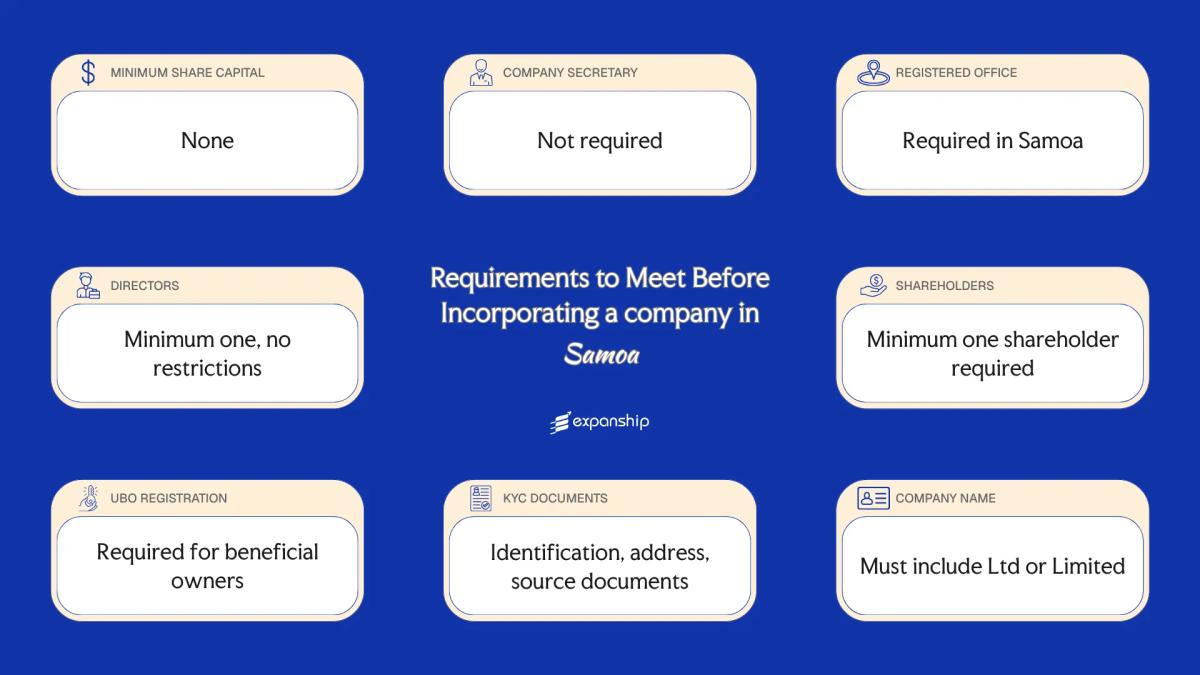
- Every international company formed in Samoa must appoint a licensed registered agent as a prerequisite to valid incorporation, with this obligation established under the International Companies Act 1987 and enforced by the Samoa International Finance Authority (SIFA).
- Beneficial ownership disclosure is a substantive compliance obligation under SIFA's reporting framework, not merely an administrative formality, and must be satisfied both at formation and on an ongoing basis.
- Directors and shareholders must meet the structural requirements specified under the International Companies Act 1987, and failure to satisfy these appointments results in rejection of the registration application.
- Company names submitted for registration in Samoa are subject to prescribed naming rules administered by SIFA, and non-compliant names will prevent successful registration of the entity.
Incorporation requirements in Samoa are governed by the International Companies Act 1987, with oversight and registration administered by the Samoa International Finance Authority (SIFA). This article addresses the structural, documentary, and compliance requirements that apply during the formation process.
Failure to satisfy these requirements results in rejection of the registration application or, where non-compliance is identified after incorporation, potential deregistration or legal liability under Samoan law.
Requirements can differ depending on the entity type selected and the nature of the business activity intended. Investors from certain jurisdictions or operating in regulated industries may face additional obligations.
The International Companies Act sets out the foundational rules that govern entity formation. This article is most relevant to foreign investors and non-resident business owners considering establishing an international company in the jurisdiction.
Minimum Share Capital Requirements in Samoa
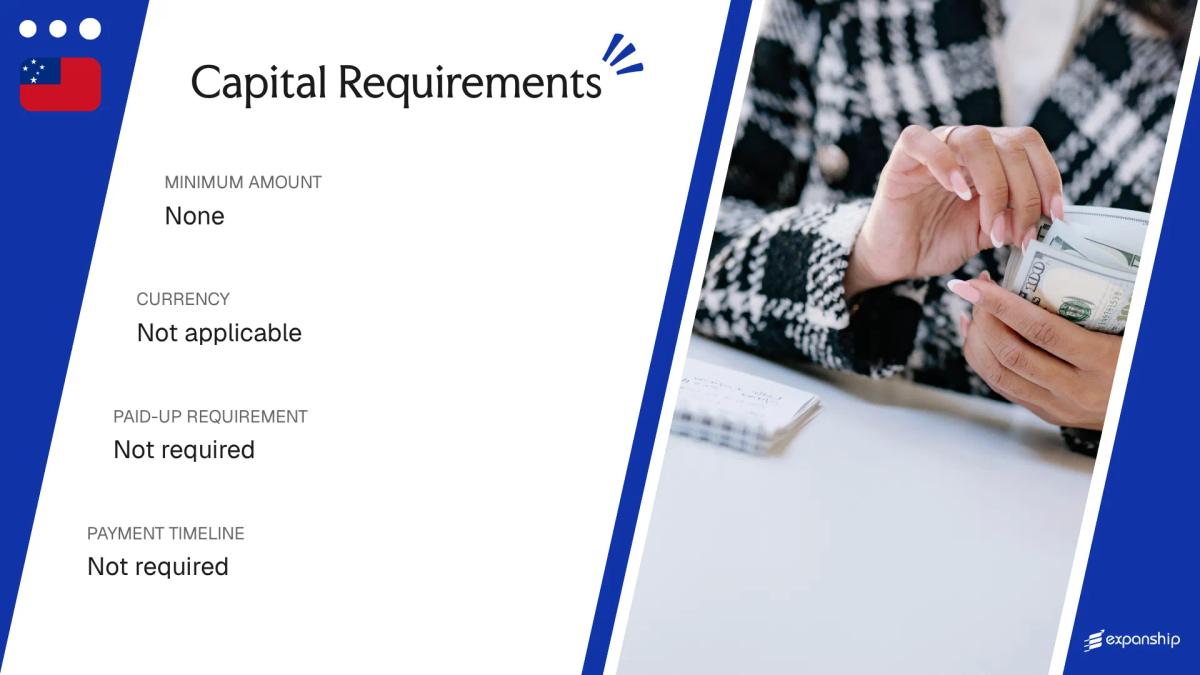
Under the International Companies Act 2009, Samoa minimum share capital requirements are notably flexible, with no statutory minimum imposed on companies incorporated as international business companies. The Samoa International Finance Authority (SIFA) oversees IBC registrations but does not mandate a minimum capital threshold at the point of incorporation.
Shares may be issued with or without par value, giving incorporators latitude in structuring the capital of the entity. There is no ongoing statutory obligation to maintain a minimum capital level after formation.
| Parameter | Detail |
|---|---|
| Minimum Authorized Share Capital | No statutory requirement |
| Maximum Authorized Share Capital | No statutory maximum |
| Minimum Paid-Up Capital | No statutory requirement |
| Paid-Up Requirement at Incorporation | No statutory requirement |
| Accepted Currency | Any currency |
| Accepted Forms of Contribution | Cash, property, services, or other consideration |
| Timeframe to Deposit Capital | No statutory timeframe |
Even though no minimum authorized capital is required, your company's articles of incorporation must still define the share structure, including the classes of shares and total number authorized for issuance.
Registered Agent Requirements in Samoa
Under the International Companies Act 1987, every company incorporated in Samoa is required to appoint a registered agent. This agent acts as the official intermediary between the company and the Samoa International Finance Authority (SIFA), the regulator overseeing international business companies.
The registered agent holds ongoing compliance obligations. These include maintaining the company's statutory records, filing annual returns with SIFA, and acting as the point of contact for regulatory correspondence on behalf of the entity.
Qualification criteria for serving as a registered agent in Samoa:
- The agent must be licensed by SIFA to provide registered agent services.
- Only entities physically based in Samoa are eligible to hold this licence.
- Licensed trust companies and law firms with the appropriate SIFA authorisation may qualify.
- Individual persons may serve only if they hold a valid SIFA-issued agent licence.
- Foreign entities without a local presence do not qualify to act as registered agent.
 Samoa
Samoa Incorporate a Company in Samoa
Set up your international business company in Samoa with full compliance support, including licensed registered agent appointment and SIFA filing.
Registered Office Requirements in Samoa
Under the International Companies Act 1987, registered office requirements in Samoa mandate that every incorporated entity maintains a physical address within the jurisdiction at all times. Failure to comply can result in the Registrar of International and Foreign Companies striking the firm off the register.
- A physical address is required; a P.O. Box alone does not satisfy the registered office requirement.
- The address must be located within Samoa; no foreign address is accepted.
- Virtual office addresses are generally permissible provided they correspond to a genuine physical location in the country.
- Proof of occupancy, such as a lease agreement or ownership document, is not typically filed with the registry but must be maintainable upon request.
- The registered office address is recorded on the public company register and is accessible to third parties.
- Any change of registered office address must be formally notified to the Registrar of International and Foreign Companies by filing the prescribed notice.
Director Requirements in Samoa
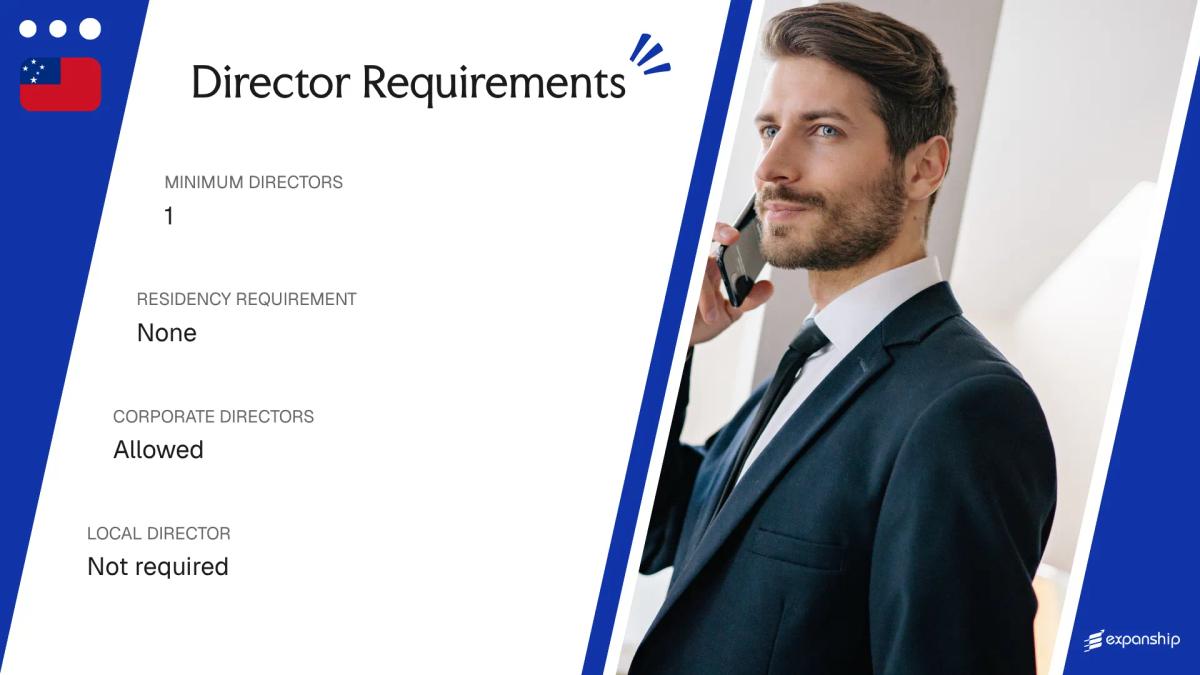
Under the International Companies Act 1988, directors of a Samoa IBC assume statutory duties that include acting in good faith, exercising reasonable care and diligence, and avoiding conflicts of interest. Breaches of these obligations can expose directors to personal liability under the Act.
| Parameter | Detail |
|---|---|
| Minimum Number of Directors | One director is required. |
| Maximum Number of Directors | No statutory maximum is prescribed. |
| Local/Resident Director Required | No local or resident director is required. |
| Nationality Restrictions | No nationality restrictions apply. |
| Minimum Age Requirement | Directors must be at least 18 years of age. |
| Corporate Directors Permitted | Yes, corporate directors are permitted under the International Companies Act 1988. |
| Director Must Be a Shareholder | No, a director is not required to hold shares in the company. |
| Publicly Listed on Registry | No, director information is not publicly disclosed on the Samoa Registry. |
| Disqualification Conditions | A person who is bankrupt or has been convicted of a relevant criminal offence may be disqualified from serving as a director. |
Despite Samoa requiring only one director, that sole director can be a corporate entity rather than a natural person, a structure that many jurisdictions explicitly prohibit.
Shareholder Requirements in Samoa
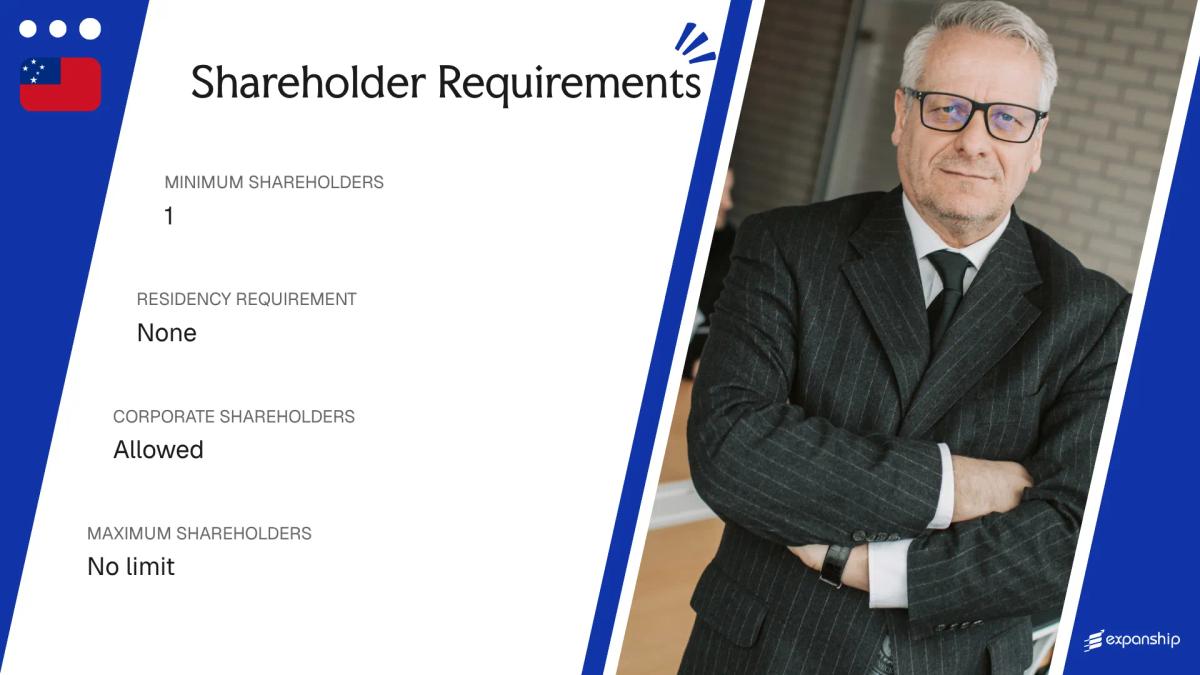
Under the International Companies Act 1988, a Samoa IBC requires a minimum of one shareholder. There is no statutory maximum, allowing structures ranging from sole ownership to multi-party arrangements.
Nationality and Residency Restrictions
Samoa company ownership requirements impose no nationality or residency conditions on shareholders. Foreign nationals and non-resident individuals may hold 100% of the shares without restriction.
Corporate Shareholders
Corporate entities are permitted to act as shareholders in a Samoa IBC. No additional licensing or local presence is required for a corporate shareholder to hold an ownership interest.
Shareholder Liability
Shareholder liability is limited to the amount unpaid on their shares. Piercing of the corporate veil remains possible under general legal principles if fraud or improper conduct is established.
Register of Shareholders
A register of shareholders must be maintained by the company, though it is not filed with any public registry. The register must be kept current and held at the registered office or with the registered agent.
Samoa Structure Your Samoa Company Ownership Correctly
Get guidance on meeting shareholder criteria and ownership requirements when incorporating in Samoa.
UBO / Beneficial Ownership Disclosure Requirements in Samoa
Under the International Companies Act 2009 and its amendments, beneficial ownership disclosure requirements in Samoa apply to international companies, with a beneficial owner generally defined as any individual who ultimately owns or controls 25% or more of the entity. The Financial Intelligence Unit (FIU) of Samoa oversees compliance under the Money Laundering Prevention Act 2007.
- Identify all natural persons holding 25% or more ownership or effective control of the company.
- Record beneficial ownership details in the company's internal register, maintained by the registered agent.
- Submit UBO information to the Samoa Financial Intelligence Unit upon incorporation or when ownership changes.
- Update the register within a prescribed period whenever a change in beneficial ownership occurs.
| Parameter | Detail |
|---|---|
| Ownership Threshold for UBO Status | 25% ownership or control |
| Filing Authority | Samoa Financial Intelligence Unit (FIU) |
| Disclosure Deadline at Incorporation | At time of incorporation |
| Publicly Accessible Register | No |
| Penalties for Non-Disclosure | Monetary penalties under the Money Laundering Prevention Act 2007 |
| Ongoing Update Obligation | Yes; updates required upon any change in beneficial ownership |
KYC / Document Requirements in Samoa
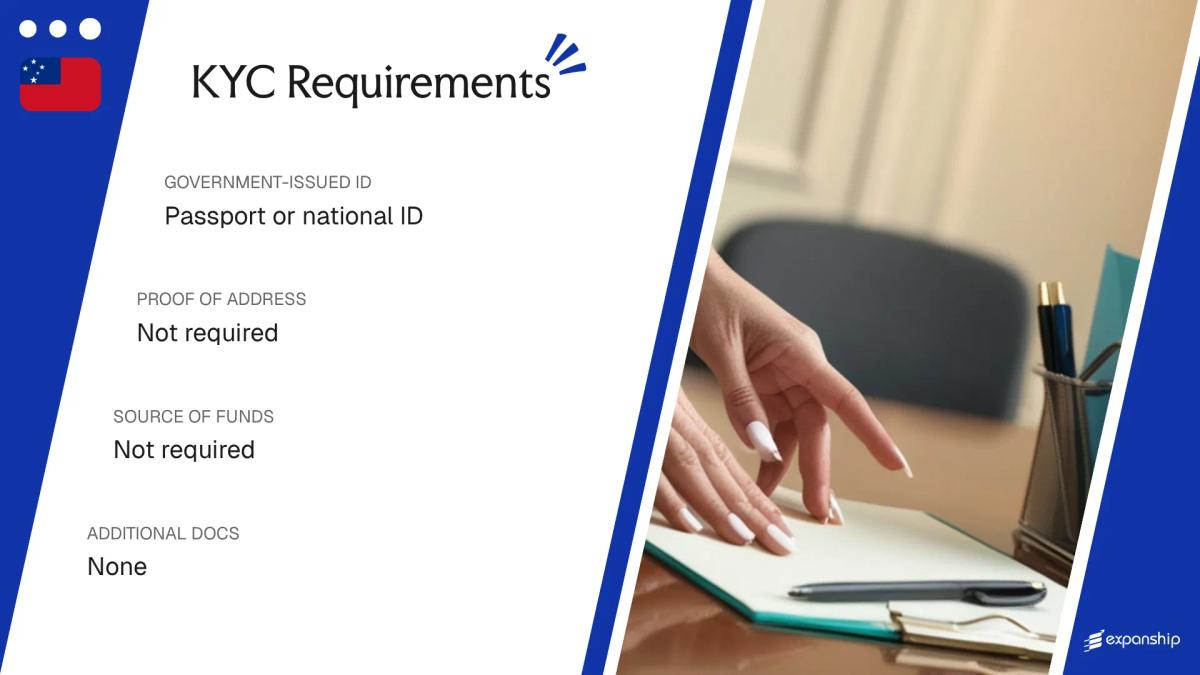
KYC requirements for Samoa company formation are governed by the Money Laundering Prevention Act 2007 and administered through the Financial Intelligence Unit, which sets the due diligence standards that registered agents must apply before incorporation can proceed.
Individual / Personal Documents
- Certified copy of a valid passport or government-issued photo ID
- Proof of residential address dated within three months, such as a utility bill or bank statement
- Signed KYC declaration or client intake form as required by the registered agent
- Recent passport-sized photograph may be required depending on the agent's internal policy
Corporate Documents
- Certificate of incorporation from the entity's jurisdiction of origin
- Constitutional documents, such as articles of association or equivalent instrument
- Register of directors and register of shareholders from the corporate entity
- Proof of registered address for the corporate shareholder or director
Source of Funds Documentation
- Recent bank statements covering a minimum of three to six months
- Audited financial accounts or accountant-prepared statements where applicable
- A written declaration explaining the origin of capital if documentary evidence is limited
Notarisation and Apostille Requirements
- Foreign identity documents generally require notarisation by a qualified notary public
- Documents originating from Hague Convention countries should carry an apostille
- Certified English translations are required for all documents not originally in English
Incomplete or uncertified source of funds documentation is the most frequently cited reason for delays in processing a Samoa IBC incorporation application.
Company Name Requirements in Samoa
Proposed names for a Samoa international business company are assessed by the Registrar of International and Foreign Companies prior to incorporation. A name is approved only if it is not already in use, not deceptively similar to an existing registered entity, and not considered offensive or contrary to public interest under Samoan law.
Names must be in the Roman alphabet and end with a legal suffix indicating limited liability, such as "Limited," "Incorporated," "Corporation," or their accepted abbreviations.
Certain words are outright prohibited or require regulatory consent before use. Terms implying a connection to government, banking, insurance, or financial services fall under restricted categories and cannot be included without prior written approval from the relevant authority.
Name reservation is available in Samoa before a formal incorporation application is submitted. A reserved name is typically held for a fixed period, during which no other entity may register under the same or a confusingly similar designation.
Samoa Compliance Services for Companies in Samoa
Maintain your Samoa company's good standing with ongoing compliance support, including annual filings, registered agent services, and regulatory reporting.
Conclusion
Samoa company incorporation requirements are governed primarily by the International Companies Act 1988, administered by the Samoa International Finance Authority (SIFA). The requirements covered in this guide span company naming rules, director and shareholder appointments, and registered agent obligations. Among the more operationally significant is the mandatory appointment of a licensed local registered agent, without which a company cannot be validly formed. Beneficial ownership disclosure obligations also carry compliance weight under SIFA's reporting framework. Once these requirements are understood, the practical next step is selecting a service provider authorised to act within Samoa's regulatory structure.
Expanship's Corporate Formation Services in Samoa
Expanship's Samoa corporate formation services are built around the specific requirements set by the Registrar of International and Foreign Companies, from IBC structuring under the International Companies Act 1987 to registered agent appointment and beneficial ownership documentation. Managing these obligations from outside Samoa adds coordination complexity, and Expanship is structured to carry that operational weight on your behalf.
Our service scope covers the full formation and maintenance cycle for your entity:
- We prepare and file all registration documents with the relevant Samoan authorities on your behalf.
- A licensed registered agent and a compliant registered office address in Samoa are provided as part of our service.
- We handle all government filings and liaise directly with the Registrar throughout the process.
- Ongoing compliance obligations, including annual renewals, are managed to keep your firm in good standing.
- We facilitate introductions to banking institutions that accept Samoa-incorporated entities.
- Tax registration and coordination with local authorities are handled where applicable.
To discuss your incorporation requirements, contact Expanship Samoa.
Frequently Asked Questions (FAQ)
No minimum paid-up share capital is prescribed under the International Companies Act 1987 for international companies incorporated in Samoa. The standard authorized share capital is typically set at a nominal amount for fee calculation purposes, but there is no statutory requirement to deposit or prove capital before the company is formed. This makes the initial setup cost predictable and straightforward from a capital perspective.
Failure to maintain a licensed registered agent in Samoa can result in the company being struck off the register held by SIFA. Once struck off, the company loses its legal standing, which affects its ability to enter contracts, hold assets, or operate in any capacity. Reinstatement is possible but involves additional fees and regulatory procedures that can delay business activity.
Corporate directors are permitted under the International Companies Act 1987, so your holding company or another legal entity can be appointed as director of a Samoa international company. There is no requirement for the director to be a Samoan resident or national. However, the corporate director itself must be a properly incorporated and valid legal entity, and its details will form part of the company's public record maintained by SIFA.
Beneficial ownership information in Samoa is held by the registered agent and reported to SIFA, but it is not made available through a publicly searchable registry. The framework aligns with FATF standards for financial intelligence purposes, meaning authorities can access the information when required for compliance or investigation. This distinction between regulatory disclosure and public disclosure is relevant if your business has confidentiality requirements.
Yes, the documentation requirements differ depending on the nature of the shareholder. Individual shareholders must provide a certified copy of a government-issued photo ID and a recent proof of residential address. Corporate shareholders are required to submit incorporation documents, a register of directors and shareholders, and, depending on the structure, KYC documentation for the underlying beneficial owners of that corporate entity.
Legal Disclaimer
The information provided in this article is for general informational purposes only and does not constitute legal, tax, or professional advice. While we strive to ensure the accuracy and timeliness of the content, laws and regulations are subject to change, and the application of laws can vary widely based on specific facts and circumstances.
Readers should not act upon this information without seeking professional counsel tailored to their individual situation. Expanship and its authors disclaim any liability for actions taken or not taken based on the content of this article.
For specific advice regarding your business setup, compliance requirements, or any legal matters, please consult with qualified legal and tax professionals in the relevant jurisdiction.