
Key Takeaways
- Samoa IBCs pay no corporate tax on foreign-sourced income, making the jurisdiction structurally efficient for holding vehicles and international trading entities that generate revenue outside Samoa's borders.
- Under the International Companies Act 2001, IBCs are not subject to annual financial reporting obligations, removing a layer of ongoing administrative and compliance cost that applies in most comparable offshore jurisdictions.
- The ICA 2001 is grounded in English common law principles, meaning corporate structures formed under it are interpretable by advisers and counterparties across the majority of international business markets.
- Regulated by the Samoa International Finance Authority (SIFA), the jurisdiction imposes no minimum capital requirement and no nationality restrictions on directors or shareholders, giving foreign owners broad flexibility in how they structure and staff an IBC.
Samoa is an independent nation in the South Pacific, operating under a stable parliamentary government and maintaining a well-established framework for international business activity. The Samoa International Finance Authority (SIFA) is the regulatory body responsible for overseeing company registration and international financial services. Foreign businesses typically incorporate through an International Business Company, the most widely used vehicle for cross-border structuring.
The jurisdiction applies a territorial tax posture, meaning income generated outside its borders is generally not subject to local corporate tax. Foreign ownership is broadly permitted, and no restrictions are placed on the nationality of directors or shareholders in internationally registered entities — a position that reflects the country's general openness to foreign direct investment.
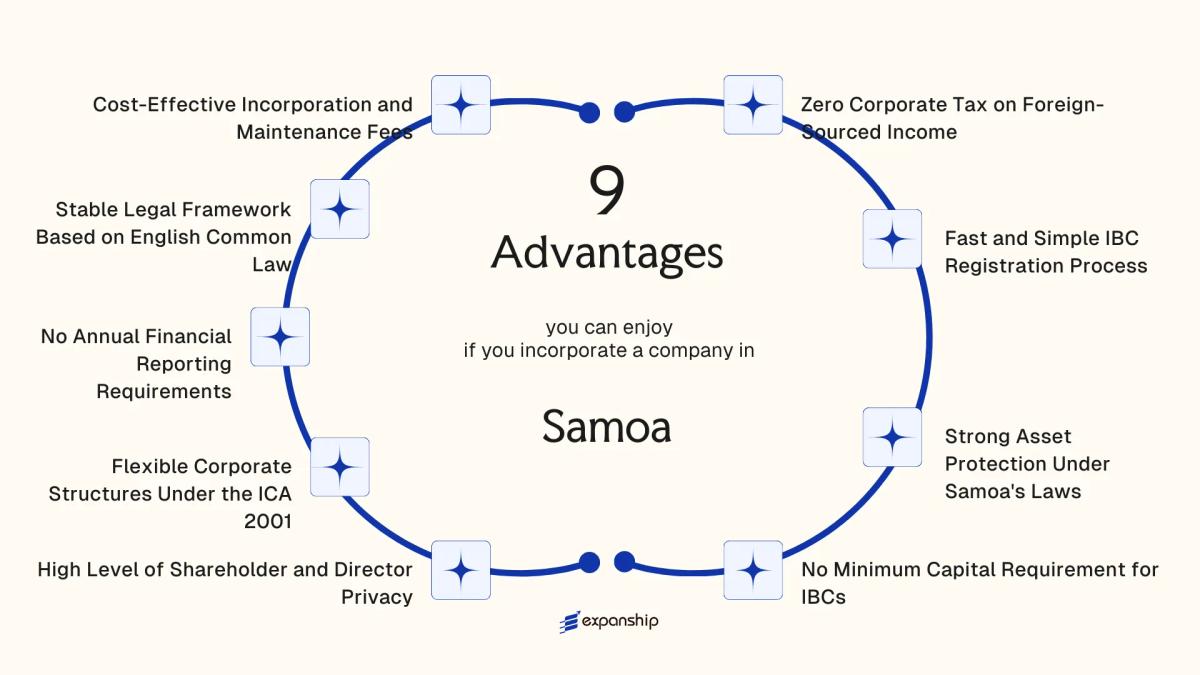
This article examines the key advantages that the benefits of incorporating in Samoa offer to business owners, investors, and corporate structuring professionals. Each section addresses a distinct aspect of the regulatory and commercial framework, drawing on the relevant provisions of the International Companies Act 2001 and associated legislation.
Zero Corporate Tax on Foreign-Sourced Income
Samoa zero tax on foreign income is the defining fiscal feature of its International Business Company structure. Under the International Companies Act 2001 (ICA 2001), an IBC that conducts its business activities exclusively outside Samoa pays zero corporate tax on that income.
What the Exemption Covers
The ICA 2001 draws a clear line between domestic and foreign-sourced income. Any revenue generated from transactions, clients, or operations outside Samoa falls outside the scope of local corporate tax entirely, meaning your retained earnings are not reduced by a domestic tax charge before reinvestment or distribution.
This exemption is not incidental — it is a structural feature of how IBCs are categorised under Samoan law. For businesses operating across multiple markets, the ability to consolidate foreign profits in a zero-tax entity has a direct impact on capital efficiency.
Eligibility Conditions That Apply
The exemption applies as long as the company does not conduct business with Samoa residents or derive income from sources within the country. A breach of that boundary can affect the company's qualifying status under the ICA 2001.
Foreign profits earned through a Samoa IBC are not subject to local corporate tax, allowing full retention of offshore income at the entity level.
Fast and Simple IBC Registration Process
Under the International Companies Act 2001 (ICA 2001), registering an IBC in Samoa is structured to minimize administrative friction for foreign applicants. The entire process is handled through a licensed registered agent — there is no requirement for the incorporator to be physically present in the country at any stage. For a business owner operating across time zones, this removes a practical barrier that exists in many other jurisdictions.
Samoa IBC registration benefits become apparent early in the process. The ICA 2001 sets a low documentation threshold: a standard application requires a memorandum and articles of association, details of the registered agent, and basic identification for directors and shareholders. No extensive government pre-approval or licensing review applies to most standard commercial structures.
Several features of the application process work in your favour:
- A single licensed agent handles the filing, reducing the number of government touchpoints
- The ICA 2001 does not require notarized foreign documents in all cases, reducing authentication costs
- No minimum number of directors or shareholders creates fewer bottlenecks at the formation stage
- Certificate of incorporation can typically be issued within a matter of days under standard procedures
Once incorporated, the entity is entered into the Samoa International Register maintained under the ICA 2001, giving the business a recognized legal standing almost immediately after filing.
 Samoa
Samoa Incorporate Your Company in Samoa
Register your Samoa IBC through a licensed registered agent with minimal documentation requirements and no physical presence needed.
Strong Asset Protection Under Samoa's Laws
Samoa asset protection benefits for businesses stem directly from statutory provisions built into the International Companies Act 2001 (ICA 2001), which governs all international business companies registered in the country.
Under the ICA 2001, assets held within a Samoa IBC are generally protected from foreign judgments that have not been recognized by Samoan courts. A creditor pursuing claims under the law of another jurisdiction cannot automatically enforce those claims against the company's assets. This means that for a foreign business owner structuring holdings through a Samoa entity, the firm's assets remain insulated from legal actions initiated outside the jurisdiction's court system.
| Feature | Detail |
|---|---|
| Foreign judgment enforcement | Not automatically recognized; must go through Samoan courts |
| Governing legislation | International Companies Act 2001 |
| Regulatory authority | Samoa International Finance Authority (SIFA) |
| Applicable company type | International Business Company (IBC) |
The Samoa International Finance Authority (SIFA) oversees compliance and registration of IBCs, providing a formal regulatory layer that adds institutional credibility to the legal framework. Assets are further protected through the permissible use of nominee structures and the strict confidentiality provisions embedded in the ICA 2001, which limit disclosure of ownership information to third parties.
For business owners holding intellectual property, investment portfolios, or intercompany receivables, this structural separation between foreign legal exposure and the company's registered assets is a material advantage. Protection is conditional on the entity remaining compliant with SIFA requirements and not being used to defraud creditors under Samoan law.
No Minimum Capital Requirement for IBCs
Under the International Companies Act 2001, there is no prescribed minimum capital requirement for Samoa IBC no minimum capital requirement structures. You can incorporate with a share capital of any amount, denominated in any currency. This removes a financial barrier that exists in many onshore and mid-shore jurisdictions where statutory minimum capital thresholds can range from a few thousand to hundreds of thousands of dollars.
For a foreign business owner, this means the registered capital of your entity does not need to reflect its operational scale. A holding company, an IP vehicle, or a trading firm can each be incorporated with a nominal share structure suited to its actual purpose rather than a regulatory minimum.
Shares may be issued as par value or no-par-value, and the authorised capital can be structured across multiple classes. This flexibility allows your business to align its share architecture with investor arrangements or ownership tiers from day one.
Keep these points in mind:
- Authorised capital does not need to equal paid-up capital
- No minimum capital applies only to IBCs, not all entity types under Samoan law
- Share capital can be denominated in foreign currencies
- Multiple share classes are permitted under the ICA 2001
- Confirm capital structure with your registered agent before filing
An IBC incorporated in Samoa can be authorised for millions in share capital while having zero shares actually issued at the time of incorporation, with no regulatory consequence under the ICA 2001.
High Level of Shareholder and Director Privacy
Samoa shareholder privacy advantages are grounded in statute rather than policy discretion. Under the International Companies Act 2001 (ICA 2001), details of shareholders and directors are not filed with the Samoa International Finance Authority (SIFA) as part of any public record, meaning third parties cannot retrieve ownership or management information through a registry search.
What the Law Withholds from Public Access
The ICA 2001 does not require shareholder registers or director lists to be submitted to any public authority. Your company's internal registers are maintained at the registered office of the licensed registered agent, accessible only to the company itself or under a valid court order. For a foreign business owner, this creates a structural separation between commercial activity and personal exposure.
Nominee arrangements are legally recognized under Samoan law, allowing beneficial owners to further distance their identity from the corporate record. This is a legitimate structural option, not a workaround, and it functions within the compliance framework established by SIFA.
The Practical Significance for Foreign Owners
Confidentiality at the director level means that individuals managing cross-border operations are not identifiable through routine corporate searches conducted in third-party jurisdictions. This matters particularly when business owners operate across markets where disclosure of affiliations could affect negotiations, competitive positioning, or personal security.
Samoa does maintain AML/CFT obligations aligned with FATF standards, so registered agents hold beneficial ownership information on file. That information, however, remains outside any publicly searchable database.
Samoa Structure Your Samoa IBC with Full Privacy Protections
Speak with Expanship about how the ICA 2001 privacy framework applies to your specific ownership and director structure.
Flexible Corporate Structures Under the ICA 2001
The International Companies Act 2001 (ICA 2001) gives incorporated entities considerable latitude in how they structure their internal governance, making Samoa IBC flexible corporate structure benefits particularly relevant for businesses with non-standard ownership or operational arrangements.
- Under the ICA 2001, a Samoa international business company can issue shares in multiple classes, with rights attached to each class defined entirely by the company's constitution. This means you can engineer voting rights, dividend entitlements, and capital distributions without being constrained by a default statutory template.
- A single individual can simultaneously hold the positions of sole director and sole shareholder. For a founder-led business, this eliminates the need to appoint nominees or satisfy minimum participant thresholds that many jurisdictions still impose.
- The ICA 2001 permits bearer shares to be restricted or prohibited through the company's own constitutional documents, giving you direct control over transferability and ownership continuity without relying on external regulatory mechanisms.
- Director meetings and shareholder resolutions can be conducted and passed in writing, without a physical or virtual assembly. This allows governance decisions to be documented and executed across time zones without scheduling constraints.
- There is no statutory requirement for a company secretary, reducing the number of obligatory officer roles your entity must maintain throughout its operational life.
No Annual Financial Reporting Requirements
Under the International Companies Act 2001 (ICA 2001), an IBC registered in Samoa is not required to file annual financial statements, audited accounts, or annual returns with any government authority. There is no statutory audit obligation, and no submission of accounts to the Registrar of International and Foreign Companies is required.
For a foreign business owner, this removes a recurring administrative burden that exists in most onshore jurisdictions. Preparing audited financials typically requires engaging licensed auditors, incurring professional fees, and meeting filing deadlines, none of which apply to a Samoa IBC.
Your company is still expected to maintain internal records sufficient to reflect its financial position. However, those records are held privately and are not subject to public disclosure or regulatory review under normal circumstances. The Samoa IBC no financial reporting requirement is therefore a structural feature of the regime, not an informal practice.
A foreign-owned Samoa IBC generating USD 500,000 in annual consulting revenue from clients outside Samoa would incur zero audit fees and zero statutory reporting costs related to that income, compared to an equivalent company in the UK, where Companies House requires annual accounts filing and potential audit obligations above certain size thresholds.
Stable Legal Framework Based on English Common Law
Samoa's common law legal framework advantages stem from its constitutional foundation in English common law, inherited through its legislative history and formalized across statutes governing commercial activity. This gives your business access to a well-developed body of precedent on contract enforcement, fiduciary duties, and corporate conduct, without the unpredictability that can accompany civil law or hybrid systems in other offshore centers.
The International Companies Act 2001 (ICA 2001) is the primary legislation governing international business companies. Drafted with reference to established common law principles, it provides foreign investors with a familiar legal environment where concepts like beneficial ownership, director liability, and shareholder rights carry consistent meanings.
Courts in Samoa apply common law reasoning, which means judicial decisions are informed by precedent. For foreign business owners accustomed to English, Australian, or Commonwealth legal systems, this reduces the interpretive uncertainty that can arise when operating under unfamiliar legal traditions.
- Contractual terms are interpreted under principles consistent with English common law
- Corporate governance standards align with Commonwealth norms
- Dispute resolution mechanisms operate within a recognized legal tradition
Samoa's legal system applies common law principles domestically, but your contracts may still need to specify governing law and jurisdiction if counterparties operate under different legal systems.
Cost-Effective Incorporation and Maintenance Fees
Samoa cost-effective offshore incorporation benefits are grounded in the actual fee structures established under the International Companies Act 2001 (ICA 2001), not in general pricing trends. Government registration fees for an International Business Company are low by design, reflecting the jurisdiction's policy of keeping entry costs accessible for foreign entrepreneurs and holding structures.
The annual renewal fees payable to the Samoa International Finance Authority (SIFA) are fixed and predictable. Because these fees do not scale with share capital or revenue, your annual cost remains consistent regardless of the business volume passing through the entity.
Registered agent fees, which are a mandatory ongoing requirement under the ICA 2001, are competitively priced relative to comparable offshore jurisdictions such as the British Virgin Islands or the Cayman Islands. This cost differential can be meaningful when maintaining multiple holding entities or special purpose vehicles within a group structure.
The absence of a statutory audit obligation under Samoan IBC regulations directly reduces your recurring professional costs. There are no mandatory financial statements to prepare, no auditor to appoint, and no accounts to file with SIFA, all of which represent billable professional service hours that other jurisdictions routinely require.
Key cost factors that distinguish Samoa's IBC fee structure include:
- Fixed government incorporation and annual renewal fees set by SIFA
- No share capital-based fee scaling
- No statutory audit or account filing fees
- Single registered agent requirement with no additional local officer mandate
Why Samoa Stands Out Among Offshore Jurisdictions
Assessed against its most direct regional competitors, the Samoa advantages over other offshore jurisdictions become clearest when viewed through the lens of what foreign business owners actually encounter in practice: formation timelines, ongoing compliance burdens, and the statutory protections afforded to their holding structures. The three comparators below, Vanuatu, the Cook Islands, and Seychelles, were selected because they occupy the same Pacific and small-island offshore space, target the same profile of foreign investor, and are routinely evaluated alongside Samoa by advisers structuring international holding or trading entities.
What the comparison reveals is not dramatic divergence on any single point, but a consistent pattern. Samoa's International Companies Act 2001 combines a zero-tax regime on foreign-sourced income with no annual accounts filing obligation and a codified asset protection framework, without imposing the higher annual government fees that some competing jurisdictions levy. For an entity that needs statutory credibility, confidentiality, and low administrative overhead simultaneously, that combination is relatively uncommon in the Pacific region.
| Parameter | Samoa (WS) | Vanuatu | Cook Islands | Seychelles |
|---|---|---|---|---|
| Tax on Foreign-Sourced Income | 0% | 0% | 0% | 0% |
| Governing IBC Legislation | International Companies Act 2001 | Companies Act 2012 | International Companies Act 1981–82 | International Business Companies Act 2016 |
| Annual Financial Reporting (IBCs) | Not required | Not required | Not required | Not required |
| Statutory Asset Protection Framework | Yes (ICA 2001) | Limited | Yes (via Cook Islands trusts; IBC protection narrower) | Limited |
| Director/Shareholder Register Public | No | No | No | No |
| Minimum Share Capital | None | None | None | None |
| Government Annual Fee Range | Low | Low to moderate | Moderate | Low |
| English Common Law Basis | Yes | Hybrid (French/English) | Yes | Yes (with civil law influence) |
Samoa Compliance Services for Samoa Companies
Maintain your Samoa IBC in good standing with ongoing regulatory support, annual renewal filings, and registered agent services.
Conclusion
Samoa's position as an offshore incorporation destination rests on a combination of structural features that are difficult to replicate in higher-tax, higher-compliance jurisdictions. The benefits of incorporating in Samoa are most evident in two areas: the complete exemption from tax on foreign-sourced income for International Business Companies, and the absence of annual financial reporting obligations under the International Companies Act 2001. Together, these reduce both the fiscal burden and the administrative overhead that typically accompany offshore entities in other jurisdictions.
The ICA 2001 also provides a legal foundation grounded in English common law principles, which means the corporate framework is interpretable and familiar to advisers and counterparties across common law jurisdictions. For a foreign business owner, that familiarity has practical value when structuring agreements, enforcing rights, or managing cross-border relationships.
Whether this structure suits your business depends on your specific activities, the jurisdictions where you generate income, and your compliance obligations at home. An IBC registered under the ICA 2001 functions well as a holding vehicle, an asset protection structure, or an international trading entity, but its suitability is always contingent on your broader corporate and tax position. Understanding exactly how the entity fits within your existing structure is the necessary step before formation proceeds.
Start Your Samoa Company with Expanship Today
Samoa company formation with Expanship covers the full registration lifecycle under the International Companies Act 2001, from preparing and legalizing constitutional documents to filing directly with the Samoa International Finance Authority (SIFA). Every step in this blog, from the zero-tax treatment of foreign-sourced income to the privacy protections afforded to directors and shareholders, falls within the scope of services Expanship manages on your behalf.
Expanship handles the specific tasks that matter most when establishing and maintaining a foreign-registered entity:
- Preparation and notarization of incorporation documents, including the Memorandum and Articles of Association
- Provision of a registered agent and registered office address as required under the ICA 2001
- Direct liaison with SIFA for company registration and ongoing compliance filings
- Post-incorporation support, covering annual renewal obligations and any statutory updates
- Banking introduction assistance to help connect your entity with suitable financial institutions
- Apostille and document legalization services where required for international use
To discuss your registration requirements, contact Expanship Samoa.
Frequently Asked Questions (FAQ)
Registration through the Samoa International Finance Authority (SIFA) is generally completed within one to two business days once all required documents are submitted. The process does not involve pre-approval hearings or extended review periods, making it one of the faster incorporation timelines among offshore jurisdictions.
The tax exemption under the ICA 2001 applies specifically to foreign-sourced income. If your company derives income from activities conducted within Samoa or from Samoan-resident counterparties, that income may be subject to domestic tax obligations and falls outside the offshore exemption framework.
The ICA 2001 does not require director or shareholder details to be filed on any public register. Nominee structures are permitted, and beneficial ownership information is held by the registered agent rather than disclosed through a publicly searchable government database.
Samoa has committed to the Common Reporting Standard (CRS) framework, which means financial account information may be shared with the tax authorities of participating jurisdictions where your beneficial owners are tax-resident. Privacy protections under the ICA 2001 govern corporate records, but they do not override treaty-based financial reporting obligations.
Failure to pay the annual fee to SIFA can result in the company being struck off the register. A struck-off entity loses its legal standing, which can affect the enforceability of contracts and the validity of asset holdings until the company is restored through the applicable reinstatement process.
Samoa's legal system is grounded in English common law principles, which means courts apply established doctrines of contract, agency, and fiduciary duty that are familiar to international counterparties and legal counsel. This provides a degree of predictability when your business enters cross-border agreements, as the underlying legal reasoning aligns with frameworks used across many other common law jurisdictions.
Legal Disclaimer
The information provided in this article is for general informational purposes only and does not constitute legal, tax, or professional advice. While we strive to ensure the accuracy and timeliness of the content, laws and regulations are subject to change, and the application of laws can vary widely based on specific facts and circumstances.
Readers should not act upon this information without seeking professional counsel tailored to their individual situation. Expanship and its authors disclaim any liability for actions taken or not taken based on the content of this article.
For specific advice regarding your business setup, compliance requirements, or any legal matters, please consult with qualified legal and tax professionals in the relevant jurisdiction.