
Key Takeaways
- Samoa's International Companies Act 1987 imposes a mandatory local registered agent requirement, creating an ongoing operational dependency and recurring compliance cost that offshore entities cannot avoid.
- With a limited double taxation treaty network, businesses incorporated in Samoa face a higher risk of being subject to withholding taxes in counterparty jurisdictions, reducing the structure's efficiency for cross-border income flows.
- Restricted banking access for offshore entities means that Samoa IBCs frequently encounter account rejections or enhanced due diligence requirements at correspondent banks, adding friction to routine financial operations.
- Samoa's FATF compliance obligations require offshore structures to meet escalating transparency and reporting standards, increasing the administrative burden on beneficial owners who initially sought a low-maintenance corporate vehicle.
Samoa operates under an evolving offshore regulatory framework, with the International Companies Act 1987 serving as the primary legislation governing foreign business structures. The disadvantages of incorporating in Samoa span several categories, from banking access to compliance obligations and operational constraints.
Not every drawback applies equally across all business types. A holding company structure faces a different set of friction points than an operational firm or a fund entity, and your exposure to these limitations depends significantly on your industry and intended use of the corporate vehicle.
This article is most relevant to foreign investors and business owners considering an International Business Company for cross-border trading, asset holding, or tax planning purposes.
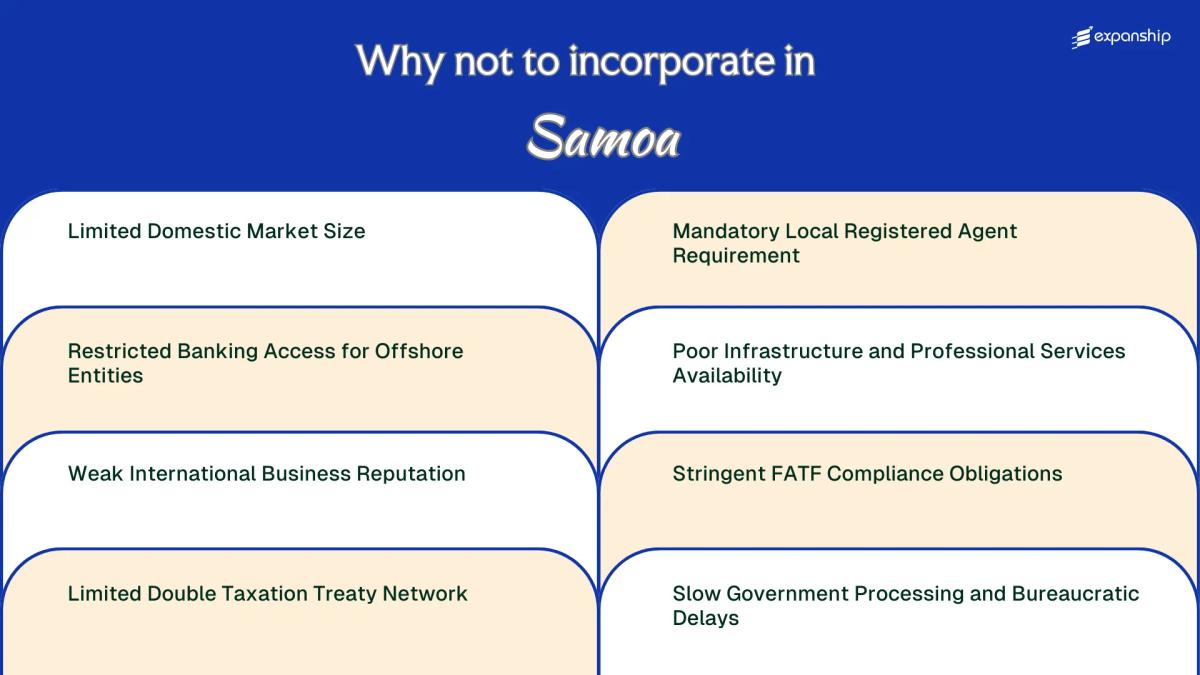
Limited Domestic Market Size
Samoa small domestic market limitations present a structural challenge that affects businesses at the revenue planning stage. The total population sits at approximately 225,000, which constrains the consumer base to a scale that cannot sustain most commercially viable operations.
A Consumer Base Too Small to Support Local Revenue
Gross domestic product remained below USD 1 billion as of recent World Bank figures, placing the domestic economy among the smaller Pacific Island markets by absolute output. Any foreign entity incorporating locally with the intention of selling to resident consumers will find that addressable demand is insufficient to meet the revenue thresholds that justify the operational costs of maintaining a compliant local presence.
Structural Dependency on External Markets
Your business cannot offset this limitation through sector diversification within the local economy, since both retail and services sectors reflect the same population ceiling. The Samoa Companies Act 2001 imposes local compliance obligations regardless of whether the firm generates domestic revenue, meaning you bear registration and maintenance costs without access to a market large enough to recover them.
A foreign business owner relying on local sales to fund operational costs will find that the domestic consumer base in Samoa cannot generate sufficient revenue to justify those costs in most industry categories.
Restricted Banking Access for Offshore Entities
Samoa offshore company banking restrictions represent one of the most operationally disruptive challenges for foreign business owners. International banks, particularly those operating under strict anti-money laundering frameworks, routinely treat entities registered under the International Companies Act 1987 with heightened scrutiny.
Correspondent banking relationships are the core problem. Major banking networks have systematically reduced exposure to Pacific island jurisdictions perceived as higher-risk, leaving Samoa-registered entities with a narrowed pool of willing financial institutions.
In practice, this creates friction across multiple operational areas:
- Opening a business account often requires in-person verification at a foreign bank branch, generating travel costs and delays for directors based outside the Pacific region
- Payment processors and fintech platforms frequently decline onboarding for companies tied to Pacific offshore registries, restricting your ability to collect revenue online
- Correspondent banking risks attached to a Samoa company can cause transactions to be flagged, delayed, or rejected by intermediary banks without prior notice
- Maintaining an account may require minimum deposit thresholds that tie up working capital
Some banks will accept these entities if paired with audited financials and verified beneficial ownership disclosures, but these requirements add professional service costs that erode the cost advantages of offshore incorporation.
 Samoa
Samoa Company Incorporation in Samoa
Understand the full scope of requirements before registering an offshore entity in Samoa.
Weak International Business Reputation
Samoa offshore reputation problems are not incidental. They stem from the jurisdiction's prolonged placement on international watchlists maintained by bodies including the Financial Action Task Force (FATF) and the OECD, which has generated lasting skepticism among banks, counterparties, and institutional investors.
The country was grey-listed by the FATF as recently as 2021 due to deficiencies in anti-money laundering and counter-terrorist financing frameworks. That designation, even after subsequent remediation efforts, leaves a traceable record that compliance officers at correspondent banks and multinational firms routinely flag.
| Risk Factor | Specific Impact |
|---|---|
| FATF grey-listing (2021) | Triggers enhanced due diligence requirements from foreign banking institutions |
| OECD scrutiny of preferential tax regimes | Increases risk of automatic rejection by EU-based counterparties |
| Samoa tax haven stigma | Reduces eligibility for payment processing with Tier-1 financial institutions |
| Low FATF mutual evaluation scores | Prolongs onboarding timelines with regulated financial intermediaries |
For a foreign business owner, this translates into rejected bank account applications, delayed correspondent banking relationships, and the cost of repeated Know Your Customer documentation rounds. These are not theoretical risks.
The International Companies Act 1988 governs offshore entity registration, but the law's origins in an era of minimal transparency requirements continues to colour how regulators in stricter jurisdictions perceive firms formed under it. An entity incorporated in Samoa carries a structural reputational burden that requires active disclosure and documentation to manage in cross-border commercial relationships.
Limited Double Taxation Treaty Network
Samoa's limited double taxation treaties represent one of the more consequential structural gaps for foreign business owners using the jurisdiction for cross-border operations. As of the most recent publicly available records from the Samoa tax authority, the country has not concluded a broad network of bilateral tax treaties, leaving most income flows unprotected from double taxation at source.
Without treaty coverage, dividends, royalties, and interest paid from a third country to a Samoan entity may be subject to full withholding tax rates imposed by the paying country. Those rates can reach 25–30% in many jurisdictions, compared to reduced treaty rates of 5–15% commonly available through hubs with extensive treaty networks such as Singapore or the Netherlands.
The lack of DTAs also affects substance and structure planning. Transactions involving a Samoan company as an intermediate holding entity carry a higher tax cost than equivalent structures routed through treaty-resident vehicles.
- Withholding taxes on dividends, interest, and royalties from counterparty countries apply at domestic rates, not reduced treaty rates
- No treaty protection means no access to mutual agreement procedures for resolving cross-border tax disputes
- Foreign tax credits may not be available to shareholders in their home jurisdiction for taxes paid on Samoan-sourced income
- Each counterparty jurisdiction determines its own applicable withholding rate independently, creating unpredictable tax costs
Despite being a long-established offshore centre under the International Companies Act 1988, Samoa has never ratified a comprehensive income tax treaty with a G20 nation.
Mandatory Local Registered Agent Requirement
Under the International Companies Act 2009, every company incorporated in Samoa must maintain a registered office and appoint a licensed local registered agent at all times. This Samoa registered agent requirement drawbacks concern becomes immediate and ongoing: you cannot incorporate or remain in good standing without paying a third-party agent, regardless of whether your business generates any revenue.
Structural Obligation Under Local Law
The Samoa International Finance Authority (SIFA) licenses registered agents, and only these licensed entities can legally fulfil the local agent role for an International Business Company. Your firm has no option to self-register or appoint an overseas representative, which removes any flexibility in managing this cost.
Practical Cost and Control Implications
Annual registered agent fees for a Samoa IBC typically range from USD 300 to USD 600 depending on the service provider, a recurring liability that exists independent of business activity. Because the agent also holds your registered office address, any lapse in payment or contractual relationship directly threatens your company's compliance status with SIFA.
Samoa Managing Registered Agent Obligations in Samoa
Understand the ongoing compliance costs and agent requirements for Samoa IBCs before committing to incorporation.
Poor Infrastructure and Professional Services Availability
Samoa professional services infrastructure limitations present a tangible operational problem for foreign incorporators who rely on third-party providers to manage ongoing compliance. The pool of qualified local professionals is small, which directly affects cost, availability, and service quality.
- The number of licensed corporate service providers operating under the Samoa International Finance Authority (SIFA) is limited, meaning your business may have little competitive choice when selecting a registered agent or compliance manager.
- Specialized legal counsel with experience in cross-border structuring is scarce locally, forcing foreign directors to source international lawyers at significantly higher cost.
- Accounting firms with capacity to handle IFRS-compliant reporting or multi-jurisdictional tax matters are few in number, creating bottlenecks during annual filing periods.
- Unreliable telecommunications and internet infrastructure can delay document transmission, digital correspondence, and time-sensitive regulatory filings.
- Service providers that do operate locally often carry high workloads, which can reduce responsiveness and increase turnaround times for routine corporate maintenance tasks.
Stringent FATF Compliance Obligations
Samoa FATF compliance obligations risks are not theoretical. The jurisdiction has appeared on the Financial Action Task Force grey list, formally known as the list of jurisdictions under increased monitoring, which signals that its AML/CFT frameworks require active remediation under international standards.
For your offshore company, grey-list status triggers heightened due diligence requirements from correspondent banks, payment processors, and institutional counterparties. Foreign firms incorporated under the International Companies Act 1987 face intensified scrutiny that imposes real operational friction.
The Money Laundering Prevention Act 2007 and its subsequent amendments require entities to maintain beneficial ownership records and submit to oversight by the Financial Intelligence Unit of Samoa. Non-compliance carries penalties, but the more immediate burden is the compliance infrastructure your business must build and sustain to satisfy external counterparties rather than domestic regulators alone.
Jurisdictions removed from FATF grey-list designation typically demonstrate measurable legislative progress across multiple action plan items, meaning the compliance burden is unlikely to ease on a short or predictable timeline.
A foreign-owned IBC operating from a grey-listed jurisdiction may face annual enhanced due diligence costs from a single European banking partner exceeding USD 3,000 to USD 8,000, covering third-party KYC reviews, legal opinions on beneficial ownership, and periodic compliance certifications, expenses that would not apply to the same entity incorporated in a FATF-compliant jurisdiction.
Slow Government Processing and Bureaucratic Delays
Samoa government processing delays incorporation timelines in ways that can directly disrupt your launch schedule. The Registrar of International and Foreign Companies, operating under the International Companies Act 1987, does not publish guaranteed turnaround benchmarks, leaving applicants without a reliable planning baseline.
Processing times for new company registrations can stretch beyond what many competing offshore centers offer. Jurisdictions such as the British Virgin Islands or Seychelles routinely complete incorporation within 24 to 48 hours; Samoa's timeline can run several business days to weeks depending on application volume and document review queues.
Physical document requirements and in-country agent dependencies compound the delay risk. If your registered agent under the RNZAG registration process encounters administrative backlogs, that bottleneck falls entirely on your timeline, not theirs.
Post-incorporation filings, including annual returns and any subsequent structural changes, face the same processing environment. Delays at this stage can push your entity into technical non-compliance before any substantive operational failure occurs on your part.
If your business requires a specific incorporation date for contractual, tax, or regulatory purposes in another jurisdiction, Samoa's absence of a guaranteed processing timeline makes that date commitment inherently unreliable.
Overcoming the Drawbacks of Incorporating in Samoa
Overcoming the Samoa incorporation drawbacks discussed in this blog requires structural decisions made before the entity is formed, not corrections applied after problems arise. Mitigating Samoa offshore company risks depends on how deliberately you align your setup with the requirements of the International Companies Act 1987 and the oversight functions of the Ministry of Commerce, Industry and Labour.
- Register your IBC through a licensed local registered agent to satisfy the mandatory residency requirement under the International Companies Act 1987.
- Open banking relationships through correspondent banking networks in jurisdictions that maintain active financial ties with Samoan-registered entities.
- Appoint a compliance officer familiar with FATF Mutual Evaluation obligations to manage ongoing AML/CFT reporting requirements.
- Structurally separate your operational business from the offshore entity to reduce exposure to treaty limitation issues arising from the narrow DTT network.
- Build government processing timelines into your incorporation schedule to account for documented bureaucratic delays at the Registrar of Companies.
These steps address known structural friction points within Samoa's regulatory framework. Managing Samoa IBC compliance challenges remains an ongoing obligation rather than a one-time formation exercise.
Samoa's Overall Value as a Business Destination
Samoa's position as an incorporation destination reflects a genuine tension between statutory convenience and practical limitations. The International Companies Act 1987 creates a structurally accessible framework, yet the compliance pressures, banking constraints, and reputational headwinds documented throughout this blog are real operational factors. For the right business profile, the jurisdiction remains a credible option; for others, those same constraints may outweigh the benefits.
| Pros | Cons |
|---|---|
| The International Companies Act 1987 allows rapid formation with minimal paid-up capital requirements. | Banking access for offshore entities is severely restricted, with few correspondent relationships available. |
| No corporate tax is levied on income earned outside Samoa by an IBC. | The double taxation treaty network is limited, leaving foreign income exposed to withholding taxes in counterparty countries. |
| A registered agent framework keeps ongoing administrative requirements straightforward. | The mandatory local registered agent adds a recurring cost with no operational flexibility to opt out. |
| Confidentiality protections exist under the corporate registry framework. | FATF-related compliance obligations increase due diligence burdens and reporting requirements for beneficial owners. |
| Formation costs remain comparatively low among Pacific offshore jurisdictions. | Government processing delays and bureaucratic inefficiencies can extend timelines unpredictably. |
Samoa's broader standing on international compliance watchlists has tangible consequences for how counterparties, banks, and regulators in other jurisdictions treat entities formed here.
Samoa Compliance Services for Companies in Samoa
Maintain your Samoa company's good standing with annual filings, beneficial ownership updates, and regulatory submissions under the International Companies Act 1987.
Conclusion
Any Samoa company formation cons summary points to a jurisdiction with real structural limitations. Restricted correspondent banking access, a thin double taxation treaty network, and the compliance obligations tied to FATF monitoring are not incidental friction — they reflect systemic conditions that affect day-to-day operations for incorporated entities. These constraints remain consistent regardless of the legal structure chosen under the International Companies Act 1987. How well your business absorbs those limitations depends largely on the quality of local representation and cross-border professional support you secure before incorporation.
Expanship's Samoa Company Formation Support
Expanship's Samoa company formation support addresses the specific operational weight that comes with incorporating under the International Companies Act 1988, meeting the Samoa Financial Intelligence Unit's AML/CFT obligations, and maintaining a compliant registered agent relationship as required by the Samoa International Finance Authority. These requirements don't disappear, but working with a service provider that understands the local regulatory framework reduces the administrative load on your team considerably.
Expanship handles the end-to-end process of forming and maintaining your Samoa entity across several key areas:
- Your company registration and corporate document preparation are handled in full, ensuring filings meet SIFA's requirements.
- A qualified local registered agent and registered office address are provided to satisfy the mandatory local presence requirement.
- All government filings and direct liaison with the relevant regulatory bodies are managed on your behalf.
- Ongoing post-incorporation compliance obligations are monitored and maintained to keep your entity in good standing.
- Banking introduction support is available to help connect your business with suitable financial institutions.
- Tax registration and liaison with applicable local authorities are coordinated as part of your setup.
Reach out to Expanship Samoa to discuss your incorporation requirements.
Frequently Asked Questions (FAQ)
The limitation applies broadly to any Samoa-registered entity generating cross-border income, regardless of industry. Samoa has a minimal treaty network, which means dividends, royalties, and service fees paid from high-tax jurisdictions to your Samoan firm may be subject to full withholding tax rates without treaty reduction.
Under the International Companies Act 1987, failure to maintain a registered agent in Samoa can result in your company being struck off the register. Reinstatement is possible but incurs additional fees and administrative delays, and any contractual obligations entered during the lapsed period may be legally uncertain.
Samoa's banking access challenges are generally considered more restrictive than BVI and comparable to Seychelles, primarily because fewer international correspondent banks maintain relationships with Samoan-registered entities. The combination of FATF scrutiny and limited domestic banking infrastructure compounds the difficulty beyond what you would typically encounter in BVI.
Non-compliance with annual filing and registered agent requirements under the International Companies Act 1987 can lead to administrative dissolution by the Samoa International Finance Authority (SIFA). Restoring a struck-off company requires a formal reinstatement application, payment of outstanding fees, and demonstrating that the entity has met its compliance obligations, a process that can take several weeks.
Registered agent fees in Samoa generally range from USD 300 to USD 600 per year, depending on the service provider and the complexity of the entity's requirements. This is a mandatory recurring cost under the International Companies Act 1987 and cannot be avoided regardless of whether the company conducts any active business.
You can attempt to open an account in a third jurisdiction, but the Samoan registration itself remains a risk factor that many banks will flag during their onboarding process. Compliance officers in EU, UK, and US-regulated banks routinely screen for jurisdiction of incorporation, and Samoa's offshore status means additional documentation requirements, longer review timelines, and a higher rate of application rejection.
Legal Disclaimer
The information provided in this article is for general informational purposes only and does not constitute legal, tax, or professional advice. While we strive to ensure the accuracy and timeliness of the content, laws and regulations are subject to change, and the application of laws can vary widely based on specific facts and circumstances.
Readers should not act upon this information without seeking professional counsel tailored to their individual situation. Expanship and its authors disclaim any liability for actions taken or not taken based on the content of this article.
For specific advice regarding your business setup, compliance requirements, or any legal matters, please consult with qualified legal and tax professionals in the relevant jurisdiction.