

Key Takeaways
- Every Panamanian Sociedad Anónima must appoint a licensed resident agent domiciled in Panama, a structural requirement embedded in Law 32 of 1927 that cannot be satisfied by a foreign representative or nominee arrangement.
- Beneficial ownership information must be disclosed and maintained under Law 52 of 2021, which established a centralized registry framework that obligates resident agents to collect and report UBO data on all registered entities.
- Bearer shares, historically a feature of Panamanian corporate law, are now effectively restricted in practical use following AML reforms, meaning share structures must be organized in a manner that establishes identifiable ownership from the outset.
- The Registro Público de Panamá serves as the competent authority for entity registration, and any deficiency in the submitted formation documents results in outright rejection of the application rather than a provisional or conditional registration.
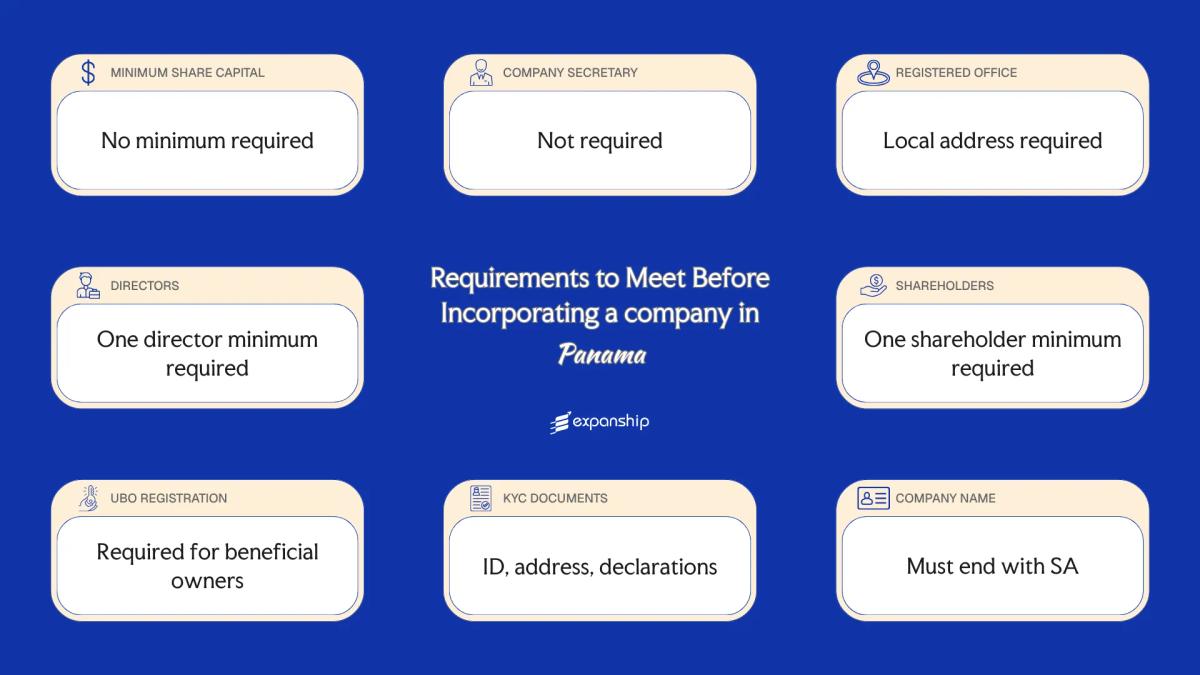
Corporate formation in Panama is governed primarily by Law 32 of 1927, which regulates the Sociedad Anónima, and by the Public Registry (Registro Público de Panamá), the government body responsible for entity registration. Understanding the full scope of Panama incorporation requirements is necessary before initiating any formation process.
This article covers the structural, administrative, and compliance-related requirements applicable to companies being incorporated under Panamanian law.
Failure to meet these requirements results in rejection of the registration application by the Registro Público, or in the case of post-incorporation non-compliance, potential cancellation of the entity's legal standing.
Specific requirements may differ depending on the entity type selected, the industry in which the business operates, and the nationality or residency profile of the shareholders and directors involved.
This article is most relevant to foreign investors and business owners who are considering establishing a Panamanian legal entity for international trading, asset holding, or regional operations.
Minimum Share Capital Requirements in Panama

Panama minimum share capital requirements are governed by Law 32 of 1927, which establishes a highly permissive capital framework for sociedades anónimas. No statutory minimum authorized capital is imposed, meaning the Public Registry of Panama does not verify a capital threshold before approving incorporation.
Authorized capital is recorded in the articles of incorporation (Pacto Social), but there is no mandatory paid-up amount at the time of registration or afterward. The capital structure is a one-time declaration made during incorporation, not an ongoing statutory obligation subject to periodic review.
| Parameter | Detail |
|---|---|
| Minimum Authorized Share Capital | No statutory minimum |
| Maximum Authorized Share Capital | No statutory maximum |
| Minimum Paid-Up Capital | No statutory requirement |
| Paid-Up Requirement at Incorporation | No statutory requirement |
| Accepted Currency | Any currency permissible |
| Accepted Forms of Contribution | Cash, assets, or services, subject to terms in the Pacto Social |
| Timeframe to Deposit Capital | No statutory timeframe |
No minimum capital does not mean authorized capital can be omitted. The Pacto Social must declare a capital structure, including the number of shares and their par or no-par value, for the Public Registry to process the incorporation.
Resident Agent Requirements in Panama
Under Panama's Corporations Law (Law 32 of 1927), appointing a resident agent is a mandatory requirement for all sociedades anónimas and other business entities incorporated in the country. This agent serves as the official point of contact between the company and Panamanian authorities.
Panama resident agent requirements extend beyond a passive administrative role. The agent is responsible for receiving legal notices, maintaining statutory records, and ensuring the entity remains in good standing with the Public Registry of Panama.
Qualification criteria for who may serve as a resident agent:
- Must be a licensed attorney or law firm admitted to practice in Panama
- Must be resident in Panama and maintain a physical presence in the country
- Individuals must hold active membership in the National Bar Association of Panama (Colegio Nacional de Abogados)
- Law firms serving in this capacity must be duly registered under Panamanian law
- Foreign attorneys or non-licensed individuals are not eligible to serve in this role
 Panama
 Incorporate a Company in Panama
Set up your business entity in Panama with guidance on legal requirements, agent obligations, and Public Registry filings.
Registered Office Requirements in Panama
Panama registered office requirements are governed by the Corporations Law (Law 32 of 1927), which mandates that every corporation maintain a registered domicile within the country. Failure to maintain a compliant legal address can result in administrative sanctions, including the entity being struck from the Public Registry of Panama.
- A physical address within Panama is required; a PO box alone does not satisfy this obligation.
- Virtual office addresses are generally accepted provided they correspond to a real, locatable premises in the country.
- The address must be locally based; a foreign address does not fulfil the Panama legal domicile requirements.
- No ownership of the premises is required; a service agreement or lease arrangement is sufficient.
- The registered address is recorded in the Public Registry and is therefore publicly accessible.
- Any change to the company's registered address must be formalised through a notarised resolution and filed with the Public Registry of Panama.
Director Requirements in Panama

Under Panama's Law 32 of 1927, directors of a sociedad anónima assume fiduciary duties toward the corporation and bear personal liability for resolutions passed in their name if those acts contravene the company's statutes or applicable law. Resignation does not automatically extinguish liability for acts that occurred during a director's tenure.
| Parameter | Detail |
|---|---|
| Minimum Number of Directors | A minimum of three directors is required by law. |
| Maximum Number of Directors | No statutory maximum is prescribed. |
| Local/Resident Director Required | No local or resident director is required. |
| Nationality Restrictions | No nationality restrictions apply; directors may be of any nationality. |
| Minimum Age Requirement | Directors must be of legal age, generally 18 years. |
| Corporate Directors Permitted | Yes, corporate directors are permitted under Law 32 of 1927. |
| Director Must Be a Shareholder | No, directors are not required to hold shares in the company. |
| Publicly Listed on Registry | Director names are recorded in the public Registro Público de Panamá. |
| Disqualification Conditions | No statutory disqualification framework is codified beyond general legal incapacity. |
Although director names are recorded in the public registry, Panama law permits nominee directors, meaning the individuals listed publicly may have no actual management authority over the company.
Shareholder Requirements in Panama

Panama corporate law, governed by Law 32 of 1927, requires a minimum of one shareholder to form a Sociedad Anónima. There is no statutory maximum on the number of shareholders permitted.
Nationality and Residency Restrictions
Panama corporation ownership requirements impose no nationality or residency conditions on shareholders. Foreign nationals and non-residents may hold 100% of the shares without restriction.
Corporate Shareholders
Legal entities, including foreign corporations, are permitted to act as shareholders in a Panamanian SA. No additional licensing or local presence is required for a corporate shareholder to hold shares.
Shareholder Liability
Under Panama company shareholder rules, liability is limited to the amount unpaid on each shareholder's subscribed shares. No general circumstances under Law 32 extend personal liability beyond that capital contribution.
Register of Shareholders
Your company must maintain an internal register of shareholders, but this register is not filed with the Public Registry and remains private. Any changes to shareholder composition should be recorded promptly in the company's books.
Panama Guidance on Shareholder Structuring When Incorporating in Panama
Get structured guidance on meeting shareholder obligations under Panamanian corporate law for your SA formation.
UBO / Beneficial Ownership Disclosure Requirements in Panama
Panama beneficial ownership disclosure requirements are governed by Law 52 of 2016, which mandates that corporations and private interest foundations identify and register their beneficial owners with a qualified resident agent. A beneficial owner is defined as any natural person who, directly or indirectly, holds or controls 25% or more of the shares or voting rights of an entity.
- Identify all natural persons meeting the 25% ownership or control threshold.
- Submit beneficial ownership information to your registered resident agent, who maintains the records on behalf of the entity.
- The resident agent files this data through the Sistema de Verificación de Beneficiario Final, the centralized platform administered by the Superintendency of Non-Financial Subjects (SSNF).
- Update the resident agent whenever a change in beneficial ownership occurs.
| Parameter | Detail |
|---|---|
| Ownership Threshold for UBO Status | 25% of shares or voting rights |
| Filing Authority | Superintendency of Non-Financial Subjects (SSNF) via resident agent |
| Disclosure Deadline at Incorporation | At the time of incorporation or upon assuming UBO status |
| Publicly Accessible Register | No |
| Penalties for Non-Disclosure | Fines and potential suspension of corporate rights under Law 52 of 2016 |
| Ongoing Update Obligation | Yes; changes must be reported to the resident agent promptly |
KYC / Document Requirements in Panama
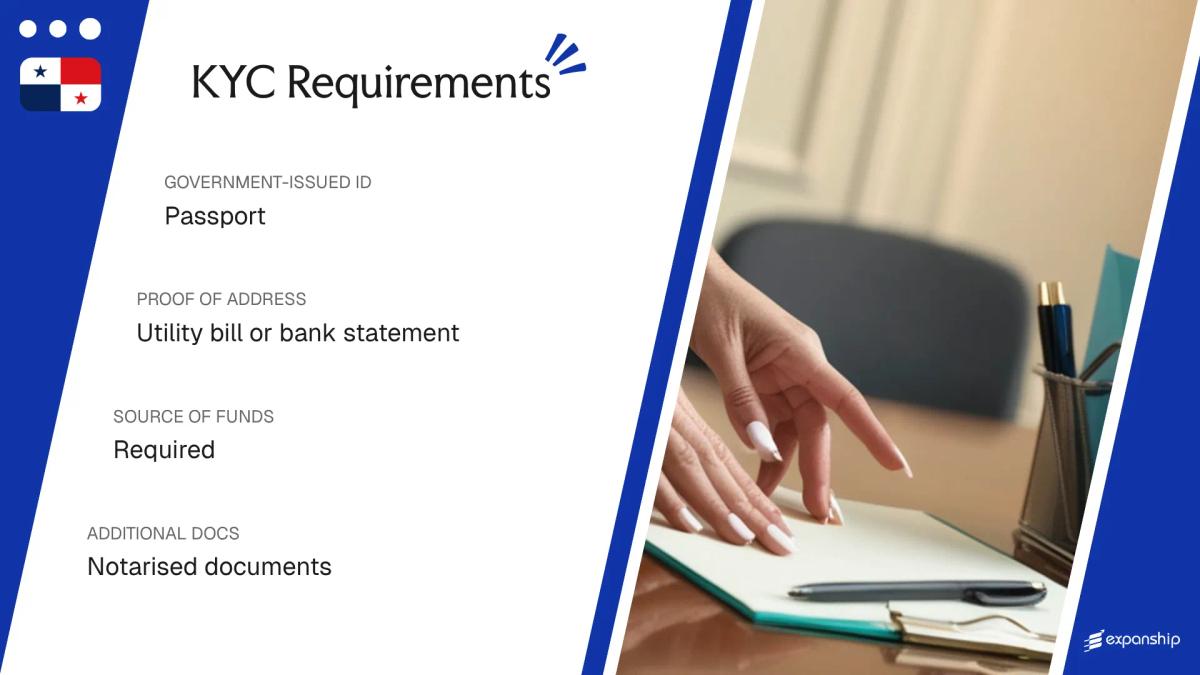
Panama KYC requirements company formation are governed by Law 23 of 2015, which established the country's AML framework and made resident agents the primary gatekeepers of due diligence for newly formed entities; compliance is overseen by the UAF.
Individual / Personal Documents
- Valid government-issued photo ID (passport preferred) for each director, shareholder, and beneficial owner
- Proof of residential address dated within three months, such as a utility bill or bank statement
- Completed KYC questionnaire or client intake form as required by the resident agent
- Two professional or personal reference letters, depending on the resident agent's internal policy
Corporate Documents
- Certificate of incorporation from the jurisdiction of origin
- Constitutional documents, including articles of association or equivalent
- Register of current directors and officers
- Proof of the corporate entity's registered address
Source of Funds Documentation
- Recent bank statements covering a minimum of three months
- Audited financial statements or accountant-certified accounts where available
- A written declaration explaining the origin of capital if documentary evidence is limited
Notarisation and Apostille Requirements
- Foreign public documents generally require an apostille under the Hague Convention
- Certified translations into Spanish are required for documents issued in other languages
- Notarisation requirements are determined by the resident agent's internal compliance standards
The most common cause of incorporation delay is submission of proof-of-address documents that exceed the three-month validity window accepted under Law 23 of 2015 compliance checks.
Company Name Requirements in Panama
Panama company name requirements are assessed during the incorporation process, with proposed names reviewed for availability and compliance before registration is confirmed. No two entities may share an identical or deceptively similar name.
Names must be in any language, provided they use the Roman alphabet. A legal suffix denoting corporate form, such as "Sociedad Anónima" or its abbreviation "S.A.," is mandatory for corporations.
Certain words are outright prohibited or require prior governmental approval. Terms implying a connection to banking, insurance, or government bodies fall under restricted categories.
Name reservation is available prior to incorporation. Reservations are generally valid for a limited period, during which no other entity may register the same name.
Panama Compliance Services for Companies in Panama
Stay current with Panama's annual filing obligations, registered agent requirements, and corporate maintenance rules.
Conclusion
Panama company incorporation requirements are governed primarily by Law 32 of 1927, alongside the reforms introduced by Law 47 of 2013 and subsequent AML regulations. The resident agent obligation and the UBO disclosure framework under Law 52 of 2021 stand out as two requirements that directly affect how your entity is structured and maintained on an ongoing basis. Bearer shares, once a defining feature of Panamanian corporations, are now effectively restricted in practical use. Once these obligations are understood, the immediate next step for a foreign investor is engaging qualified local counsel and fulfilling the documentation and registration process with the Public Registry.
Expanship's Corporate Formation Services in Panama
Expanship's Panama corporate formation services are structured around the specific requirements that govern SA and SRL formation under the Corporations Law (Law 32 of 1927) and related regulations, including resident agent obligations, registered office maintenance, and UBO disclosure procedures under Law 23 of 2015. Our role is to manage the procedural and administrative burden these requirements place on your business, so your team can focus on operations rather than paperwork.
From initial registration through to ongoing compliance, our service scope covers the full formation cycle:
- Preparing and filing incorporation documents with the Public Registry of Panama
- Providing a licensed resident agent and registered office address in-country
- Handling government filings and liaising with the relevant regulatory authorities on your behalf
- Managing post-incorporation compliance obligations as your entity matures
- Facilitating introductions to banking institutions operating in Panama
- Coordinating tax registration and liaison with the Dirección General de Ingresos (DGI)
To discuss your requirements, contact Expanship Panama.
Frequently Asked Questions (FAQ)
Yes, every Panamanian S.A. must appoint a resident agent under the Código de Comercio, and that agent must be a licensed Panamanian attorney or law firm. The requirement is ongoing, not just at the point of incorporation, meaning the appointment must be maintained for the life of the company. Removing a resident agent without appointing a replacement puts the entity in breach of its legal obligations.
A company that loses its resident agent or registered office address risks being struck from the Public Registry, which effectively suspends its legal standing to operate, enter contracts, or enforce rights in Panama. The Public Registry of Panama administers this process and has the authority to mark the company as irregular. Reinstatement is possible but involves legal fees, back payments, and processing delays.
Beneficial ownership records in Panama are held in a private system, not on a publicly searchable registry. Under Law 52 of 2016 and its subsequent amendments, the information is maintained by the registered resident agent and made available only to competent authorities upon a formal legal request. This is a meaningful structural distinction from jurisdictions that have adopted public UBO registers.
A Panama S.A. requires a minimum of three directors, so a single individual cannot hold all board seats. However, one person can hold all issued shares, meaning sole ownership is permitted even though the directorship threshold must be met with three separate individuals. Directors do not need to be Panamanian residents or nationals, so the requirement can be satisfied with foreign individuals.
Yes, the documentation differs materially. An individual shareholder must provide government-issued identification and proof of address, whereas a corporate shareholder must supply certified constitutional documents, a certificate of good standing, and identification for its underlying beneficial owners. The resident agent is responsible for collecting and verifying this information under Panama's AML framework, and gaps in corporate shareholder documentation are a common cause of delays in the formation process.
A Panama S.A. must include a suffix that signals its corporate form, such as "S.A.", "Corp.", "Inc.", or "Ltd." Names that imply a connection to government bodies, regulated financial activities, or internationally protected terms require prior approval or are outright prohibited. Two companies cannot hold the same name within the Public Registry, and a name search is required before submission to confirm availability.
Legal Disclaimer
The information provided in this article is for general informational purposes only and does not constitute legal, tax, or professional advice. While we strive to ensure the accuracy and timeliness of the content, laws and regulations are subject to change, and the application of laws can vary widely based on specific facts and circumstances.
Readers should not act upon this information without seeking professional counsel tailored to their individual situation. Expanship and its authors disclaim any liability for actions taken or not taken based on the content of this article.
For specific advice regarding your business setup, compliance requirements, or any legal matters, please consult with qualified legal and tax professionals in the relevant jurisdiction.