

Key Takeaways
- Panama's strict territorial tax system means foreign-sourced income faces zero Panamanian income tax liability, making the Sociedad Anónima a structurally sound vehicle for international holding and trading operations.
- Because the Public Registry does not require public disclosure of shareholder identity, beneficial owners of a Panamanian entity can maintain a level of privacy that many comparable offshore jurisdictions no longer permit.
- The Sociedad Anónima framework imposes no minimum capital requirement and supports nominee directors, giving foreign owners considerable flexibility in how they structure governance without triggering additional regulatory thresholds.
- Absent currency exchange controls, capital can move freely across borders, a feature that — combined with territorial taxation — provides operational latitude that few jurisdictions offer simultaneously within the same legal framework.
Panama is an independent republic in Central America, governed by a civil law legal system with company registration overseen by the Public Registry. Foreign nationals face no restrictions on owning a Panamanian entity outright, and the country maintains an open posture toward foreign direct investment across most sectors. The Sociedad Anónima remains the most common vehicle through which international businesses establish a legal presence here.
On taxation, the country applies a strict territorial system — income generated outside its borders is not subject to local tax. This principle sits at the center of most Panama company formation advantages and explains the sustained interest from entrepreneurs and holding structures worldwide.
This article examines the specific benefits of incorporating in Panama, drawing on the legal and regulatory framework that governs foreign-owned companies under Panamanian law. Each section addresses a distinct advantage so you can assess whether this jurisdiction fits your operational and structural objectives.
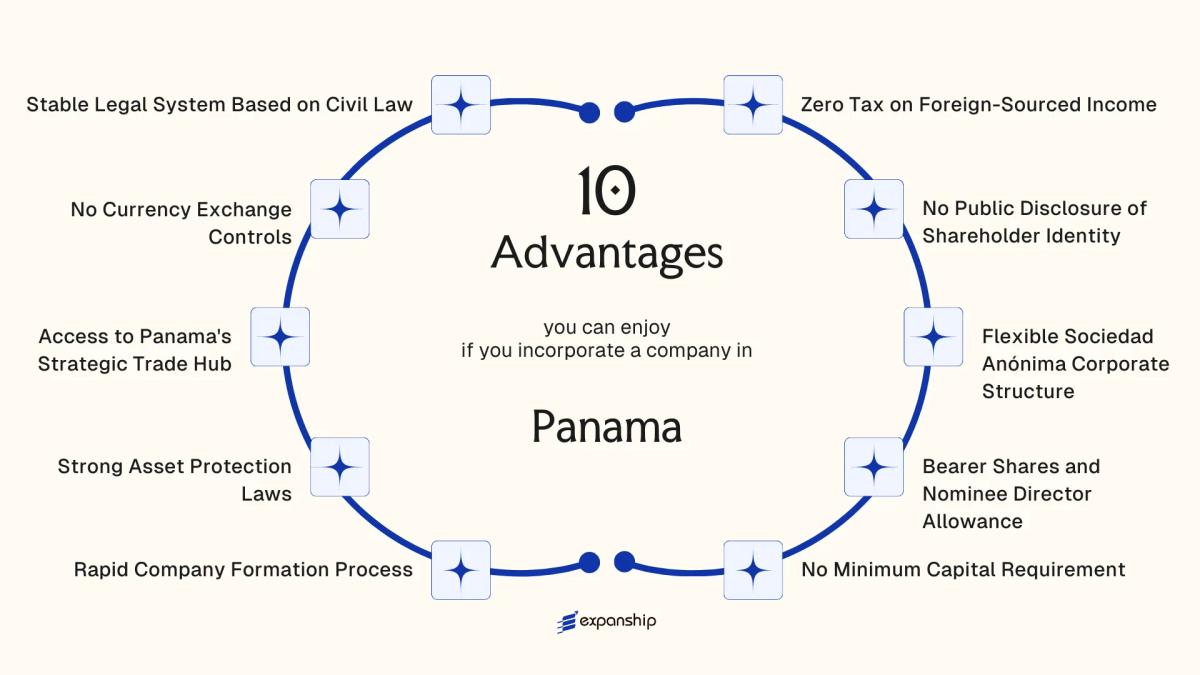
Zero Tax on Foreign-Sourced Income
Panama zero tax on foreign income is the direct result of a territorial tax principle codified in the Fiscal Code of Panama. Under this system, only income generated from activities occurring within the country is subject to taxation.
How the Territorial Rule Is Defined
The Dirección General de Ingresos (DGI) determines tax liability based on where economic activity takes place, not where the company is registered or where its shareholders reside. A Panamanian entity that invoices clients abroad, holds foreign assets, or conducts business operations entirely outside the country owes no income tax on those earnings to the Panamanian state.
What This Means for Foreign-Owned Businesses
For a business structured to serve international markets, this separation between source and registration jurisdiction removes a significant cost burden. Your firm retains full profits generated outside Panama without treaty dependency or complex exemption applications, since the exemption is structural rather than discretionary.
The Panama territorial tax system benefits businesses precisely because the zero-tax treatment applies by default under the Fiscal Code, not as a special regime subject to renewal or government approval.
Foreign-sourced profits are fully retained by your company with no income tax obligation to the Panamanian state, by operation of law.
No Public Disclosure of Shareholder Identity
Panama shareholder privacy benefits stem directly from the Corporations Law (Law 32 of 1927), which governs the formation and operation of the Sociedad Anónima. Under this statute, there is no requirement to file shareholder details with any public registry. The Public Registry of Panama records the articles of incorporation, the registered agent, and the corporate directors, but ownership information remains entirely outside its scope.
This matters in practical terms. Your identity as a shareholder is not accessible to third parties, competitors, or the general public through any routine registry search. That absence of disclosure is structural, not discretionary.
The reasons this arrangement works in your favour as a foreign owner are specific:
- Shareholder registers are maintained privately by the company itself or its registered agent, not submitted to a government body
- No beneficial ownership information is required to appear in any document filed at the Public Registry
- Third parties cannot identify ownership through public filings without a court order or formal legal process
- Confidentiality is embedded in the statutory framework, not dependent on elective privacy structures
Panama corporate confidentiality advantages apply equally to resident and non-resident shareholders. The law draws no distinction based on the shareholder's nationality or domicile, which gives foreign owners the same structural protections as any local entity.
 Panama
 Company Incorporation in Panama
Incorporate your Sociedad Anónima in Panama with full shareholder confidentiality and no public disclosure requirements.
Flexible Sociedad Anónima Corporate Structure
The Sociedad Anónima, or SA, is the predominant corporate vehicle in Panama and the structure most commonly used by foreign investors and international holding companies. Understanding the Panama Sociedad Anónima structure benefits requires looking at how the law itself is written, specifically Law 32 of 1927, which governs SA formation and remains the foundational statute for this entity type.
Under Law 32, the SA can be structured with remarkable latitude. Shares may be issued in multiple classes, each carrying different voting rights, dividend entitlements, or transfer restrictions, allowing founders to separate economic interest from governance control. This is particularly useful for joint ventures or family-owned holding structures where control concentration matters.
| Feature | Detail |
|---|---|
| Minimum shareholders | 1 (no maximum) |
| Minimum directors | 3 (can be same nationality or foreign) |
| Share classes permitted | Multiple, with variable rights |
| Registered agent requirement | Yes, must be a Panama-licensed attorney or firm |
| Corporate books location | Flexible; can be held abroad |
Directors are not required to be Panamanian residents or nationals, and board meetings can be held anywhere in the world. The corporate books, while legally required, may be maintained outside the country. For a foreign business structuring regional operations or an asset-holding entity, this geographic flexibility reduces administrative friction without sacrificing legal standing under Panamanian corporate law.
Bearer Shares and Nominee Director Allowance
Panama bearer shares nominee director benefits remain a defining feature of the country's corporate framework, drawing foreign investors who require structural privacy without sacrificing legal standing. Under the Corporations Law (Law 32 of 1927), a Sociedad Anónima may appoint nominee directors, meaning individuals who hold directorial positions on your behalf. This separates your name from publicly accessible records at the Registro Público de Panamá.
Nominee directors allow your business to maintain a clean public profile while you retain actual control through private agreements such as resignation letters held in trust and undated share transfer documents. These arrangements are legally recognized and commonly structured by local registered agents.
Historically, bearer shares allowed complete ownership anonymity. Following FATF-driven reforms, bearer shares must now be immobilized with authorized custodians under Law 47 of 2013, yet beneficial ownership information remains confidential and is not disclosed publicly.
Keep the following points in mind:
- Nominee directors must sign a private mandate agreement defining the limits of their authority
- Bearer shares held by custodians are not visible in the public registry
- Your identity as beneficial owner is disclosed only to the custodian, not filed in any public database
- Nominee arrangements do not transfer actual control of the entity to the nominee
Even after the 2015 bearer share reforms, Panama remains one of the few civil law jurisdictions where nominee structures and immobilized bearer shares can coexist within the same corporate entity.
No Minimum Capital Requirement
Panama imposes no statutory minimum capital requirement for incorporating a Sociedad Anónima (S.A.), which means your business can be registered without depositing or committing any specific sum of capital upfront. This Panama no minimum capital requirement benefit directly reduces the financial threshold that would otherwise gate entry into a new market.
Capital Flexibility from Day One
Under Panama's Commercial Code and the framework established by Law 32 of 1927, the authorized share capital can be set at any amount the founders determine. Shares can be issued at par or no-par value, and the full authorized capital does not need to be paid up at the time of incorporation. For a foreign entrepreneur structuring an early-stage holding entity or a special-purpose vehicle, this means legal existence is not contingent on proving available funds to a registrar.
Practical Implications for Foreign-Owned Entities
The absence of a paid-up capital minimum distinguishes Panama from jurisdictions that require founders to deposit certified funds into a blocked account before incorporation proceeds. In much of continental Europe, for instance, minimum paid-in capital requirements for equivalent corporate forms can range from several thousand to tens of thousands of euros. Your firm retains the freedom to allocate capital according to actual operational needs rather than satisfying a regulatory formality. This structural flexibility is especially relevant when the entity is designed primarily to hold assets, manage contracts, or consolidate group income rather than conduct high-volume transactional business.
Panama Maximize Your Panama Incorporation Benefits
Speak with an Expanship specialist to understand how Panama's capital-free incorporation structure applies to your specific business or investment goals.
Rapid Company Formation Process
Incorporating a Sociedad Anónima (S.A.) in Panama typically takes between three and five business days once the required documents are submitted to the Public Registry of Panama. This speed is a direct product of the country's legal framework under Law 32 of 1927, which governs S.A. formation and imposes minimal procedural requirements on foreign applicants.
- You are not required to be physically present at any stage of the registration process. A local licensed attorney acts as your registered agent and files directly with the Public Registry, which removes the logistical burden that slows incorporation in many civil law jurisdictions.
- There is no pre-approval process from a government ministry or foreign investment authority. The absence of a regulatory gatekeeping step means your entity can become legally operational within days rather than weeks.
- The documents required at formation are limited to the articles of incorporation (pacto social), naming at least three directors and a registered agent. No audited accounts, business plans, or proof of existing operations are needed from the foreign applicant.
- Once registered, the firm can open a corporate bank account and enter contracts immediately, giving you an active legal presence without the extended waiting periods common in higher-regulation markets.
Strong Asset Protection Laws
Panama asset protection laws benefits foreign investors through a legal framework that separates personal liability from corporate obligations. Under the Corporations Law (Law 32 of 1927), a Sociedad Anónima is treated as a distinct legal person, meaning creditors of the company generally cannot pursue the personal assets of shareholders, and personal creditors of a shareholder cannot reach assets held within the entity.
Panamanian courts apply a strict interpretation of corporate separateness. This makes it significantly harder for foreign judgments to pierce the corporate veil compared to common law jurisdictions, where courts have broader discretion to disregard the corporate form.
For investors using foundations, the Private Interest Foundation Law (Law 25 of 1995) adds another layer of structural separation. Assets transferred into a Fundación de Interés Privado are legally owned by the foundation itself, not by the founder, which removes those assets from the founder's personal estate.
A foreign investor with $2 million in real estate and securities held through a Panamanian Fundación de Interés Privado would, under Law 25 of 1995, have those assets treated as foundation property rather than personal property, placing them outside the reach of personal creditors under Panamanian civil procedure.
Access to Panama's Strategic Trade Hub
Panama's geographic position at the midpoint of the Western Hemisphere places it directly on one of the world's highest-volume maritime corridors. The Panama Canal handles approximately 5% of global trade annually, connecting over 140 shipping routes across 80 countries. For a business incorporated here, physical proximity to this corridor translates into reduced transit times and lower logistics costs when sourcing or distributing goods internationally.
The Colón Free Trade Zone, established under Law 18 of 1948, is the largest free trade zone in the Western Hemisphere by trade volume. Goods entering the zone can be stored, repackaged, and re-exported without attracting import duties, making it operationally relevant for trading companies, distributors, and manufacturers with regional supply chains.
Panama's logistics hub advantages extend beyond the canal itself:
- Tocumen International Airport serves as the primary air cargo hub for Latin America
- The Panama Ports Company operates container terminals at both Atlantic and Pacific entrances to the canal
- A Special Economic Zone framework under Law 41 of 2004 offers additional tax incentives for firms operating within designated areas
Tax incentives available within the Colón Free Trade Zone and Special Economic Zones apply specifically to qualifying activities conducted within those zones, not to all companies incorporated in Panama.
No Currency Exchange Controls
Panama's no currency exchange controls benefit stands out for one structural reason: the country has no central bank and no monetary authority managing a domestic currency. The US dollar has been legal tender since 1904, operating under the Monetary Agreement of 1904 and subsequent arrangements that formalized full dollarization. Your business transacts, invoices, and holds funds in the same currency used by the world's largest economy, without a conversion layer between you and your money.
Capital Moves Without Restriction
There is no statutory framework governing capital inflows or outflows because no such framework has been enacted. Foreign investors transfer profits abroad, repatriate capital, or fund operations across borders without filing for regulatory approval or satisfying minimum holding periods. In jurisdictions where exchange controls exist, even temporary restrictions can freeze operational liquidity, a structural risk that simply does not exist here.
No Forex Exposure on Domestic Operations
Because the firm operates exclusively in USD, there is no currency mismatch between your international contracts and your local accounts. This removes the need for hedging instruments, currency risk provisions, or exposure management that businesses incorporated in countries with volatile local currencies routinely absorb as an operating cost.
Practical Implications for Cross-Border Structures
- Dividend distributions to foreign shareholders are paid in USD with no conversion or withholding mechanics tied to exchange rate events
- Intercompany loans denominated in USD carry no conversion risk at the Panama entity level
- Banking relationships with Panama's international financial center are conducted in the same currency as most global trade finance instruments
Stable Legal System Based on Civil Law
Panama's civil law legal system benefits foreign businesses through predictability. The country's legal framework derives from the Napoleonic Code tradition, codified through statutes rather than built on judicial precedent. This means commercial rules are written, published, and accessible, so your legal advisors can assess obligations without waiting on case law interpretation.
The primary commercial statute governing corporations is Law 32 of 1927, which has remained the foundational corporate law for nearly a century. Long legislative continuity reduces the risk of sudden structural changes that could disrupt your entity's operations. Foreign business owners can structure their affairs under rules that have been tested and interpreted across decades.
Panama's stable legal framework advantages extend to contract enforcement. Civil law systems codify obligations in detailed statutes, which reduces ambiguity in commercial disputes. Courts apply written codes directly, giving contracting parties a more defined starting point for dispute resolution.
The country's judiciary operates through a tiered structure, with the Supreme Court of Justice at its apex. Commercial matters are addressed through civil and commercial courts, and legal proceedings follow codified procedural rules under the Judicial Code. This structure gives institutional clarity to how disputes are processed.
Key features of this legal environment that carry practical weight for foreign entities include:
- Statutory corporate rules under Law 32 of 1927 that do not require ongoing judicial reinterpretation
- Written contract law that reduces reliance on discretionary judicial reasoning
- A codified procedural framework that sets defined stages for commercial litigation
- Recognition of foreign judgments under established international private law principles
Why Panama Stands Out Among Offshore Jurisdictions
Compared to Belize, the Cayman Islands, and the British Virgin Islands, Panama occupies a distinct position among offshore destinations. These three jurisdictions target broadly similar investors — those seeking tax efficiency, structural flexibility, and privacy — making them the most realistic alternatives a business owner would evaluate alongside a Panamanian incorporation.
What the comparison reveals is not simply a list of matching features, but a difference in legal maturity and trade utility. Panama's territorial tax system is codified under the Fiscal Code and backed by a functioning civil law judiciary, whereas several competing jurisdictions rely more heavily on administrative discretion. Beyond the legal framework, the country's physical infrastructure — the Canal, Colón Free Trade Zone, and Tocumen International Airport — gives incorporated entities a credible operational base, not just a registration address. That operational dimension is largely absent in purely offshore centres like the Cayman Islands or BVI.
| Parameter | Panama | BVI | Cayman Islands | Belize |
|---|---|---|---|---|
| Territorial Tax System | Yes (Fiscal Code) | Yes | Yes | Yes |
| Civil Law Legal Framework | Yes | No (Common Law) | No (Common Law) | No (Common Law) |
| Shareholder Privacy | Yes | Yes | Yes | Yes |
| Free Trade Zone Access | Yes (Colón FTZ) | No | No | No |
| Nominee Directors Permitted | Yes | Yes | Yes | Yes |
| No Minimum Share Capital | Yes | Yes | Yes | Yes |
| Active Double Tax Treaty Network | Limited but growing | Minimal | Minimal | Minimal |
Panama Compliance Services for Companies in Panama
Maintain your Panamanian company's good standing with annual filings, registered agent obligations, and regulatory reporting handled by specialists.
Conclusion
Panama's territorial tax system, combined with the structural flexibility of the Sociedad Anónima and some of the region's most developed asset protection statutes, forms a coherent framework rather than a collection of isolated incentives. For foreign business owners whose revenue originates outside the country, the benefits of incorporating in Panama rest on a legally grounded foundation that has remained largely consistent across successive administrations.
Territorial taxation means income earned abroad is not subject to Panamanian income tax, and the absence of currency exchange controls means capital moves freely across borders. These two features, taken together, give an international business genuine operational flexibility that many comparable jurisdictions do not offer simultaneously.
Suitability depends on your business model, the jurisdictions where you earn revenue, and the compliance obligations you carry from your home country. A holding entity, an international trading firm, and a consultancy operating across Latin America each have different exposure to these advantages. The structural features documented across this article apply broadly, but their value varies by use case.
For businesses that do meet the profile, incorporating here is a decision that can be executed quickly, maintained without excessive administrative burden, and supported by a civil law system that has handled commercial disputes for over a century. The practical next step is confirming that your specific structure aligns with the applicable rules under Panamanian law and the regulatory requirements of your home jurisdiction.
Start Your Panama Company with Expanship Today
Expanship assists foreign business owners in forming and maintaining Sociedad Anónima entities in Panama, handling filings with the Registro Público de Panamá and managing ongoing obligations under Law 32 of 1927 and subsequent corporate regulations. The territorial tax framework, nominee structures, and asset protection provisions covered throughout this blog each carry specific administrative requirements, and meeting them correctly from incorporation onward reduces exposure to compliance risk.
Expanship's Panama company formation services cover the full scope of what a foreign owner needs to establish and maintain a compliant entity:
- Preparation and legalization of incorporation documents, including the public deed filed before a Panamá notary
- Registered agent and registered office provision, as required under Panamanian law for all corporations
- Liaison with the Registro Público de Panamá for filing and certificate retrieval
- Post-incorporation compliance management, including annual fees and resident agent obligations
- Nominee director and shareholder arrangements where applicable
- Banking introduction assistance with local and international financial institutions
To discuss your requirements and how to incorporate in Panama with Expanship, contact Expanship Panama directly.
Frequently Asked Questions (FAQ)
Yes, foreign nationals can fully own and incorporate a Sociedad Anónima in Panama without establishing residency. The entity requires at least three directors and three officers — positions that can be filled by nominees — and there is no requirement for any of them to be Panamanian citizens or residents. Shareholders face no nationality or residency restrictions under the current commercial code.
Panama applies a territorial tax system, meaning income generated from sources outside the country is not subject to Panamanian income tax. A firm incorporated locally but operating exclusively with foreign clients, providing services abroad, or holding international assets would owe no income tax on those earnings to the Dirección General de Ingresos. Only income with a Panamanian source falls within the domestic tax base.
Bearer shares remain legally recognized in Panama, though their use is now regulated under Law 47 of 2013, which introduced a custodian requirement. Physical bearer share certificates must be held by an authorized custodian — typically a licensed Panamanian attorney or financial institution — and the custodian is required to maintain records of the beneficial owner. Unrestricted anonymous bearer share arrangements are no longer permitted under this framework.
Registration with the Public Registry of Panama generally takes between three and five business days once the notarized Articles of Incorporation are submitted. Preparation of the incorporation documents by a resident agent can often be completed within one to two business days prior to filing. Total elapsed time from instruction to registered entity is frequently under two weeks.
No minimum paid-up capital is required to incorporate a Sociedad Anónima. The authorized capital stated in the Articles of Incorporation does not need to be deposited or demonstrated at the time of registration. This means your business can proceed with formation regardless of the capital amount declared in its founding documents.
Foreign judgments are not automatically enforceable against assets held through a Panamanian entity. For a foreign court's ruling to take effect domestically, it must be recognized through an exequatur proceeding before the Supreme Court of Justice of Panama, which evaluates whether the judgment meets specific procedural and legal standards. Assets structured under Panamanian law retain a meaningful layer of protection against direct enforcement of overseas rulings.
Panama does not maintain currency exchange controls, and there are no restrictions on the repatriation of profits, capital, or dividends from a locally incorporated entity. The U.S. dollar functions as the de facto currency alongside the Balboa, eliminating exchange rate risk on dollar-denominated transactions. Transfers can be conducted freely through the domestic banking system without regulatory approval from a central bank authority.
Legal Disclaimer
The information provided in this article is for general informational purposes only and does not constitute legal, tax, or professional advice. While we strive to ensure the accuracy and timeliness of the content, laws and regulations are subject to change, and the application of laws can vary widely based on specific facts and circumstances.
Readers should not act upon this information without seeking professional counsel tailored to their individual situation. Expanship and its authors disclaim any liability for actions taken or not taken based on the content of this article.
For specific advice regarding your business setup, compliance requirements, or any legal matters, please consult with qualified legal and tax professionals in the relevant jurisdiction.