

Key Takeaways
- Panama's removal from the FATF greylist remains conditional on sustained compliance reforms, meaning foreign-owned entities incorporated there continue to carry reputational exposure when engaging counterparties in regulated financial markets.
- Law 47's restrictions on bearer shares have reduced structural flexibility for founders who previously relied on anonymous ownership arrangements within Panamanian Sociedades Anónimas.
- With a limited network of double taxation treaties, Panamanian holding structures face elevated withholding tax exposure on cross-border income flows compared to jurisdictions with broader treaty coverage.
- Foreign-owned entities operating through a Panamanian vehicle remain structurally dependent on a licensed registered agent for core corporate functions, creating an ongoing administrative and cost obligation that cannot be internalized.
Panama operates under an evolving compliance framework, shaped by ongoing pressure from supranational bodies including the Financial Action Task Force (FATF) and the OECD. The disadvantages of incorporating in Panama span regulatory, banking, reputational, and structural categories — each examined individually in the sections that follow.
The significance of any given drawback depends heavily on your business model, whether you operate in financial services, hold intellectual property, or run an active trading entity will determine which constraints bear most directly on your structure. Governed primarily by the Código de Comercio, Panama's corporate framework carries specific obligations that foreign-owned entities must account for from formation onward.
This article is most relevant to non-resident founders, foreign investors, and multinational structures considering a Sociedad Anónima or similar Panamanian vehicle as part of their international holding or operational setup.
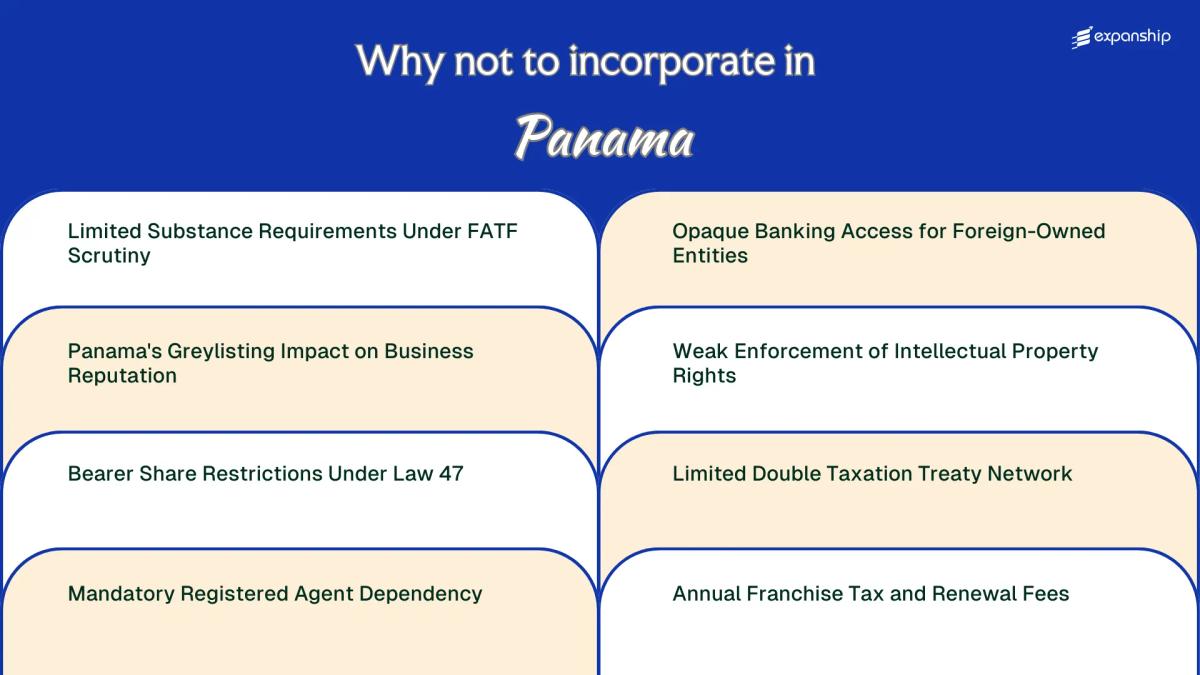
Limited Substance Requirements Under FATF Scrutiny
Panama substance requirements FATF risks stem from a structural gap: Panamanian law imposes no general economic substance obligation on corporations or foundations simply for being registered there.
No Domestic Substance Threshold
Unlike jurisdictions that enacted economic substance legislation in response to OECD pressure, no equivalent framework applies broadly to Panamanian sociedades anónimas. Your entity can maintain zero employees, no physical office, and no local operations without breaching any domestic rule, which is precisely what draws FATF scrutiny to offshore structures registered there.
That absence of a substance floor means foreign-owned firms cannot demonstrate meaningful local activity when correspondent banks or tax authorities in high-compliance jurisdictions run FATF Panama compliance checks against the entity.
Heightened FATF Compliance Challenges
FATF has historically identified Panama as deficient in beneficial ownership transparency and anti-money laundering controls. Foreign businesses registered there face elevated due diligence requests from European and North American counterparties, directly because the jurisdiction's regulatory record shapes how those counterparties assess risk.
Panama offshore entity scrutiny problems are not theoretical; they translate into rejected account applications and delayed transactions.
The absence of any statutory economic substance requirement gives foreign counterparties and regulators no verifiable local activity to assess, making your entity structurally difficult to defend under international compliance reviews.
Panama's Greylisting Impact on Business Reputation
Panama greylisting business reputation risks are not abstract. Since the Financial Action Task Force added Panama to its grey list in June 2019, and again in 2023, foreign-owned entities registered here face heightened scrutiny from correspondent banks, institutional counterparties, and payment processors worldwide.
Banks in EU and North American jurisdictions apply enhanced due diligence under their own AML frameworks when processing transactions linked to grey-listed countries. That means your business faces slower onboarding, additional documentation demands, and, in some cases, outright refusal of services.
The practical friction this creates includes:
- Correspondent banking partners declining to process transactions routed through Panamanian entities, cutting off access to USD or EUR clearing
- Institutional clients requiring additional legal opinions or compliance certifications before signing contracts with your firm
- Payment processors flagging your business for manual review, adding delays that affect cash flow
- Investors and auditors treating grey-list status as a red flag during due diligence, raising the cost of capital
FATF grey-list designation does not carry direct legal penalties for registered companies. The damage is structural: counterparties treat the jurisdiction's compliance standing as a proxy for your entity's own risk profile, regardless of your actual business activities.
 Panama
 Company Incorporation in Panama
Understand what incorporating in Panama involves before making a decision.
Bearer Share Restrictions Under Law 47
Panama bearer share restrictions under Law 47 fundamentally altered what was once the defining feature of a Sociedad Anónima. Enacted in 2015, Law 47 eliminated the practical utility of bearer shares by requiring that all such instruments be immobilized with an authorized custodian, which must be a licensed Panamanian financial institution or attorney.
You cannot hold or transfer bearer shares freely. Every certificate must be deposited with a custodian, and that custodian is legally obligated to identify the beneficial owner, record the information, and report it to the Superintendence of Non-Financial Service Providers (SSNF) upon request.
| Requirement | Detail | Burden for Foreign Owner |
|---|---|---|
| Custodian type | Licensed Panamanian financial institution or regulated attorney | Limits choice; adds local dependency |
| Beneficial owner disclosure | Mandatory identification to custodian | Eliminates anonymous share ownership |
| Reporting obligation | SSNF can compel disclosure upon request | No guarantee of confidentiality |
| Custody fees | Ongoing annual fees charged by custodian | Recurring cost with no operational benefit |
The anonymous share ownership that historically drew foreign investors to Panamanian structures no longer exists in any functional sense. What remains is a bearer share certificate that carries custodial costs while providing none of the privacy once associated with it.
Entities incorporated before Law 47 and holding legacy bearer shares faced mandatory conversion or immobilization deadlines, meaning even historical structures lost their prior-status protections.
Mandatory Registered Agent Dependency
Panama registered agent dependency risks stem directly from Article 2 of Law 32 of 1927, which requires every Panamanian corporation to maintain a registered agent who must be a licensed Panamanian attorney or law firm. This is not an administrative formality. Your company's legal standing depends entirely on a private third party remaining active, licensed, and solvent.
If your agent resigns, loses their license, or ceases operations, your entity's corporate status can fall into default. Replacing an agent requires filing a notarized amendment with the Public Registry of Panama, which takes time and incurs additional fees during a period when your company may already be non-compliant.
Unlike jurisdictions where registered agents have purely administrative roles, Panamanian agents often serve as the sole point of contact for state notifications. Missing a government communication routed through an unresponsive agent creates direct compliance exposure for your business.
- Registered agent must be a licensed Panamanian attorney or law firm at all times
- Agent resignation or license revocation directly affects your company's standing
- Replacing an agent requires a formal amendment filed with the Public Registry
- Government and legal notices are delivered through the agent, not directly to you
- Annual registered agent fees are a recurring, non-negotiable cost of maintaining the entity
A Panamanian corporation can technically remain registered even after its registered agent dies, until a formal substitution is filed, leaving the entity in a legally ambiguous position during that gap.
Opaque Banking Access for Foreign-Owned Entities
Panama banking access problems foreign companies are well-documented and stem from the country's continued presence on international grey lists, which has made correspondent banking relationships fragile for foreign-owned entities registered there.
Structural Barriers Facing Foreign-Owned Entities
Foreign nationals holding Panamanian corporations face heightened scrutiny under the Financial Action Task Force's Recommendation 10, which requires banks to conduct enhanced due diligence on non-resident beneficial owners. Many local banks, including those supervised by the Superintendencia de Bancos de Panamá, have responded by refusing account applications from foreign-owned shell structures outright, regardless of disclosed business activity.
Panama offshore company bank account restrictions tightened further following the 2016 Mossack Fonseca disclosures, with several international correspondent banks severing ties with Panamanian financial institutions entirely.
Practical Consequences for Account Applicants
Your business may face waiting periods exceeding six months, requests for apostilled corporate documents, and demands for proof of economic substance before a basic corporate account is approved. Panama foreign-owned entity banking challenges are compounded by the absence of a standardized onboarding framework, meaning each bank applies its own undisclosed risk criteria. Entities with nominee directors or complex ownership chains face the highest rejection rates.
Panama Addressing Corporate Banking Challenges in Panama
Understand your options for banking access as a foreign-owned entity incorporated in Panama, including documentation requirements and jurisdiction-specific risk factors.
Weak Enforcement of Intellectual Property Rights
Panama intellectual property rights limitations present a specific operational risk: the country's enforcement infrastructure does not match the formal protections that exist on paper under Law 35 of 1996 and its subsequent amendments.
- MICI (Ministry of Commerce and Industries) handles IP registrations, but your filing does not guarantee active monitoring or ex officio enforcement against infringers.
- Border control measures against counterfeit goods remain inconsistently applied at the Colon Free Zone, one of the largest free trade zones in the Western Hemisphere, exposing rights holders to direct commercial loss.
- Civil litigation for IP infringement is slow and costly, making enforcement economically impractical for most foreign-owned firms with limited local legal standing.
- Weak IP protection Panama companies face means trademark and patent rights require you to fund private legal action rather than relying on state intervention.
- Panama trademark patent risks are compounded by the absence of a specialized IP tribunal, routing disputes through general civil courts with no dedicated expertise.
Limited Double Taxation Treaty Network
Panama's double tax treaty network limitations are a material structural gap for foreign-owned entities. The country has signed fewer than 20 DTTs, covering a narrow set of partners that excludes the United States, the United Kingdom, Germany, and most of the EU member states.
For your business, this creates direct exposure to withholding taxes imposed at source by counterparty countries. Dividend, royalty, and interest payments routed through a Panamanian entity may attract withholding rates of 15% to 30% in the paying jurisdiction, with no treaty-based reduction available.
Panama tax treaty restrictions also affect transfer pricing planning. Without treaty protection, dispute resolution mechanisms such as Mutual Agreement Procedures are unavailable with most trading partners.
The practical cost compounds when your clients or parent companies are based in high-withholding jurisdictions. A Panamanian holding structure receiving dividends from a German subsidiary, for example, would face German withholding tax at the standard domestic rate, currently 25%, with no treaty relief applicable.
Hypothetical scenario: A Panama-incorporated holding company receiving EUR 500,000 in annual dividends from a German subsidiary would be subject to Germany's 25% withholding tax, resulting in EUR 125,000 withheld at source, with no DTT mechanism to reduce or reclaim that amount.
Annual Franchise Tax and Renewal Fees
Panama annual franchise tax drawbacks are modest in absolute terms but carry structural costs that compound over time. Corporations incorporated under the Panamanian Corporations Law (Law 32 of 1927) are subject to an annual franchise tax of USD 300, payable to the Public Registry of Panama.
That figure alone is not prohibitive, but it does not represent your total annual cost. Registered agent fees, which are legally mandatory for all foreign-owned entities, typically add USD 200 to USD 500 or more per year depending on the provider and services included.
If your firm also maintains a resident director, nominee shareholders, or a local registered address beyond the agent's basic service, those fees accumulate separately. A dormant company with no active operations still incurs these recurring charges in full each year.
Non-payment of the franchise tax triggers a surcharge and can result in the entity being declared in bad standing with the Public Registry. Reinstatement requires settling arrears, which adds retroactive cost for any period of non-compliance.
- Annual franchise tax: USD 300 (Public Registry)
- Registered agent fee: USD 200 to USD 500+ annually
- Additional nominee or address services: billed separately
A company in bad standing with the Public Registry of Panama cannot legally execute contracts, open bank accounts, or transfer shares until all outstanding franchise taxes and surcharges are cleared.
Overcoming Panama's Corporate Drawbacks
Overcoming Panama's corporate drawbacks requires structural decisions made before incorporation, not reactive adjustments after problems surface. The challenges documented in this blog, from FATF greylisting to treaty gaps, respond to specific formation and compliance choices.
- Register bearer shares only in the dematerialised form now required under Law 47 of 2013 and confirm custody arrangements with a licensed custodian.
- Establish genuine economic activity within your entity to satisfy the substance expectations outlined under Panama's FATF commitments.
- Select a bank with prior experience onboarding foreign-owned Panamanian entities to reduce delays tied to enhanced due diligence protocols.
- Register intellectual property through the Dirección General del Registro de la Propiedad Industrial to create an enforceable local record.
- Account for the annual franchise tax and Public Registry renewal fees in your operational budget from the outset.
- Assess treaty availability for your target markets before committing to a Panamanian structure, given the jurisdiction's limited double taxation agreement network.
None of these steps eliminates the underlying regulatory conditions that produce these challenges. They reduce exposure within a framework that remains subject to ongoing international review.
Panama's Overall Business Case
Weighing the Panama incorporation pros and cons honestly, the jurisdiction retains a credible position for foreign business owners who understand its regulatory context. The disadvantages covered in this blog are real and measurable, yet they exist alongside structural advantages that continue to attract international firms.
| Pros | Cons |
|---|---|
| Territorial tax system exempts foreign-sourced income from corporate income tax | FATF greylisting increases due diligence burdens and reputational friction with foreign counterparties |
| Panama's S.A. and S.R.L. structures offer flexible corporate governance under the Commercial Code | Limited substance requirements expose entities to heightened scrutiny from foreign tax authorities |
| No requirements to hold local meetings or appoint resident directors | Bearer shares are now immobilized under Law 47, reducing historical anonymity advantages |
| The Colón Free Zone and strategic canal-linked logistics position the country as a trade hub | Foreign-owned entities face restricted access to local banking, with extensive KYC requirements |
| No capital gains tax on foreign-sourced transactions | The absence of a broad double taxation treaty network limits treaty relief for cross-border structures |
Substance over structure is the practical threshold for any business evaluating this destination. Your entity's ability to manage banking relationships and third-party perception will largely determine whether the jurisdiction's tax and governance advantages translate into operational value.
Panama Corporate Compliance Services in Panama
Maintain your Panama entity's good standing with annual filings, registered agent coordination, and regulatory reporting support.
Conclusion
Panama's position as an offshore incorporation destination carries real structural limitations that affect day-to-day operations and long-term viability. The Panama company formation disadvantages summary points to three recurring pressure points: the jurisdiction's FATF greylisting status, which directly damages banking relationships and counterparty confidence; the thin treaty network under Law 694 and its predecessors, which leaves cross-border income exposed to withholding taxes; and the entrenched banking access difficulties faced by foreign-owned entities. Addressing these constraints requires deliberate structuring decisions before incorporation, not after.
Expanship's Panama Incorporation Services
Expanship Panama incorporation services are structured around the specific compliance obligations that make this jurisdiction demanding in practice. From Panama's FATF greylisting history and the registered agent requirements under the Public Registry to substance documentation demands, the operational weight of maintaining a compliant Panamanian entity is real. Expanship's role is to reduce that burden, not to make it disappear.
Our Panama corporate services cover the full incorporation lifecycle and ongoing compliance obligations.
- Preparing and filing company registration documents with the Public Registry of Panama
- Providing a resident registered agent and registered office address as required by Panamanian law
- Handling government filings and liaising directly with relevant regulatory authorities on your behalf
- Managing post-incorporation compliance to keep your entity in good standing year to year
- Facilitating introductions to banking institutions familiar with foreign-owned Panamanian entities
- Completing tax registration and coordinating with local fiscal authorities where applicable
Reach out to Expanship Panama to discuss your incorporation requirements.
Frequently Asked Questions (FAQ)
Law 47 of 2011 effectively ended anonymous bearer share ownership for all Panamanian corporations by requiring that bearer shares be immobilised and held in custody by an authorised custodian. This applies to all sociedades anónimas, not a subset of structures. Any company that fails to comply with the custodian requirement risks having its shares treated as void for the purpose of exercising shareholder rights.
Foreign-owned Panamanian entities face enhanced due diligence requirements from local banks, many of which have tightened their onboarding standards following international pressure related to Panama's greylisting status. Banks commonly request extensive beneficial ownership documentation, proof of business activity, and source-of-funds evidence that goes beyond standard corporate account requirements in other jurisdictions. Accounts for holding structures or entities without local economic activity are frequently declined outright.
The annual franchise tax for a Panamanian sociedad anónima is currently set at USD 300. This fee is payable to the Public Registry and is separate from any fees charged by your registered agent for their annual maintenance services. Failure to pay results in the company falling into bad standing, which can affect its legal capacity to enter contracts or access notarial services.
Panama has one of the thinner treaty networks among mid-tier incorporation jurisdictions, with fewer than 20 double taxation agreements in force. By comparison, jurisdictions such as Singapore or the Netherlands maintain networks exceeding 80 treaties. For businesses routing income through Panama that originates in or flows to high-tax countries, the absence of treaty relief can result in withholding taxes being levied at domestic rates rather than reduced treaty rates.
Under Panamanian corporate law, every sociedad anónima must maintain a resident registered agent who is a licensed Panamanian attorney or law firm. If the registered agent relationship lapses, the company loses its legal point of contact with the Public Registry, which can result in the firm being struck from the register for non-compliance. Reinstatement requires payment of outstanding fees and penalties, and the process can take several months depending on the backlog at the Public Registry.
Registering intellectual property in jurisdictions with stronger enforcement frameworks, such as the US, EU member states, or the UK, is a practical workaround, but it does not resolve the problem if your primary market or operations involve Panama directly. Infringement occurring within Panama remains subject to local enforcement mechanisms, which are widely regarded as slow and inconsistently applied. The gap between formal IP law on the books and actual enforcement outcomes remains a recognised structural weakness in the Panamanian legal system.
Your Panama company cannot legally operate without a licensed local registered agent, which means a third party holds structural influence over your entity's standing with the Public Registry. If your registered agent ceases operations, loses their licence, or fails to forward official correspondence, your company may miss critical filings or legal notices without your knowledge. Migrating to a new agent requires formal documentation and coordination with the Public Registry, and the transition period carries compliance risk if not managed carefully.
Legal Disclaimer
The information provided in this article is for general informational purposes only and does not constitute legal, tax, or professional advice. While we strive to ensure the accuracy and timeliness of the content, laws and regulations are subject to change, and the application of laws can vary widely based on specific facts and circumstances.
Readers should not act upon this information without seeking professional counsel tailored to their individual situation. Expanship and its authors disclaim any liability for actions taken or not taken based on the content of this article.
For specific advice regarding your business setup, compliance requirements, or any legal matters, please consult with qualified legal and tax professionals in the relevant jurisdiction.