
Key Takeaways
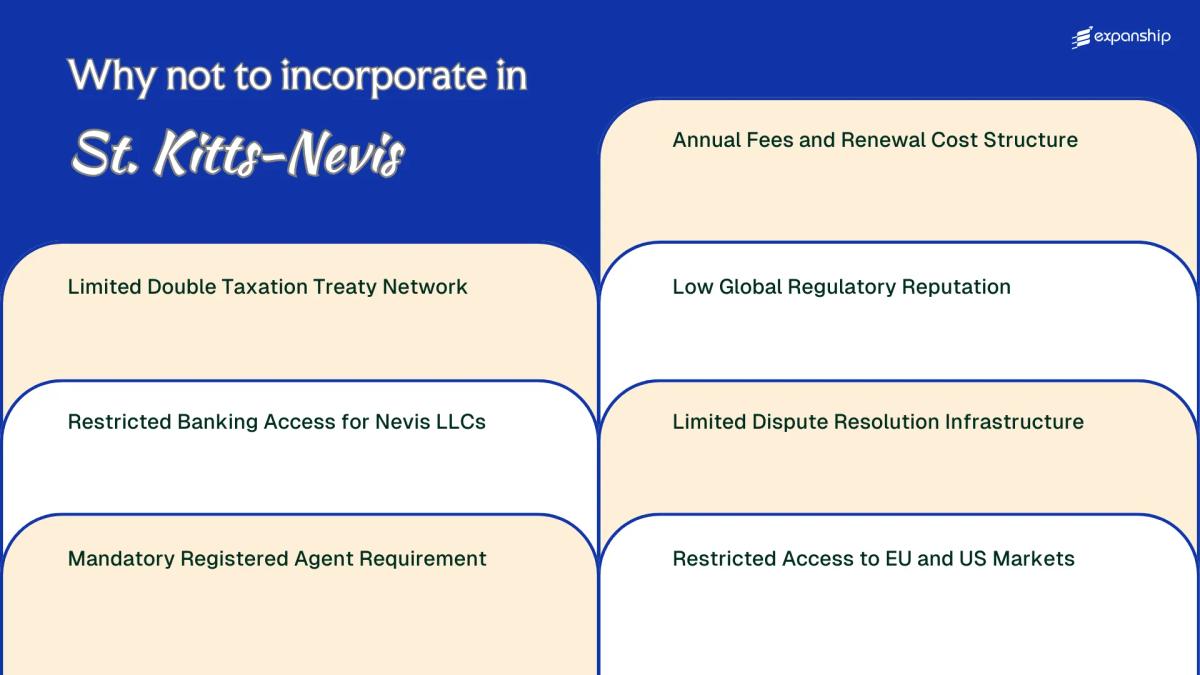
- St. Kitts and Nevis maintains no significant double taxation treaty network, meaning foreign investors cannot rely on treaty-based withholding tax reductions when repatriating income across most jurisdictions.
- Entities incorporated under the Nevis Business Corporation Ordinance or the Nevis LLC Ordinance must retain a licensed registered agent at all times, creating an ongoing compliance cost that cannot be eliminated regardless of the company's activity level.
- Correspondent banking relationships are frequently declined for Nevis LLCs due to the jurisdiction's limited regulatory standing, making routine cross-border transactions materially more difficult to execute than in treaty-compliant or FATF-whitelisted jurisdictions.
- Businesses structured through Nevis face compounding friction when seeking access to EU or US counterparties, as the jurisdiction's offshore classification triggers enhanced due diligence requirements that can delay or block commercial relationships entirely.
St. Kitts and Nevis operates under a lightly regulated offshore framework, governed primarily by the Nevis Business Corporation Ordinance and the Nevis LLC Ordinance, which grant significant structural flexibility with comparatively minimal disclosure requirements. That positioning attracts a specific profile of foreign investor — and produces a specific set of disadvantages that this article examines across regulatory, financial, and operational dimensions.
Not every drawback applies equally to all business types. A holding company, an operating entity, and a fund structure will each encounter different friction points under this framework.
This article is most relevant to foreign entrepreneurs, fund managers, and international investors who intend to use a Nevis LLC or corporation for active business operations or cross-border transactions, rather than purely domestic purposes.
Limited Double Taxation Treaty Network
St. Kitts and Nevis tax treaty limitations create a measurable gap in tax planning options for foreign business owners. The federation has signed very few formal double taxation agreements, leaving most cross-border income flows exposed to potential dual taxation.
No Treaty Coverage for Major Trading Partners
St. Kitts and Nevis has not concluded comprehensive double taxation treaties with major economies including the United States, the United Kingdom, Germany, or China. Dividends, royalties, and service fees paid from those jurisdictions to a Nevis LLC or a St. Kitts entity carry no treaty-based withholding tax reductions, meaning foreign source taxes cannot be offset against a home country liability through a bilateral mechanism.
The Caribbean Community (CARICOM) tax treaty framework does provide some relief within the regional bloc, but its practical scope is narrow for businesses operating outside the Caribbean. If your firm's revenue originates primarily from OECD-member countries, that regional coverage offers limited functional relief.
Structural Impact on Corporate Tax Planning
Without treaty protections, withholding taxes imposed by source countries apply at their full domestic rates. A business receiving royalty income from a country imposing a 30% withholding rate on non-treaty jurisdictions absorbs that cost entirely, with no mechanism to reclaim it under the Nevis double taxation agreement restrictions framework.
Your firm may face full domestic withholding rates from source countries with no bilateral offset mechanism, making St. Kitts and Nevis structurally unsuitable for treaty-dependent income structures.
Restricted Banking Access for Nevis LLCs
Nevis LLC banking access restrictions represent one of the most operationally significant drawbacks of structuring a business under the Nevis Limited Liability Company Ordinance. Many international banks treat Nevis-registered entities as high-risk by default, which directly limits where your firm can hold accounts.
Correspondent banking relationships between Caribbean offshore jurisdictions and major financial institutions have narrowed considerably since the mid-2010s. A Nevis LLC often cannot open accounts with Tier-1 banks in the US, UK, or EU without extensive documentation and compliance reviews that may still end in rejection.
Practical friction this creates for foreign business owners includes:
- Being forced to open accounts in third-party jurisdictions, adding layers of administrative cost and currency conversion exposure
- Submitting to enhanced due diligence processes that can delay account activation by weeks or months
- Facing account terminations without prior notice when a correspondent bank exits a region
- Operating with payment processors that restrict or block transactions originating from Caribbean offshore entities
Some fintech and EMI providers do serve Nevis LLCs, but these accounts carry higher fees and transaction limits that constrain business operations.
 Nevis
Nevis Company Incorporation in St. Kitts and Nevis
Set up your Nevis LLC with full guidance on structural requirements, registered agent obligations, and compliance under the Nevis LLC Ordinance.
Mandatory Registered Agent Requirement
The St. Kitts and Nevis registered agent requirement is not optional. Under the Nevis Business Corporation Ordinance and the Nevis Limited Liability Company Ordinance, every entity formed in Nevis must maintain a licensed registered agent physically located on the island at all times. This is a continuous statutory obligation, not a one-time formation step.
Your business cannot self-appoint. The registered agent must be a licensed professional or firm approved under Nevis law, which means you are permanently dependent on a third-party service provider simply to remain in good standing.
| Requirement | Detail | Burden on Foreign Owner |
|---|---|---|
| Agent appointment | Mandatory at formation and continuously thereafter | No flexibility to self-represent or appoint an internal officer |
| Agent location | Must be physically based in Nevis | Limits choice to a small pool of local licensed providers |
| Annual retention cost | Typically USD 400–900 per year depending on provider | Recurring cost with no compliance benefit to the business itself |
| Consequence of lapse | Entity may lose good standing or face administrative dissolution | Disproportionate penalty for an administrative oversight |
Under the Nevis Multiform Foundations Act, the same residency-based agent obligation applies to foundations, extending this cost across multiple entity types. The market for licensed agents on the island is small, which reduces competitive pricing pressure and gives you limited recourse if service quality is poor.
Annual Fees and Renewal Cost Structure
St. Kitts and Nevis annual renewal fee drawbacks are less visible at the incorporation stage but accumulate into a predictable annual liability your business cannot avoid. Under the Nevis Business Corporation Ordinance and the Nevis Limited Liability Company Ordinance, entities are required to pay annual government fees to maintain good standing, and these fees are non-negotiable regardless of whether the company conducted any activity during the year.
Nevis LLC ongoing maintenance cost risks extend beyond the government fee itself. Your registered agent, mandated by law, charges a separate annual retainer, and these fees vary by provider with no regulated cap.
The combined cost of government renewal fees and registered agent retainers means a dormant entity still incurs recurring expenses. For businesses that incorporated speculatively or are in a low-revenue phase, that fixed cost structure creates an ongoing financial obligation with no proportional benefit.
Failure to pay the annual fee results in the company being struck off the register. Reinstatement is possible but triggers additional fees, which compounds the original cost burden.
- Annual government renewal fees apply under the relevant Nevis ordinance regardless of trading activity
- Registered agent fees are charged separately and annually, with no statutory ceiling on rates
- Non-payment leads to administrative dissolution and reinstatement incurs extra costs
- Both obligations run concurrently, meaning two separate payments are required each year to maintain standing
A Nevis LLC can be struck off the register and lose legal standing without any court order or formal notice to its directors, solely due to an unpaid annual fee.
Low Global Regulatory Reputation
St. Kitts and Nevis low regulatory reputation risks are a real operational concern for foreign business owners, not just an abstract perception issue. Offshore credibility problems tied to the Nevis LLC structure, in particular, trigger heightened scrutiny from banks, regulators, and institutional counterparties across major markets.
Why the Reputational Signal Creates Friction
The federation has historically appeared on watchlists maintained by bodies including the OECD and the Financial Action Task Force, and while its compliance status has shifted over time, the association persists in counterparty risk assessments. Foreign firms structured through Nevis offshore entities frequently encounter automatic due diligence escalations from European and North American financial institutions, independent of the entity's actual compliance standing.
The Practical Cost of Low Credibility
FATF compliance concerns attached to Caribbean tax haven classifications mean your entity may be subject to enhanced correspondent banking reviews or outright account refusals. This perception-driven friction translates directly into delayed transactions, higher compliance costs, and reduced access to institutional services that comparable entities registered in OECD-member jurisdictions would not face. Businesses operating in regulated sectors such as financial services or fintech bear a disproportionate share of this burden.
Nevis Assessing Regulatory Exposure Before Incorporating in St. Kitts and Nevis
Understand how reputational and compliance factors tied to this jurisdiction may affect your entity's standing with banks, regulators, and institutional partners.
Limited Dispute Resolution Infrastructure
St. Kitts and Nevis dispute resolution limitations present a structural problem for foreign business owners who expect enforceable commercial remedies without significant procedural delays or jurisdictional gaps. Dispute resolution options available to Nevis LLC structures are thin compared to major offshore centers with dedicated commercial court divisions.
- The Eastern Caribbean Supreme Court handles commercial disputes for the federation, but its docket is shared across multiple OECS member states, creating a backlog that can extend proceedings well beyond timelines typical in purpose-built commercial courts.
- No dedicated commercial court division exists within the local judiciary, meaning complex cross-border disputes are processed through a general civil framework ill-suited to sophisticated corporate matters.
- St. Kitts and Nevis arbitration infrastructure lacks the institutional presence found in centers like Singapore or the BVI, forcing parties to either arbitrate abroad at higher cost or rely on contractual dispute clauses that may prove difficult to enforce locally.
- Absent bilateral enforcement treaties with major economies, foreign judgments are not automatically recognized, requiring fresh legal proceedings in the originating jurisdiction at additional expense.
Restricted Access to EU and US Markets
St. Kitts and Nevis EU US market access restrictions are a concrete operational problem, not an abstract compliance concern. Offshore entities incorporated under the Nevis Business Corporation Ordinance or the Nevis Limited Liability Company Ordinance carry a jurisdictional profile that triggers heightened scrutiny from EU and US counterparties.
Under the EU's framework for non-cooperative jurisdictions, Caribbean offshore structures face automatic enhanced due diligence requirements from EU-regulated financial institutions and business partners. Your Nevis company may be technically permitted to transact, but EU banks and payment processors routinely decline or delay onboarding for entities from jurisdictions on or adjacent to grey-listed territories.
US market access carries similar friction. FINCEN's beneficial ownership reporting requirements and correspondent banking restrictions mean US banks apply stringent Know Your Customer filters to Caribbean offshore entities, frequently resulting in account refusals.
- EU-regulated platforms may refuse merchant accounts for Nevis-registered firms
- US payment processors often classify Caribbean offshore entities as high-risk by default
- Cross-border trading limitations extend to trade finance, with letters of credit harder to obtain through major US and EU banks
A Nevis LLC seeking to open a USD-denominated merchant account with a US acquiring bank for e-commerce operations would typically face a high-risk surcharge of 2.5% to 3.5% per transaction, compared to 0.3% to 1.5% for entities incorporated in US or EU jurisdictions, representing a direct and recurring operating cost increase on gross revenue.
Overcoming Incorporation Challenges in St. Kitts and Nevis
Overcoming St. Kitts and Nevis incorporation challenges requires structural planning rather than reactive fixes. The disadvantages covered in this blog each have addressable counterparts, though none of them disappear simply through entity selection.
- Pair your Nevis LLC with a bank account in a jurisdiction that maintains correspondent banking relationships with established international networks, reducing the account access friction documented under the Financial Services Regulatory Commission's oversight framework.
- Register under the Nevis LLC Ordinance to confirm your entity type before engaging with any tax reporting obligations, since treaty limitations affect LLCs and IBCs differently.
- Appoint a licensed registered agent as required under the Nevis Limited Liability Company Ordinance 1995 to maintain good standing and satisfy annual renewal requirements.
- Structure dispute resolution clauses in your operating agreement to reference a recognised international arbitration body, given the limited local judicial infrastructure.
- Monitor EU and US beneficial ownership disclosure requirements independently, as compliance obligations in those markets apply regardless of Nevis registration status.
These steps operate within a regulatory environment shaped by the Financial Services Regulatory Commission and ongoing OECD compliance pressures. Structural decisions made at formation carry consequences that span multiple jurisdictions, not just the federation itself.
St. Kitts and Nevis Still Worth Considering
The disadvantages covered in this blog are real and measurable. St. Kitts and Nevis incorporation still worth it as a question depends entirely on whether your business can work within those constraints, particularly the limited banking access, absence of a broad tax treaty network, and the reputational friction that comes with many offshore-registered entities.
| Pros | Cons |
|---|---|
| No corporate income tax on foreign-sourced income under the Nevis Business Corporation Ordinance | No meaningful double taxation treaty network, creating potential for double taxation on cross-border income |
| Strong statutory asset protection provisions under Nevis LLC legislation | Correspondent banking restrictions make opening and maintaining accounts difficult for many Nevis-registered entities |
| No public disclosure of beneficial ownership under current local rules | Ongoing registered agent fees add a fixed annual cost regardless of business activity |
| Relatively low government incorporation and renewal fees | Perceived low regulatory standing increases due diligence burdens with foreign counterparties |
| Offshore structures can be formed quickly under existing ordinances | Limited local judicial infrastructure means complex disputes often require resolution outside the federation |
Credibility with EU and US counterparties remains a persistent challenge for entities registered here. That friction does not disappear through structuring alone.
Nevis Compliance Services for Companies in St. Kitts and Nevis
Maintain good standing for your Nevis LLC or St. Kitts entity with ongoing compliance support, including registered agent coordination, annual renewal filings, and regulatory monitoring.
Conclusion
St. Kitts and Nevis occupies a specific position in the offshore market: a low-tax jurisdiction with asset protection statutes under the Nevis Limited Liability Company Ordinance, but one carrying structural limitations that affect operational reach. The St. Kitts and Nevis company formation cons summary points consistently to two areas: restricted banking access for Nevis LLCs and the absence of substantive double taxation agreements. Both constraints affect how your entity functions beyond the federation's borders. Addressing these limitations requires deliberate structuring, and professional guidance informed by current regulatory practice reduces the margin for costly compliance errors.
Expanship's St. Kitts and Nevis Incorporation Services
Expanship's St. Kitts and Nevis incorporation services are designed to reduce the operational burden that comes with meeting the specific compliance obligations outlined throughout this blog — from satisfying the Nevis Island Administration's registered agent requirements under the Nevis Business Corporation Ordinance to managing annual renewal filings and maintaining good standing across ongoing regulatory obligations.
Our service scope covers the practical side of incorporating and maintaining a Nevis LLC or federal company.
- We prepare and file all registration documents with the relevant authority on your behalf.
- A qualified registered agent and local office address are provided to meet mandatory statutory requirements.
- We handle government filings and liaise with regulatory bodies directly.
- Post-incorporation compliance management keeps your entity in good standing year to year.
- Banking introduction assistance is available to help your business work through access constraints.
- Tax registration and coordination with local authorities is included where applicable.
Contact Expanship St. Kitts and Nevis to discuss your incorporation requirements.
Frequently Asked Questions (FAQ)
The reputational pressure from international bodies like the OECD applies across entity types registered in the federation, including Nevis LLCs formed under the Nevis Limited Liability Company Ordinance and International Business Companies incorporated under federal legislation. No exemption exists for entities that are genuinely active businesses rather than holding structures. The classification affects how correspondent banks, payment processors, and foreign counterparties assess your entity's risk profile.
Failure to maintain a registered agent puts the LLC in breach of the Nevis Limited Liability Company Ordinance, which can result in the entity losing its good standing or being struck off the register. Reinstatement requires additional fees and administrative steps through the Nevis Island Administration. The gap in good standing can also invalidate certificates of incumbency and other corporate documents you may need for banking or contracts.
Annual government fees for a Nevis LLC renewal are set by the Nevis Island Administration and have historically ranged from several hundred US dollars, but when combined with mandatory registered agent fees and any compliance or accounting obligations, the total recurring cost is typically between USD 1,000 and USD 2,500 per year. These figures do not include costs associated with substance requirements or foreign account reporting obligations your home country may impose on you as a beneficial owner. The cost structure is not prohibitive on its own but becomes significant when weighed against the jurisdictional limitations.
St. Kitts and Nevis faces comparable or greater market access restrictions than most other offshore jurisdictions when dealing with EU and US counterparties, largely because it lacks bilateral investment treaties and a meaningful tax treaty network with either bloc. A company incorporated in, for example, Cyprus or Malta benefits from EU passporting and treaty protections that are simply unavailable to a Nevis entity. For businesses that need active trading relationships or regulated financial activity in either market, this is a structural limitation rather than an administrative inconvenience.
The federation's dispute resolution infrastructure is limited for complex cross-border commercial matters. While the Eastern Caribbean Supreme Court has jurisdiction over cases in St. Kitts and Nevis, there is no dedicated international commercial court or arbitration center within the jurisdiction. Parties typically need to rely on foreign arbitration clauses or pursue litigation abroad, which adds cost and procedural complexity that would not arise in jurisdictions with established commercial arbitration frameworks.
The Nevis Limited Liability Company Ordinance provides for administrative penalties and loss of good standing when an LLC fails to meet its annual obligations, including payment of government fees and maintenance of a registered agent. An entity struck off the register loses its legal protections, including the asset protection provisions that are often the primary reason businesses choose Nevis. Restoration to the register is possible but requires settlement of outstanding fees plus reinstatement charges determined by the Nevis Island Administration.
St. Kitts and Nevis has a very limited tax treaty network, and no comprehensive income tax treaty with major economies such as the United States, Germany, the United Kingdom, or China. This means withholding taxes on dividends, interest, or royalties flowing into a Nevis LLC from those countries are governed solely by domestic source-country rules, often at the maximum statutory rate. Businesses that depend on treaty-reduced rates to make their ownership structure tax-efficient will find Nevis unsuitable for that purpose.
Legal Disclaimer
The information provided in this article is for general informational purposes only and does not constitute legal, tax, or professional advice. While we strive to ensure the accuracy and timeliness of the content, laws and regulations are subject to change, and the application of laws can vary widely based on specific facts and circumstances.
Readers should not act upon this information without seeking professional counsel tailored to their individual situation. Expanship and its authors disclaim any liability for actions taken or not taken based on the content of this article.
For specific advice regarding your business setup, compliance requirements, or any legal matters, please consult with qualified legal and tax professionals in the relevant jurisdiction.