
Key Takeaways
- Foreign-sourced income falls entirely outside St. Kitts and Nevis's domestic tax net under the federation's territorial tax system, meaning internationally focused companies carry no local corporate tax exposure on revenue generated abroad.
- The Nevis LLC Act provides a statutory asset protection framework that places meaningful legal barriers between a company's assets and external creditors, making it one of the more defensible structures available in the offshore Caribbean.
- Companies incorporated under the Nevis Business Corporation Ordinance face no mandatory annual financial reporting requirements, which reduces the administrative burden on non-resident founders managing cross-border operations.
- Because neither capital gains nor inheritance tax applies in St. Kitts and Nevis, business owners can transfer or liquidate offshore holdings without triggering the tax events that would arise in many onshore jurisdictions.
St. Kitts and Nevis is a two-island federation in the Eastern Caribbean, operating as a fully independent nation within the Commonwealth since 1983. Company registration falls under the oversight of the Registrar of Companies, the authority responsible for incorporating entities under both federal and Nevisian legislation. Foreign businesses most commonly use the Nevis LLC when structuring operations through this federation.
The benefits of incorporating in St. Kitts and Nevis draw particular interest from founders and business owners seeking a territorial tax posture — where only locally sourced income falls within the domestic tax net. Foreign ownership faces no statutory restrictions, and the government maintains an open position toward foreign direct investment across most sectors.
Structuring a business here does not require local shareholders or directors in many cases, which gives non-resident founders a degree of operational flexibility from the outset. This article examines the key advantages that make St. Kitts and Nevis company formation a practical option for internationally focused businesses.
Zero Corporate Tax on Foreign-Sourced Income
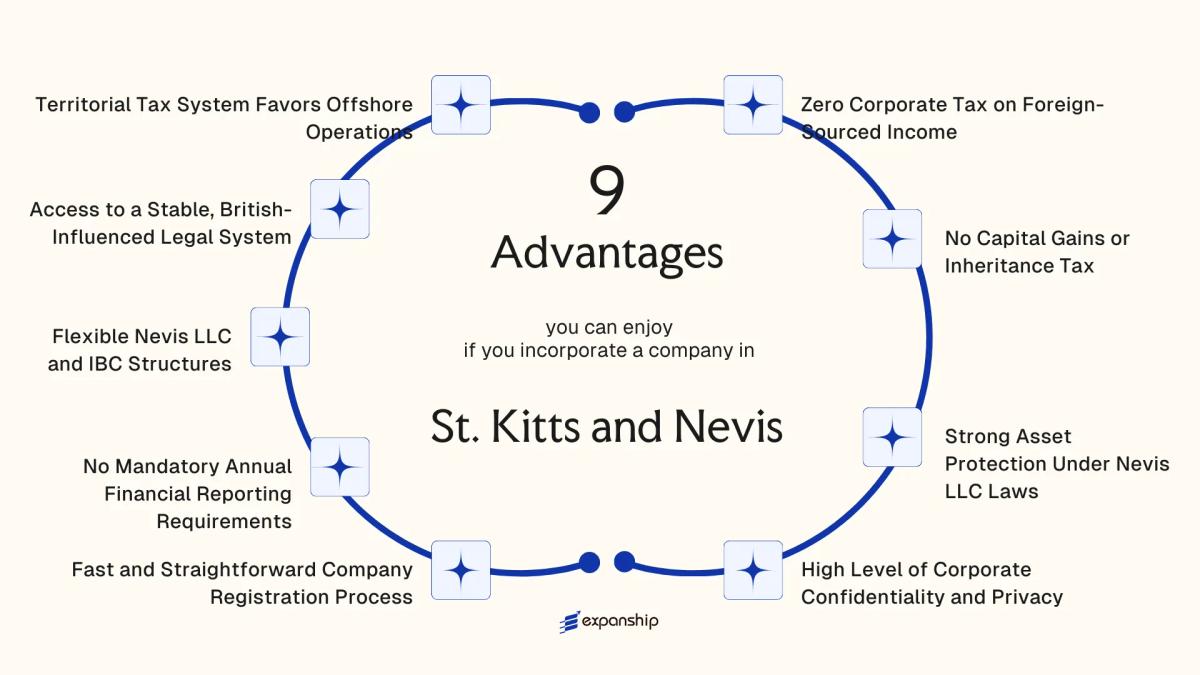
St. Kitts and Nevis zero tax on foreign income is the defining fiscal feature of the jurisdiction's offshore framework. Foreign-sourced income earned by an IBC or Nevis LLC is not subject to corporate tax at the federal level.
How the Exemption Is Structured
Under the Nevis Business Corporation Ordinance and the Nevis Limited Liability Company Ordinance, entities incorporated in Nevis are explicitly exempt from local taxation on income generated outside the federation. This means your company's profits from foreign clients, international transactions, or cross-border investments remain untouched by local tax authorities.
What This Means in Practice
The Nevis IBC foreign income tax exemption applies as long as the business does not conduct commercial activity within the domestic market. For foreign entrepreneurs routing international revenue through a Nevis structure, this creates a material cost advantage compared to onshore jurisdictions where corporate tax rates commonly range from 20% to 30%.
Income your company earns from outside the federation is not subject to corporate tax under Nevis law, preserving the full margin on cross-border revenue.
No Capital Gains or Inheritance Tax
Neither capital gains tax nor inheritance tax applies to companies and individuals within this federation. For foreign business owners, the absence of no capital gains tax in St. Kitts and Nevis means that profits realized from the sale of shares, property held through a corporate structure, or investment assets are not subject to a separate levy at the point of disposal. That distinction is material when structuring exits, portfolio rebalancing, or asset transfers across ownership cycles.
The inheritance tax exemption carries equal significance for estate and succession planning. Wealth accumulated within a Nevis IBC or LLC can pass between generations without triggering a tax event at the federal level, which makes these structures practical vehicles for long-term family asset holding.
Practically, the Nevis IBC capital gains tax advantages extend to:
- Proceeds from disposing of shares in a Nevis IBC are not assessed at the federal level, removing a common friction point in corporate restructuring
- No stepped-up valuation or inheritance tax calculation is required when transferring ownership interests, which reduces administrative cost
- Asset appreciation within the structure is retained in full, rather than partially eroded at exit
These rules are grounded in the Nevis Business Corporation Ordinance and the Nevis Limited Liability Company Ordinance, both of which govern offshore entity structures. The St. Kitts and Nevis tax-free wealth transfer benefits apply to foreign-sourced assets held offshore, so income arising domestically or activities conducted within the federation fall outside this framework.
 Nevis
Nevis Company Incorporation in St. Kitts and Nevis
Establish a Nevis IBC or LLC with no capital gains or inheritance tax obligations on foreign-sourced income and offshore asset transfers.
Strong Asset Protection Under Nevis LLC Laws
Nevis LLC asset protection advantages are among the most technically specific in the Caribbean, grounded in the Nevis Limited Liability Company Ordinance of 1995 as amended. Under this legislation, a creditor who obtains a judgment against an LLC member cannot seize that member's interest in the company directly. The only remedy available to such a creditor is a charging order, meaning they may be entitled to receive distributions if and when the LLC chooses to make them. Since the LLC is not obligated to distribute profits, a charging order often produces no recovery in practice.
| Feature | Detail |
|---|---|
| Governing legislation | Nevis Limited Liability Company Ordinance, 1995 (as amended) |
| Creditor remedy available | Charging order only |
| Statute of limitations on fraudulent transfer claims | Generally 2 years |
| Required bond for foreign plaintiffs filing suit | Typically required before proceedings commence |
| Manager/member liability | Limited to agreed contribution |
Foreign plaintiffs seeking to challenge transfers into a Nevis LLC must post a substantial bond before local courts will hear the case, which raises the effective cost of litigation against the structure. Combined with a short statute of limitations on fraudulent conveyance claims, this creates a procedural environment where pursuing assets held inside a properly structured LLC is genuinely difficult. For foreign investors holding business assets, intellectual property, or investment capital, this means that a Nevis LLC can function as a holding structure where personal exposure to third-party claims is structurally contained.
High Level of Corporate Confidentiality and Privacy
St. Kitts and Nevis corporate confidentiality benefits are grounded in statute, not just policy. Under the Nevis Business Corporation Ordinance and the Nevis Limited Liability Company Ordinance, neither shareholder names nor member details are filed with any public registry. This means your ownership structure remains outside the reach of public searches by default.
For a Nevis IBC, director and officer information is not recorded in publicly accessible registers. The registered agent holds this information domestically, but disclosure to third parties requires a formal legal process initiated within the Nevis jurisdiction. Foreign court orders are not automatically enforceable — a claimant must re-litigate the matter locally, which creates a meaningful procedural barrier against opportunistic disclosure demands.
Nevis LLC member confidentiality operates under a similar framework. The operating agreement, which typically names members and their economic interests, is a private document and does not form part of any public filing.
Keep these points in mind:
- Nominee shareholders or directors are permissible and do not compromise the legal standing of the entity
- Beneficial ownership information may be shared with local authorities under anti-money laundering obligations
- Confidentiality protections apply to lawfully structured entities; they do not shield fraudulent arrangements
- Your registered agent is the gatekeeper for official communications and disclosure requests
Foreign judgments against a Nevis LLC cannot be directly enforced on the island — creditors must file a new case under Nevis law, starting the clock on a strict statute of limitations.
Fast and Straightforward Company Registration Process
One of the practical St. Kitts and Nevis fast company registration benefits is the speed at which a foreign owner can establish a legal entity without needing to be physically present. Under the Nevis Business Corporation Ordinance and the Nevis Limited Liability Company Ordinance, formation is handled entirely through a licensed registered agent based on the island, eliminating the need for in-person appearances or notarized foreign documents in most cases.
Formation Timelines That Affect Operational Decisions
A Nevis IBC or LLC can typically be incorporated within 24 to 48 hours once the registered agent submits the required documentation to the Nevis Island Administration. For businesses that need to open accounts, execute contracts, or meet investor timelines, this speed directly reduces the gap between the decision to incorporate and the ability to operate.
Contrast this with jurisdictions that require multi-week processing, government publication periods, or mandatory director inspections. The administrative burden on your business is substantially lower from day one.
What Drives the Process Efficiency
The registered agent system centralizes compliance obligations, meaning you do not interact directly with the government registry yourself. Your agent files the Articles of Organization or Articles of Incorporation, pays the statutory fees, and delivers the certificate of formation to you.
No government-mandated waiting periods or publication requirements apply to Nevis offshore company setup under standard conditions, which means the structure is legally valid and usable almost immediately after formation is confirmed.
Nevis Get Your Nevis Entity Incorporated Without Delay
Speak with an Expanship specialist about registering your Nevis LLC or IBC efficiently and in full compliance with local requirements.
No Mandatory Annual Financial Reporting Requirements
Neither Nevis IBCs nor Nevis LLCs are required to file annual financial statements, submit audited accounts, or report income figures to any local regulatory authority. This absence of a mandatory reporting obligation is built into the governing legislation — the Nevis Business Corporation Ordinance for IBCs and the Nevis Limited Liability Company Ordinance for LLCs.
- Your firm is not required to prepare audited financial statements for submission to a government body, which eliminates the cost of mandatory external audits that many comparable jurisdictions impose.
- No annual return of financial data is filed with the Nevis Financial Services Regulation and Supervision Department, meaning your income figures, asset values, and profit margins remain outside any public or regulatory disclosure framework.
- Internal records must still be maintained to satisfy the registered agent and satisfy general legal standards, but there is no prescribed format, no filing deadline, and no penalty structure tied to financial reporting cycles.
- For a foreign business owner managing multiple entities across jurisdictions, the Nevis LLC audit exemption removes a recurring administrative burden that would otherwise require local accountants, translators, and compliance calendars.
- This structure is particularly relevant where the operating company sits in a higher-reporting jurisdiction but the holding entity is registered in Nevis — the holding layer carries no independent reporting obligation of its own.
Flexible Nevis LLC and IBC Structures
The Nevis LLC and IBC flexible structure advantages are largely statutory in origin. The Nevis Limited Liability Company Ordinance of 1995 (amended in 2017) permits single-member formation, allows members and managers to be of any nationality, and imposes no requirement for local directors or shareholders. Your business can be structured entirely by non-residents without triggering additional compliance burdens.
International Business Companies incorporated under the St. Kitts and Nevis IBC Act offer comparable flexibility. An IBC can issue multiple classes of shares, operate without a minimum capital requirement, and hold assets across jurisdictions. This structural range means the entity can be tailored to holding, trading, or service functions without restructuring costs.
For the Nevis LLC specifically, the operating agreement governs internal affairs almost entirely. There is no statutory requirement to file that agreement publicly, which means ownership arrangements, profit-sharing mechanics, and management authority remain private by contract rather than by exemption.
Hypothetical scenario: A foreign investor establishes a Nevis LLC with two foreign members and no local director requirement. Compared to a UK LLP, which requires at least two designated members and public filing of a partnership agreement, the Nevis structure eliminates both the residency constraint and the disclosure obligation from day one.
Access to a Stable, British-Influenced Legal System
St. Kitts and Nevis British legal system advantages stem from the federation's constitutional foundation in English common law, which has governed the territory since the colonial period and remains the basis for commercial and civil jurisprudence today. For a foreign business owner, this means contractual disputes, property rights, and corporate obligations are adjudicated under a legal tradition that is well-documented, internationally recognized, and predictable in its application.
Nevis operates under the Nevis Business Corporation Ordinance and the Nevis Limited Liability Company Ordinance, both of which draw directly from common law principles. Courts interpret these statutes using precedent-based reasoning, so legal outcomes for your entity are less subject to discretionary or politically influenced rulings than in civil law jurisdictions without equivalent judicial independence structures.
Appeals from the Eastern Caribbean Supreme Court, which serves as the primary judicial body for the federation, can be escalated to the Caribbean Court of Justice or, in certain cases, to the Privy Council in London. That connection to the Privy Council gives foreign investors access to one of the most authoritative appellate bodies in common law jurisdictions worldwide.
Privy Council access depends on the nature of the case and procedural eligibility under Eastern Caribbean Supreme Court rules; it is not automatically available for all commercial disputes.
Territorial Tax System Favors Offshore Operations
St. Kitts and Nevis territorial tax system benefits are rooted in a straightforward legal principle: only income generated within the federation is subject to local taxation. Foreign-sourced income falls entirely outside the scope of domestic tax law, which means a Nevis IBC or LLC conducting business exclusively outside the federation owes no corporate income tax to the local revenue authority.
How Territorial Scope Is Defined
Under Nevis offshore territorial taxation rules, the determining factor is where income originates, not where the company is registered. A Nevis-registered entity receiving fees, dividends, royalties, or trading income from foreign clients or foreign transactions has no domestic tax liability on those earnings. This is a structural feature of the tax code, not a discretionary exemption or incentive program requiring application or approval.
Practical Implications for Foreign Operators
For a foreign investor running an international holding company, a service firm, or an e-commerce operation through a Nevis entity, the tax position is predictable from the outset. There are no thresholds to monitor, no percentage rates that shift based on income levels, and no annual tax filings required for qualifying offshore income.
- Income from foreign consulting contracts is outside local tax scope
- Royalties received from non-resident licensees are not taxable locally
- Dividends distributed from foreign subsidiaries to a Nevis holding entity are not subject to local corporate tax
- Capital deployed in foreign investments is not assessed under domestic income tax rules
Why St. Kitts and Nevis Stands Out Among Offshore Jurisdictions
Comparing this federation against its most relevant competitors reveals a consistent pattern: the combination of statutory asset protection under the Nevis Limited Liability Company Ordinance and a territorial tax framework places it alongside, and in several respects ahead of, other Caribbean incorporation centres that target the same foreign investor profile. The jurisdictions selected for comparison — Belize, the British Virgin Islands, and Panama — are the ones a business owner evaluating St. Kitts and Nevis would most likely also be weighing, given their overlapping positioning as low-tax, privacy-oriented offshore centres.
What the table below surfaces is not simply a list of rates. It reflects how structural differences in charging regimes, reporting obligations, and creditor-access rules translate into different risk and cost profiles over time. St. Kitts and Nevis advantages over other offshore jurisdictions become most apparent in the asset protection column, where the statutory charging order restriction under Nevis law limits a creditor's remedy to economic distributions rather than ownership interference — a protection not replicated at the same statutory level in all competing centres.
| Parameter | St. Kitts and Nevis | Belize | British Virgin Islands | Panama |
|---|---|---|---|---|
| Corporate Tax on Foreign Income | 0% | 0% | 0% | 0% |
| Annual Financial Reporting | Not required for IBCs/LLCs | Not required | Required for most entities | Not required |
| Statutory Asset Protection | Strong — charging order only remedy under Nevis LLC Ordinance | Moderate | Moderate | Moderate |
| Minimum Government Annual Fee | Low fixed fee | Low fixed fee | Moderate — scales with share capital | Low fixed fee |
| Legal System Basis | English common law | English common law | English common law | Civil law (Napoleonic) |
| Nominee Shareholders Permitted | Yes | Yes | Yes | Yes |
| Public Register of Beneficial Owners | No | No | Partially — accessible to competent authorities | No |
Nevis Compliance Services for Companies in St. Kitts and Nevis
Maintain your entity's good standing with ongoing compliance support tailored to Nevis LLC and IBC structures, including registered agent requirements and statutory filings.
Conclusion
St. Kitts and Nevis makes a coherent case for foreign business owners who want a jurisdiction where the tax treatment, legal structure, and privacy framework all point in the same direction. The territorial tax system means foreign-sourced income falls entirely outside the corporation's local tax exposure, while the Nevis LLC structure provides a distinct layer of asset protection that few comparable jurisdictions match in statutory terms.
Those two features alone address the two concerns most commonly raised by international business owners: how income is taxed and how assets are shielded from external claims. The benefits of incorporating in St. Kitts and Nevis are most pronounced for companies that generate revenue outside the federation and have no intention of conducting domestic trade.
The right fit depends on your specific business model, the jurisdictions where your clients or counterparties are based, and the legal requirements of your home country. Not every offshore structure produces the same outcome for every business. Understanding how the Nevis Business Corporation Ordinance or the LLC Act applies to your situation is what determines whether this jurisdiction delivers the expected outcome. The next step is confirming that the structure you choose aligns with your operational and compliance obligations before registration proceeds.
Start Your St. Kitts and Nevis Incorporation With Expanship Today
Expanship provides formation and ongoing compliance services for Nevis LLCs and IBCs, the two principal offshore structures established under the Nevis Limited Liability Company Ordinance and the St. Kitts and Nevis International Business Companies Act respectively. Each engagement covers the full administrative cycle, from initial registration with the Nevis Island Administration through to annual renewal filings. Expanship's team liaises directly with local registered agents and the relevant government registrar on your behalf.
Services available through Expanship St. Kitts and Nevis cover the following:
- Preparation and notarization of incorporation documents, including Articles of Organization or Memorandum and Articles of Association
- Provision of a licensed registered agent and registered office address in Nevis, as required by statute
- Filing coordination with the Nevis Island Administration or the St. Kitts Financial Services Regulatory Commission
- Post-incorporation compliance management, including annual renewal tracking and statutory record maintenance
- Document legalization and apostille facilitation where required for cross-border use
- Introduction to banking institutions that accept offshore corporate applicants from this jurisdiction
Frequently Asked Questions (FAQ)
Foreign-sourced income earned by a Nevis LLC or IBC is subject to a zero percent corporate tax rate under the territorial tax system applied to these offshore structures. This exemption covers profits, dividends, and interest derived from business conducted outside the federation. Income generated domestically, however, falls outside this exemption and would be subject to local tax obligations.
Under the Nevis Limited Liability Company Ordinance, a creditor holding a foreign judgment cannot directly seize the assets of a Nevis LLC. The creditor's remedy is generally limited to obtaining a charging order against the debtor's membership interest, which does not grant voting rights or management control. This statutory restriction makes it structurally difficult for a foreign claimant to dissolve or liquidate the company to satisfy a judgment.
No mandatory annual financial reporting requirement applies to IBCs incorporated under the federal framework governing international business companies in the federation. There is no statutory obligation to file audited accounts with a government body or make financial records publicly available. Internal accounting records must be maintained, but the form and location of those records are generally left to the company's discretion.
Incorporation under the Nevis Limited Liability Company Ordinance can generally be completed within one to three business days once all required documentation is submitted to the Nevis Island Administration. The process involves filing articles of organization and paying the prescribed registration fee. Actual timelines may vary depending on the registered agent's processing capacity and whether any additional due diligence is required.
Yes, the federation operates under a common law system inherited from British legal tradition, with final appellate jurisdiction vested in the Caribbean Court of Justice or, in some cases, the Privy Council in London. This framework means that contract principles, fiduciary duties, and corporate governance concepts follow established common law doctrine, which is familiar to legal counsel in the United Kingdom, Canada, Australia, and other common law jurisdictions. Cross-border enforceability of contracts is generally more predictable under a recognized legal tradition than under untested civil law regimes.
Member and manager details of a Nevis LLC are not filed in any public register, meaning ownership information is not accessible through a standard public records search. The Nevis Limited Liability Company Ordinance does not require the disclosure of beneficial ownership in publicly available filings. Disclosure obligations may arise under specific circumstances such as a court order or compliance with international information exchange agreements to which the federation is a party.
Legal Disclaimer
The information provided in this article is for general informational purposes only and does not constitute legal, tax, or professional advice. While we strive to ensure the accuracy and timeliness of the content, laws and regulations are subject to change, and the application of laws can vary widely based on specific facts and circumstances.
Readers should not act upon this information without seeking professional counsel tailored to their individual situation. Expanship and its authors disclaim any liability for actions taken or not taken based on the content of this article.
For specific advice regarding your business setup, compliance requirements, or any legal matters, please consult with qualified legal and tax professionals in the relevant jurisdiction.