

Key Takeaways
- Belize IBCs incorporated under the International Business Companies Act are structurally barred from conducting business with Belizean residents or owning local real estate, making the vehicle unsuitable for any business model with a domestic commercial dimension.
- Because Belize maintains a very limited network of double tax treaties, companies routing income through a Belize IBC receive no treaty-based withholding tax relief in most counterparty jurisdictions, increasing the overall tax cost of cross-border transactions.
- The absence of a publicly accessible corporate registry means that institutional counterparties, banks, and regulated clients must rely on notarized certificates and registered agent confirmations to verify ownership, adding friction and delay to standard due diligence processes.
- Belize's repeated exposure to FATF and OECD grey-listing reviews places any entity incorporated there under heightened correspondent banking scrutiny, frequently resulting in account refusals or de-risking decisions by international financial institutions regardless of the individual company's compliance posture.
Belize operates under a lightly regulated offshore framework, governed primarily by the International Business Companies Act — legislation designed to attract foreign capital rather than mirror the compliance standards of onshore financial centres.
The disadvantages of incorporating in Belize span several categories, from banking access to international regulatory exposure, each addressed separately in the sections that follow.
Not every drawback applies equally to all business models. A holding company with no active operations faces different risks than a trading entity seeking institutional banking relationships or contracts with regulated counterparties.
This article is most relevant to foreign investors and entrepreneurs who intend to use a Belize IBC for cross-border transactions, client-facing commercial activity, or structures requiring third-party due diligence acceptance.
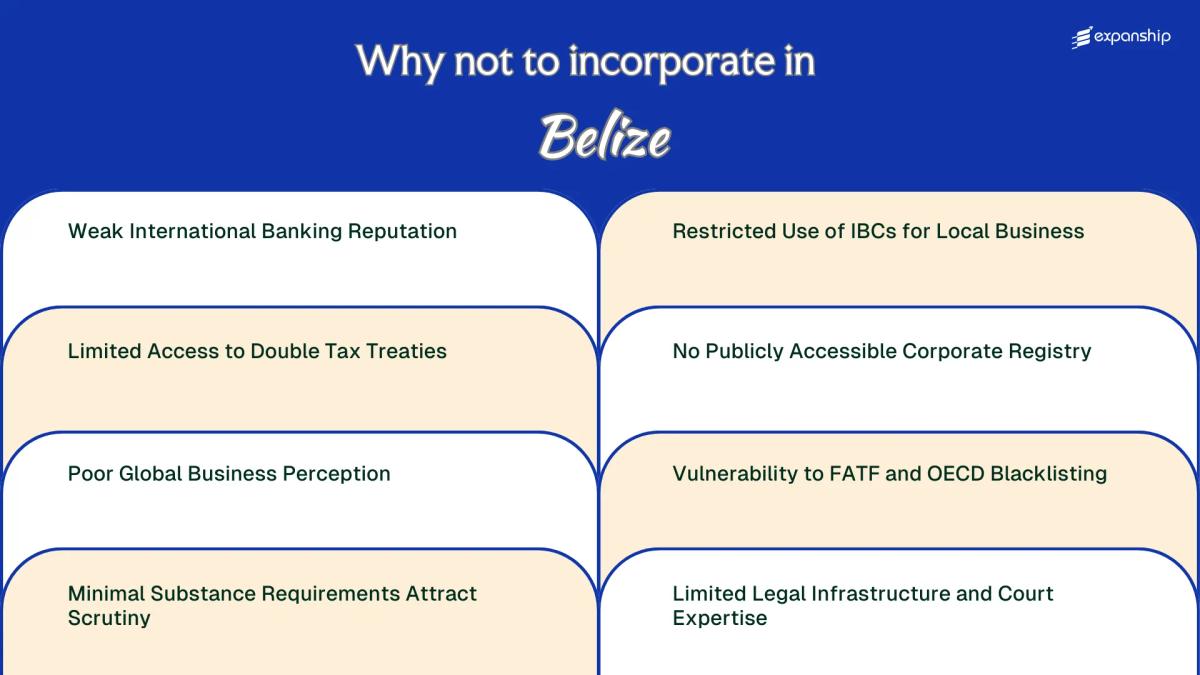
Weak International Banking Reputation
Belize offshore banking problems are among the most practical obstacles you will face after incorporation. The jurisdiction's long-standing reputation as a low-regulation offshore centre has made correspondent banks in the US, UK, and EU deeply reluctant to process transactions linked to Belizean IBCs.
Restricted Access to Reputable Banking Institutions
Many tier-one banks apply blanket de-risking policies toward entities registered under the International Business Companies Act, regardless of the company's actual activity or ownership. Opening a business account with a credible institution in Europe or North America becomes substantially harder when your firm holds a Belize registration address.
Opening bank account Belize company difficulties often force owners into second-tier or offshore-only banks with higher fees, lower transfer limits, and weaker international clearing networks.
Correspondent Banking Exposure
Belize IBC banking restrictions are not codified as formal prohibitions but arise from how foreign compliance officers assess the jurisdiction's risk profile. Your business pays for that perception through delayed transactions, enhanced due diligence requests, and account refusals.
Even if your Belize IBC is fully compliant with local regulations, foreign banks may refuse to open or maintain accounts based solely on the jurisdiction of incorporation.
Limited Access to Double Tax Treaties
Belize tax treaty limitations are among the most structurally significant drawbacks for foreign businesses using an International Business Company. The country has signed very few tax treaties with other nations, meaning most IBCs cannot access reduced withholding tax rates on dividends, royalties, or interest payments flowing between jurisdictions.
Without treaty protection, your business bears the full domestic withholding tax burden in counterparty countries. This creates a direct cost disadvantage against competitors incorporated in treaty-network jurisdictions like Singapore or the Netherlands.
That exposure translates into concrete operational friction:
- Receiving dividends from foreign subsidiaries without treaty relief means higher gross tax deductions, reducing actual returns.
- Royalty payments routed through a Belize entity face full source-country withholding, making IP holding structures commercially inefficient.
- Banking counterparts and foreign tax authorities may question treaty eligibility claims, triggering additional compliance filings.
- Cross-border service contracts become harder to price competitively when withholding costs cannot be mitigated through treaty provisions.
The International Business Companies Act does not itself confer treaty access. Treaty benefits depend entirely on bilateral agreements, which Belize has pursued minimally.
 Belize
 Company Incorporation in Belize
Understand the full regulatory picture before incorporating a Belize IBC, including tax exposure and compliance obligations.
Poor Global Business Perception
Belize offshore company reputation risks are not theoretical. Correspondent banks, institutional investors, and foreign procurement offices routinely flag Belizean IBCs as high-risk counterparties, often before any due diligence has been conducted on your specific entity.
The reputational burden stems directly from how the International Business Companies Act has historically been applied. Low formation costs, bearer share instruments (now restricted but not forgotten), and minimal disclosure requirements built a structural association with tax avoidance and opacity that persists in compliance databases worldwide.
| Trigger | Practical Consequence | Affected Party |
|---|---|---|
| Jurisdiction flagged in bank risk matrices | Account opening declined without review | IBC owner |
| No public beneficial ownership registry | KYC escalation to enhanced due diligence tier | All counterparties |
| Historic bearer share permissibility | Automatic high-risk classification in EU/UK compliance systems | IBC engaging European partners |
| OECD harmful tax practices history | Contractual exclusion from some institutional procurement processes | Service firms, consultancies |
Perception risks tied to Belize incorporation credibility problems extend beyond banking. Corporate partners in regulated industries, including financial services, pharmaceuticals, and defence contracting, may contractually prohibit engaging entities registered in jurisdictions classified as tax havens under their internal policies.
The Belize tax haven stigma also affects your firm's ability to raise capital from institutional sources. Venture funds and private equity vehicles operating under EU or US fund mandates frequently exclude entities domiciled in jurisdictions without adequate exchange of information agreements.
Minimal Substance Requirements Attract Scrutiny
Belize substance requirements scrutiny is a growing concern that directly affects how foreign-owned IBCs are perceived by overseas banks, tax authorities, and compliance officers.
Under the International Business Companies Act, IBCs face minimal mandatory operational requirements. There is no statutory obligation to maintain a physical office, hire local employees, or demonstrate genuine economic activity within the country. That absence of substance triggers automatic red flags when foreign regulators assess whether your entity has real commercial purpose.
The OECD's base erosion and profit shifting framework, alongside the EU's code of conduct criteria, treats low-substance offshore structures as high-risk. An IBC with no employees, no local expenditure, and no management decisions made in-country may be reclassified by your home jurisdiction's tax authority as a controlled foreign corporation or a tax-avoidance vehicle.
This reclassification carries direct financial consequences. It can expose your business to additional tax assessments, penalties, and mandatory disclosure requirements in your country of residence.
- No minimum local staffing or payroll requirement exists under the IBC Act, which foreign tax authorities use as grounds to deny entity recognition.
- Management and control tests applied by OECD member states may override the IBC's registered status entirely.
- Beneficial ownership reporting obligations exist under Belize's domestic framework, but substance documentation is not formally verified at incorporation.
- Lack of demonstrable substance can void treaty protections or tax exemption claims made in third jurisdictions.
Despite having no formal economic substance law equivalent to those enacted in the Cayman Islands or BVI, Belize IBCs are still subject to scrutiny under foreign substance tests applied by EU and OECD member states where their owners are tax residents.
Restricted Use of IBCs for Local Business
Belize IBC local business restrictions exist because the International Business Companies Act explicitly prohibits IBCs from conducting business with Belizean residents or owning real property within the country.
The Statutory Prohibition and Its Scope
Under the IBC Act, an entity registered as an International Business Company cannot trade locally, employ residents in any operational capacity within Belize, or engage Belizean-based customers as its market. This restriction is not a formality — it structurally disqualifies the IBC from serving as an operational vehicle if your actual business activities are centered in the country of incorporation.
Practical Consequences for Foreign Owners
If your business model requires any local presence, supplier relationships, or domestic revenue generation, you will need a separate domestic company structure, creating redundant administrative and compliance costs. The IBC framework was designed for purely offshore operations, meaning any deviation from that model forces a restructuring that the original registration does not accommodate.
Belize Structuring Around Belize IBC Operational Limits
Speak with our corporate specialists about whether a Belize IBC fits your business structure or whether an alternative entity type better serves your operational requirements.
No Publicly Accessible Corporate Registry
Belize corporate registry privacy risks cut both ways. While confidentiality attracts incorporators, the absence of any publicly searchable corporate registry creates tangible verification problems for counterparties dealing with your business.
- Third parties, including banks, suppliers, and institutional investors, cannot independently verify your company's existence, ownership, or good standing through any public database, which forces them to rely solely on documents you provide.
- This unverifiable structure routinely triggers enhanced due diligence requirements from correspondent banks and financial institutions operating under FATF-aligned compliance frameworks.
- The Belize IBC transparency drawbacks become concrete when foreign courts or regulators request official corporate records, since no centralized public registry exists to serve as an independent reference point.
- Counterparties in jurisdictions with mandatory public registries, such as EU member states under the Fourth Anti-Money Laundering Directive, may refuse to contract with entities that cannot be externally verified.
- Registered agents hold incorporation records privately, meaning any disclosure depends entirely on the agent's cooperation rather than a statutory public access mechanism.
Vulnerability to FATF and OECD Blacklisting
Belize FATF blacklisting risks are not theoretical. The jurisdiction has faced scrutiny from both the Financial Action Task Force and the OECD over deficiencies in anti-money laundering frameworks and tax transparency commitments, creating real exposure for businesses registered there.
When a jurisdiction is greylisted or blacklisted, the consequences extend directly to your company. Correspondent banks become reluctant to process transactions routed through entities from flagged jurisdictions, and counterparties in regulated markets may refuse to contract with you altogether.
The OECD's work on harmful tax practices has previously identified offshore centers with low-substance regimes as targets for inclusion on its list of non-cooperative jurisdictions. An entity incorporated under Belize's International Business Companies Act that cannot demonstrate genuine economic activity remains particularly exposed to this classification.
Greylisting alone carries measurable costs. Enhanced due diligence requirements imposed on your business by foreign banks and payment processors translate into delayed account openings, higher compliance fees, and in some cases, outright rejection.
A foreign-owned IBC operating from Belize that triggers enhanced due diligence procedures with a European correspondent bank may face onboarding delays of 60 to 90 days and compliance review fees ranging from $500 to $2,000 per application, costs that recur with each new banking relationship the entity attempts to establish.
Limited Legal Infrastructure and Court Expertise
Belize legal infrastructure limitations present a concrete operational risk for foreign business owners who expect meaningful recourse when disputes arise. The domestic court system has limited exposure to complex cross-border commercial litigation, and there is no dedicated commercial court with specialist judges experienced in international corporate law.
Disputes involving an IBC are nominally governed by the International Business Companies Act, but enforcing a judgment locally or internationally remains procedurally uncertain. Unlike jurisdictions such as Singapore or the Cayman Islands, there is no established body of commercial case law that provides predictability for contract enforcement or shareholder disputes.
Belize IBC dispute resolution problems are also structural. Arbitration infrastructure is underdeveloped, meaning your business cannot readily access a locally anchored alternative to litigation backed by international standards.
If a foreign counterparty refuses to honour an agreement, the practical cost of pursuing enforcement through the Belizean courts, in terms of time, legal fees, and outcome uncertainty, is disproportionate relative to most offshore alternatives.
If your IBC is likely to be party to substantial commercial contracts or cross-border transactions, the absence of a specialised commercial court and limited arbitration infrastructure means dispute resolution may require proceedings in a foreign jurisdiction entirely, at significant additional cost.
Strategies to Overcome These Challenges
Overcoming Belize incorporation challenges requires a structural approach rather than reactive fixes. The disadvantages covered in this blog stem from systemic gaps in the jurisdiction's regulatory architecture, and addressing them means building compliance and credibility into the entity from the outset.
- Appoint a licensed registered agent in Belize as required under the International Business Companies Act, Chapter 270, to maintain a compliant local presence.
- Establish a bank account in a jurisdiction with stronger correspondent banking access to offset the limited options available through domestic Belizean institutions.
- Maintain auditable financial records voluntarily, even where the IBC Act does not mandate public disclosure, to satisfy due diligence requests from foreign counterparties.
- Monitor the FATF plenary outcomes regularly, as changes to Belize's status directly affect banking access and counterparty risk assessments.
- Avoid using the IBC structure for activities that constitute doing business locally, as defined under the IBC Act, to remain within the permitted scope of the entity type.
Mitigating Belize IBC risks is possible, but it requires ongoing attention to international regulatory developments, not just initial formation compliance. The Financial Intelligence Unit of Belize and international bodies like the OECD continue to shape the operating conditions for offshore entities registered here.
Belize Still a Viable Option
Asking whether Belize is still good for offshore company formation requires a direct answer: yes, for a specific range of use cases, but not universally. The International Business Companies Act, Chapter 270, governs a jurisdiction that has faced genuine regulatory pressure, banking restrictions, and reputational challenges — none of which disappear by choosing the right structure.
| Pro | Con |
|---|---|
| Zero corporate tax on foreign-sourced income under the IBC framework | Correspondent banking relationships are difficult to secure due to weak international reputation |
| Annual maintenance costs remain low relative to comparable offshore jurisdictions | Belize holds no meaningful double tax treaty network, limiting treaty-based planning |
| Formation under the IBC Act is straightforward with minimal filing requirements | Minimal economic substance requirements increase the risk of scrutiny from foreign tax authorities |
| No publicly accessible corporate registry, offering structural privacy | That same registry opacity raises compliance red flags in high-transparency financial systems |
| IBCs are not subject to local income, capital gains, or inheritance tax | IBCs are prohibited from conducting business with Belizean residents or owning local real estate |
Your business profile determines whether those trade-offs are acceptable. An entity with no need for banking in regulated jurisdictions, no treaty-dependent income flows, and operations entirely outside Belize can still function within this framework without the disadvantages becoming operational blockers.
Belize Compliance Services for Companies in Belize
Maintain your Belize IBC in good standing with timely registered agent renewals, annual fee filings, and regulatory updates under the International Business Companies Act.
Conclusion
Belize company incorporation cons summary points to a jurisdiction that offers structural simplicity under the International Business Companies Act but carries meaningful trade-offs. Banking access remains the most operationally disruptive drawback, with many correspondent banks applying blanket restrictions to Belize-registered entities. The absence of a public corporate registry also limits the entity's credibility with counterparties who require transparent ownership verification. Exposure to FATF grey-listing further complicates institutional relationships. Structural planning and appropriate professional support determine whether those risks remain manageable for your specific business model.
Expanship's Belize Incorporation Support
Belize IBC formation support services come with jurisdiction-specific obligations that require consistent attention, particularly around registered agent requirements under the International Business Companies Act and Belize's evolving compliance posture before bodies like FATF and the OECD. Expanship works with your business to manage these obligations directly, reducing the administrative weight that comes with maintaining a Belize IBC without understating the real scrutiny this jurisdiction attracts.
Our Belize company registration assistance covers the full incorporation cycle and beyond.
- We prepare and file all incorporation documents, including the Memorandum and Articles of Association, with the Belize Companies Registry.
- A licensed registered agent and local registered office are provided in accordance with statutory requirements.
- We handle government filings and liaise with the relevant regulatory authorities on your behalf.
- Post-incorporation compliance, including annual renewals, is managed on an ongoing basis.
- Banking introduction assistance is available to help you approach financial institutions familiar with Belize-registered entities.
- Where applicable, we assist with tax registration and liaison with local authorities.
Reach out to Expanship Belize to discuss your incorporation requirements.
Frequently Asked Questions (FAQ)
It affects any entity whose shareholders or directors are resident in countries that tax foreign income or apply withholding taxes on dividends and interest. Belize has not signed a significant network of tax treaties, so income routed through a Belize IBC does not benefit from reduced withholding rates at source, and shareholders in high-tax jurisdictions cannot claim treaty relief on distributions. An entity whose owners are based in a territorial tax system may feel this less acutely, but the gap remains a structural limitation.
A return to the FATF grey list would trigger automatic enhanced due diligence requirements on Belize-connected transactions under the policies of most regulated financial institutions. Banks, payment processors, and fund administrators in compliant jurisdictions would be required to scrutinize or exit relationships with Belize entities, compounding the already difficult banking access problem. Belize was previously subject to FATF monitoring, and the reputational damage from a relisting would be immediate and difficult to reverse quickly.
For most modern commercial purposes, it functions as a disadvantage. Counterparties, investors, and financial institutions conducting KYC checks cannot independently verify directorship, ownership, or share structure through a public registry, which increases friction in due diligence processes. Many institutional partners treat the absence of verifiable public records as a red flag rather than a privacy benefit, particularly under beneficial ownership disclosure frameworks now standard in the EU and UK.
Belize's International Business Companies Act does not impose the same economic substance requirements that the Cayman Islands, BVI, and Bermuda introduced following OECD pressure in 2018 and 2019. That absence attracts regulatory scrutiny rather than providing a competitive edge, because OECD member states view entities from jurisdictions without substance rules as higher-risk for profit-shifting arrangements. Jurisdictions that adopted substance legislation have gained a degree of international acceptance that Belize currently lacks.
Under the International Business Companies Act, a standard Belize IBC is structurally prohibited from carrying on business within Belize or deriving income from Belizean-resident clients. If your business model requires a local presence, employment of Belizean staff, or transactions with Belize-based counterparties, you would need a domestic company structure registered under the Companies Act instead. Operating outside these boundaries as an IBC exposes the entity to regulatory penalties and potential deregistration.
The direct financial cost varies, but the indirect costs are measurable. Being incorporated in a jurisdiction flagged by the OECD's Forum on Harmful Tax Practices means your home-country tax authority may apply controlled foreign corporation rules, transfer pricing adjustments, or deny deductions for payments made to the Belize entity. Some EU member states maintain their own blacklists under the EU list of non-cooperative jurisdictions, which can trigger defensive tax measures including withholding taxes of 25% or more on payments to entities based in listed countries.
It creates a concrete enforcement risk, particularly for contracts governed by Belizean law or disputes that must be resolved in Belizean courts. The domestic legal system lacks the depth of specialist commercial court expertise found in jurisdictions like the BVI, Cayman Islands, or Singapore, which have dedicated financial services divisions with experienced judges. Parties relying on Belizean jurisdiction clauses in high-value contracts may find enforcement slower and outcomes less predictable than in jurisdictions with established commercial court infrastructure.
Legal Disclaimer
The information provided in this article is for general informational purposes only and does not constitute legal, tax, or professional advice. While we strive to ensure the accuracy and timeliness of the content, laws and regulations are subject to change, and the application of laws can vary widely based on specific facts and circumstances.
Readers should not act upon this information without seeking professional counsel tailored to their individual situation. Expanship and its authors disclaim any liability for actions taken or not taken based on the content of this article.
For specific advice regarding your business setup, compliance requirements, or any legal matters, please consult with qualified legal and tax professionals in the relevant jurisdiction.