

Key Takeaways
- Belize IBCs incorporated under the International Business Companies Act pay zero corporate tax on foreign-sourced income, allowing international operations to retain earnings that would otherwise be reduced by local taxation.
- Director and shareholder identities are kept out of the public record by statute, giving business owners a level of privacy that many onshore and mid-shore jurisdictions no longer offer.
- The absence of mandatory audits, financial reporting requirements, and minimum capital thresholds means ongoing administrative costs remain structurally low throughout the life of the entity, not just at incorporation.
- Foreign judgments face meaningful enforcement barriers under Belizean law, making the IBC a functional vehicle for asset protection in addition to its tax and operational benefits.
Belize is an independent nation on the eastern coast of Central America, a former British colony that has operated as a sovereign state since 1981. Company registration is governed by the Belize Companies Registry, which operates under the authority of the Companies and Corporate Affairs Department. Foreign businesses typically incorporate through an International Business Company, commonly referred to as an IBC. The jurisdiction maintains a territorial tax posture, meaning income generated outside its borders is generally not subject to local corporate tax. Foreign ownership faces no statutory restrictions, and the government has historically maintained an open position toward foreign direct investment across its registered entity framework.
Incorporated under the International Business Companies Act, firms registered here benefit from a legal environment shaped largely by English common law principles inherited from the colonial era. This article examines the principal advantages that make Belize company formation a practical option for foreign investors and entrepreneurs operating across multiple markets.
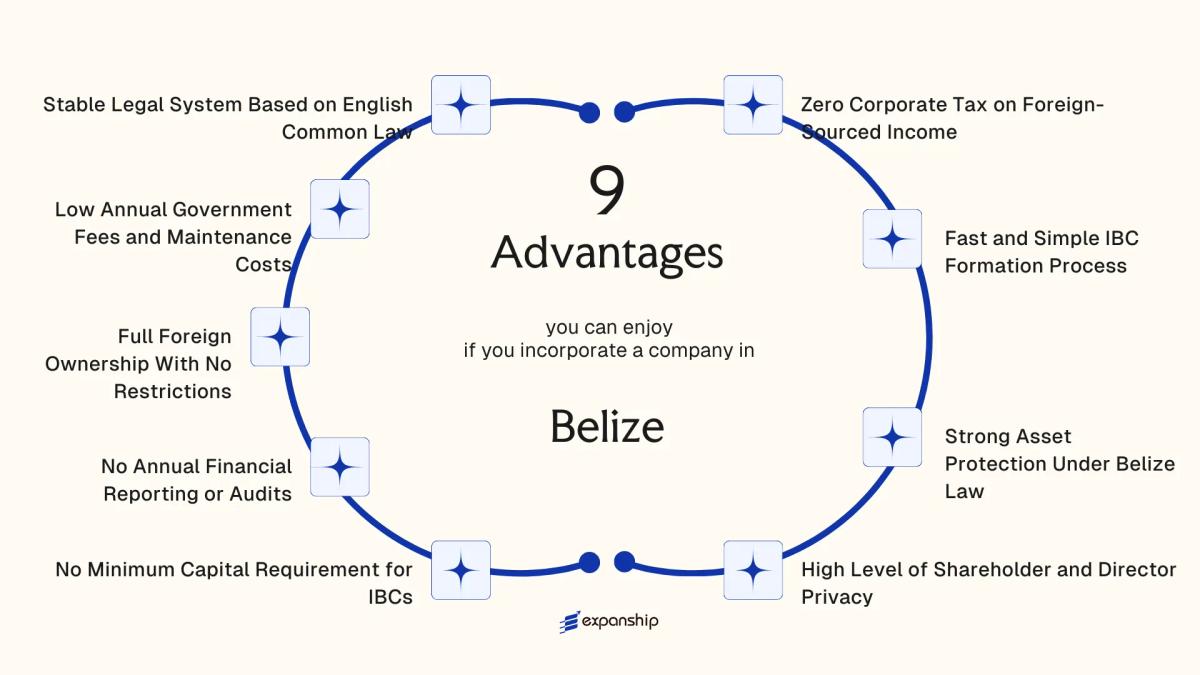
Zero Corporate Tax on Foreign-Sourced Income
Under the International Business Companies Act of Belize, an IBC that conducts all of its operations and earns all of its revenue outside the country is not subject to corporate income tax on those earnings. This is the structural foundation of the Belize zero tax on foreign income benefit that draws holding companies, trading firms, and consulting entities to this jurisdiction.
How the Tax Exemption Is Defined
The exemption is not discretionary — it is statutory. Income sourced from foreign clients, foreign contracts, or foreign assets falls entirely outside the Belizean tax base, meaning your company retains its full pre-tax profit without any obligation to file a corporate tax return on those earnings.
What This Means for Structuring
A business operating across multiple markets can use a Belize IBC as the contracting or invoicing entity for non-Belizean revenue, with no corporate tax applied at the entity level. The condition is clear: the firm must not conduct business with persons resident in Belize or derive income from Belize-sourced activity.
Foreign-sourced profits retained in your Belize IBC are not reduced by corporate tax at the entity level.
Fast and Simple IBC Formation Process
Belize IBC formation advantages stem partly from how quickly and simply a new entity can be established under the International Business Companies Act (Chapter 270 of the Laws of Belize). Registration is handled through a licensed registered agent, who submits the required documentation to the Belize Companies Registry on your behalf. There is no requirement for you to be physically present at any stage.
The documentation threshold is low by design:
- A single director and single shareholder satisfy the structural minimum, reducing the organisational burden for sole operators or small firms
- Nominee services are permitted, which means you are not required to disclose your personal details in public filings
- No notarisation or apostille of foreign documents is required at the point of incorporation
- The memorandum and articles of association can be filed in a standard form, without the need for bespoke drafting in most cases
Incorporation can typically be completed within 24 to 48 hours once documentation is submitted. For a foreign business owner, this compressed timeline means your entity can be operational and ready to open bank accounts or enter contracts within days, not weeks. Jurisdictions that require multi-stage regulatory approvals, capital verification, or notarised translations impose real delays on market entry. The IBC structure avoids those bottlenecks entirely.
 Belize
 Incorporate a Company in Belize
Register your Belize IBC through Expanship with full registered agent support and compliance handling.
Strong Asset Protection Under Belize Law
Belize asset protection benefits are rooted in specific statutory provisions, not general offshore convention. The primary instrument is the International Business Companies Act, Chapter 270 of the Laws of Belize, which structures IBCs as entities legally separated from their shareholders' personal assets. That separation means creditors pursuing claims against you personally cannot, as a default position, reach assets held within a properly structured Belizean IBC.
| Feature | Statutory Basis | Practical Effect |
|---|---|---|
| Shareholder liability limitation | IBC Act, Cap. 270 | Personal assets excluded from corporate debts |
| Foreign judgment insulation | Common law recognition rules | External rulings require local re-litigation |
| Flexible share structures | IBC Act provisions | Ownership can be structured to restrict transferability |
Foreign judgments present a particular consideration. Belize does not operate under automatic mutual recognition treaties with most creditor-friendly jurisdictions, so a court ruling obtained abroad must be relitigated domestically before it can be enforced against a Belizean entity. That procedural barrier gives you meaningful time and legal standing to respond to claims before assets are ever at risk.
Share structures under the IBC framework also support protection indirectly. The Act permits bearer shares in restricted form and allows for nominee arrangements, meaning ownership interests can be structured in ways that complicate third-party tracing. This applies as long as the structure complies with current anti-money laundering obligations under the Money Laundering and Terrorism (Prevention) Act.
High Level of Shareholder and Director Privacy
Belize shareholder privacy advantages stem directly from the International Business Companies Act (IBC Act), which explicitly restricts public access to ownership and directorship records. The names of shareholders and directors are not filed with the Belize Companies Registry and are therefore not accessible through any public search. For foreign business owners, this means your involvement in the entity remains outside the reach of public scrutiny.
Under the IBC Act, a company may issue bearer shares, though these must now be held by an authorized custodian. Directors can be corporate entities rather than named individuals, and a registered agent in Belize holds the statutory records locally. This structure means Belize IBC director confidentiality benefits are built into the legal architecture, not treated as optional arrangements.
The practical value here is insulation. Your name does not appear in any registry that a competitor, litigant, or third party can access through routine inquiry.
Keep these points in mind:
- Shareholder and director details are held privately by the registered agent, not filed publicly with the Belize Companies Registry
- Bearer shares, where issued, must be held by a licensed custodian under current regulations
- Corporate directors are permitted, allowing an additional layer of separation between the beneficial owner and public records
- Privacy protections apply only to entities that remain compliant with the IBC Act and do not conduct local Belize business
Belize does not require the beneficial owner's name to appear on any government-facing document at the time of incorporation, which is unusual even among established offshore centers.
No Minimum Capital Requirement for IBCs
Belize IBC no minimum capital requirement is one of the most structurally practical features of the International Business Companies Act, Chapter 270 of the Laws of Belize. Under this legislation, there is no prescribed minimum paid-up or authorized capital amount that an IBC must maintain, which means your business can be incorporated and remain fully operational without committing any specific sum of capital at the outset.
Capital Structure Is Defined by the Company, Not the Regulator
The IBC Act permits shares to be issued with or without par value, and the authorized share capital can be set at any amount the incorporators choose. This flexibility allows you to structure equity in a way that reflects your actual operational model rather than satisfying a statutory threshold that has no bearing on the entity's activities.
For businesses that operate as holding structures, intellectual property vehicles, or investment conduits, this matters considerably. Capital does not need to be injected simply to meet a legal formality.
Practical Implications for Foreign Investors
Many jurisdictions require minimum capital deposits that must be verified by a local authority or notary before incorporation is complete. No such condition applies to a Belize IBC, which removes both the administrative burden and the capital lock-up associated with those requirements.
Shares can be denominated in any currency, and the capital structure can be amended post-incorporation through a straightforward resolution process under the Act.
Belize Structure Your Belize IBC Capital the Right Way
Speak with an Expanship specialist about configuring your IBC's share capital structure to align with your business objectives and investor requirements.
No Annual Financial Reporting or Audits
Under the International Business Companies Act of Belize, IBCs are not required to prepare, file, or submit annual financial statements to any government body. There is no statutory audit requirement, and no financial records need to be disclosed to the Belize Companies Registry or any public authority. This absence of Belize no annual reporting requirements translates directly into lower administrative overhead and reduced professional fees for foreign-owned entities.
- Your business does not need to engage a licensed auditor each year, which eliminates a recurring cost that can run into thousands of dollars annually in higher-compliance jurisdictions.
- No financial statements are filed with the registry, meaning your revenue figures, profit margins, and capital structure remain outside the public record.
- The company is still required to maintain internal accounting records sufficient to reflect its financial position, but these records stay in your possession and are not submitted to regulators.
- Because no government body reviews filed accounts, there is no administrative delay caused by filing backlogs, rejection of non-compliant statements, or mandatory resubmission processes.
- Operational entities structured through a Belize IBC can allocate time and resources toward business activity rather than satisfying reporting cycles that serve no compliance function relevant to their offshore operations.
Full Foreign Ownership With No Restrictions
One of the more structurally significant Belize full foreign ownership advantages is that the International Business Companies Act permits non-residents to hold 100% of shares in a Belize IBC without any mandatory local partner or resident director requirement. There is no statutory cap on foreign equity, and no sector-specific carve-outs apply to the IBC structure.
This matters in practical terms because your business retains its original ownership architecture. You are not required to dilute equity, negotiate joint venture arrangements, or transfer decision-making authority to a local nominee simply to satisfy a residency condition.
Under the IBC Act, shareholders and directors may be of any nationality and resident anywhere in the world. A single individual can simultaneously hold the roles of sole shareholder and sole director, which keeps governance straightforward for a foreign investor operating without local partners.
A foreign investor who incorporates a Belize IBC retains 100% equity and full voting control without any local equity requirement. A comparable structure in jurisdictions such as the UAE mainland would require a local partner holding at least 51% of shares under pre-2021 commercial company laws, directly affecting profit distribution and governance authority.
Low Annual Government Fees and Maintenance Costs
One of the tangible Belize low annual government fees advantage for foreign business owners is the fixed, predictable cost structure imposed on International Business Companies (IBCs). Under the International Business Companies Act, the annual government renewal fee is a flat rate regardless of the company's authorized share capital, keeping yearly obligations modest and foreseeable.
This flat-fee model means your business avoids the scaling cost structures common in higher-cost jurisdictions, where annual state fees can increase with capital or revenue thresholds. For a holding entity or investment vehicle with no local operations, this keeps the cost of maintaining an active registration low year after year.
Registered agent fees, which are mandatory under the Act, are a separate private cost, but the market for such services in Belize remains competitive. Combined with government renewal fees, total annual upkeep for a dormant or lightly active IBC typically remains well below what comparable structures cost in EU or Asia-Pacific jurisdictions.
- No graduated fee tiers based on share capital
- No mandatory local office or staffing requirements that add indirect costs
- Annual renewal processed through your registered agent, without requiring direct government filings by you
Annual fees and registered agent costs must both be paid to keep the IBC in good standing; failure to renew results in the company being struck off the register under the IBC Act.
Stable Legal System Based on English Common Law
Belize English common law business advantages are grounded in the country's constitutional and judicial framework, which has operated continuously since independence in 1981. The legal system follows English common law principles, meaning courts apply precedent-based reasoning familiar to lawyers and investors from the UK, Canada, Australia, and other common law jurisdictions.
Judicial Structure and Predictability
The court hierarchy runs from the Supreme Court through the Court of Appeal, with final appellate jurisdiction held by the Caribbean Court of Justice. This structure provides a defined appellate path for commercial disputes. Foreign business owners can engage local or international legal counsel without needing to learn an entirely unfamiliar procedural system.
Statutory Framework for IBCs
The International Business Companies Act, Cap. 270 governs offshore entities and was modelled on common law corporate principles. Contract enforcement, directorial duties, shareholder rights, and dissolution procedures all follow established legal doctrines rather than untested regulatory frameworks. When a dispute arises, your business operates within a body of law that has centuries of interpretive history behind it.
Practical Advantages for Foreign Investors
The stability of the legal framework matters most in specific situations:
- Contract disputes are adjudicated using familiar evidentiary and procedural standards
- Shareholder agreements and corporate resolutions carry the same legal weight as in other common law jurisdictions
- Asset protection structures created under Belizean law are interpreted through common law equity principles, including trust doctrine
Why Belize Stands Out Among Offshore Jurisdictions
Belize advantages over other offshore jurisdictions become clearer when the jurisdiction is placed alongside the Caribbean and Central American alternatives that foreign investors typically evaluate simultaneously. Panama, the Cayman Islands, and the British Virgin Islands attract similar incorporation profiles, making them the most relevant benchmarks. Each offers offshore structuring tools, yet material differences exist in reporting obligations, formation timelines, and fee structures.
What the comparison reveals is not that these jurisdictions are structurally inferior, but that Belize occupies a distinct position on the cost-efficiency and administrative simplicity spectrum. Under the International Business Companies Act, IBCs face no annual audit requirement and no mandatory financial reporting to the Belize Companies Registry, a requirement that applies in some form in the BVI and Cayman Islands. Annual government fees remain fixed at a flat rate regardless of authorised capital up to a certain threshold, keeping ongoing maintenance costs predictable without the tiered fee schedules common in competing jurisdictions.
| Parameter | Belize IBC | British Virgin Islands BC | Panama Corporation | Cayman Islands Exempted Co. |
|---|---|---|---|---|
| Annual Reporting to Registry | Not required | Not required | Not required | Not required |
| Mandatory Audit | No | No | No | No |
| Formation Timeframe | 1-2 business days | 3-5 business days | 3-5 business days | 4-7 business days |
| Annual Government Fee (approx.) | USD 100-200 | USD 450+ | USD 300+ | USD 854+ |
| Legal System | English Common Law | English Common Law | Civil Law | English Common Law |
| Foreign Ownership | 100% permitted | 100% permitted | 100% permitted | 100% permitted |
| Bearer Shares Permitted | No | No | No | No |
Belize Compliance Services for Belize Companies
Maintain your Belize IBC in good standing with registered agent requirements, government fee renewals, and ongoing statutory obligations managed by our specialists.
Conclusion
Belize IBC formation consolidates several structurally distinct advantages into a single legal vehicle. The zero-tax treatment on foreign-sourced income under the International Business Companies Act, combined with the absence of mandatory audits or financial reporting, means your operational costs and administrative obligations remain low across the life of the entity, not just at the point of formation.
Two features carry particular weight for foreign business owners: the statutory privacy protections that keep director and shareholder information out of the public record, and the asset protection architecture embedded in Belizean law, which imposes a meaningful barrier against foreign judgment enforcement. These are not incidental features. They reflect deliberate policy choices encoded in the IBC framework.
Whether these advantages translate into genuine value depends on how your business generates income, where your clients are based, and what compliance obligations your home jurisdiction imposes. A Belize IBC fits certain structures well, particularly holding companies, consulting firms, and businesses operating across multiple foreign markets with no income sourced locally. Engaging qualified legal and tax counsel before formation ensures the structure functions as intended within your broader corporate and tax position. The next step is understanding how to set up and maintain the entity correctly from the outset.
Start Your Belize Company With Expanship Today
Belize company formation with Expanship covers the full administrative path from initial structuring decisions to post-incorporation obligations. The services are calibrated to the specific requirements of the International Business Companies Act, Cap. 270, and the practicalities of filing with the Belize Companies and Corporate Affairs Registry. Whether your entity is newly formed or requires ongoing compliance management, the service scope addresses each stage directly.
Expanship handles the operational and legal groundwork so your business can be properly constituted and maintained without gaps in compliance:
- Preparation and legalization of incorporation documents, including Memorandum and Articles of Association
- Provision of a licensed registered agent and registered office address, as required under Belize IBC law
- Liaison with the Belize Companies and Corporate Affairs Registry for government filings and annual renewal submissions
- Post-incorporation compliance management, including record-keeping support aligned with the IBC Act's requirements
- Banking introduction assistance to connect your entity with financial institutions that accept Belize-registered companies
Reach out to Expanship Belize to discuss how your incorporation can be structured and managed in accordance with local regulatory requirements.
Frequently Asked Questions (FAQ)
An IBC incorporated under the International Business Companies Act is exempt from Belizean corporate income tax on income earned outside the country. This exemption applies provided the company does not conduct business with residents of Belize or deal in local real estate. The tax treatment is embedded in the statute itself, not granted through a discretionary ruling.
No audited financial statements are required to be filed with the Belize Companies Registry or any other regulatory authority for a standard IBC. The company must maintain internal records sufficient to reflect its financial position, but there is no statutory obligation to submit or publish those records. This stands in contrast to many comparable offshore jurisdictions that impose annual reporting requirements.
The names of directors and shareholders of a Belize IBC are not recorded in any publicly searchable government registry. The International Business Companies Act allows nominee arrangements, and beneficial ownership information is held by the registered agent rather than disclosed in public filings. Certain information may be disclosed to competent authorities under applicable mutual legal assistance frameworks.
Incorporation of a Belize IBC can generally be completed within one to two business days once the registered agent submits the required documentation to the Belize Companies Registry. The process requires filing a Memorandum and Articles of Association along with the prescribed registration form. No pre-approval, government interview, or waiting period beyond standard processing applies.
Annual government renewal fees for a Belize IBC are fixed at a flat statutory rate, which has historically been among the lower figures in the Caribbean offshore sector, though the exact amount is subject to change by regulation. The fee is payable through the registered agent and does not vary based on the company's authorized capital or turnover. Late payment attracts penalties under the International Business Companies Act.
No minimum paid-up or authorized share capital is required under the International Business Companies Act. The company can be incorporated with a nominal share structure, and capital does not need to be deposited into a bank account as a condition of registration. This applies equally to companies with a single shareholder or multiple shareholders across different jurisdictions.
Belize's legal system is founded on English common law, and its corporate legislation draws from that tradition, providing a body of established case law and legal principles recognizable to practitioners in the United Kingdom, Canada, and other common law jurisdictions. Commercial disputes involving IBCs may be adjudicated through the Belize court system, which follows common law procedures and precedent. This legal foundation gives foreign investors a degree of familiarity with how contracts, fiduciary duties, and shareholder rights are interpreted.
Legal Disclaimer
The information provided in this article is for general informational purposes only and does not constitute legal, tax, or professional advice. While we strive to ensure the accuracy and timeliness of the content, laws and regulations are subject to change, and the application of laws can vary widely based on specific facts and circumstances.
Readers should not act upon this information without seeking professional counsel tailored to their individual situation. Expanship and its authors disclaim any liability for actions taken or not taken based on the content of this article.
For specific advice regarding your business setup, compliance requirements, or any legal matters, please consult with qualified legal and tax professionals in the relevant jurisdiction.