
Key Takeaways
- Belize operates a territorial tax system, meaning foreign-sourced income is generally not subject to local taxation, a feature that makes the International Business Company (IBC) — governed by the International Business Companies Act — the most registered entity type in the country.
- The Belize Companies and Corporate Affairs Registry, operating under the Ministry of Finance, oversees company registration and ongoing compliance across all available structures, from IBCs to sole proprietorships.
- Foreign firms can establish a presence in Belize without full incorporation by registering a Branch Office, Representative Office, or Foreign Company Registration, each carrying distinct operational and legal implications.
- Beneficial ownership reporting requirements are being tightened by the International Financial Services Commission in line with international transparency standards, meaning entities formed today will face progressively stricter disclosure obligations.
Introduction to Entity Types in Belize
Belize is a small Central American nation bordered by Mexico to the north, Guatemala to the west and south, and the Caribbean Sea to the east. It is an independent state and a member of the Commonwealth, with a legal system rooted in English common law. Company registration and ongoing compliance fall under the oversight of the Belize Companies and Corporate Affairs Registry, which operates under the Ministry of Finance.
Understanding the available business entity types in Belize matters before committing to any structure, as each carries distinct legal, operational, and tax implications. The jurisdiction operates a territorial tax system, meaning foreign-sourced income is generally not subject to local taxation — though the specifics vary by entity type.
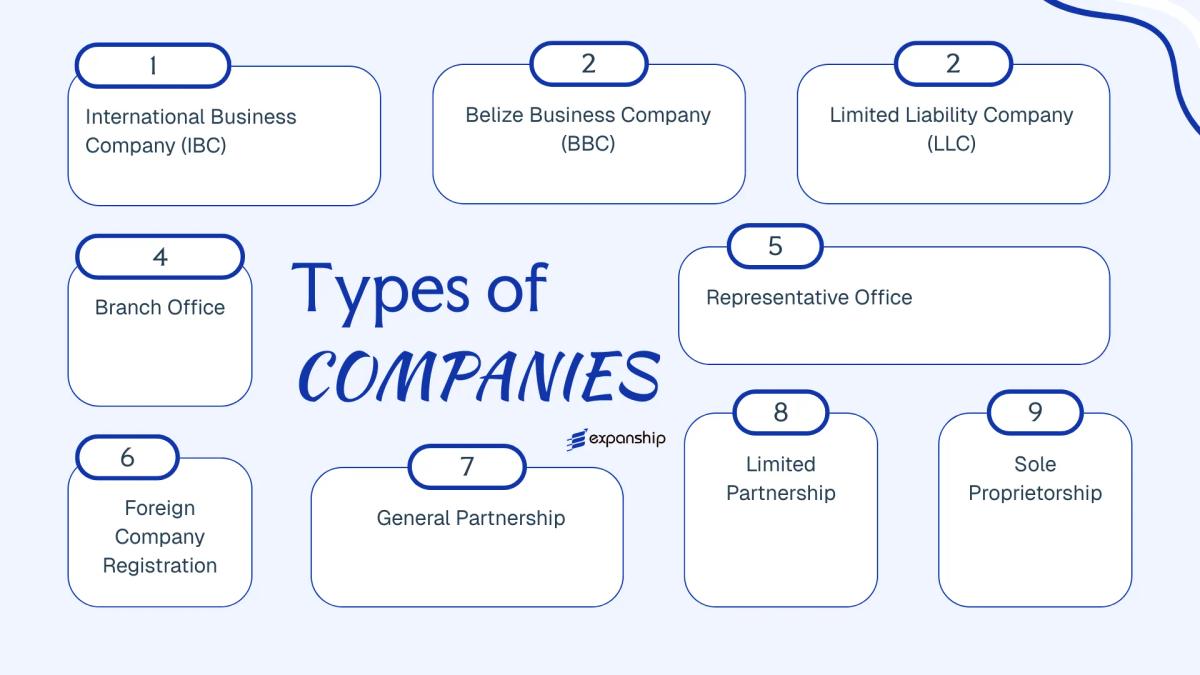
Firms can be registered under several structures: the International Business Company (IBC), the Belize Business Company (BBC), the Limited Liability Company (LLC), a Branch Office, a Representative Office, a Foreign Company Registration, a General Partnership, a Limited Partnership, and a Sole Proprietorship. Each of these Belize company structures is examined in detail across the sections that follow.
An Overview of Business Structures in Belize
Belize business structures for foreign investors are governed primarily by the Companies Act, Chapter 250, alongside dedicated legislation such as the International Business Companies Act and the Limited Liability Companies Act. Several distinct entity types are available, each designed to serve a different commercial purpose — from offshore holding arrangements to local trading operations.
Business Structures at a Glance
| Entity Type | Legal Form | Liability | Taxed / Exempt | Local Trading | Minimum Members | Regulatory Authority | Governing Act |
|---|---|---|---|---|---|---|---|
| IBC | Corporation | Limited | Exempt | Not permitted | 1 shareholder | Belize Companies Registry | IBC Act, Cap. 270 |
| BBC | Corporation | Limited | Taxed | Permitted | 1 shareholder | Belize Companies Registry | Companies Act, Cap. 250 |
| LLC | Hybrid entity | Limited | Exempt (default) | Restricted | 1 member | Belize Companies Registry | LLC Act, 2011 |
| Branch Office | Foreign company | Parent liable | Taxed on local income | Permitted | N/A | Belize Companies Registry | Companies Act, Cap. 250 |
| Representative Office | Foreign company | Parent liable | Generally exempt | Not permitted | N/A | Belize Companies Registry | Companies Act, Cap. 250 |
| General Partnership | Partnership | Unlimited | Taxed | Permitted | 2 partners | Belize Companies Registry | Partnerships Act |
| Limited Partnership | Partnership | Mixed | Taxed | Permitted | 1 GP + 1 LP | Belize Companies Registry | Partnerships Act |
| Sole Proprietorship | Individual | Unlimited | Taxed | Permitted | 1 individual | Local authority | General law |
Each of these structures is examined in full in the sections below.
International Business Company (IBC)
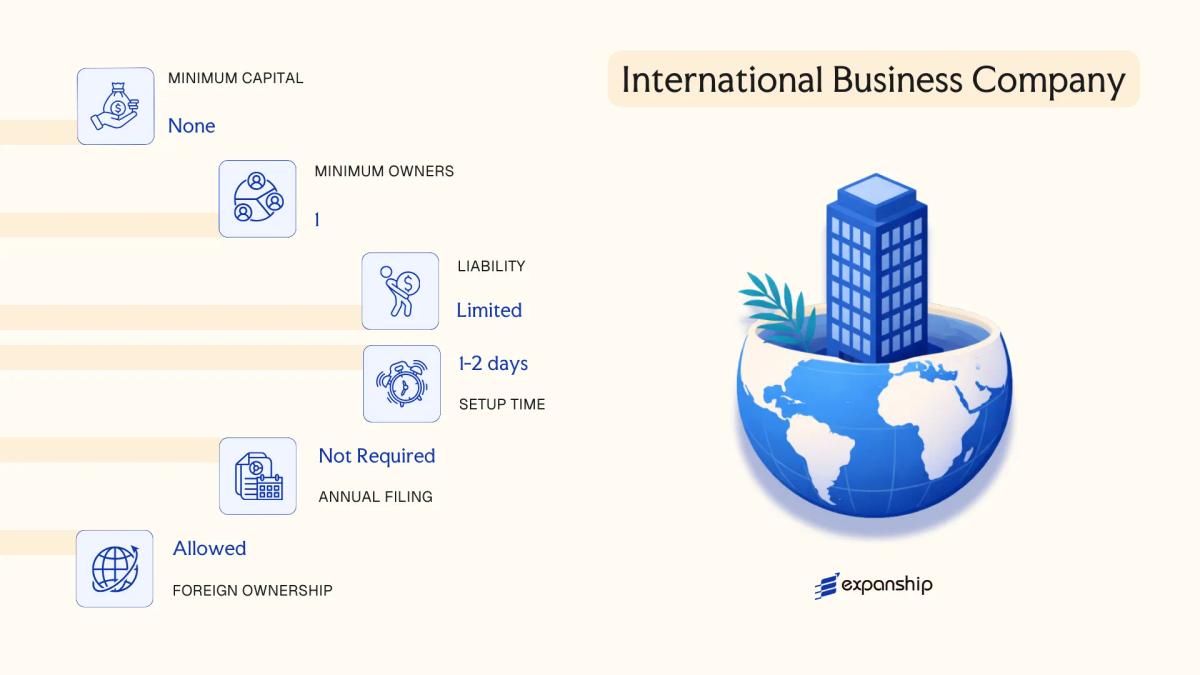
The Belize International Business Company IBC is governed by the International Business Companies Act, Chapter 270 of the Laws of Belize, originally enacted in 1990 and significantly amended over subsequent years. It is a separate legal entity with its own rights and obligations, distinct from its shareholders.
Structured for cross-border activity, this entity carries limited liability for its members and operates primarily outside Belize. Belize IBC registration is administered through the Belize Companies and Corporate Affairs Registry, with a licensed registered agent serving as a mandatory intermediary.
Key Characteristics
| Requirement | Detail | Notes |
|---|---|---|
| Legal Form | Private company limited by shares | Separate legal personality; liability capped at share value |
| Members | Shareholders (min. 1, no max); Directors (min. 1, no max) | Directors and shareholders may be the same person; corporate directors permitted |
| Local Presence | Licensed registered agent and registered office required | No requirement for local directors or employees |
| Capital | No minimum share capital; USD common | Shares may be issued with or without par value |
| Privacy | Beneficial ownership not on public record | Filed with registered agent; accessible to authorities |
| Restrictions | Cannot conduct business with Belize residents or own local real estate | Intended solely for international operations |
Focus Points
- Taxation: IBCs are exempt from corporate income tax, withholding tax, capital gains tax, and stamp duty on income derived outside Belize; no VAT applies to offshore transactions.
- Economic Substance: IBCs conducting relevant activities may be subject to economic substance requirements under the International Business Companies (Amendment) Act.
- Annual Compliance: Annual renewal fees are payable to the Registry; financial statements are not required to be filed publicly.
- Treaty Access: Belize has a limited tax treaty network; IBCs generally do not benefit from double taxation agreements.
- Conversion: An IBC may be converted to a Belize Business Company under applicable legislation.
Closing
The IBC suits holding structures, international trading, IP ownership, and asset protection arrangements. Its primary advantage is the tax exemption on foreign-sourced income; its key limitation is the prohibition on conducting business within Belize or with resident persons.
Best suited for non-resident entrepreneurs and international businesses requiring a low-compliance offshore vehicle for holding or trading activities conducted entirely outside Belize.
 Belize
 Company Incorporation in Belize
Incorporate a Belize IBC or other business entity with Expanship's end-to-end registration support.
Belize Business Company (BBC)
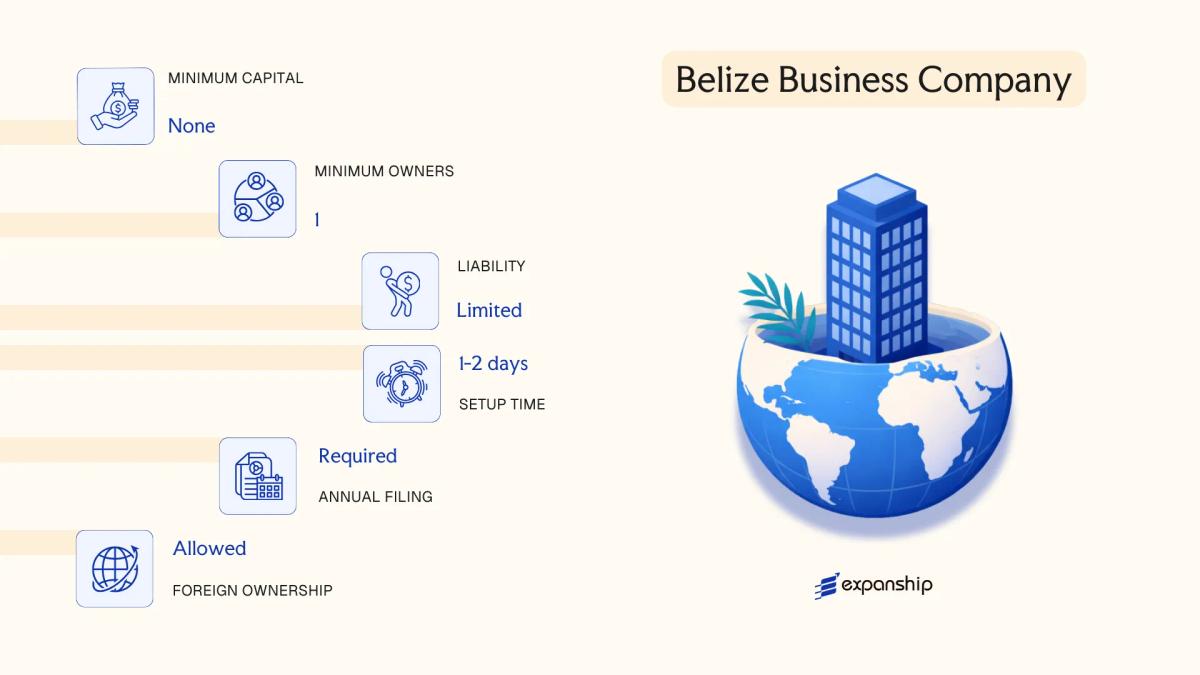
Introduced under the Belize Business Companies Act, 2022, the Belize Business Company BBC formation represents a structural reform of the country's domestic company law, replacing the former Companies Act framework with a modernised regime. The BBC carries separate legal personality and offers members limited liability, making it the standard general-purpose company form for both resident and non-resident operators.
Unlike its predecessor, the BBC is designed to serve a broader commercial function, accommodating local trading activity, holding structures, and cross-border operations under a single legislative framework.
Key Characteristics
| Requirement | Detail | Notes |
|---|---|---|
| Legal Form | Private or Public Company Limited by Shares | Separate legal personality; limited liability |
| Governance | Directors and Shareholders | Minimum 1 director and 1 shareholder; no maximum; same person may hold both roles |
| Local Presence | Registered Agent and Registered Office required | Must be maintained continuously; agent must be licensed in Belize |
| Capital | No mandatory minimum share capital; denominated in any currency | Shares may be issued with or without par value |
| Privacy | Beneficial ownership disclosed to the registered agent | Public register does not expose full ownership details |
| Annual Filing | Annual return and financial records required | Records must be kept; audit requirements depend on company size |
Focus Points
- Taxation: BBCs engaged in domestic activity are subject to income tax under Belize's Income and Business Tax Act; no VAT applies at the entity level on most services, though stamp duty applies to certain transactions.
- Economic Substance: Companies with income from relevant activities must satisfy economic substance requirements under the International Tax Co-operation (Economic Substance) Act, 2019.
- Annual Compliance: Annual returns must be filed with the Belize Companies and Corporate Affairs Registry; failure to file carries statutory penalties.
- Conversion: A BBC may be converted from a pre-existing company incorporated under the repealed Companies Act, subject to prescribed transition procedures.
- Restrictions: BBCs conducting licensed activities such as banking, insurance, or financial services require sector-specific authorisation from the relevant regulator.
Closing
The BBC suits businesses requiring a general-purpose corporate vehicle for local trading, regional holding, or asset management. Its statutory flexibility is an advantage; however, the economic substance obligations add a compliance layer that purely offshore operators may find burdensome compared to an IBC structure.
The BBC is most appropriate for businesses with genuine operational activity in or through Belize that require a locally recognised corporate structure with broad commercial scope.
Limited Liability Company (LLC)
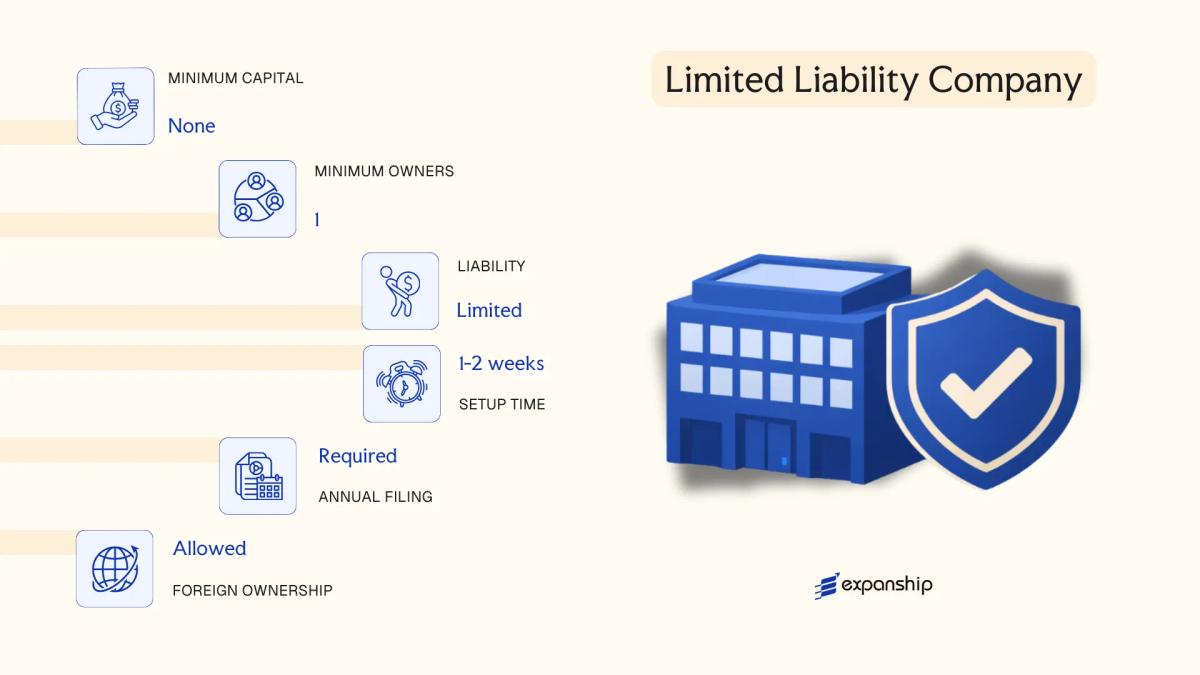
Belize's LLC framework is governed by the Limited Liability Companies Act, Chapter 250 of the Laws of Belize. A Belize Limited Liability Company combines the liability protection of a corporation with the operational flexibility of a partnership, and it holds a separate legal personality distinct from its members.
Membership interests, rather than shares, define ownership in this structure. Members are not personally liable for the debts or obligations of the business beyond their agreed contributions.
Key Characteristics
| Requirement | Detail | Notes |
|---|---|---|
| Legal Form | Hybrid entity (corporate + partnership elements) | Separate legal personality; governed by an Operating Agreement |
| Members | Minimum 1; no maximum; referred to as Members | Managers may be appointed separately to handle operations |
| Local Presence | Registered Agent and Registered Office required | Both must be maintained within Belize at all times |
| Capital | No minimum capital requirement; no prescribed currency | Contributions may be in cash, property, or services |
| Privacy | Member names not filed in a public register | Operating Agreement and member details remain confidential |
Focus Points
- Taxation: No corporate income tax, withholding tax, capital gains tax, or stamp duty on foreign-sourced income; domestic income may be taxable under general revenue laws.
- Economic Substance: LLCs engaged in relevant activities may be subject to economic substance obligations under the Income and Business Tax Act amendments.
- Annual Compliance: Annual renewal fees are payable to the Belize Companies and Corporate Affairs Registry to maintain the entity in good standing.
- Treaty Access: Belize has a limited tax treaty network, which may restrict LLC access to treaty benefits in other jurisdictions.
- Conversion: An LLC may generally be converted to another entity type under applicable legislation, subject to regulatory approval.
Belize LLCs are commonly used for asset holding, fund structuring, and joint ventures where pass-through tax treatment and flexible governance are priorities. The absence of minimum capital requirements reduces setup friction, though the limited tax treaty network can constrain cross-border structuring efficiency.
This structure suits international investors and joint venture partners seeking flexible internal governance with confidentiality, particularly where income originates outside Belize.
Foreign Entities in Belize [Branch Office, Representative Office, Foreign Company Registration]
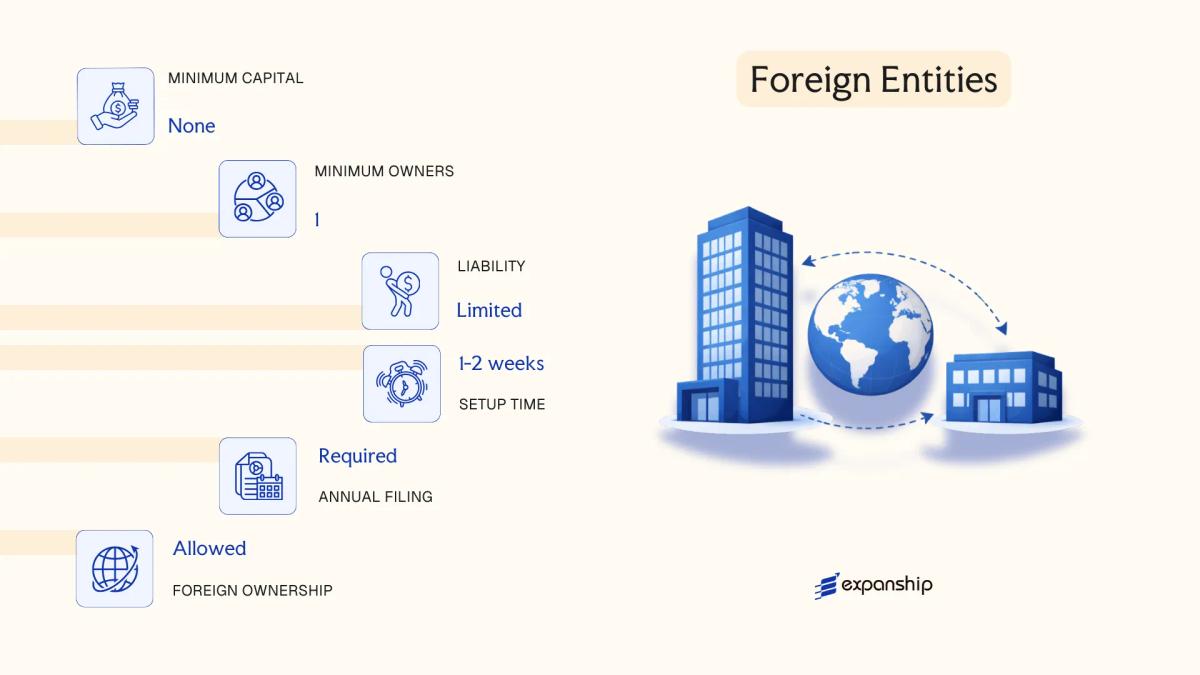
Foreign companies seeking a presence without incorporating a new local entity have several structural options available. Foreign company registration in Belize is governed by the Companies Act, Chapter 250 of the Laws of Belize, which sets out the requirements for overseas firms to operate within the jurisdiction. Each structure carries distinct legal implications regarding liability, taxation, and operational scope.
A registered foreign entity does not acquire separate legal personality in Belize — it remains an extension of the parent company, meaning the parent retains full legal and financial responsibility for activities conducted locally.
Key Characteristics
| Requirement | Detail | Notes |
|---|---|---|
| Legal Form | Extension of foreign parent company | No separate legal personality created |
| Members / Officers | Directors and officers of the parent entity | Local representative or agent typically required |
| Local Presence | Registered Agent; physical address | Must maintain a registered office address in-country |
| Capital | No minimum capital requirement | Parent company's capital structure applies |
| Privacy | Parent company details filed with Belize Companies Registry | Public record upon registration |
| Governing Body | Belize Companies Registry | Filing and compliance managed through the Registrar |
Focus Points
- Taxation: The parent entity may be subject to Belize tax on locally sourced income; no separate corporate tax filing is created for the branch itself, though general tax obligations under the Income and Business Tax Act may apply.
- Economic Substance: Foreign entity registrations are generally not considered tax resident and are unlikely to trigger substance requirements, though this depends on the nature of activities conducted locally.
- Annual Compliance: Annual returns and renewal filings are required with the Belize Companies Registry to maintain active status.
- Restrictions: Foreign entities cannot conduct activities beyond those permitted to the parent company under its home jurisdiction charter.
Sub-Types
Branch Office
A branch office operates as a direct extension of the parent company, conducting substantive commercial activities such as sales or service delivery. The parent entity bears unlimited liability for all branch obligations.
Representative Office
A representative office is limited to non-revenue-generating activities, typically market research, liaison functions, or promotional work. It cannot enter into contracts or generate income on behalf of the parent in its own right.
Foreign Company Registration
This is the formal process of registering an existing overseas company under the Companies Act to legally operate within the territory. It differs from a branch in that it fulfills a statutory recognition requirement rather than defining an operational model.
Closing
Registering a foreign entity suits businesses that need a local footprint without the administrative overhead of incorporating a new subsidiary. The primary advantage is speed of establishment; the notable limitation is that the parent company remains fully exposed to liabilities arising from local operations.
Foreign entities in Belize are most appropriate for established overseas companies conducting limited or exploratory local activities where full subsidiary incorporation is not yet warranted.
Partnerships in Belize [General Partnership, Limited Partnership]
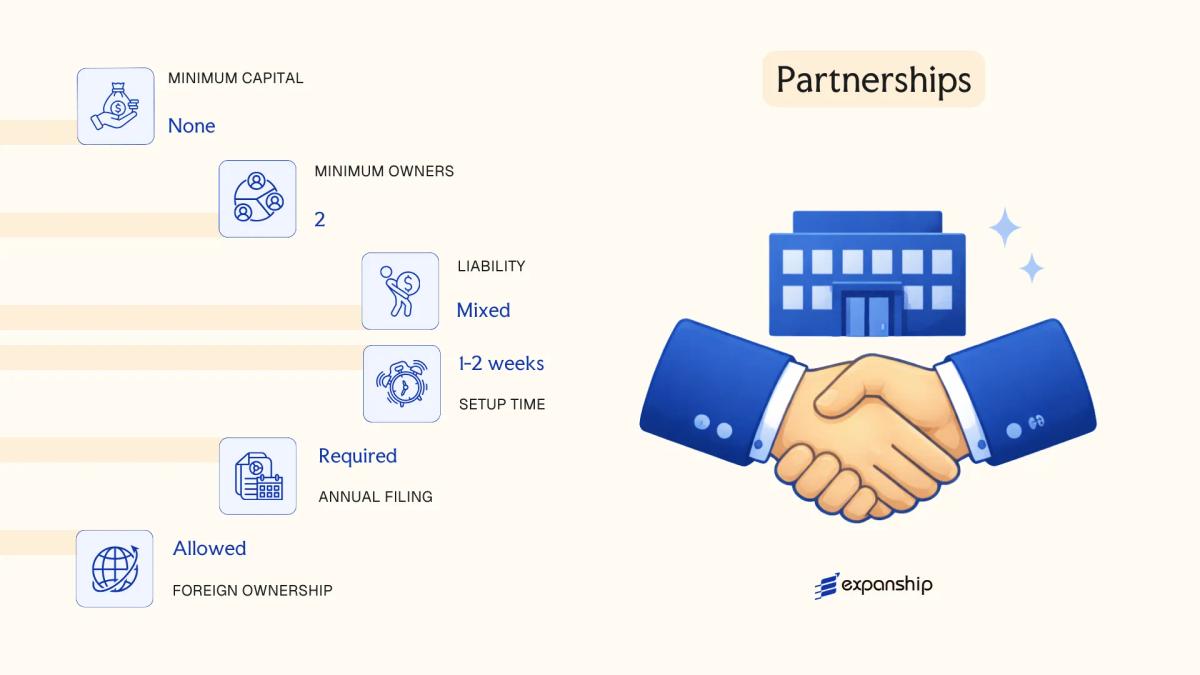
Belize limited partnership registration falls under the Partnerships Act, Chapter 270 of the Laws of Belize, which governs both general and limited partnerships. Unlike IBCs or BBCs, a partnership in this jurisdiction does not possess separate legal personality — the firm is constituted by its partners, and obligations attach accordingly.
General partnerships bind all partners with unlimited joint and several liability for the firm's debts. Limited partnerships introduce a two-tier structure, allowing limited partners to cap their exposure to the amount of their contributed capital, while at least one general partner retains unlimited liability.
Key Characteristics
| Requirement | General Partnership | Limited Partnership |
|---|---|---|
| Legal Personality | None — partners act collectively | None |
| Partners | Minimum 2 general partners; no statutory maximum | Minimum 1 general partner (unlimited liability) + 1 limited partner; no statutory maximum |
| Registration | Filed with the Belize Companies Registry; name registration required | LP agreement and certificate filed with the Belize Companies Registry |
| Local Presence | Registered address required | Registered address required |
| Capital | No minimum; contributions in any agreed form | Capital contribution by limited partners must be specified in the LP certificate |
| Privacy | Partner names appear on public register | General partner names disclosed; limited partner details may offer slightly more privacy |
Focus Points
- Taxation: Partnerships are generally treated as pass-through entities — profits are taxed at the partner level rather than at the firm; no separate corporate income tax applies at the entity level, though individual partners may have local tax obligations.
- Economic Substance: Partnerships conducting relevant activities in Belize may be subject to economic substance requirements under the International Tax Co-operation (Economic Substance) Act.
- Annual Compliance: Annual renewal fees apply; general partnerships must maintain updated registration; limited partnerships must file any material changes to the LP certificate.
- Treaty Access: Belize has a limited tax treaty network, which may restrict the utility of partnership structures for international tax planning purposes.
- Management Restrictions: A limited partner who participates in management risks losing their limited liability protection under the Act.
Sub-Types
General Partnership
All partners share management authority and bear unlimited personal liability. This structure suits small domestic ventures or professional firms where partners actively co-manage operations.
Limited Partnership (LP)
The LP separates passive investors (limited partners) from active managers (general partners). Your business can use this structure for investment vehicles, fund structures, or arrangements where one party contributes capital without involvement in day-to-day management.
Closing
Partnerships in Belize are used primarily for domestic trading, professional services, and investment arrangements where pass-through tax treatment is desirable. The absence of a minimum capital requirement is a practical advantage, though unlimited liability exposure for general partners remains a structural constraint that warrants careful consideration.
General partnerships suit small domestic firms with active co-owners; limited partnerships are more appropriate for investment structures where passive capital contributors require liability protection.
Sole Proprietorship
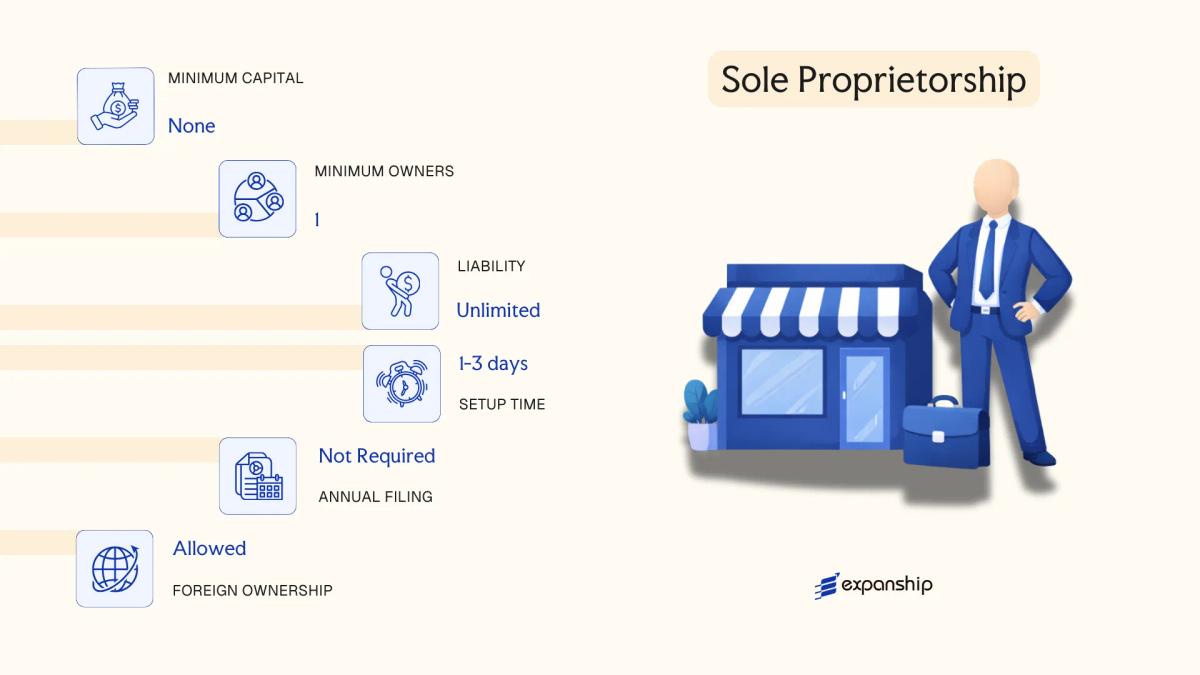
A sole proprietorship in Belize is the simplest form of business registration available to individuals operating under their own name or a trade name. Governed primarily by the Registration of Business Names Act, this structure does not create a separate legal entity — the owner and the business are legally the same person.
Because no separation exists between personal and business assets, the proprietor bears unlimited personal liability for all debts and obligations incurred by the business. Registration is administered through the Belize Companies Registry, and self-employed business registration in Belize under this structure is relatively straightforward.
Key Characteristics
| Requirement | Detail | Notes |
|---|---|---|
| Legal Form | Unincorporated business | No separate legal personality from the owner |
| Proprietor | Single individual | One owner; referred to as the proprietor |
| Local Presence | Physical address required | No registered agent requirement, but a local business address must be provided |
| Capital | No minimum | No statutory capital requirement |
| Privacy | Name and address on public register | Limited privacy; business name and owner details are publicly accessible |
Focus Points
- Taxation: Subject to personal income tax on business profits; no separate corporate tax applies; standard GST obligations may apply depending on turnover threshold.
- Annual Compliance: Annual renewal of the business name registration is required to maintain active status.
- Restrictions: Cannot issue shares, raise equity, or admit partners without restructuring into a different legal form.
- Treaty Access: No access to bilateral tax treaties, as the proprietor is taxed as an individual.
- Conversion: Can be converted into a company or partnership, but this requires a fresh incorporation process rather than a simple structural amendment.
Closing
This structure suits resident individuals running small-scale, locally focused operations where administrative simplicity outweighs the need for liability protection. The absence of incorporation costs is a practical advantage, but unlimited personal liability is a significant exposure that makes it unsuitable for higher-risk or capital-intensive activities.
Resident individuals operating low-risk, single-person service or trade businesses who prioritise minimal compliance overhead over liability protection.
How to Choose the Right Entity Type in Belize
Knowing how to choose a business entity in Belize requires more than comparing registration fees — the structure you select has direct legal, tax, and operational consequences that are difficult to reverse after formation.
Why Your Entity Choice Matters
The wrong structure creates concrete problems:
- Registering an International Business Company to conduct trade with Belize residents puts the company in breach of the Belize Business Companies Act, which can result in striking off or financial penalties.
- Choosing a tax-exempt entity when you need access to double tax treaty benefits means withholding tax reductions in counterpart jurisdictions will not apply to your firm.
- Forming a company when a foundation would serve your asset protection objectives locks you into annual shareholder and directorship obligations that foundations do not carry.
Key Factors to Consider
- Business Activity: Passive asset-holding, active trading, and regulated sectors such as banking or fund management each point to a structurally different entity under Belizean law.
- Local vs. Offshore Operations: Transacting with Belize residents requires a structure permitted to conduct domestic business, such as a BBC.
- Tax Objectives: Full exemption, treaty access, and territorial taxation are available under different regimes — your target outcome determines which entity qualifies.
- Privacy Requirements: Some registers require public disclosure of directors and shareholders; nominee arrangements are permissible under certain structures but carry compliance conditions.
- Substance Capacity: If you cannot maintain personnel or decision-making activity in the jurisdiction, select an entity type where economic substance requirements do not apply.
- Exit Strategy: Not all entity types permit redomiciliation or conversion — confirm these options before formation if your long-term plans may require structural change.
Belize Compliance Services for Companies in Belize
Maintain good standing across annual filings, registered agent requirements, and regulatory obligations for your Belize entity.
Conclusion
Incorporating a company in Belize means selecting from a defined set of structures, each governed by distinct legislation. The IBC, regulated under the International Business Companies Act, remains the most registered entity type in the country, favored by non-resident entrepreneurs for its tax-neutral treatment on foreign-sourced income. The BBC serves businesses requiring a local operational presence, while the LLC offers members contractual flexibility in profit distribution and management. Branches and representative offices suit foreign firms testing the market without full incorporation. General and limited partnerships, along with sole proprietorships, address smaller or domestically focused operations.
Regulatorily, the International Financial Services Commission continues to tighten compliance standards in line with international transparency expectations, including beneficial ownership reporting. This trajectory signals that entities formed today will operate under progressively stricter disclosure requirements. Selecting the right structure from the outset determines both your compliance obligations and operational scope. Expanship's team works directly with these frameworks to support accurate entity selection and formation.
How Expanship Can Assist You
Expanship's Belize company formation services cover every structure discussed in this blog — from the IBC and BBC under the Belize Companies Act to the LLC governed by the Limited Liability Companies Act. Our team works directly with the Belize Companies and Corporate Affairs Registry to keep your filing process accurate and timely.
From initial structuring to post-incorporation obligations, here is what we handle on your behalf:
- Document preparation, notarization, and legalization
- Registered agent and registered office provision
- Government filing and Companies Registry liaison
- Ongoing compliance management, including annual returns
- Director and shareholder record maintenance
- Banking introduction assistance
Your business requirements shape how we engage — there is no fixed package forced onto every client. Reach out to [Expanship Belize](bz/contact-us) to discuss the right approach for your specific structure.
Frequently Asked Questions (FAQ)
The International Business Company remains the most frequently incorporated structure. Its exemption from local income tax, zero capital gains tax, and minimal annual reporting obligations make it the default choice for non-resident entrepreneurs and holding structures.
An IBC is restricted from trading with Belizean residents or owning local real estate, whereas a BBC can conduct business domestically and is subject to local tax obligations. Compliance requirements for a BBC are notably higher, including audited financials under certain thresholds defined by the Belize Companies Act 2022.
The IBC provides the highest degree of confidentiality. Shareholder and director details are not part of the public register, and nominee services are legally permitted under the International Business Companies Act. Beneficial ownership information is held by the registered agent but is not publicly disclosed.
An IBC and a BBC each require one director and one shareholder, so a sole individual can form either. Partnerships, by definition, require a minimum of two partners, making them unsuitable for single-person ownership.
All principal entity types, including the IBC, BBC, LLC, and registered branch, are open to foreign ownership without residency requirements. There is no mandatory local shareholder or director for an IBC or LLC, which distinguishes Belize from many competing jurisdictions.
The Belize Companies Act 2022 allows for the continuation and re-registration of companies, including foreign entities converting into a local structure. Conversion between an IBC and a BBC is possible through formal application, though the process involves regulatory review and amended constitutional documents.
The IBC has the lightest compliance footprint: no mandatory audit, no public financial filing, and a single annual fee payable to the registered agent. By contrast, a BBC and an LLC have incrementally greater reporting obligations depending on their activity and revenue profile.
The IBC, BBC, and LLC each carry distinct legal personality, meaning they can contract, hold assets, and incur liabilities independently of their members or directors. General partnerships do not have separate legal personality under Belizean law, making partners personally liable for firm obligations.
Legal Disclaimer
The information provided in this article is for general informational purposes only and does not constitute legal, tax, or professional advice. While we strive to ensure the accuracy and timeliness of the content, laws and regulations are subject to change, and the application of laws can vary widely based on specific facts and circumstances.
Readers should not act upon this information without seeking professional counsel tailored to their individual situation. Expanship and its authors disclaim any liability for actions taken or not taken based on the content of this article.
For specific advice regarding your business setup, compliance requirements, or any legal matters, please consult with qualified legal and tax professionals in the relevant jurisdiction.