
Key Takeaways
- Seychelles IBCs registered under the Companies Act carry no meaningful economic presence requirements, which disqualifies them from accessing most double tax treaties and exposes beneficial owners to full withholding tax liability in counterparty jurisdictions.
- Banks in well-regulated financial centres routinely apply enhanced due diligence or outright decline to open accounts for Seychelles-registered entities, creating operational friction that can undermine the practical utility of the structure.
- Economic substance reporting obligations introduced under international pressure have added compliance costs to what was previously a near-zero-maintenance offshore vehicle, eroding one of the jurisdiction's primary cost advantages.
- Owners relying on a Seychelles IBC for complex holding or financing structures face material limitations in the local legal framework, as the jurisdiction lacks the depth of case law and specialist corporate legislation available in more established offshore centres such as the Cayman Islands or BVI.
Seychelles operates under a relatively light regulatory framework for offshore entities, though its compliance obligations have expanded in recent years under pressure from international standard-setting bodies. The Companies Act governs the formation and ongoing obligations of International Business Companies, the primary vehicle used by foreign investors.
The disadvantages of incorporating in Seychelles span regulatory, operational, banking, and reputational categories. Not every drawback applies equally to all businesses — a holding company with no active trading faces a different risk profile than a firm conducting cross-border commercial transactions.
This article is most relevant to foreign entrepreneurs, holding company owners, and international investors who are evaluating Seychelles IBC risks before committing to this structure, particularly those operating in industries where banking access, tax treaty eligibility, or jurisdictional reputation carry material consequences.
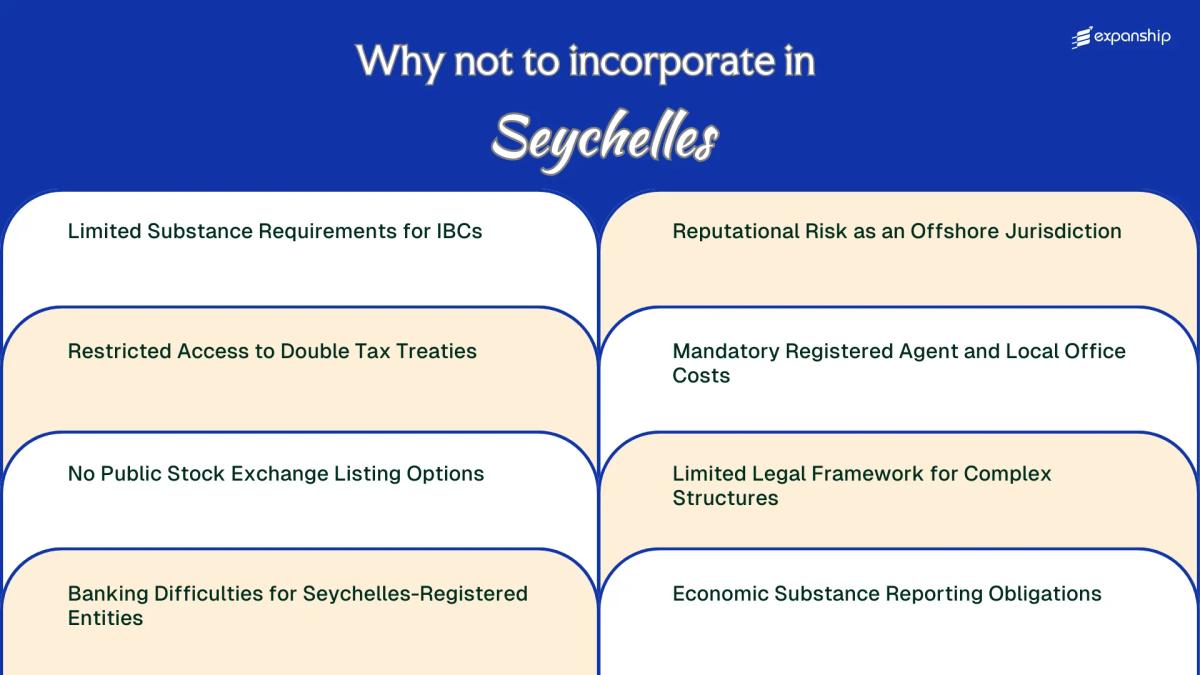
Limited Substance Requirements for IBCs
Seychelles IBC substance requirements limitations remain minimal by design, which creates real exposure for foreign business owners operating in an era of tightened global compliance standards.
Physical Presence Is Not Required, but Its Absence Has Consequences
Under the International Business Companies Act 2016, a Seychelles IBC is not required to maintain employees, office space, or any operational activity within the jurisdiction. For counterparties, correspondent banks, and tax authorities in your home country, this absence of economic presence is a red flag that can trigger substance-over-form challenges, causing foreign revenue authorities to disregard the IBC's separate legal personality entirely.
Your home jurisdiction may reclassify the entity's income as your own personal income, exposing you to domestic tax liabilities the structure was intended to manage.
Foreign Regulators Fill the Gap That Local Law Leaves Open
The Financial Intelligence Unit of Seychelles does not impose minimum trading or staffing thresholds on IBCs. That regulatory silence does not protect you internationally; OECD member states and FATF-compliant jurisdictions apply their own economic substance tests to foreign-registered entities when assessing controlled foreign corporation rules.
Seychelles offshore company substance risks are therefore largely imported from abroad, not generated locally.
If your home jurisdiction applies controlled foreign corporation legislation, a Seychelles IBC with no staff, no directors resident in the country, and no local operations may be treated as a domestic entity for tax purposes, nullifying its legal and fiscal structure.
Restricted Access to Double Tax Treaties
Seychelles double tax treaty restrictions represent one of the most significant structural limitations of the International Business Company (IBC) framework. The country maintains a limited network of tax treaties, and crucially, IBCs are typically excluded from claiming benefits under those agreements.
Under the Income Tax Act and the specific terms of individual treaty protocols, treaty access is generally reserved for entities subject to domestic taxation. IBCs, which are exempt from local income tax under the International Business Companies Act 2016, fail to meet this residency and tax liability threshold.
For your business, this creates direct financial exposure:
- Dividends, royalties, or interest paid to an IBC from treaty-partner countries may attract full statutory withholding tax rates, which can reach 15-25% depending on the source country.
- Without treaty protection, cross-border income flows become materially more expensive than structures routed through treaty-efficient jurisdictions such as Cyprus or Mauritius.
- Tax authorities in counterparty jurisdictions may deny any treaty claim outright, creating unpredictable cash flow outcomes on recurring payments.
The exemption that makes IBCs administratively simple is precisely the feature that disqualifies them from treaty relief.
 Seychelles
 Company Incorporation in Seychelles
Understand the full structural and tax implications before registering an IBC in Seychelles.
No Public Stock Exchange Listing Options
Seychelles IBCs have no public stock exchange listing options under the International Business Companies Act 2016. The Act explicitly prohibits IBCs from making public offerings of their securities, which means your company cannot raise capital from retail investors through any regulated exchange.
No domestic equity market exists in the jurisdiction. Without a local bourse, even if the IBC structure were reformed, there would be no compliant venue to list shares or issue publicly traded debt instruments.
| Restriction | Detail | Implication for Business Owners |
|---|---|---|
| Public securities offering | Prohibited under IBC Act 2016 | Cannot raise equity from public investors |
| Domestic stock exchange | None established | No local listing venue available |
| Regulated debt issuance | Not supported under IBC framework | Bond or note programs require redomiciliation |
| Secondary share market | No regulated secondary market | Share transfers limited to private arrangements |
For businesses that anticipate needing institutional capital or eventual IPO access, the IBC structure creates a structural ceiling. Growth-stage companies that rely on public equity financing have no compliant path under Seychelles company capital markets limitations without redomiciling to another jurisdiction entirely.
This restriction is not a matter of regulatory discretion. It is embedded in the statutory design of the IBC. The only entities that could theoretically access capital markets would need to operate under a different legal vehicle, outside the IBC framework.
Banking Difficulties for Seychelles-Registered Entities
Opening a bank account for a Seychelles company banking difficulties situation is one of the most consistent operational obstacles reported by foreign business owners using IBCs incorporated under the International Business Companies Act 2016.
Major international banks, including those in the EU and UK, apply heightened due diligence to entities registered in Seychelles under FATF and OECD guidance on high-risk jurisdictions. This means your application faces automatic scrutiny before any review of your actual business activity begins.
Many banks refuse IBC accounts outright. Others impose conditions that amount to the same result: requirements for in-country directors, proof of local economic activity, or minimum deposit thresholds that IBCs structurally cannot meet.
Correspondent banking relationships further compound the problem. Even if a local Seychelles bank accepts your entity, transactions may be blocked or delayed by correspondent banks abroad that apply their own compliance filters to jurisdictions on monitoring lists.
- IBCs registered under the International Business Companies Act 2016 carry elevated risk classifications with most tier-one banks
- You may be required to demonstrate beneficial ownership disclosure before a bank will process your application
- Account applications can be refused without a stated reason under most banks' internal risk policies
- Maintaining an account in a third-country jurisdiction creates additional reporting obligations in your home country
- Some payment processors and fintech platforms apply blanket restrictions to Seychelles-registered entities
Even after successfully opening a bank account, Seychelles IBCs can have accounts closed without notice if their bank undergoes an internal de-risking review, regardless of the entity's own compliance record.
Reputational Risk as an Offshore Jurisdiction
Seychelles offshore jurisdiction reputational risk is a tangible commercial liability, not merely a perception issue. Financial institutions and regulatory bodies in high-scrutiny markets actively flag entities registered under the International Business Companies Act 2016 during due diligence reviews.
How the Jurisdiction Is Categorised
The Financial Action Task Force and the EU have historically scrutinized Seychelles for anti-money laundering deficiencies, and the jurisdiction appeared on the EU's list of non-cooperative jurisdictions for tax purposes in 2020. That listing, even after subsequent removal, leaves a documented compliance trail that counterparties in Europe and North America reference when assessing your entity's risk profile.
Practical Consequences for Your Business
Correspondent banks, payment processors, and institutional partners routinely apply enhanced due diligence to firms incorporated in jurisdictions carrying a tax haven reputation, which translates directly into delayed onboarding, higher compliance costs, or outright rejection. The stigma attached to an IBC structure can undermine contractual relationships even where the underlying business is fully legitimate. This reputational burden is less pronounced for entities that can demonstrate genuine operational activity, but most IBCs incorporated for holding purposes cannot make that case convincingly.
Seychelles Addressing Compliance Perception Risks for Your Seychelles Entity
Understand how reputational and regulatory scrutiny affects Seychelles-registered companies and what structural considerations apply to your situation.
Mandatory Registered Agent and Local Office Costs
Every Seychelles IBC must appoint a licensed registered agent under the International Business Companies Act 2016, and that agent must maintain a registered office address on the islands. This structure creates a fixed, recurring cost that your business cannot waive or self-manage from abroad.
- Annual registered agent fees are a mandatory line item regardless of whether your IBC conducts any activity, meaning dormant entities still carry this operational cost.
- You have no option to fulfil the registered office requirement independently, since only Financial Services Authority-licensed agents are legally authorised to provide this service.
- Licensed agent fees vary across providers with no regulated price ceiling, leaving your annual maintenance cost subject to the commercial decisions of a third party.
- Replacing a registered agent requires a formal transfer process under the IBC Act, which adds administrative friction and potential service gaps if your current agent raises fees or exits the market.
- Unlike some jurisdictions where a local director or shareholder can double as the registered agent, Seychelles law treats these as distinct obligations, compounding your compliance overhead.
Limited Legal Framework for Complex Structures
The Seychelles limited legal framework drawbacks become most visible when foreign business owners attempt to structure multi-tiered holdings, joint ventures, or hybrid entities under local law. The primary legislation governing offshore companies, the International Business Companies Act 2016, was designed for straightforward holding and trading structures. It does not provide the statutory architecture that more developed jurisdictions offer for complex arrangements.
Sophisticated structures — such as protected cell companies used for segregated asset pools, or statutory mergers with foreign entities — have limited procedural support in local corporate law. When disputes arise within complex arrangements, the courts have a narrower body of precedent to draw from compared to jurisdictions like Cayman Islands or BVI, where decades of case law address intricate corporate governance questions.
Your business may also find that the local legal profession has restricted capacity to advise on cross-border restructurings that require simultaneous application of foreign law principles alongside Seychelles company law.
A business owner structuring a three-tier holding arrangement with a Seychelles IBC as the intermediary layer may need to retain legal counsel in a second jurisdiction — such as Mauritius or Singapore — to handle the structural complexity that local practitioners cannot fully address, adding an estimated USD 5,000 to USD 15,000 in additional annual legal advisory costs depending on the transaction scope.
Economic Substance Reporting Obligations
Seychelles economic substance reporting obligations, introduced through the Business Tax (Economic Substance) Act, require certain resident entities carrying out relevant activities to demonstrate genuine operational presence. If your IBC falls within a defined category — such as holding company, finance and leasing, or intellectual property activities — you must file an annual Economic Substance Return with the Seychelles Revenue Commission. Failure to comply triggers financial penalties and potential strike-off.
The compliance burden is disproportionate for foreign-owned shell structures with no physical operations. Demonstrating adequate employees, expenditure, and management direction from within the jurisdiction is often impractical for businesses incorporated purely for holding or treasury purposes.
Non-compliant entities face escalating penalties, and repeated failures can result in the entity being reported to foreign tax authorities under automatic exchange of information frameworks. This amplifies the Seychelles ESR compliance risks well beyond a domestic fine.
The scope of "relevant activities" is defined under the Act and does not automatically capture every IBC, but any entity generating income from a qualifying activity is fully subject to substance requirements regardless of whether it actually conducts operations.
If your entity earns income from any activity classified as "relevant" under the Business Tax (Economic Substance) Act, substance requirements apply in full, irrespective of the company's operational size or the volume of income generated.
How to Overcome These Incorporation Drawbacks
Overcoming Seychelles incorporation drawbacks requires structural planning rather than reactive fixes. The challenges covered in this blog — from banking access to economic substance obligations — each have established responses within the existing regulatory and corporate framework.
- Register your IBC alongside a substance-holding entity in a treaty-accessible jurisdiction to address the absence of double tax treaty access.
- Appoint a licensed registered agent approved by the FSA to satisfy the mandatory local office requirement under the International Business Companies Act 2016.
- Establish documented economic substance records annually to meet reporting obligations administered by the Seychelles Revenue Commission.
- Open corporate banking accounts in correspondent-friendly jurisdictions where Seychelles-registered entities are routinely onboarded.
- Use a jurisdiction with a recognised stock exchange for any capital-raising structure, keeping the IBC as a holding vehicle only.
These steps operate within the boundaries set by the Financial Services Authority and the Companies Ordinance. None eliminate the underlying constraints, but each addresses a specific structural limitation that affects how the entity functions across jurisdictions.
Seychelles Still a Viable Jurisdiction
Seychelles remains a credible incorporation destination despite the documented drawbacks. The IBC framework under the International Business Companies Act 2016 continues to attract foreign-owned holding structures, IP vehicles, and trading entities where operational simplicity outweighs the need for treaty access or local banking depth.
| Pros | Cons |
|---|---|
| No corporate tax on foreign-sourced income for IBCs | No access to Seychelles' limited tax treaty network for most IBC structures |
| Minimal share capital requirements and fast incorporation timelines | Banking institutions routinely decline or scrutinize accounts for Seychelles-registered entities |
| Low statutory maintenance costs relative to many comparable jurisdictions | Mandatory registered agent fees apply regardless of business activity |
| Confidentiality protections remain intact for beneficial owners under current law | Offshore registration carries reputational exposure with banks, counterparties, and regulators |
| Flexible corporate structuring under the 2016 IBC Act | Economic substance reporting obligations add compliance requirements for certain activities |
Whether your business fits this profile depends on how the tradeoffs above map to your actual operating requirements. The jurisdiction suits structures where treaty benefits are unnecessary and where banking needs can be met through correspondent arrangements or accounts held in other jurisdictions.
Seychelles Compliance Services for Seychelles Companies
Maintain good standing for your Seychelles IBC with ongoing compliance support, including registered agent coordination, annual return filings, and economic substance reporting under the relevant statutory framework.
Conclusion
Seychelles company incorporation cons summary points to a jurisdiction that functions well for specific, low-complexity offshore structures but carries real operational limitations. Banking access remains a persistent obstacle, with correspondent banking restrictions affecting day-to-day business activity. The absence of meaningful double tax treaty access limits how efficiently cross-border income can flow through a Seychelles IBC. Economic substance reporting obligations under the Economic Substance Act add compliance demands that many registrants did not anticipate at formation. Addressing these constraints requires deliberate planning before incorporation, not after.
Expanship's Seychelles Incorporation Support
Expanship's Seychelles incorporation support is designed to help your business manage the practical weight of operating within this jurisdiction's specific regulatory environment. From the Financial Services Authority's oversight requirements to the economic substance reporting obligations introduced in recent years, the compliance workload is real. Expanship reduces the operational burden of meeting these requirements, though the underlying obligations remain yours to satisfy.
Our services cover the full incorporation and post-registration cycle across both routine and more involved engagements.
- We prepare and file all company registration documentation with the relevant Seychelles authorities.
- Registered agent and local office provision is handled on your behalf, satisfying the mandatory requirements under the IBC Act.
- We liaise directly with government bodies and regulatory offices throughout the filing process.
- Post-incorporation compliance management keeps your entity in good standing on an ongoing basis.
- Banking introduction assistance connects your business with institutions familiar with Seychelles-registered entities.
- Tax registration and liaison with local authorities is managed as part of your broader compliance obligations.
Reach out to Expanship Seychelles to discuss your incorporation requirements.
Frequently Asked Questions (FAQ)
It affects any IBC that generates income across multiple jurisdictions, which describes most internationally active businesses. Seychelles has a limited treaty network, and IBCs are specifically excluded from the treaties that do exist, meaning withholding taxes on dividends, royalties, and interest paid to or from treaty countries cannot be reduced through a Seychellois structure. The impact is most severe for businesses with high-volume cross-border income flows.
Under the Business Tax (Economic Substance) Regulations, failure to file a substance return or demonstrate adequate substance in a relevant activity can result in financial penalties and, in serious cases, spontaneous exchange of information with the tax authority in your home jurisdiction. The Seychelles Revenue Commission administers enforcement, and non-compliance records can be shared with foreign tax authorities under automatic exchange frameworks such as CRS.
The mandatory registered agent fee typically ranges from USD 100 to USD 300 per year, depending on the service provider, though this figure excludes government renewal fees and any additional compliance or nominee services. The Seychelles International Business Companies Act 2016 requires every IBC to maintain a registered agent physically present in Seychelles at all times, so this cost is non-negotiable regardless of how dormant or active the company is.
Seychelles entities face notably harder banking conditions than IBCs registered in jurisdictions with stronger regulatory reputations, such as Singapore or Hong Kong. Most Tier 1 banks in Europe and North America will decline or heavily scrutinize account applications from Seychelles-registered firms, and even offshore-friendly banks that do accept them often require extensive beneficial ownership documentation and impose transaction monitoring conditions that add ongoing administrative burden.
Yes, directly. The Seychelles IBC framework under the International Business Companies Act 2016 was designed for straightforward holding and trading structures, not for multi-party joint ventures, complex equity arrangements, or structures requiring detailed statutory protections for minority shareholders. Gaps in the local case law mean disputes involving sophisticated governance provisions may lack reliable judicial precedent, creating legal uncertainty that is a genuine structural risk for investors entering into binding commercial arrangements through a Seychelles entity.
Under the Beneficial Ownership Act 2020, IBCs are required to maintain up-to-date beneficial ownership information with their registered agent, and failure to do so can result in administrative penalties imposed by the Financial Intelligence Unit. The penalties escalate with continued non-compliance, and because Seychelles participates in international beneficial ownership information-sharing arrangements, deficiencies can trigger scrutiny from regulators in other jurisdictions where your business operates.
Legal Disclaimer
The information provided in this article is for general informational purposes only and does not constitute legal, tax, or professional advice. While we strive to ensure the accuracy and timeliness of the content, laws and regulations are subject to change, and the application of laws can vary widely based on specific facts and circumstances.
Readers should not act upon this information without seeking professional counsel tailored to their individual situation. Expanship and its authors disclaim any liability for actions taken or not taken based on the content of this article.
For specific advice regarding your business setup, compliance requirements, or any legal matters, please consult with qualified legal and tax professionals in the relevant jurisdiction.