

Key Takeaways
- Global Business Companies incorporated under the Companies Act 2001 must demonstrate genuine economic substance in Mauritius, creating ongoing operational costs that reduce the appeal of using the jurisdiction purely as a holding or structuring vehicle.
- The Financial Services Commission imposes layered licensing requirements on financial and fund structures that extend timelines and add regulatory overhead before a company can begin operations.
- Mauritius maintains a relatively limited double taxation treaty network compared to competing jurisdictions, and several key treaties — including the India-Mauritius treaty — have been renegotiated to restrict capital gains benefits that previously made the jurisdiction attractive.
- Foreign investors in regulated sectors face ownership caps that constrain control over their Mauritius entities, making the jurisdiction unsuitable for certain cross-border operating structures regardless of the corporate vehicle chosen.
Mauritius operates under a heavily regulated financial and corporate framework, overseen by bodies including the Financial Services Commission and the Registrar of Companies. The drawbacks of Mauritius company formation span licensing, banking access, substance requirements, treaty limitations, and sector-specific ownership rules.
Not every disadvantage applies equally to all structures. A Global Business Company faces a different compliance burden than a domestic entity, and the cons of setting up business in Mauritius will differ depending on whether you are establishing a holding vehicle, a fund, or an operating subsidiary.
This article is most relevant to foreign investors and non-resident business owners incorporating under the Companies Act 2001 who intend to use Mauritius for cross-border structuring or international trade. The disadvantages of incorporating in Mauritius examined here are specific to that context.
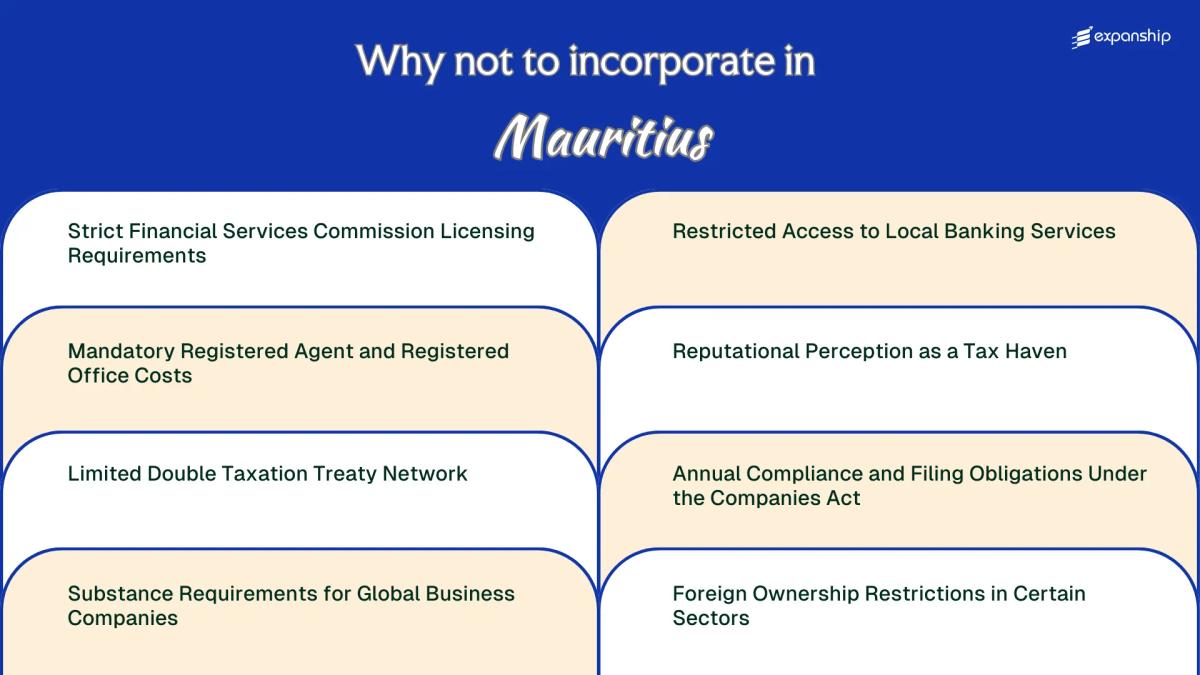
Strict Financial Services Commission Licensing Requirements
Mauritius FSC licensing restrictions affect any firm that intends to conduct regulated financial activities through a Global Business Company or a licensed entity. The Financial Services Commission, established under the Financial Services Act 2007, governs this process, and its requirements create material friction for foreign operators.
Licensing Categories Impose Specific Entry Barriers
The FSC administers dozens of distinct licence categories, including Investment Dealer, CIS Manager, and Payment Intermediary Service licences, each carrying separate fit-and-proper assessments, minimum capital thresholds, and prescribed organisational requirements. Foreign applicants often underestimate the documentation burden, particularly the requirements around directors' qualifications, internal governance structures, and compliance officer appointments.
Processing timelines can extend to several months, delaying your firm's ability to generate revenue.
Ongoing Obligations Compound the Initial Cost
Once licensed, your business faces continuous FSC reporting obligations, periodic audits, and the requirement to maintain qualified resident personnel. Failure to meet ongoing conditions can trigger licence suspension under the Financial Services Act.
These Mauritius financial services regulation drawbacks are not theoretical; the FSC has demonstrated a willingness to refuse or revoke licences where applicants fall short of prescribed standards.
If your firm cannot sustain qualified resident compliance staff and meet the FSC's capital adequacy requirements on a continuous basis, your licence remains at risk of suspension regardless of initial approval.
Mandatory Registered Agent and Registered Office Costs
Mauritius registered agent costs represent a fixed, unavoidable overhead that applies regardless of your company's revenue or activity level. Under the Companies Act 2001 and the Financial Services Act 2007, every Global Business Company (GBC) must appoint a licensed Management Company as its registered agent. These firms are licensed by the Financial Services Commission (FSC), and their fees are set by the market, not capped by regulation.
For foreign owners, this creates a structural dependency. You cannot self-administer these functions, which means annual agent fees are non-negotiable from day one.
The practical burden this creates includes:
- Paying recurring Management Company retainers even during dormant periods when the entity conducts no transactions
- Bearing the cost of a mandatory registered office address you cannot substitute with your own foreign business address
- Absorbing fee increases unilaterally set by your appointed Management Company, with limited competitive alternatives in a concentrated service market
- Funding compliance coordination through a third party for every FSC submission, adding indirect costs beyond the stated retainer
Domestic companies face fewer such obligations, making this cost layer disproportionately a foreign-entity burden.
 Mauritius
 Company Incorporation in Mauritius
Understand the full cost structure before incorporating a Global Business Company in Mauritius, including mandatory registered agent obligations.
Limited Double Taxation Treaty Network
Mauritius double taxation treaty limitations present a concrete structural problem for businesses with cross-border revenue streams. The country has signed around 46 tax treaties, a figure that sounds reasonable in isolation but falls short when your operations span Southeast Asia, Sub-Saharan Africa, or Latin America, where coverage is either absent or thin.
Several of your target markets may simply not have a treaty with the jurisdiction. Without a treaty in place, income earned in those countries can be taxed both at source and in Mauritius, eroding margins that a holding or investment structure was specifically designed to protect.
| Region | Treaty Coverage | Practical Exposure |
|---|---|---|
| Southeast Asia | Partial (e.g., Malaysia, Singapore present; Vietnam, Philippines absent) | Withholding tax applies at domestic rates in non-treaty countries |
| Sub-Saharan Africa | Limited (South Africa, Rwanda, Zambia covered; Nigeria, Ghana absent) | Dividend and royalty flows from major economies remain fully taxable at source |
| Latin America | Minimal | No treaty relief available; double taxation risk is high |
| Middle East | Very limited | Interest and royalty payments subject to source-country withholding |
Treaty abuse concerns have also narrowed the practical value of existing agreements. India renegotiated its treaty with Mauritius in 2016, eliminating capital gains exemptions on shares acquired after April 2017. That amendment removed one of the network's most commercially significant benefits.
For a Global Business Company relying on treaty access as a core part of its tax position, gaps in coverage translate directly into higher effective tax rates and reduced competitiveness in non-treaty markets.
Substance Requirements for Global Business Companies
Mauritius Global Business Company substance requirements have grown significantly more demanding since the 2018 amendments to the Income Tax Act and subsequent FSC guidelines. A GBC must now demonstrate genuine economic substance on the island, meaning it cannot simply be a letterbox entity managed from abroad.
The Financial Services Commission requires that a GBC be managed and controlled from Mauritius. In practice, this means board meetings must be held locally, a majority of directors must be resident, and strategic decisions must originate on the island.
This creates a concrete operational burden for foreign owners. Hiring qualified resident directors, maintaining a physical office, and conducting board activity locally all generate recurring costs that do not exist under less prescriptive regimes.
The substance rules also affect treaty eligibility. A GBC that fails to demonstrate sufficient local management risks losing access to treaty benefits entirely, which undermines one of the primary commercial reasons for using this structure.
- A majority of directors must be Mauritius-resident
- Board meetings must physically take place in Mauritius
- Core income-generating activities must be conducted locally
- Adequate local staff and expenditure levels must be maintained
- Non-compliance disqualifies the entity from treaty protection under the Income Tax Act
Did You Know? A GBC that fails the substance test is not automatically dissolved but loses its tax residency certificate, making all foreign income potentially taxable without treaty relief.
Restricted Access to Local Banking Services
Mauritius banking access restrictions affect Global Business Companies (GBCs) more acutely than domestic entities, as local banks apply heightened due diligence under the Bank of Mauritius's AML/CFT guidelines, often resulting in prolonged account opening timelines or outright refusals.
Structural Barriers for Foreign-Owned Entities
Banks such as MCB and SBM routinely require extensive documentation from foreign directors and beneficial owners, including source-of-funds evidence, audited financials, and group structure charts. For a newly incorporated GBC with no local operating history, satisfying these requirements can take several months, delaying the entity's ability to transact entirely.
Practical Consequences for Day-to-Day Operations
Restricted banking services for Mauritius companies are not limited to account opening; foreign-owned firms may face transaction monitoring holds or restrictions on correspondent banking in higher-risk corridors. Your business may need to maintain banking relationships across multiple institutions to ensure operational continuity, adding administrative overhead and cost. GBCs holding a Category 1 licence under the Financial Services Act are somewhat better positioned, but this does not eliminate scrutiny.
Mauritius Addressing Banking Access Challenges for Your Mauritius Entity
Understand the documentation requirements, regulatory expectations, and account opening processes that affect foreign-owned companies incorporated in Mauritius.
Reputational Perception as a Tax Haven
Mauritius tax haven reputation risks remain a genuine commercial liability, particularly for entities seeking credibility with European banks, institutional partners, or multinational counterparties.
- Your company may face automatic scrutiny from EU and FATF member-state financial institutions, as the jurisdiction has previously appeared on the EU's list of non-cooperative jurisdictions for tax purposes, creating compliance friction that adds time and cost to routine banking and investment relationships.
- Correspondent banks in major financial centres often apply enhanced due diligence to structures involving Global Business Companies licensed under the Financial Services Act 2007, which can delay account opening or result in outright rejection.
- Counterparties in regulated industries, such as fund management or insurance, may require additional legal opinions or structural changes before contracting with a firm registered under the Companies Act 2001 in this offshore jurisdiction.
- The perception of tax-motivated structuring can undermine your business's credibility even where full economic substance is demonstrated under the FSC's substance requirements.
Annual Compliance and Filing Obligations Under the Companies Act
Mauritius Companies Act compliance burdens fall disproportionately on foreign-owned entities that lack in-country administrative infrastructure. Under the Companies Act 2001, every company must file an annual return with the Registrar of Companies, accompanied by audited financial statements if the entity meets prescribed thresholds.
Global Business Companies face an additional layer, as the Financial Services Commission requires separate annual filings, including certificates of compliance and confirmation of economic substance. Failing to meet either deadline exposes the company to penalties and, in serious cases, striking off the register.
Audit requirements apply even to entities with minimal turnover, meaning your business must retain a locally approved auditor regardless of operational scale. That fixed cost compounds the ongoing expense of maintaining local directors and a registered office.
- Annual return filing with the Registrar of Companies
- Audited financial statements (where applicable under the Companies Act 2001)
- FSC compliance certificate for Global Business Companies
- Substance confirmation documentation
Private companies are exempt from certain public disclosure rules, but the core filing calendar still demands consistent attention from offshore owners who may be managing operations remotely across different time zones.
A foreign-owned Global Business Company with minimal annual revenue could realistically incur USD 3,000 to USD 6,000 per year in combined audit, compliance, and FSC filing fees, before accounting for local director remuneration or registered agent charges. This fixed cost floor exists regardless of whether the entity conducts any active transactions during the financial year.
Foreign Ownership Restrictions in Certain Sectors
Mauritius foreign ownership sector restrictions apply across several industries under specific legislative frameworks, and the limitations are direct rather than procedural. Foreign investors cannot hold majority stakes in certain locally sensitive sectors, which immediately narrows the scope of control your business can exercise.
Under the Non-Citizens (Property Restriction) Act and related sector-specific regulations, foreign ownership in areas such as sugar production, fishing, and certain retail activities is either capped or subject to ministerial approval. This approval process introduces uncertainty, delays, and no guaranteed outcome.
Sectors where restrictions commonly affect foreign entities include:
- Sugar industry operations on agricultural land
- Retail trade businesses with a physical presence targeting the local consumer market
- Artisanal fishing and inshore fishing activities
- Certain media and broadcasting operations
Each of these restrictions means your firm may be structurally barred from majority ownership or full operational control, regardless of capital commitment or business readiness.
The Board of Investment (now integrated under the Economic Development Board) does not have blanket authority to override sector-specific ownership caps, so escalating approval requests does not reliably resolve the underlying restriction.
Foreign ownership caps in regulated sectors are set by statute, not policy, meaning no amount of negotiation with regulatory bodies can circumvent the legislative ceiling without an amendment to the governing law.
Overcoming Incorporation Challenges in Mauritius
Overcoming Mauritius incorporation challenges requires structural preparation rather than reactive adjustments after formation. The disadvantages covered in this blog are addressable, but each demands deliberate action before and during the incorporation process.
- Appoint a qualified resident management team to satisfy the Financial Services Commission substance requirements applicable to Global Business Companies.
- Engage a licensed management company to fulfil the mandatory registered agent and registered office obligations under the Financial Services Act 2007.
- Select a GBC structure with sufficient operational presence to qualify for double taxation treaty benefits under the Income Tax Act.
- Conduct advance due diligence with local banks to assess eligibility criteria before incorporation, reducing the risk of account rejection post-registration.
- Identify any sector-specific foreign ownership restrictions under the relevant licensing regulations before committing to a business activity.
Each of these steps operates within a framework governed by the Companies Act 2001 and Financial Services Act 2007. Addressing structural gaps early reduces the risk of regulatory non-compliance after the entity is formally registered.
Mauritius Still a Viable Business Destination
Mauritius remains a credible incorporation destination despite the compliance burdens, substance demands, and reputational pressures documented throughout this blog. The jurisdiction's treaty network, regulatory framework under the Financial Services Commission, and established legal infrastructure still make it a functional base for cross-border structures, provided your business can absorb the associated costs and obligations.
| Pros | Cons |
|---|---|
| Mauritius has signed double taxation agreements with several African and Asian jurisdictions, reducing withholding tax exposure on qualifying income flows. | The treaty network remains narrower than competing hubs, limiting coverage for businesses with operations in certain key markets. |
| The Global Business Company structure offers a recognized legal vehicle for international holding and investment activity. | GBC entities must demonstrate genuine economic substance, requiring local staff, directors, and decision-making on the island. |
| No foreign ownership restrictions apply to most sectors, allowing full equity control by non-resident shareholders. | Regulated sectors including banking, insurance, and broadcasting impose local participation or licensing conditions. |
| The Companies Act 2001 provides a codified corporate governance framework familiar to common law practitioners. | Annual compliance obligations under the Act, including filings and statutory records, generate recurring administrative costs. |
| Incorporating through a licensed management company is a well-established process. | Mandatory registered agent and registered office requirements add fixed costs that cannot be avoided regardless of business activity. |
Securing reliable banking access remains a practical constraint, and the global tax haven perception continues to draw scrutiny that affects how counterparties and financial institutions treat Mauritius-incorporated entities.
Mauritius Compliance Services for Companies in Mauritius
Annual filings, statutory record maintenance, and ongoing regulatory obligations under the Companies Act 2001 and Financial Services Commission requirements.
Conclusion
A Mauritius company formation drawbacks summary reflects a jurisdiction that offers real structural advantages but carries concrete compliance costs that businesses must account for before incorporating. Substance requirements under the FSC framework, restricted banking access for Global Business Companies, and the ongoing reputational scrutiny tied to tax haven perception are among the most operationally significant obstacles. Addressing these requires accurate pre-incorporation planning and sustained professional oversight once the entity is active.
Expanship's Services for Your Mauritius Expansion
Expanship Mauritius company formation services are structured around the specific compliance demands that this blog has outlined, from FSC licensing thresholds to the economic substance requirements that apply to Global Business Companies under the Financial Services Act 2007. Expanship's role is to reduce the operational weight of these obligations, not to make them disappear.
Beyond incorporation, the firm's service scope covers the full administrative cycle of establishing and maintaining a Mauritius entity:
- Your company is registered with all required documentation prepared to meet the Registrar of Companies' standards.
- A resident registered agent and compliant registered office are provided as required under the Companies Act 2001.
- Government filings and direct liaison with the FSC and other relevant authorities are handled on your behalf.
- Post-incorporation compliance management keeps your entity in good standing on an ongoing basis.
- Banking introduction support connects your business with local institutions familiar with GBC structures.
- Tax registration and coordination with the Mauritius Revenue Authority are managed as part of the setup process.
Reach out through Expanship Mauritius to discuss your specific structure and requirements.
Frequently Asked Questions (FAQ)
Not all entities require FSC licensing, but any company carrying out financial services activities, including fund management, investment advisory, or insurance, must obtain the relevant FSC licence before operating. Global Business Companies holding a Category 1 licence that conduct regulated activities also fall under FSC oversight. Operating without the required licence exposes the company to criminal liability under the Financial Services Act 2007.
A Global Business Company that cannot demonstrate adequate economic substance risks losing its tax residency status in Mauritius, which directly undermines its ability to access double taxation treaty benefits. The FSC can also suspend or revoke the company's licence under the Financial Services Act 2007 if substance obligations are not maintained. This effectively makes the entire structure non-functional from a tax and regulatory standpoint.
Registered agent and registered office fees for a Global Business Company typically range from USD 1,000 to USD 3,000 per year, depending on the management company engaged. These costs are mandatory under the Companies Act 2001 and cannot be avoided by self-appointing, as only a licensed Management Company can act as registered agent for a GBC. This recurring expense adds to the overall cost of maintaining the structure.
Banking access in Mauritius is more restrictive than in several comparable jurisdictions because local banks apply rigorous Know Your Customer and source-of-funds checks, often requiring physical presence or certified documentation from multiple jurisdictions. Banks such as SBM and MCB have tightened onboarding processes significantly in recent years, and many Global Business Companies report delays of several months before an account is operational. In contrast, some alternative jurisdictions have banking infrastructure that is more accustomed to international holding structures with minimal local activity.
Foreign ownership restrictions in certain sectors cannot be avoided through structuring alone; they are imposed by sector-specific legislation and require government approval or local partnership arrangements. Sectors such as sugar production, fishing, and some retail activities carry explicit restrictions under Mauritian law, and the Economic Development Board reviews applications for exemptions on a case-by-case basis. There is no guaranteed path to full foreign ownership in these sectors regardless of the corporate structure used.
Under the Companies Act 2001, failure to file annual returns or financial statements can result in administrative fines imposed on both the company and its directors. The Registrar of Companies has the authority to strike off a non-compliant entity, which creates significant legal complications for any underlying contracts, assets, or licences held in the company's name. Directors can also face personal liability if the non-compliance is deemed wilful or persistent.
The impact of Mauritius's treaty network depends on where your investors and target income sources are located. Companies routing income from jurisdictions not covered by a treaty, or from countries that have renegotiated their treaties with Mauritius, such as India following the 2016 protocol amendment, will not receive the same withholding tax relief that made the jurisdiction attractive historically. Businesses focused on African markets may find coverage more relevant, while those with Asian or Latin American income flows may find the network insufficient for their structuring needs.
Legal Disclaimer
The information provided in this article is for general informational purposes only and does not constitute legal, tax, or professional advice. While we strive to ensure the accuracy and timeliness of the content, laws and regulations are subject to change, and the application of laws can vary widely based on specific facts and circumstances.
Readers should not act upon this information without seeking professional counsel tailored to their individual situation. Expanship and its authors disclaim any liability for actions taken or not taken based on the content of this article.
For specific advice regarding your business setup, compliance requirements, or any legal matters, please consult with qualified legal and tax professionals in the relevant jurisdiction.