

Key Takeaways
- Because the Cayman Islands levies no corporate income tax, entities incorporated there are structurally excluded from accessing double tax treaty networks, forcing cross-border transactions to absorb withholding taxes that treaty-resident structures would otherwise reduce or eliminate.
- The Cayman Islands Economic Substance Law imposes active substance obligations on entities conducting relevant activities, requiring demonstrable local management, expenditure, and physical presence rather than a nominal registration.
- CIMA's regulatory oversight creates a layered licensing and reporting burden that varies by entity type, meaning fund vehicles and financial services structures face ongoing compliance costs well beyond standard annual government fees.
- The Cayman Islands' placement on the FATF grey list has materially narrowed correspondent banking relationships and institutional counterparty acceptance, creating friction for entities that depend on access to mainstream financial infrastructure.
The disadvantages of incorporating in the Cayman Islands are not uniform — they differ considerably depending on your business model, investor base, and the regulatory requirements tied to your specific entity type.
Cayman Islands operates under a heavily regulated offshore framework, overseen by bodies such as the Cayman Islands Monetary Authority (CIMA) and shaped by legislation including the Companies Act.
This article addresses structural, regulatory, and operational drawbacks spanning tax treaty limitations, substance obligations, banking access, and reputational exposure. Not every disadvantage applies equally to all structures — a Cayman exempted company used for fund domiciling faces a different compliance profile than one used for holding intellectual property.
Foreign investors and fund managers structuring vehicles for institutional capital are most likely to encounter the full range of Cayman Islands company formation drawbacks covered here.
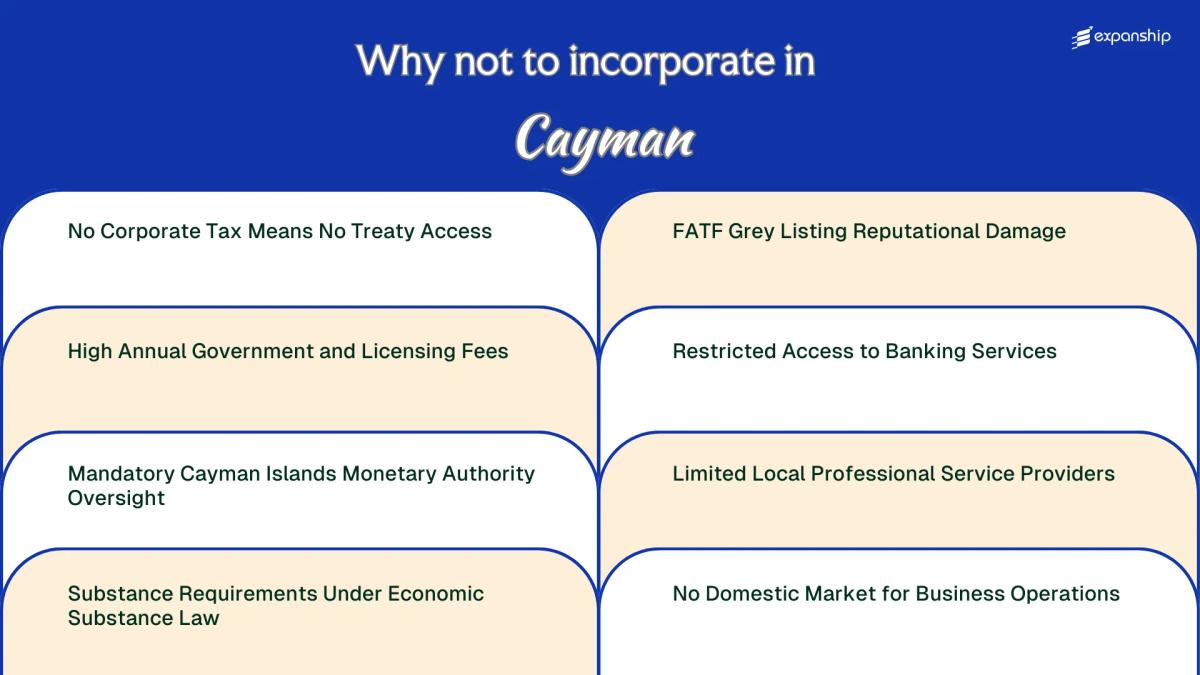
No Corporate Tax Means No Treaty Access
Cayman Islands no tax treaty access is a structural consequence of the territory's zero-tax regime, not an administrative oversight. Because the Cayman Islands levies no corporate income tax, it has no basis on which to negotiate or ratify double taxation agreements with other countries.
No Treaty Network Means No Withholding Tax Relief
Without a treaty network, dividends, royalties, and interest payments flowing from a treaty-dependent country to your Cayman entity are subject to full source-country withholding tax rates. A German company paying royalties to a Cayman-incorporated firm, for example, cannot apply a reduced treaty rate and must withhold at the domestic statutory rate instead.
This structural gap increases the total tax cost of cross-border income flows in ways that a jurisdiction with even a modest treaty network would avoid.
Practical Cost for Operating Businesses
For businesses routing real commercial income through a Cayman entity, the absence of treaty protection erodes the financial efficiency that the zero-tax offshore company structure was intended to produce.
Holding companies or IP-owning entities expecting to receive foreign-source income bear the full brunt of this limitation, since no domestic relief mechanism exists to recover excess withholding.
Foreign business owners must calculate the full withholding tax exposure at source before assuming that a zero-tax Cayman structure produces an overall tax saving.
High Annual Government and Licensing Fees
Cayman Islands high annual government fees represent one of the most immediate and predictable cost burdens for foreign business owners. An exempted company, the structure most commonly used by international investors, is subject to an annual government fee that scales with its authorised share capital and can reach into the thousands of US dollars each year.
These fees are not tied to revenue or activity. Your business pays the same amount whether it generated income or remained dormant, which is a structural cost with no flexibility.
Registered investment funds and licensed entities face additional renewal fees payable to the Cayman Islands Monetary Authority, compounding the annual overhead considerably.
In practice, this creates several layers of recurring cost friction:
- Your company renewal fees increase if you raise authorised share capital, turning a routine corporate restructuring into a direct cost trigger
- Licensed fund structures must budget for CIMA renewal fees on top of standard government dues, a dual-fee obligation not present in lower-cost offshore alternatives
- Failure to pay annual fees on time risks administrative strike-off under the Companies Act, requiring reinstatement procedures that add professional and filing costs
- Even a dormant entity with no operations must maintain full fee payments to preserve its legal standing
Small to mid-sized businesses with limited transaction volumes are disproportionately affected, since the fee structure does not distinguish between high-activity and inactive entities.
 Cayman
 Cayman Islands Company Incorporation
Understand the full cost structure before setting up your exempted company in the Cayman Islands.
Mandatory Cayman Islands Monetary Authority Oversight
Any fund, bank, trust company, insurance firm, or securities business operating in the jurisdiction falls under the supervision of the Cayman Islands Monetary Authority, known as CIMA. For foreign business owners, Cayman Islands Monetary Authority oversight risks are not abstract. Licensing applications, ongoing reporting obligations, and the threat of regulatory action all translate directly into time and expenditure.
CIMA operates under the Monetary Authority Law (2020 Revision) and sector-specific statutes such as the Securities Investment Business Law and the Mutual Funds Law. Each regulated entity must meet licensing thresholds before commencing operations, and those thresholds carry both upfront costs and recurring compliance obligations.
| Entity Type | Governing Law | Annual Filing / Reporting Requirement | Consequence of Non-Compliance |
|---|---|---|---|
| Mutual Fund (Registered) | Mutual Funds Law | Annual audited financial statements required | Deregistration and potential CIMA enforcement action |
| Securities Business | Securities Investment Business Law | Ongoing CIMA reporting and capital adequacy rules | License suspension or revocation |
| Insurance Company | Insurance Law | Actuarial reports and annual returns to CIMA | Regulatory penalties and loss of license |
| Trust Company | Banks and Trust Companies Law | Periodic prudential returns to CIMA | Civil and criminal liability for directors |
Smaller foreign operators frequently underestimate the administrative load. Retaining qualified compliance officers and local counsel to satisfy CIMA reporting cycles adds recurring costs that are not offset by the absence of corporate tax.
CIMA also holds broad intervention powers, including the authority to appoint inspectors, issue directions, and apply to court for the winding up of non-compliant entities. These powers apply regardless of whether a firm has a physical presence locally. Entities that assumed light-touch oversight often encounter CIMA regulatory compliance challenges only after licensing is already granted, at a point when restructuring is expensive.
Substance Requirements Under Economic Substance Law
Cayman Islands economic substance requirements apply to any entity registered there that earns income from a "relevant activity." These activities include banking, insurance, fund management, financing and leasing, headquarters business, shipping, distribution and service centres, intellectual property, and holding company functions. Defined under the International Tax Co-operation (Economic Substance) Act, the law was enacted in 2019 in response to EU pressure on zero-tax jurisdictions.
For a foreign business owner, the compliance burden is direct and financial. Your entity must demonstrate adequate employees, physical premises, and management direction from within the jurisdiction — costs that erode the margin that made offshore incorporation attractive in the first place.
Failure to satisfy the test triggers escalating penalties and potential disclosure to foreign tax authorities. That reporting obligation specifically targets the jurisdiction where your beneficial owners are tax resident.
- Entities conducting relevant activities must file an annual economic substance notification with the Cayman Islands Tax Information Authority.
- Pure equity holding companies face a reduced but not eliminated substance test under the Act.
- Non-compliance penalties begin at CI$10,000 and can reach CI$100,000 in subsequent years.
- Spontaneous information exchange with foreign tax authorities is triggered upon a finding of non-compliance.
- The substance test requires demonstrable local direction and management, not merely a registered address.
Even a passive holding company with no active revenue stream must still file an economic substance notification each year — there is no blanket exemption for dormant entities.
FATF Grey Listing Reputational Damage
From 2021 to 2023, the Cayman Islands appeared on the FATF grey list, triggering Cayman Islands FATF grey listing reputational risk that persisted well beyond its formal removal. Even after delisting, correspondent banks, institutional investors, and fund administrators had already recalibrated their due diligence standards for entities incorporated there.
How Grey Listing Affected Institutional Perception
Being placed under FATF monitoring signaled deficiencies in the jurisdiction's anti-money laundering and counter-terrorist financing frameworks, prompting counterparties in the EU, UK, and US to apply enhanced due diligence to any associated entity. Your business may still face elevated scrutiny from financial institutions that maintain internal blacklists or risk appetite policies built during the grey-listing period.
The Residual Compliance Burden on Your Entity
The reputational damage embedded into banking and investor relationships does not reset automatically upon FATF delisting. Hedge funds, private equity structures, and SPVs domiciled there often report longer onboarding timelines and increased documentation requirements from prime brokers and custodians, translating directly into operational delays and added legal costs.
Cayman Addressing Incorporation Challenges in the Cayman Islands
Understand the regulatory and reputational risks associated with Cayman Islands incorporation before committing to a structure.
Restricted Access to Banking Services
Cayman Islands banking access restrictions affect offshore entities more acutely than those incorporated in jurisdictions with recognized tax treaties or OECD-whitelisted status. Opening and maintaining a corporate bank account presents structural obstacles that go beyond standard compliance requirements.
- Most international banks apply enhanced due diligence to Cayman-registered entities under their own internal risk policies, meaning your firm faces longer onboarding timelines and higher documentation burdens than companies incorporated in lower-risk jurisdictions.
- Correspondent banking relationships have contracted globally in response to FATF scrutiny, and Cayman companies bear the downstream consequence of reduced banking options in key financial hubs.
- Many retail and commercial banks in the United States, United Kingdom, and European Union decline to open accounts for offshore Cayman Islands corporate structures outright, regardless of the entity's actual business activity.
- Offshore Cayman Islands banking challenges are compounded by the absence of a bilateral tax information agreement with many banking jurisdictions, which some institutions treat as an automatic risk escalation factor.
- Accounts that are successfully opened often carry higher transaction fees, stricter wire transfer thresholds, or mandatory minimum deposit requirements compared to accounts held by onshore entities.
Limited Local Professional Service Providers
The pool of Cayman Islands limited professional service providers is small relative to major onshore financial centers. Only firms licensed under the Companies Management Law (2021 Revision) can act as registered agents or provide corporate administration services, which concentrates the market among a handful of established firms.
This concentration limits your negotiating position on fees and service terms. If your primary provider underperforms or exits the market, your options for switching are structurally narrow.
Specialist legal and accounting professionals with offshore-specific expertise also command premium rates. Cayman-qualified attorneys and licensed corporate service providers operate in a low-competition environment, and that pricing reflects it.
Registered agent availability is not the only constraint. Firms that can handle complex fund structuring, regulatory filings with the Cayman Islands Monetary Authority, and cross-border tax reporting simultaneously are few, and their capacity is often allocated to larger institutional clients first.
A foreign-owned exempted company requiring concurrent support on CIMA registration, economic substance filings, and AML compliance could face annual professional fees exceeding USD 15,000 to USD 25,000, depending on entity complexity, given the limited provider competition in the jurisdiction.
No Domestic Market for Business Operations
Cayman Islands no domestic market limitations are structural, not incidental. An exempted company incorporated under the Companies Act (2023 Revision) is legally prohibited from carrying on business within the jurisdiction. This restriction is a condition of the exempted company structure itself, not an oversight.
Your firm cannot sell goods or services locally, hire staff for local operations, or generate revenue from Cayman-resident clients without converting to a different entity type or obtaining a trade and business licence under the Trade and Business Licensing Act. That licensing pathway is narrow and primarily reserved for businesses serving the local population, which creates a hard ceiling on how the entity can be used.
For foreign owners expecting operational flexibility, this structure functions purely as a holding, financing, or investment vehicle. Any actual commercial activity must be conducted through entities established in other jurisdictions, adding administrative layers and associated costs to your overall structure.
- Exempted companies cannot employ local staff for operational roles without triggering separate regulatory obligations
- Revenue generated inside the territory risks invalidating the exempted status
- Local business activity requires a separate domestic company structure under Cayman law
If your business model involves any direct commercial activity, client servicing, or revenue generation in a single location, the exempted company structure will not accommodate that function legally without a separate entity and licensing approval.
Overcoming Cayman Incorporation Challenges
Overcoming Cayman Islands incorporation challenges requires structural planning, not just paperwork. The disadvantages covered in this blog, from economic substance obligations to banking access constraints, each have defined compliance pathways under existing law.
- Elect an appropriate legal vehicle, such as an Exempted Company under the Companies Act (As Revised), to align your structure with the intended business activity and ownership profile.
- Satisfy the Economic Substance Act requirements by ensuring your entity demonstrates genuine activity in its relevant sector, including qualified employees and physical presence where required.
- Register with the Cayman Islands Monetary Authority if your business engages in any regulated activity under the Monetary Authority Act or relevant sector legislation.
- Address FATF grey listing exposure by maintaining full beneficial ownership records on the General Registry as required under the Beneficial Ownership Transparency Act, 2023.
- Mitigate banking access difficulty by establishing accounts in jurisdictions with which your Cayman entity maintains documented operational ties.
These steps operate within a framework shaped by CIMA oversight and international reporting standards, including OECD Common Reporting Standard obligations. Structural compliance does not eliminate the jurisdiction's inherent limitations, but it does reduce regulatory and reputational exposure.
Cayman Islands Still a Viable Option
The Cayman Islands exempted company structure retains genuine utility for foreign businesses despite the disadvantages covered in this blog. Reputational headwinds from the FATF grey listing, combined with substance requirements under the International Tax Co-Operation (Economic Substance) Act, have raised the cost and complexity of maintaining a compliant entity here. Whether those trade-offs are acceptable depends on your business model and operational reality.
| Pros | Cons |
|---|---|
| No corporate income tax, capital gains tax, or withholding tax on profits | Zero-tax status bars access to double tax treaty networks |
| The Companies Act provides a well-established legal framework for exempted companies | Annual government and registered office fees are among the higher-cost jurisdictions globally |
| Recognised financial centre with an established base of funds and structured finance activity | FATF grey listing has damaged correspondent banking relationships and raises due diligence burdens |
| Regulatory oversight by CIMA provides institutional credibility | Substance requirements under the Economic Substance Act demand genuine local activity for relevant entities |
| Neutral jurisdiction with no foreign exchange controls | Limited domestic market means all revenue-generating activity must originate abroad |
Remaining viable does not mean remaining simple. The compliance burden has grown materially since 2020, and banking access continues to present practical obstacles for newly incorporated entities.
Cayman Compliance Services for Companies in the Cayman Islands
Maintain good standing under the Companies Act, meet Economic Substance Act obligations, and manage CIMA-related filings through a structured compliance programme.
Conclusion
A Cayman Islands incorporation risks summary must account for the structural limitations that come with the jurisdiction's zero-tax model. FATF grey listing has complicated banking access, and Economic Substance Law obligations under the Private Funds Act and other sector-specific regulations impose real operational demands. Addressing these disadvantages requires accurate entity setup, ongoing regulatory compliance, and direct engagement with service providers who understand CIMA's requirements. Professional guidance specific to Cayman structures remains the practical path forward for any business weighing this option.
Expanship Powers Your Cayman Islands Setup
Incorporating in the Cayman Islands brings real administrative weight, from satisfying CIMA's licensing thresholds to demonstrating genuine economic substance under the Private Funds Act and International Tax Co-operation (Economic Substance) Act. As your Cayman Islands company setup service provider, Expanship works alongside you to manage that compliance burden so your team is not spending time deciphering regulatory correspondence or missing government filing deadlines.
Our service scope covers the full incorporation and post-incorporation cycle:
- Your company registration and corporate document preparation are handled end to end.
- A registered agent and registered office in the Cayman Islands are provided to meet statutory requirements.
- Government filings and direct liaison with the Cayman Islands General Registry and CIMA are managed on your behalf.
- Ongoing compliance obligations, including annual return submissions and fee payments, are tracked and executed.
- Banking introduction assistance connects your entity with institutions familiar with Cayman structures.
- Tax registration and coordination with relevant local authorities are managed as part of your setup.
Reach out to Expanship Cayman Islands to discuss your incorporation requirements.
Frequently Asked Questions (FAQ)
The Economic Substance Act (2021 Revision) applies to entities conducting one or more "relevant activities," which include fund management, banking, insurance, financing and leasing, headquarters business, shipping, and intellectual property holding. A pure equity holding company faces a lighter substance test, but it is not fully exempt. If your business falls within any listed category, you must demonstrate adequate physical presence, qualified staff, and decision-making in the Cayman Islands or face escalating penalties.
A first-year failure to satisfy the Economic Substance Act can result in a fine of up to CI$100,000, and a second-year breach can attract penalties of up to CI$500,000 along with potential strike-off of the entity. The Cayman Islands Tax Information Authority is the enforcement body and shares non-compliance findings with the tax authorities in the jurisdiction where your beneficial owners are resident. That information-sharing dimension turns a local compliance failure into a cross-border tax exposure.
Banking access for Cayman entities is broadly comparable to other jurisdictions on the FATF grey list, but the Cayman Islands carries higher scrutiny than, for example, the British Virgin Islands, because of its profile as a major fund domicile and the volume of international transactions flowing through Cayman structures. The combination of grey listing status and the entity's lack of a domestic banking market means you will almost certainly need to bank outside the islands, increasing your exposure to correspondent bank risk.
Failure to pay the annual government fee, which for most exempted companies is set at a fixed amount determined by the Companies Act (2023 Revision) based on authorised share capital, triggers a penalty surcharge and ultimately results in the company being struck off the register. Reinstatement is possible but requires payment of all outstanding fees, penalties, and a formal application. A struck-off company cannot legally conduct business or enter contracts during the period it is off the register.
No. The Cayman Islands has no corporate income tax and has not entered into any comprehensive double tax treaties with major economies, which means your entity has no treaty residence to invoke. Payments flowing into the structure from jurisdictions that levy withholding taxes on dividends, interest, or royalties will bear the full statutory rate applicable in the source country, with no treaty reduction available.
The Cayman Islands Monetary Authority requires licensed entities to maintain prescribed internal controls, submit audited financial statements, and notify CIMA of material changes to ownership, directors, or business scope. Ongoing compliance involves annual fees payable directly to CIMA, which are separate from government registry fees, and any breach of a licence condition can result in suspension or revocation. For smaller operations, the cost of maintaining these obligations, including the need for locally approved auditors and compliance officers, can be disproportionate to the business volume being generated.
Legal Disclaimer
The information provided in this article is for general informational purposes only and does not constitute legal, tax, or professional advice. While we strive to ensure the accuracy and timeliness of the content, laws and regulations are subject to change, and the application of laws can vary widely based on specific facts and circumstances.
Readers should not act upon this information without seeking professional counsel tailored to their individual situation. Expanship and its authors disclaim any liability for actions taken or not taken based on the content of this article.
For specific advice regarding your business setup, compliance requirements, or any legal matters, please consult with qualified legal and tax professionals in the relevant jurisdiction.