

Key Takeaways
- The Cayman Islands imposes no corporate income, capital gains, or inheritance taxes under the Tax Concessions Act, allowing businesses structured around cross-border investment or asset holding to retain earnings without domestic tax erosion.
- Exempted Companies incorporated under the Companies Act (2023 Revision) face no restrictions on foreign ownership, no requirement for local directors or shareholders, and no mandatory operational presence on the islands, making the structure fully accessible to international entrepreneurs and institutional investors.
- Because the jurisdiction's legal framework derives from English common law and is overseen by established bodies including the Cayman Islands Monetary Authority (CIMA), fund managers raising capital from US and European institutions benefit from a level of legal familiarity that reduces friction in investor due diligence.
- The absence of currency or exchange controls means businesses can move capital across borders without regulatory restriction, a material advantage for holding companies and trading entities managing multi-currency cash flows.
The Cayman Islands is a British Overseas Territory situated in the western Caribbean Sea, comprising three islands — Grand Cayman, Cayman Brac, and Little Cayman. As a territory of the United Kingdom, it operates under a stable legal system derived from English common law, with its own legislature and regulatory institutions. Company registration falls under the oversight of the Cayman Islands Registrar, which administers business formation under the Companies Act (2023 Revision).
Foreign businesses incorporating here most commonly do so through an Exempted Company. The territory maintains a zero-tax posture, imposing no income, corporate, or capital gains taxes on entities incorporated within its borders. There are no restrictions on foreign ownership, and the jurisdiction does not require local shareholders or directors, making it fully accessible to international entrepreneurs and institutional investors.
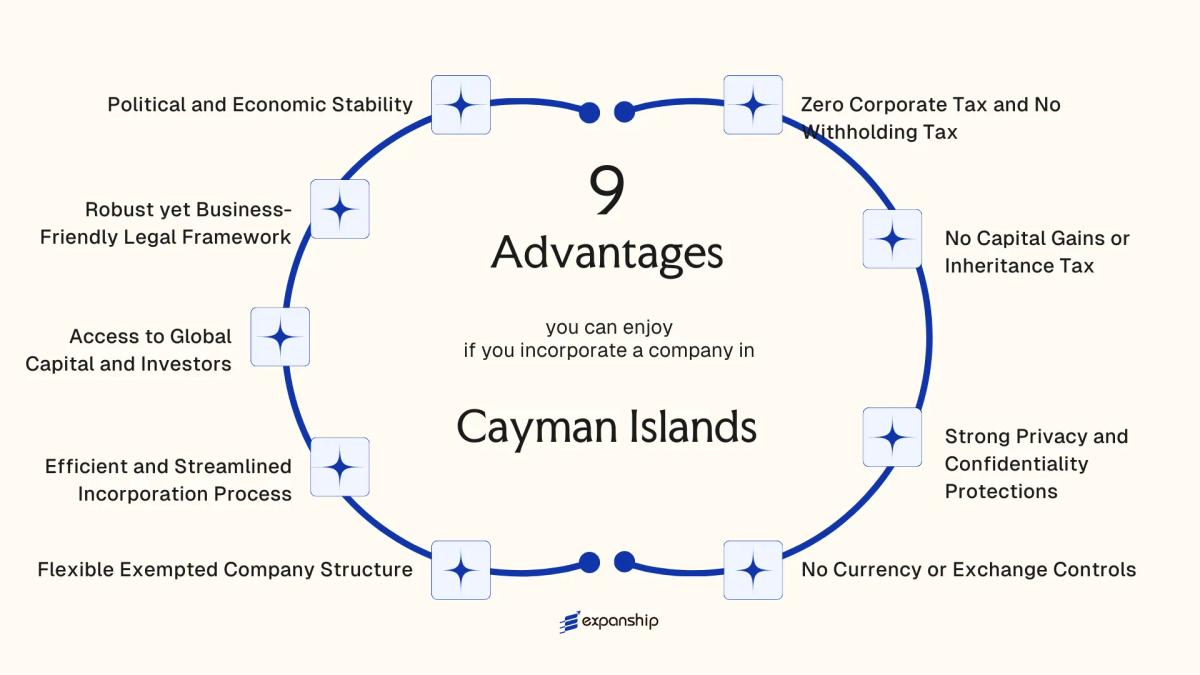
The benefits of incorporating in Cayman Islands span tax efficiency, structural flexibility, privacy, and access to international capital markets. This article examines the principal advantages that make Cayman Islands company formation a material consideration for businesses operating across borders.
Zero Corporate Tax and No Withholding Tax
Exempted companies incorporated in the Cayman Islands pay zero corporate income tax on profits, regardless of how much revenue the business generates or where it originates. This is not a reduced rate or a temporary relief — it is a structural feature of the jurisdiction's fiscal regime.
What the Exemption Covers
Under the Tax Concessions Act (as revised), an exempted company can apply for a formal undertaking from the Cayman Islands government guaranteeing exemption from any future taxation on income or profits for up to 30 years from the date of registration. Your firm retains its full earnings without any portion being deducted at the corporate level.
Distributions to shareholders are equally unaffected. No withholding tax applies to dividends, interest, or royalty payments made to non-resident shareholders, which means capital can flow out of the entity to foreign investors without any tax leakage at the source.
Why This Matters Structurally
For businesses that consolidate international revenue through a holding or fund structure, the absence of both taxes eliminates a layer of friction that would otherwise require treaty planning or entity restructuring. Compared to the OECD average corporate tax rate of approximately 23%, the differential is material.
Your company retains 100% of its profits at the corporate level, with no withholding tax reducing distributions to foreign shareholders.
No Capital Gains or Inheritance Tax
No capital gains tax in the Cayman Islands applies to all gains realized on the sale or disposal of shares, securities, real property, and other assets. There is no legislation imposing such a tax on either residents or exempted companies incorporated under the Companies Act (2023 Revision). For foreign investors and fund structures, this means profits realized on portfolio exits, asset disposals, or business sales are retained in full rather than reduced by a tax event at the entity level.
Inheritance tax is equally absent. Transfers of assets or ownership interests upon death carry no estate duty or succession tax liability under Cayman law. For family offices, holding structures, and generational wealth vehicles, this removes a category of tax exposure that exists in many OECD jurisdictions, where estate tax rates can exceed 40%.
The practical scope of these exemptions is broad:
- Gains on the disposal of fund interests are not subject to any local tax trigger, regardless of the asset class held
- Succession of shares in an exempted company passes without a local tax charge, simplifying estate planning across generations
- No distinction is drawn between short-term and long-term holding periods, so there is no incentive to delay asset sales for tax reasons
These exemptions apply under the Tax Concessions Act (2018 Revision), which grants a statutory undertaking to exempted companies confirming freedom from taxes on profits, capital gains, and other levies for a period of up to 20 years.
 Cayman
 Incorporate a Company in the Cayman Islands
Set up an exempted company in the Cayman Islands and access a zero capital gains and inheritance tax environment for your investment or holding structure.
Strong Privacy and Confidentiality Protections
Cayman Islands privacy protections for companies are grounded in statute, not discretionary policy. Under the Companies Act (2023 Revision), exempted companies are not required to file shareholder registers, director lists, or financial statements with any public registry. That means ownership and financial information remain outside the reach of public disclosure requirements by law.
This structural confidentiality has direct value for your business. Competitors, litigants, and unauthorized third parties cannot retrieve ownership or financial data through a routine registry search, because that data simply does not exist in any public database.
| Information Type | Public Disclosure Required | Filing Recipient |
|---|---|---|
| Shareholder Register | No | Held at registered office only |
| Director Register | No | Filed with Registrar, not public |
| Financial Statements | No | No public filing obligation |
| Beneficial Ownership | No (private regime) | Competent Authority only |
Beneficial ownership information is maintained through a private regime administered by the Cayman Islands Monetary Authority (CIMA) and accessible only to designated competent authorities for law enforcement or regulatory purposes. This differs from public registers now mandated in several EU member states.
Confidentiality under the Confidential Information Disclosure Act (2016) further restricts unauthorized disclosure of business information by service providers, carrying criminal penalties for breach. For business owners who require structural privacy without sacrificing legal standing, this framework provides a defined and enforceable basis.
No Currency or Exchange Controls
No currency controls Cayman Islands business owners benefit from means capital can move in and out of the jurisdiction without restriction. There is no legislation imposing exchange controls on companies incorporated under the Companies Act (2023 Revision). Funds raised overseas can be held, deployed, or repatriated in any currency without prior regulatory approval.
For an exempted company conducting business internationally, this translates directly into operational flexibility. Treasury functions can be managed centrally without structuring transactions around approval thresholds or reporting windows that exist in jurisdictions like India, China, or Brazil, where outbound capital transfers are subject to government review.
Under the Monetary Authority framework administered by the Cayman Islands Monetary Authority (CIMA), there is no prescribed functional currency requirement. Your firm can maintain accounts and settle obligations in USD, EUR, GBP, or any other currency relevant to its business.
Keep the following in mind to maintain this freedom without complication:
- Ensure your exempted company conducts no local business within the Islands, as that status underpins the absence of exchange restrictions
- Maintain proper banking records in your operating currencies for AML compliance purposes
- Verify that your home jurisdiction does not impose outbound investment restrictions that apply independently
Despite having no exchange controls, CIMA maintains a regulated financial services sector that is fully FATF-compliant, meaning free capital movement operates alongside internationally recognised anti-money laundering standards, not in absence of them.
Flexible Exempted Company Structure
The Cayman Islands exempted company is the dominant vehicle for international business and investment funds, and its structural design is a direct expression of that purpose. Governed by the Companies Act (2023 Revision), this entity type is specifically built for foreign-owned operations that conduct business outside the jurisdiction, which means its rules are calibrated to serve international use rather than domestic regulation.
Shareholder and Capital Flexibility
An exempted company can be incorporated with a single shareholder and a single director, removing the multi-party requirements that many civil law jurisdictions impose. Share capital can be denominated in any currency, with no minimum paid-up capital requirement, so your firm can structure its capitalization to match the functional currency of its actual operations.
Shares can be issued in multiple classes with differing economic and voting rights, and the company's articles of association can be drafted to accommodate complex equity arrangements. This flexibility matters particularly for venture-backed structures, joint ventures, and investment vehicles where different investor tiers require distinct rights.
Governance and Operational Adaptability
An exempted company is not required to hold annual general meetings in the Cayman Islands, and resolutions can be passed by written consent. Directors can be located anywhere in the world, meaning your governance structure does not need to be anchored locally.
The Cayman Islands flexible corporate structure for foreign investors also permits a company to migrate in or redomicile out under Part XVI of the Companies Act, preserving corporate continuity without dissolution and re-incorporation elsewhere.
Cayman Structure Your Cayman Exempted Company Correctly
Speak with Expanship's corporate specialists about configuring your exempted company's share classes, governance framework, and compliance obligations under the Companies Act.
Efficient and Streamlined Incorporation Process
Registering a company through the Cayman Islands Registrar of Companies is a process designed to avoid unnecessary delays. For an exempted company, which is the structure most commonly used by foreign-owned businesses, incorporation can typically be completed within one to two business days once documentation is submitted. This speed is not incidental; it reflects a deliberately minimal set of registration requirements that do not impose the administrative burdens found in many onshore jurisdictions.
- No requirement to file details of directors or shareholders in a public register means your business can be operational without exposing ownership information during the formation process itself.
- The Companies Act (2023 Revision) does not require a local resident director, removing the time and cost of sourcing in-country personnel before the entity can be formally registered.
- There is no minimum capital requirement for an exempted company, so the entity can be incorporated and ready to conduct business without funds being tied up in a statutory reserve.
- Standard government fees are fixed and predictable, which allows your legal and formation costs to be budgeted accurately from the outset.
The cumulative effect is that a foreign founder or fund manager can establish a functioning legal entity quickly, without waiting on regulatory pre-approvals or navigating multi-stage government review processes that are common in EU and Commonwealth jurisdictions.
Access to Global Capital and Investors
Cayman Islands access to global capital markets is a structural reality, not a byproduct of reputation alone. The jurisdiction is the dominant global domicile for hedge funds, private equity vehicles, and alternative investment funds, with the Cayman Islands Monetary Authority (CIMA) overseeing a regulated fund sector that institutional investors across North America, Europe, and Asia already recognize and accept.
Funds registered under the Mutual Funds Act or the Private Funds Act carry a CIMA-regulated status that satisfies due diligence requirements for major institutional allocators. This recognition removes a significant barrier for managers raising capital from pension funds, endowments, and sovereign wealth funds, which often cannot allocate to vehicles domiciled in unrecognized or lightly regulated offshore jurisdictions.
The Cayman Stock Exchange (CSX) provides a listing venue specifically designed for debt instruments, fund shares, and structured products. Listing on the CSX can satisfy certain investor mandates that require publicly listed vehicles, expanding the pool of eligible capital sources.
A 2023 industry estimate cited by the Cayman Finance association indicated that over 85% of the world's hedge funds are domiciled in the Cayman Islands, reflecting the concentration of institutional fund infrastructure in the jurisdiction.
Robust yet Business-Friendly Legal Framework
The Cayman Islands business-friendly legal framework is grounded in English common law, which gives foreign investors a familiar and well-tested legal foundation. Grand Court decisions can be appealed through to the UK Privy Council, providing access to one of the most authoritative appellate bodies in the world.
The Companies Act (2023 Revision) governs exempted companies and sets clear rules on corporate capacity, director duties, and shareholder rights. Because the statute has been refined over decades of commercial use, it contains fewer ambiguities than company laws in newer offshore jurisdictions, reducing the risk of unexpected legal exposure for your business.
Judicial independence is a structural feature here, not a convention. The Financial Services Division of the Grand Court handles complex commercial disputes with judges who have significant experience in international finance and fund litigation. This specialization means disputes involving fund structures, SPVs, or cross-border transactions are resolved by judges familiar with the instruments at issue.
- Court proceedings can be conducted in English, removing translation-related procedural delays
- Cayman Islands law is widely accepted by institutional lenders and counterparties as governing law in international financing agreements
Exempted companies are generally prohibited from carrying on business within the Cayman Islands itself, so confirm your intended activities align with this restriction before structuring around this entity type.
Political and Economic Stability
The Cayman Islands political stability for business is grounded in its constitutional status as a British Overseas Territory. Governed under the Cayman Islands Constitution Order 2009, the territory operates with its own elected Legislative Assembly and Cabinet while the United Kingdom retains responsibility for defense and foreign affairs. This arrangement has remained unchanged in its fundamental structure for decades, giving foreign-owned entities a predictable operating environment.
Political continuity directly reduces sovereign risk. For investment funds, holding companies, and special purpose vehicles registered here, the absence of political upheaval means the regulatory and legal framework does not shift unpredictably between administrations.
The territory's legal system is based on English common law, with appeals ultimately heard by the Judicial Committee of the Privy Council in London. Access to that appellate structure gives dispute resolution a level of consistency that purely domestic court systems in smaller jurisdictions often cannot offer.
From an economic standpoint, the Cayman Islands stable business environment benefits from a currency pegged to the US dollar at a fixed rate of KYD 1 to USD 1.20, a rate that has held since 1974. This peg eliminates exchange rate volatility between the Cayman dollar and the world's primary reserve currency, which matters directly when structuring cross-border transactions.
Key economic stability indicators include:
- No public debt burden that could trigger fiscal instability or sudden tax introduction
- The Cayman Islands Monetary Authority (CIMA) maintains regulated oversight of financial services
- Formal compliance with FATF standards, reducing the risk of regulatory blacklisting
Why the Cayman Islands Outperforms Other Offshore Jurisdictions
Comparing the Cayman Islands vs other offshore jurisdictions reveals a pattern worth examining before making a final incorporation decision. The three jurisdictions most frequently considered alongside the Caymans are the British Virgin Islands, Bermuda, and Luxembourg. The BVI shares a similar Caribbean common law foundation and targets overlapping investor profiles. Bermuda competes directly for insurance, reinsurance, and investment fund mandates. Luxembourg, while onshore EU, draws capital from institutional investors who weigh it against offshore alternatives for fund structuring. Measured against these three, the official CIMA page regulatory framework and absence of direct taxation hold up consistently across multiple parameters.
What the table below cannot convey is the cumulative effect of these features operating together. A jurisdiction may match on one parameter, such as zero corporate tax, but fall short on fund regulation depth, legal precedent, or the volume of institutional capital already operating within its framework. The Cayman Islands benefits from decades of established case law under the Grand Court, a large pool of experienced local practitioners, and CIMA's internationally recognised supervisory standards, all of which reduce structural and operational uncertainty for foreign businesses.
| Parameter | Cayman Islands | BVI | Bermuda | Luxembourg |
|---|---|---|---|---|
| Corporate Income Tax | 0% | 0% | 0% | 17% standard rate |
| Capital Gains Tax | None | None | None | Applicable in certain circumstances |
| Withholding Tax on Distributions | None | None | None | Applicable to non-treaty residents |
| Primary Fund Vehicle | Exempted Limited Partnership, SPC | Limited Partnership | Exempted Partnership | SICAV, RAIF |
| Fund Regulatory Body | CIMA | FSC | BMA | CSSF |
| Legal System | English Common Law (Grand Court) | English Common Law | English Common Law | Civil Law (EU-based) |
| Exchange Controls | None | None | None | None (EU framework applies) |
| Beneficial Ownership Public Register | No (private register held by CIMA) | Transitional, not yet fully public | No | Yes (EU directive requirement) |
| FATF Status | Compliant | Compliant | Compliant | Compliant |
Cayman Compliance Services for Cayman Islands Companies
Maintain your Cayman Islands company's good standing with annual filings, economic substance assessments, and CIMA reporting support.
Conclusion
The core case for Cayman Islands company formation rests on a combination of factors that are difficult to replicate elsewhere: a zero-tax environment codified under the Tax Concessions Act, a well-established Exempted Company structure that imposes no operational requirements on foreign business activity, and a legal system grounded in English common law that institutional investors and fund managers recognise and trust.
Your specific structure, industry, and investor base will determine how much weight each of these factors carries. A fund manager raising capital from US and European institutions will find the jurisdiction's legal familiarity and regulatory neutrality more material than, say, a holding company owner whose primary concern is inheritance tax exposure or the absence of exchange controls.
Incorporating here is not a universal solution, but for businesses structured around cross-border investment, international trade, or asset holding, the benefits of incorporating in Cayman Islands align closely with how modern international business operates. The next step is matching those structural advantages to your specific corporate requirements, a process that benefits from qualified guidance on entity selection, registered office obligations under the Companies Act (2023 Revision), and ongoing compliance with CIMA or CIMA-adjacent reporting where applicable.
Start Your Cayman Islands Company with Expanship Today
When you decide to start a Cayman Islands company with Expanship, you engage a service structured around the specific requirements of the Companies Act (2023 Revision) and the regulatory expectations of the Cayman Islands Registrar of Companies. From Exempted Company formation to ongoing compliance under the Companies Act and the Economic Substance Act, the support covers the actual obligations a foreign business owner faces after incorporation.
Expanship's service scope across this jurisdiction includes:
- Preparation and legalization of incorporation documents, including Memorandum and Articles of Association
- Provision of a licensed registered agent and registered office address, as required under the Companies Act
- Filing and direct liaison with the Cayman Islands Registrar of Companies
- Post-incorporation compliance management, including annual return filings and economic substance assessments
- Director and shareholder register maintenance in accordance with statutory requirements
- Banking introduction assistance to support account establishment with regional and international financial institutions
Reach out to Expanship Cayman Islands to discuss the structure that fits your operational and compliance requirements.
Frequently Asked Questions (FAQ)
The corporate tax rate is zero. Exempted Companies can apply for a Tax Exemption Certificate under the Tax Concessions Act (As Revised), which guarantees exemption from any future corporate income tax, withholding tax, or capital gains tax for up to 50 years from the date of issue. This statutory guarantee provides long-term certainty rather than relying solely on current policy.
A physical office is not required, though a registered office address in the jurisdiction must be maintained through a licensed registered agent. There is no statutory requirement for a local director under the Companies Act (As Revised), meaning your board can be entirely non-resident.
The Cayman Islands Monetary Authority (CIMA) regulates entities that conduct regulated activities, including mutual funds and private funds registered under the Mutual Funds Act (As Revised) and the Private Funds Act (As Revised). A standard Exempted Company used purely as a holding structure or for general commercial purposes does not require CIMA licensing, though any fund-related activity triggers registration obligations.
An Exempted Company that has obtained a Tax Exemption Certificate under the Tax Concessions Act (As Revised) is contractually protected against such a change for the duration of the certificate, currently up to 50 years. This statutory undertaking binds the government, providing a legal safeguard rather than a discretionary policy position.
Standard incorporation is generally completed within one to three business days once all required documentation has been submitted to the Registrar of Companies. Expedited processing is available for an additional government fee, which can reduce turnaround to within 24 hours. Exact timelines depend on the completeness of the submitted documents and current registry volumes.
The jurisdiction has adopted the OECD Common Reporting Standard (CRS), participates in the Foreign Account Tax Compliance Act (FATCA) framework with the United States, and is compliant with Financial Action Task Force (FATF) recommendations. This regulatory standing generally supports access to correspondent banking relationships, as international banks apply lower due diligence risk ratings to entities from jurisdictions with demonstrable compliance records.
Legal Disclaimer
The information provided in this article is for general informational purposes only and does not constitute legal, tax, or professional advice. While we strive to ensure the accuracy and timeliness of the content, laws and regulations are subject to change, and the application of laws can vary widely based on specific facts and circumstances.
Readers should not act upon this information without seeking professional counsel tailored to their individual situation. Expanship and its authors disclaim any liability for actions taken or not taken based on the content of this article.
For specific advice regarding your business setup, compliance requirements, or any legal matters, please consult with qualified legal and tax professionals in the relevant jurisdiction.