Corporate Services Built for Substance to Establish Your Presence in the Cayman Islands
Cayman is where funds, holding companies, and serious structures are set up, and the upkeep is as important as the launch. Our specialists guide your setup and manage the annual filings, accounts, governance, and records that keep it in order.
Expanship is a privately owned company. We are not a government agency, department, registry or regulator, and we are not affiliated with, endorsed by, or acting for the Government of the Cayman Islands, the Cayman Islands Monetary Authority, or the General Registry. We advise you, prepare and coordinate your paperwork, and act on your behalf; whether a company or document is approved, and when, is decided by those authorities alone.
The Jurisdiction
What the Cayman Islands offers a company
KY
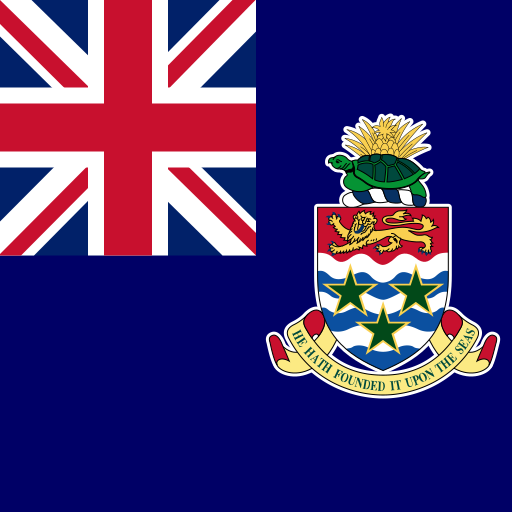
Cayman IslandsOverseas Territory of the United Kingdom
Legal system
English common law
Company law
Companies Act (2025 Revision)
Final appeal
Privy Council, London
Currency
Cayman Islands dollar, pegged to the US dollar
Exchange controls
None
Local presence required
Registered office with a corporate services provider
Companies authority
Registrar of Companies
Regulator
Cayman Islands Monetary Authority
The law
The common law that institutional counsel expects
Your company is governed by English common law under a Companies Act revised continuously, and the final appeal is heard by the Judicial Committee of the Privy Council in London. It is the body of law that fund managers, lenders and their counsel already draft against, which is why Cayman documents rarely need explaining.
The money
A pegged currency, and no permits
The Cayman Islands dollar is pegged to the United States dollar, and there are no exchange controls. The company holds and moves funds in any currency, in and out, without a permit from the territory.
The records
Members closed, directors behind a paid search
The register of members is closed to public inspection and beneficial owners are held for competent authorities only. Director names can be obtained only through a paid company search; the full list is not public and nothing is browsable.
The presence
A registered office, held by a corporate services provider
The local presence is a registered office maintained by a corporate services provider. There is no resident director test and no resident shareholder test, and the company is not obliged to take space or employ anyone in the islands.
The year
January carries most of it
The economic substance notification and the annual return with the government fee both fall due on 31 January, the return carrying a grace period to 31 March. The economic substance return, where the company has a reportable activity, follows within twelve months of the financial year end. There is no audit and no tax return for an ordinary exempted company.
Our services
What we do for a Cayman Islands company
Formation, compliance, secretarial work and local presence for a Cayman Islands company, each on its own page. Follow a branch for the detail.
The company
Your Cayman Islands company
Formed once through a corporate services provider in the islands, whichever of the two structures you choose, then maintained by us through each January that follows.
Our assessment of the Cayman Islands on twenty measures across five categories, each scored out of ten, alongside what the international bodies that review the territory currently record.
Privacy & Confidentiality
Privacy Score7.0
Director Anonymity7.5
Beneficial Ownership7.0
Information Exchange7.0
Average7.1
Banking & Financial
Banking Acceptance9.5
Financial Reputation9.5
Currency Freedom9.5
Banking Partnerships9.5
Average9.5
Regulatory & Compliance
Regulatory Framework9.5
OECD Compliance8.5
EU Recognition9.5
FATCA/CRS Compliance9.5
Average9.3
Business Environment
Incorporation Speed9.5
Tax Efficiency10.0
Political Stability9.5
Legal System9.5
Average9.6
International Recognition
Global Reputation9.5
Treaty Network4.0
Trade Relations7.0
Diplomatic Status8.5
Average7.3
Compare with
JurisdictionOverall /10
Anguilla7.6
Bahamas8.4
Belize7.3
British Virgin Islands8.1
Cyprus8.2
Marshall Islands7.8
Mauritius8.0
Panama7.7
Saint Kitts and Nevis8.1
Saint Vincent and the Grenadines7.8
Samoa7.5
Seychelles7.6
Cayman Islands scores 8.6 overall
Cayman Islands
Privacy & Confidentiality
What the beneficial ownership register holds, who is allowed to see it, and what leaves the jurisdiction automatically each year.
Score out of ten
Privacy Score
Balanced transparency with strong compliance
7.0
Director Anonymity
Filed with the authorities, paid search only
7.5
Beneficial Ownership
Central record, authority access
7.0
Information Exchange
Full CRS/FATCA compliance, automatic exchange
7.0
Banking & Financial
How readily international banks open and hold accounts for entities formed here, and how freely money moves once they do.
Score out of ten
Banking Acceptance
Strong acceptance worldwide
9.5
Financial Reputation
Widely used domicile for investment funds
9.5
Currency Freedom
KYD pegged to USD, no exchange controls
9.5
Banking Partnerships
Strong domestic sector, global correspondent network
9.5
Regulatory & Compliance
The governing law, the bodies that supervise it, and where the jurisdiction sits on the international tax and transparency regimes.
Score out of ten
Regulatory Framework
Mature regulatory infrastructure
9.5
OECD Compliance
Largely Compliant rating
8.5
EU Recognition
Not on EU Annex I or Annex II
9.5
FATCA/CRS Compliance
Full compliance, established infrastructure
9.5
Business Environment
What it takes to form and run an entity here: how fast, what it is taxed, and how stable the law behind it has proved.
Score out of ten
Incorporation Speed
1-2 days standard, same-day available
9.5
Tax Efficiency
0% corporate tax, exemption undertaking available
10.0
Political Stability
Stable British Overseas Territory
9.5
Legal System
English common law, Privy Council appeals
9.5
International Recognition
How the jurisdiction is regarded outside its own borders, and how far its treaty and trade arrangements actually reach.
Score out of ten
Global Reputation
Widely recognised offshore financial centre
9.5
Treaty Network
TIEAs only, very limited DTAs
4.0
Trade Relations
British territory benefits, limited independent access
7.0
Diplomatic Status
British Overseas Territory standing
8.5
OECD Global Forum and Inclusive Framework
4
Exchange of information rating
Largely CompliantGlobal Forum peer review
Base erosion and profit shifting
ImplementedInclusive Framework
Country-by-country reporting
Early adopterIn force
Multilateral Instrument
SignatoryMultilateral
Financial Action Task Force and its Caribbean body
4
Increased monitoring
Removed October 2023All strategic deficiencies addressed
Regional membership
MemberCaribbean Financial Action Task Force
Beneficial ownership
Framework in forceComprehensive regime
Next mutual evaluation
Fifth roundScheduled 2026
Account reporting regimes
4
Foreign Account Tax Compliance Act
Model 1 agreementIn force since 2013
Common Reporting Standard
ExchangingOver 100 jurisdictions
Competent authority
Tax Information AuthorityManages all exchanges
Crypto-Asset Reporting Framework
CommittedAdoption pending
Tax cooperation instruments
4
Tax information exchange agreements
Over 30 in forceBilateral
Mutual Administrative Assistance Convention
In forceMultilateral
Double taxation agreement
United KingdomWith extensions
Regional tax administration
MemberCaribbean Association of Tax Administrators
European Union
1
List of non-cooperative jurisdictions
Not listedNeither Annex I nor Annex II
Domestic supervision
3
Financial services supervision
Monetary AuthorityCIMA, supervision and oversight
Fund law
Mutual Funds Act and Private Funds ActGoverning statutes
Regulated investment funds
Over 100,000Under Monetary Authority supervision
Start your company
Two Cayman Islands structures, and what the law asks of each
Whichever you choose, the formation is one piece of work with one fee. The company then holds a registered office in the islands for as long as it exists, and three further arrangements are yours to take or leave.
Already have a Cayman company with another provider? Bring it to us for US$350, one time. Its registration number, its date of formation and its contracts do not change. About transferring your company→
The package price includes the government fees, which are set by the Cayman Islands authorities and passed on at cost. The rest is our fee for advising you, preparing and coordinating your paperwork, and handling the incorporation on your behalf; whether the company is approved, and when, is decided by those authorities alone.
Hold a presence in the islands
Two things the company must have for as long as it exists: an address in the islands, and a corporate services provider standing behind it. Both are covered for your first year inside the formation fee, and both renew annually after that.
Appointment A
Registered agent
A Cayman company holds its registered office through a corporate services provider in the islands. The provider receives what the authority sends, keeps the statutory records and stays on the record. We put that appointment in place and keep it current.
A street address in George Town that is recorded as your company’s address. A post box or an address outside the islands does not satisfy the Companies Act. Your statutory records are held there and your correspondence is forwarded on.
A governance decision taken at formation, not an extra bought afterwards. Two separate arrangements, each documented before any share or interest is issued.
A bank needs the company to exist before it will open an account, which is why this sits outside the formation. Every package already carries an assisted opening with a digital provider; a bank account is arranged on its own.
Opening
Usually remoteA few banks ask for a call. We say which, first.
The papers
Assembled by usCompany documents, IDs, what the business does.
The decision
The bank’sOn its own timetable, in weeks rather than days.
Commonly opened inSingapore, Hong Kong, Europe, the United States, or with a digital provider. Cayman has a banking sector of its own, no requirement to use it, and no exchange controls either way.
A Cayman company is formed once and maintained for as long as you own it. Most of its year falls in January, and we hold that work under one annual package with a page for each part.
01
The filings
Documents that leave your company on dates the islands set. Each one is drafted from records we already hold, sent to you for a single approval, and filed.
13jurisdictions, should the next company be elsewhere
Why Expanship
Set up with care. Kept in order every year.
Cayman expects a company to be kept properly: the annual return, the substance filing, the books and the local office. The same team that set yours up looks after all of it, at one price agreed before we started.
One price
Same team
What every engagement includes
One price, agreed first
The setup, the local office and the year’s filings in one figure, agreed first.
A named contact
One person who knows your file and answers for it, not a ticket queue.
A written checklist
What we need from you, and what happens next, set out before the work starts.
The same team, every year
Annual return, substance filing, ownership and records, by the people who set it up.
Nothing to travel for
Onboarding to signing, all online. No trip to the islands unless the law demands one.
Your information, handled
Strict security protocols and professional confidentiality throughout the process.
The jurisdiction in six questions, and working with us in four.
About the jurisdiction
Because its company law is the one fund managers, lenders and their counsel already draft against. Cayman documents rarely need explaining to institutional counterparties, the jurisdiction has a mature regulator and its own banking sector, and there is no direct tax. It costs more than smaller jurisdictions, and that is part of what is being bought.
English common law, under a Companies Act revised continuously, most recently in 2025. The final appeal lies to the Judicial Committee of the Privy Council in London.
No. The Cayman Islands has no corporate income tax, no capital gains tax and no withholding tax. A company pays an annual government fee. A tax exemption undertaking, usually for twenty years, can be applied for, and whether it is granted is the government's decision.
The Cayman Islands is on neither EU list and was removed from FATF increased monitoring in October 2023. The OECD Global Forum rates it Largely Compliant, and the next FATF mutual evaluation is scheduled for 2026.
Very little. The list of members is closed to public inspection and beneficial ownership is held for the authorities only. Director names can be obtained through a paid company search, but nothing is browsable and there is no public list.
Yes. A Cayman company can be wholly owned by non-residents, with no local shareholder requirement and no resident director test. The registered office, held through a corporate services provider in the islands, is the only local presence.
Working with us
The economic substance notification and the annual return, with the government fee, both fall due on 31 January, with a grace period to 31 March for the return. Where the company carries on a relevant activity, a fuller substance return follows within twelve months of the year end. There is no audit and no tax return for an ordinary company.
Yes. The company needs a registered office in the islands, which we hold for you through a corporate services provider, and nothing else local. Directors and shareholders can be anywhere, and the company need not take space or employ anyone in Cayman.
Yes, in Cayman or abroad. Accounts are commonly opened in Singapore, Hong Kong, Europe or the United States, or with a digital provider. There is no requirement to use the local banking sector and no exchange controls. We prepare the file and the bank decides.
Cayman is the most expensive jurisdiction in our range, and the fees reflect that. Formation starts from US$2,749, including the government fee, the first year's registered office and the company documents, and the annual package starts from US$2,749 a year. Our fee and the government's are shown separately on the pricing page.
No. Expanship is a privately owned company. We are not a government agency, department, registry or regulator, and we are not affiliated with, endorsed by, or acting for the Government of the Cayman Islands, the Cayman Islands Monetary Authority, or the General Registry. We advise you, prepare and coordinate your paperwork, and act on your behalf. Whether a company or document is approved, and when, is decided by those authorities alone.
Our own work: advice on the right structure and the right service, due diligence on every member, preparing and coordinating your paperwork, and handling your incorporation, annual compliance and company changes on your behalf. Where a package includes government fees, they are set by the Cayman Islands authorities, not by us, and are passed on at cost; where it does not, they are quoted separately before you commit.
Contact Us
Speak with our Cayman team
Funds, holding companies, substance, and the annual upkeep of a Cayman entity. Describe what you are planning and a specialist will respond.
Expanship is a private company, not a government agency. Submitting this form requests a consultation with our advisors; it does not place an order, start an incorporation, or create a professional relationship, and nothing we reply with is legal, tax, or financial advice.