

Key Takeaways
- Foreign investors must comply with ownership restrictions and additional licensing conditions imposed under the Market Access List established by the Law on Investment (Law No. 61/2020/QH14) before a registration application can be accepted for conditional business lines.
- Every enterprise operating in Vietnam is required to maintain a registered office address within the country's territory, and failure to meet this obligation post-incorporation can result in revocation of the enterprise registration certificate.
- Unlike many common law jurisdictions, Vietnam's Law on Enterprises (Law No. 59/2020/QH14) imposes no statutory requirement to appoint a corporate secretary, making this a structurally distinct compliance consideration for foreign investors familiar with other frameworks.
- Registration applications are submitted through the National Business Registration Portal under the Ministry of Planning and Investment, and applications that do not satisfy the documentary and structural requirements specific to the chosen entity type will be rejected.
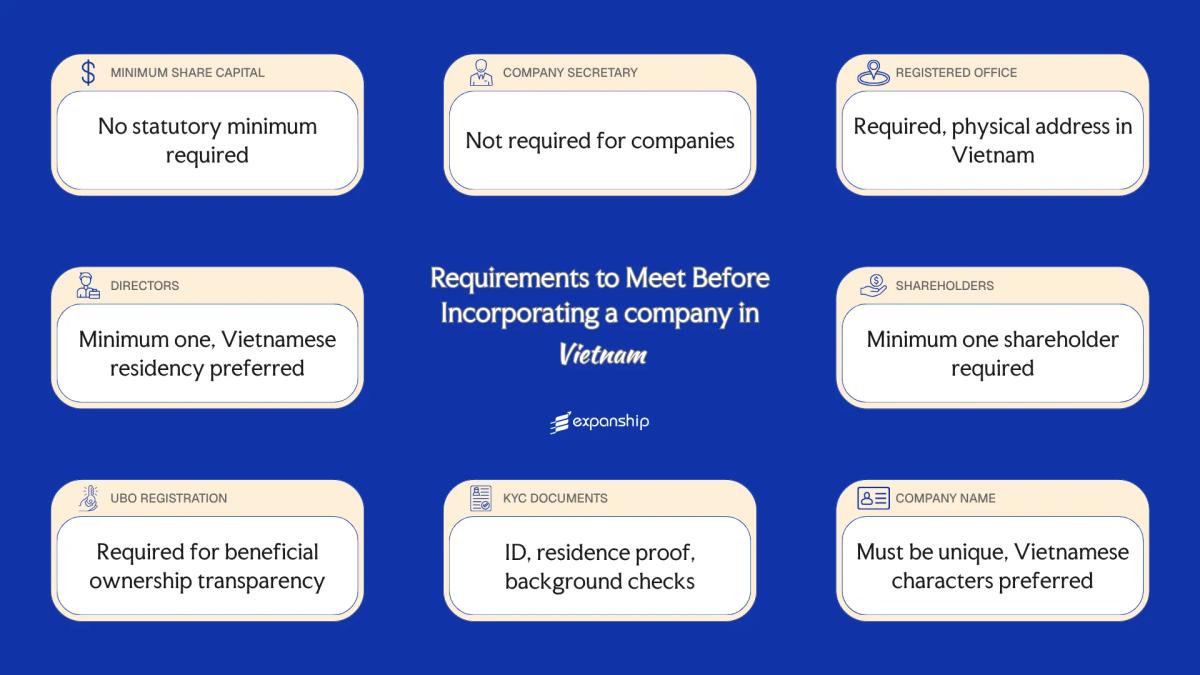
Incorporation requirements in Vietnam are governed primarily by the Law on Enterprises (Law No. 59/2020/QH14) and the Law on Investment (Law No. 61/2020/QH14), with the Business Registration Portal under the Ministry of Planning and Investment serving as the central registration authority. This article covers the structural, documentary, and compliance requirements applicable to entities establishing a legal presence in the country.
Failure to meet these requirements results in rejection of the registration application or, where non-compliance occurs post-incorporation, potential revocation of the enterprise registration certificate.
Specific requirements differ depending on the chosen entity type, the industry sector, and whether the investor is a foreign national or a foreign-owned entity, as certain sectors are subject to additional conditions under the Market Access List.
Foreign investors, particularly those entering for the first time without an existing local presence, will find this article most directly relevant to their Vietnam business setup requirements.
Minimum Share Capital Requirements in Vietnam
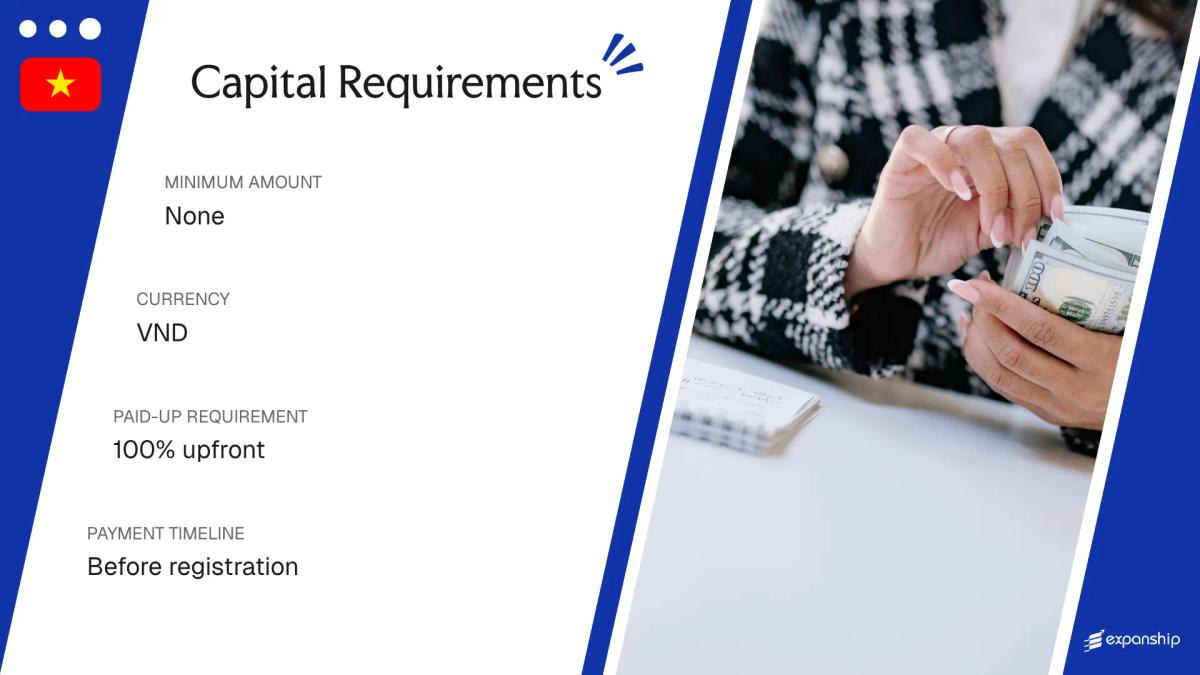
Vietnam minimum share capital requirements are governed primarily by the Law on Enterprises 2020 (Law No. 59/2020/QH14), which applies to both limited liability companies and joint stock companies. No universal statutory minimum is prescribed for most business types, though sector-specific legal capital (vốn pháp định) thresholds apply in regulated industries such as banking, insurance, and real estate.
Charter capital must be fully contributed within 90 days of the company's registration date, as stipulated under Article 47 (for LLCs) and Article 113 (for joint stock companies) of the Law on Enterprises 2020. The Business Registration Office under the Department of Planning and Investment is responsible for registering and overseeing declared capital at incorporation.
| Parameter | Detail |
|---|---|
| Minimum Authorized Share Capital | No statutory minimum for most sectors; sector-specific legal capital applies in regulated industries |
| Maximum Authorized Share Capital | No statutory maximum |
| Minimum Paid-Up Capital | No statutory minimum outside regulated sectors |
| Paid-Up Requirement at Incorporation | Full charter capital must be contributed within 90 days of issuance of the Enterprise Registration Certificate |
| Accepted Currency | Vietnamese Dong (VND); foreign currency contributions are permissible and converted at prevailing exchange rates |
| Accepted Forms of Contribution | Cash, convertible assets, intellectual property rights, technology, and other assets as agreed by members |
| Timeframe to Deposit Capital | Within 90 days from the date of Enterprise Registration Certificate issuance |
The absence of a statutory minimum does not eliminate your obligation to declare a charter capital figure at registration. The amount declared becomes a legal commitment, and failure to contribute it in full within the 90-day window requires a formal capital reduction filing with the Business Registration Office.
Company Secretary Requirements in Vietnam
Vietnam does not impose a standalone company secretary requirement in the same form as common law jurisdictions. Under the Enterprise Law 2020, the equivalent compliance function is fulfilled primarily by the legal representative, who bears statutory responsibility for corporate governance obligations on behalf of the entity.
A limited liability company or joint-stock company must designate at least one legal representative, whose details are registered with the Business Registration Office under the Department of Planning and Investment. This individual holds accountability for signing official documents, maintaining statutory records, and ensuring the firm meets its ongoing reporting obligations to state authorities.
Qualification criteria for serving as a legal representative include:
- Must be at least 18 years of age and have full civil legal capacity under Vietnamese law
- Cannot be currently serving a criminal sentence or subject to a court-imposed business prohibition
- Foreign nationals may serve as legal representative, subject to holding a valid work permit
- At least one legal representative must be resident in Vietnam; if all reside abroad, a written authorisation to a resident individual is required
- State-owned enterprises are subject to additional restrictions on who may hold this role

Incorporate a Company in Vietnam
Set up your legal entity in Vietnam with accurate registration, compliant structure, and support from local specialists.
Registered Office Requirements in Vietnam
Vietnam registered office requirements are governed primarily by the Law on Enterprises (No. 59/2020/QH14), which mandates that every business entity maintain a physical headquarters address within Vietnamese territory. Failure to maintain a valid, locatable address can result in administrative penalties under Decree 122/2021/ND-CP and may trigger suspension of the enterprise registration certificate by the Business Registration Office.
- A physical address is required; a PO box alone does not satisfy the headquarters requirement.
- The address must be located within Vietnam, in the same province or city specified in the enterprise registration certificate.
- Virtual office addresses are generally not accepted as a compliant registered headquarters under current regulatory interpretation.
- Either ownership title or a valid lease agreement for the premises must be available to support the registered address.
- The headquarters address is publicly recorded in the National Business Registration Portal (dangkykinhdoanh.gov.vn) and is accessible to third parties.
- Any change to the registered address requires a formal amendment filing with the Business Registration Office within ten working days of the change.
- If the new address falls under a different provincial jurisdiction, the file must be transferred to the corresponding local Business Registration Office.
Director Requirements in Vietnam

Under Vietnam's Enterprise Law 2020, directors assume direct statutory liability for losses caused to the company through decisions that violate the law or the firm's charter. Meeting Vietnam director requirements for incorporation means understanding that the appointed Legal Representative bears personal responsibility for ensuring regulatory compliance with the Ministry of Planning and Investment and relevant provincial business registration offices.
| Parameter | Detail |
|---|---|
| Minimum Number of Directors | One director is required; a Limited Liability Company (LLC) requires at least one Legal Representative, while a Joint Stock Company (JSC) requires a Board of Directors with a minimum of three members. |
| Maximum Number of Directors | For a JSC, the Board of Directors may not exceed eleven members under the Enterprise Law 2020; no statutory maximum applies to LLCs. |
| Local/Resident Director Required | No statutory residency requirement exists, though the Legal Representative must designate a resident agent if they are absent from Vietnam for more than thirty days. |
| Nationality Restrictions | No nationality restrictions apply; foreign nationals may serve as directors or Legal Representatives. |
| Minimum Age requirement | Directors must be at least eighteen years of age. |
| Corporate Directors Permitted | Corporate directors are not permitted; only individuals may serve as directors or Legal Representatives under the Enterprise Law 2020. |
| Director Must Be a Shareholder | No statutory requirement exists for a director to hold shares in the company. |
| Publicly Listed on Registry | The Legal Representative's name and details are recorded in the National Business Registration Portal and are publicly accessible. |
| Disqualification Conditions | Individuals declared legally incapacitated, those serving criminal sentences, or persons banned from business management by a court order are disqualified from serving as directors under the Enterprise Law 2020. |
Vietnam requires every company to designate at least one Legal Representative at all times, and if that person leaves the country for more than thirty days without appointing a substitute in writing, the company is in statutory breach, regardless of whether any business activity occurred during the absence.
Shareholder Requirements in Vietnam
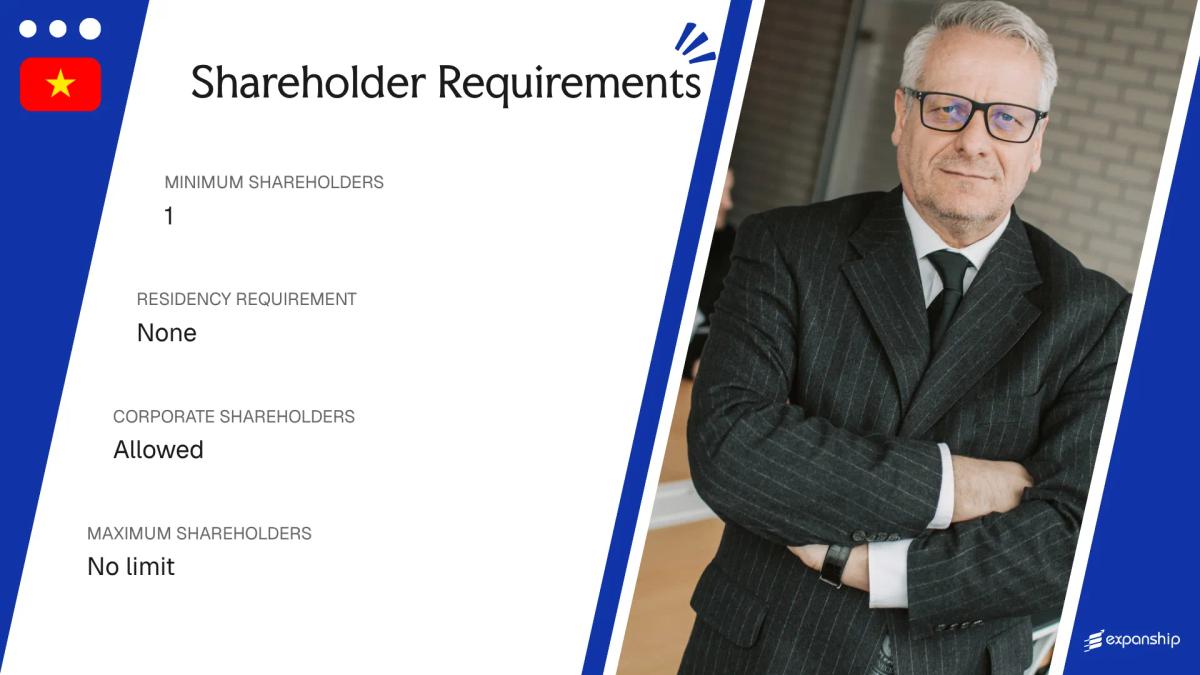
Under the 2020 Law on Enterprises, a single-member LLC requires exactly one owner, while a multi-member LLC permits between two and fifty members. Joint-stock companies must have a minimum of three shareholders, with no upper limit on the total number.
Nationality and Residency Restrictions
Vietnam shareholder requirements for incorporation place no residency obligation on shareholders. Vietnam foreign shareholder regulations do, however, impose sector-specific foreign ownership caps under the Market Access Conditions schedule attached to the 2020 Investment Law.
Corporate Shareholders
Legal entities may hold membership interests or shares in Vietnamese companies. No restriction prohibits a fully foreign-owned corporate entity from acting as the sole shareholder in a single-member LLC.
Shareholder Liability
In both LLC structures and joint-stock companies, shareholder liability is limited to the capital contribution committed in the charter. Liability does not extend beyond that amount under ordinary circumstances.
Register of Shareholders
Joint-stock companies are required to maintain a register of shareholders from the date of issuance of the enterprise registration certificate. The register is not publicly accessible, though updates must reflect any ownership transfer within ten days of the transaction.
Structuring Your Ownership for Vietnam Incorporation
Get guidance on meeting Vietnam's shareholder and ownership structure requirements before you register your entity.
UBO / Beneficial Ownership Disclosure Requirements in Vietnam
Vietnam beneficial ownership disclosure requirements are governed primarily by the Law on Anti-Money Laundering (AML Law No. 14/2022/QH15) and Decree 19/2023/ND-CP, which defines a beneficial owner as any individual who ultimately owns or controls 25% or more of an entity, or who exercises effective control through other means.
- Identify all individuals meeting the UBO threshold and compile their personal details prior to or at the point of registration.
- Submit beneficial ownership information to the Business Registration Authority as part of the enterprise registration process under the Law on Enterprises (No. 59/2020/QH14).
- Maintain an internal register of beneficial owners, updated whenever ownership or control arrangements change.
- Report changes in UBO information to the relevant authority within the timeframe prescribed by Decree 19/2023/ND-CP.
| Parameter | Detail |
|---|---|
| Ownership Threshold for UBO Status | 25% or more of capital contribution or voting rights, or effective control by other means |
| Filing Authority | Business Registration Authority (Department of Planning and Investment) |
| Disclosure Deadline at Incorporation | At the time of enterprise registration |
| Publicly Accessible Register | No statutory public UBO register; information held internally and by registration authority |
| Penalties for Non-Disclosure | Administrative fines apply under Decree 19/2023/ND-CP; specific amounts subject to regulatory determination |
| Ongoing Update Obligation | Yes; updates required upon any change in beneficial ownership or control |
KYC / Document Requirements in Vietnam
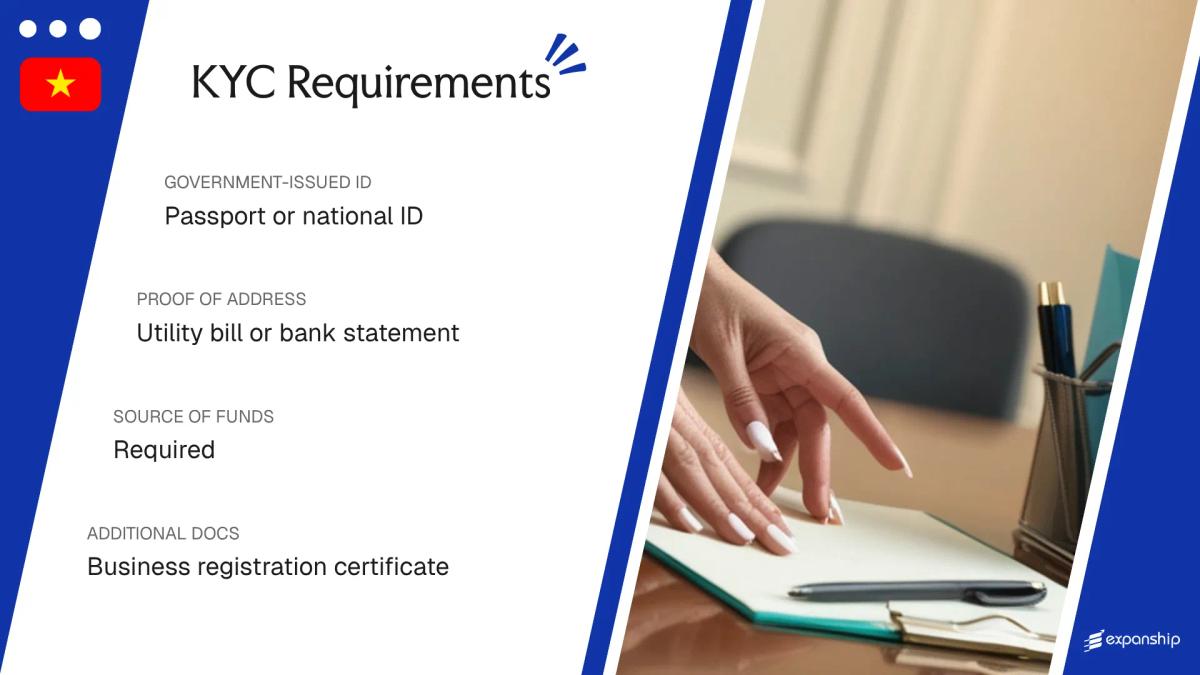
Vietnam KYC document requirements for incorporation are governed by the Law on Anti-Money Laundering (No. 14/2022/QH15), administered by the State Bank of Vietnam. All founding shareholders, legal representatives, and beneficial owners must be identified and verified before the Department of Planning and Investment processes the enterprise registration.
Individual / Personal Documents
- Valid passport or national identity card for each individual shareholder, director, or legal representative
- Proof of residential address dated within three months, such as a utility bill or bank statement
- A specimen signature form may be required by the registration authority
- For foreign nationals, a valid visa or residence permit may be requested alongside the passport
Corporate Documents
- Certificate of incorporation or equivalent constitutional document for the corporate shareholder or parent entity
- Articles of association or memorandum confirming the entity's legal structure and authorised signatories
- Current register of directors issued by the home jurisdiction's company registry
- Proof of the corporate entity's registered office address
Source of Funds Documentation
- Bank statements covering a minimum of three to six months prior to incorporation
- Audited financial statements where the contributing entity is an established business
- A written declaration of the source of capital may be required for foreign-invested enterprises
Notarisation and Apostille Requirements
- Foreign-issued documents must be notarised in the country of origin and legalised or apostilled before submission
- Official translations into Vietnamese must be certified by a licensed translator recognised in Vietnam
- Notarised copies of identity documents are required for all non-resident founders
Uncertified translations or missing legalisation on foreign corporate documents are the most frequent cause of registration delays at the Department of Planning and Investment.
Company Name Requirements in Vietnam
Vietnam company name requirements are assessed at the point of registration through the national business registration portal, where proposed names are checked against an existing database of registered entities. Duplicate or near-identical names are rejected, and the assessment also screens for names that could mislead the public about the nature or scale of the business.
Names must be written in Vietnamese or in a romanized Vietnamese transliteration; a foreign-language version may be registered alongside the primary name but cannot replace it. Each entity type carries a mandatory legal suffix reflecting its structure, and this suffix must appear in the official registered name.
Certain words are restricted and require prior approval from relevant state authorities before use, including terms that imply government affiliation, national scope, or regulated professional fields. Words considered offensive, contrary to national traditions, or liable to cause public confusion are prohibited outright.
Name reservation is available through the national business registration system prior to formal incorporation. Reserved names are held for a defined period, during which no other applicant may register an identical name, and the reservation is applied for through the same online portal used to submit the full incorporation application.
Compliance Services for Companies in Vietnam
Manage your ongoing statutory obligations in Vietnam, from annual filings and license renewals to regulatory reporting and corporate record maintenance.
Conclusion
Vietnam company incorporation requirements are defined primarily under the Law on Enterprises 2020 and the Law on Investment 2020, administered through the National Business Registration Portal and relevant provincial Departments of Planning and Investment. Among the requirements covered, foreign ownership restrictions tied to conditional business lines and the mandatory registered office address carry particular operational weight. The absence of a statutory corporate secretary role distinguishes Vietnam from many common law jurisdictions. Once these requirements are understood, the practical next step is assembling compliant documentation and identifying the appropriate legal entity structure before submitting registration filings.
Expanship's Corporate Services for Vietnam Expansion
Expanship supports your Vietnam corporate services incorporation work by handling the procedural requirements that come with operating under the Enterprise Law 2020 and coordinating with the Business Registration Office under the Ministry of Planning and Investment. From preparing charter documents to managing interactions with the Department of Planning and Investment at the provincial level, the firm reduces the operational burden your team would otherwise carry directly.
Beyond initial registration, Expanship offers a range of services to support your Vietnam business registration assistance needs:
- Preparing and filing company registration documents with the relevant Vietnamese authorities.
- Providing a registered agent and compliant office address in Vietnam.
- Liaising with government bodies, including the Business Registration Office, on your behalf.
- Managing post-incorporation obligations such as annual reporting and licence renewals.
- Introducing you to local banking partners familiar with foreign-invested enterprises.
- Handling tax registration and coordination with the General Department of Taxation.
Contact Expanship Vietnam to discuss your incorporation requirements.
Frequently Asked Questions (FAQ)
For most business lines, Vietnam does not impose a statutory minimum charter capital, meaning you declare an amount you determine appropriate. However, conditional business sectors — including banking, finance, insurance, and real estate brokerage — carry legally mandated minimum capital thresholds set by sector-specific regulations, and registering below those thresholds will result in rejection of your licence application.
A foreign national can serve as legal representative, but under the Law on Enterprises, at least one legal representative must be permanently resident in Vietnam. If all legal representatives reside abroad, the company must designate an authorised person residing in Vietnam to handle correspondence from competent authorities on the firm's behalf.
Failure to report or update beneficial ownership information, as required under Decree 01/2021/ND-CP and Vietnam's anti-money laundering framework, can result in administrative fines imposed by the Business Registration Office. Persistent non-compliance or deliberate concealment may escalate to criminal liability under Vietnam's Penal Code, particularly where the concealment is linked to money laundering or tax evasion.
Yes. Under the Law on Enterprises, shareholders of a joint stock company must contribute their committed charter capital within 90 days from the date the enterprise registration certificate is issued. Members of a limited liability company face the same 90-day window, and failure to contribute on time requires the company to reduce its registered charter capital accordingly through a formal amendment filing.
Vietnam does not impose a statutory company secretary requirement equivalent to those in Hong Kong or Singapore. The compliance and administrative functions typically handled by a company secretary in common law jurisdictions are distributed across the legal representative, the members' council or board of directors, and — where applicable — the board of controllers under the Law on Enterprises.
Foreign individual shareholders are generally required to provide a notarised and apostilled copy of their passport, proof of residential address, and in some cases a bank reference letter. Foreign corporate shareholders must submit notarised and apostilled copies of their certificate of incorporation, constitutional documents, and proof of the authorised signatory's identity — all translated into Vietnamese by a certified translator recognised in Vietnam.
A one-member LLC in Vietnam can be owned entirely by a single individual, and that same individual may also serve as the legal representative and director of the entity. However, if that sole owner is a foreign national residing outside Vietnam, the residency requirement for legal representatives means the owner must either establish Vietnamese residency or appoint a resident authorised representative to satisfy the obligations under the Law on Enterprises.
Legal Disclaimer
The information provided in this article is for general informational purposes only and does not constitute legal, tax, or professional advice. While we strive to ensure the accuracy and timeliness of the content, laws and regulations are subject to change, and the application of laws can vary widely based on specific facts and circumstances.
Readers should not act upon this information without seeking professional counsel tailored to their individual situation. Expanship and its authors disclaim any liability for actions taken or not taken based on the content of this article.
For specific advice regarding your business setup, compliance requirements, or any legal matters, please consult with qualified legal and tax professionals in the relevant jurisdiction.