

Key Takeaways
- Foreign investors are prohibited from holding majority or full ownership in numerous strategic sectors under Vietnam's Law on Investment, which maintains sector-specific foreign ownership caps that can block market entry entirely or force reliance on local joint venture partners.
- Obtaining the necessary approvals to operate in Vietnam frequently requires both an Investment Registration Certificate and an Enterprise Registration Certificate, with additional sector-specific sub-licenses that extend the pre-operational timeline well beyond the standard registration window.
- Vietnam's legal representative requirement mandates that a locally resident individual be formally accountable for regulatory compliance, creating a structural dependency that adds administrative complexity for foreign-owned entities without a pre-established local presence.
- Currency repatriation and cross-border capital transfers remain subject to State Bank of Vietnam oversight and foreign exchange controls, meaning profit remittances and capital withdrawals are conditional on meeting specific documentation and approval requirements rather than being freely executable.
Vietnam operates under an evolving but tightly administered regulatory framework, where foreign business activity is governed primarily by the Law on Enterprises and the Law on Investment. The disadvantages of incorporating in Vietnam span multiple operational and structural dimensions that affect foreign-owned entities across the setup and post-registration phases.
Not every drawback carries the same weight for every business. The cons of Vietnam company formation affect a foreign manufacturing firm differently than a service-based entity, and sector-specific restrictions mean that the risks vary significantly depending on your industry classification.
This article is most directly relevant to foreign investors seeking majority or full ownership of a locally incorporated entity, particularly those operating in regulated sectors or managing cross-border capital flows.
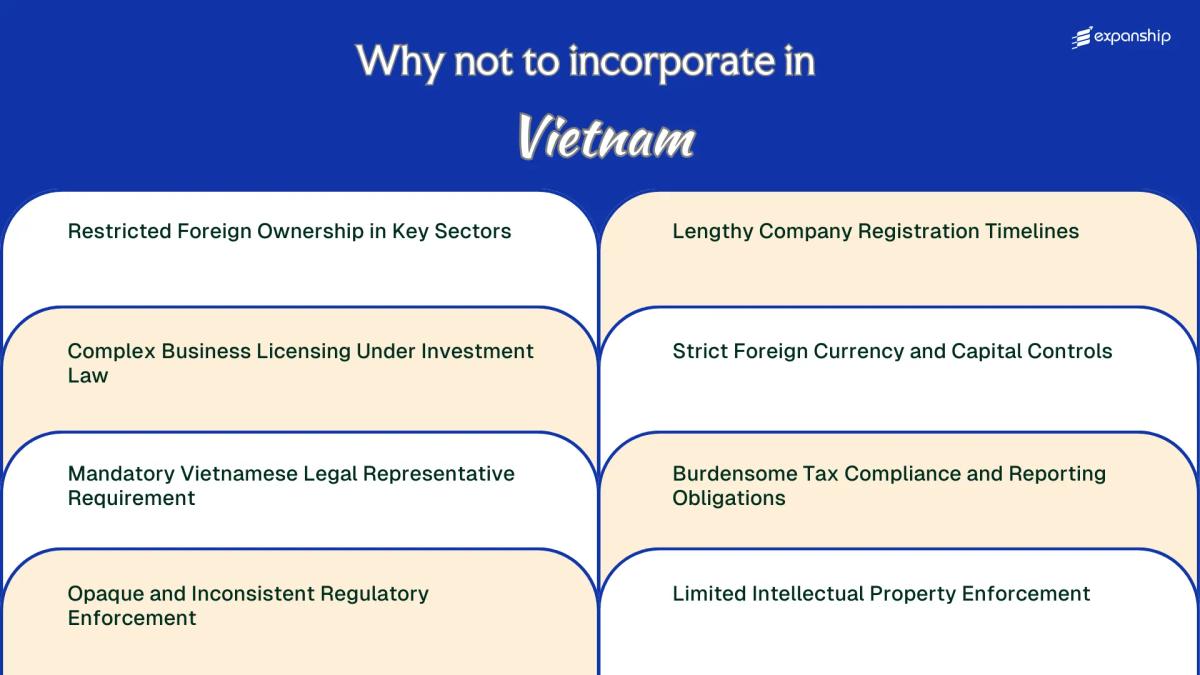
Restricted Foreign Ownership in Key Sectors
Vietnam foreign ownership restrictions remain one of the most structurally binding constraints foreign investors face when establishing a presence in the country.
Sector-Based Ownership Caps Under the Investment Law
Vietnam's Law on Investment (No. 61/2020/QH14) classifies business activities into conditional and prohibited lines, with the specific foreign ownership caps governed by Vietnam's WTO Schedule of Specific Commitments and sector-specific legislation. In telecommunications, broadcasting, and certain financial services, foreign equity is capped at 49% or lower, meaning your entity cannot be majority foreign-owned without special government dispensation.
This forces many investors into joint venture structures with local partners, transferring a degree of operational control that would be unacceptable in most other Southeast Asian markets.
Conditional Business Lines Restrict Operational Flexibility
Over 200 business lines are classified as conditional under current regulations, requiring additional licenses, ownership adjustments, or ministry-level approval before a foreign-invested enterprise can operate. Even minor variations in business scope can trigger reclassification, exposing your firm to compliance gaps mid-operation.
Restrictions are not always uniformly applied across provinces, creating further unpredictability in planning.
If your intended business activity falls within a conditional sector, the applicable ownership cap may prevent full foreign control, and no amount of capital contribution can override that statutory ceiling without legislative or regulatory change.
Complex Business Licensing Under Investment Law
Vietnam business licensing challenges begin before your company opens its doors. Under the Law on Investment 2020, most foreign-owned enterprises must obtain both an Investment Registration Certificate (IRC) and an Enterprise Registration Certificate (ERC) before conducting any business activity. This two-stage process is administered by the Department of Planning and Investment, and delays at either stage stall the entire operation.
Beyond registration, certain business lines trigger additional sub-license requirements. Your ERC may list an approved sector, yet a separate sector-specific license from a different ministry is still required before you can operate legally in that line of work.
This creates compounding friction for foreign businesses:
- Obtaining a sub-license from a technical ministry can take months beyond ERC issuance, meaning your registered entity sits idle while fixed costs accumulate
- Each conditional business sector requires documentary proof of minimum conditions, forcing early capital expenditure before revenue begins
- Any change to your IRC-registered investment scope requires an amendment process that restarts regulatory review, adding cost and delay to ordinary business pivots
Foreign entities operating across multiple sectors face the highest exposure. A firm offering both education and technology services, for example, may require separate licensing tracks under different ministries simultaneously.

Company Incorporation in Vietnam
Understand the full registration process for foreign-owned entities in Vietnam, from IRC and ERC filing to sector-specific licensing.
Mandatory Vietnamese Legal Representative Requirement
Every limited liability company and joint-stock company registered under Vietnam's Enterprise Law 2020 must designate at least one legal representative. That person must be a resident of Vietnam, meaning your firm cannot assign this role to a foreign director living abroad.
The residency requirement creates a structural dependency on a local individual who holds significant legal authority. Under the Enterprise Law, the legal representative can bind the company in contracts, sign official documents, and interact with state agencies, all without requiring shareholder approval for routine acts.
| Requirement | Detail | Implication for Foreign Owners |
|---|---|---|
| Residency obligation | Must be resident in Vietnam | Foreign-based owners cannot self-appoint |
| Minimum count | At least one legal representative required | Single point of failure if rep becomes unavailable |
| Personal liability exposure | Rep bears liability for compliance failures | Difficult to attract qualified, trustworthy candidates |
| Absence rule | Rep absent over 30 days must appoint written substitute | Gaps in representation can delay filings and approvals |
The Vietnam legal representative requirement problems become acute when the appointed individual is a hired nominee rather than a genuine business partner. That person retains the legal capacity to act on behalf of the entity, creating exposure if their conduct is unauthorised or disputed.
Personal liability attached to the role makes recruiting a reliable resident representative genuinely difficult. Few qualified professionals will accept unlimited exposure under a foreign-controlled structure without substantial compensation or indemnity arrangements.
Opaque and Inconsistent Regulatory Enforcement
Vietnam regulatory enforcement inconsistencies represent one of the more unpredictable risks for foreign-owned entities operating under the Investment Law 2020 and Enterprise Law 2020. Inspections by bodies such as the Ministry of Planning and Investment (MPI), the General Department of Taxation, and provincial-level Departments of Planning and Investment do not follow a uniform interpretation of the same statutory text.
Two businesses in the same sector can receive contradictory guidance from different provincial authorities on identical compliance questions. This absence of harmonized enforcement means your firm cannot reliably predict how a regulation will be applied at the local level.
Official circulars are frequently amended without transitional periods, leaving registered entities exposed to retroactive compliance expectations. For foreign firms, this creates direct legal and financial exposure with little recourse.
- Enforcement outcomes vary by province, not just by law
- Regulatory inspections from multiple agencies can overlap without coordination
- Circular amendments may take effect without grace periods for existing businesses
- Foreign-invested enterprises face heightened scrutiny compared to domestically owned firms
- Written guidance from one authority carries no binding weight with another
Vietnam has no consolidated administrative guidance database, meaning two provincial offices can issue legally conflicting written opinions on the same regulation with no official mechanism to reconcile them.
Lengthy Company Registration Timelines
Vietnam company registration delays are a consistent friction point for foreign investors, with the formal process spanning multiple agencies before a business can legally operate.
Statutory Timelines That Rarely Hold in Practice
Under the Law on Investment (No. 61/2020/QH14) and the Law on Enterprises (No. 59/2020/QH14), foreign investors must first obtain an Investment Registration Certificate (IRC) from the provincial Department of Planning and Investment (DPI), then a separate Enterprise Registration Certificate (ERC). The IRC alone carries a statutory review period of 15 working days, but slow business registration timelines in Vietnam mean that figure frequently extends well beyond that in practice, particularly in provinces with high application volumes or where additional sector approvals are required.
What the Delays Cost Your Business
For businesses in conditional investment sectors, the DPI may also require pre-approval from a ministry or the Prime Minister's Office, adding weeks or months before your entity can be formally established. Each waiting period defers your legal capacity to hire staff, open a corporate bank account, or execute contracts, creating compounding operational costs before the firm generates any revenue. Lengthy company setup in Vietnam disproportionately affects time-sensitive market entries where competitors can establish presence faster in comparable regional jurisdictions.
Support with Vietnam Company Registration Timelines
Get structured guidance on managing IRC and ERC processing stages, coordinating with the Department of Planning and Investment, and reducing delays during your Vietnam market entry.
Strict Foreign Currency and Capital Controls
Vietnam foreign currency controls restrictions create direct operational friction for foreign-owned entities, particularly when moving profits or capital across borders.
- The State Bank of Vietnam (SBV) requires foreign investors to conduct all capital contributions and profit remittances through a designated Direct Investment Capital Account (DICA), meaning any transfer outside this account structure is blocked regardless of its commercial purpose.
- Repatriating profits is only permitted after the foreign-invested enterprise has fulfilled all outstanding tax obligations and submitted audited financial statements, which delays access to your own returns.
- Capital repatriation problems in Vietnam frequently arise because the SBV requires documentary evidence that the original investment was lawfully registered, placing the evidentiary burden entirely on the foreign investor.
- Foreign loans brought into a business are subject to SBV registration requirements and borrowing limits tied to the entity's charter capital, restricting how you structure cross-border financing.
- Vietnamese dong is not freely convertible internationally, so converting local revenue into foreign currency depends on commercial bank availability of foreign exchange at the time of transfer.
Burdensome Tax Compliance and Reporting Obligations
Vietnam tax compliance burdens foreign companies through a layered system of obligations administered by the General Department of Taxation (GDT), requiring filings across multiple tax types on different schedules throughout the year.
VAT-registered entities must submit monthly or quarterly VAT declarations, while corporate income tax requires quarterly provisional payments followed by an annual finalisation return. Missing a quarterly CIT provisional payment triggers late payment interest of 0.03% per day under the Law on Tax Administration No. 38/2019/QH14, a rate that compounds quickly against larger payables.
Foreign-invested enterprises are also subject to Foreign Contractor Tax (FCT), which applies to payments made to overseas service providers. This creates a withholding obligation that many foreign owners fail to anticipate, generating unexpected compliance gaps.
Transfer pricing documentation under Decree 132/2020/ND-CP adds a further layer for entities with related-party transactions, requiring annual disclosure forms and, in some cases, full local files.
A foreign-owned company making $50,000 USD in annual payments to an overseas parent for management services would owe FCT on those payments and must file withholding declarations separately from its standard CIT return, adding both cost and administrative complexity with no consolidated filing mechanism available.
Limited Intellectual Property Enforcement
Vietnam intellectual property enforcement problems stem from a structural gap between legal rights on paper and practical protection in practice. The Law on Intellectual Property (as amended in 2022) provides a formal framework, but administrative enforcement through bodies such as the Market Management Force (Quản lý thị trường) and the Inspectorate of the Ministry of Science and Technology remains inconsistent.
Civil litigation through the court system is technically available, yet cases routinely take years to resolve, which drains resources and erodes the commercial value of the IP being protected.
Counterfeit goods and trademark infringement remain widespread across both physical markets and e-commerce platforms. Criminal prosecution for IP violations requires proof of intent and commercial scale, conditions that are difficult to satisfy and rarely pursued.
For foreign firms that entered the market relying on brand recognition, this enforcement gap means that local competitors can operate with near-identical branding for extended periods without facing meaningful consequences.
- Customs recordation with the General Department of Vietnam Customs offers border protection, but registration must be actively maintained and renewed.
- IP rights holders bear the burden of identifying, documenting, and reporting violations before any agency will act.
Even a properly registered trademark or patent in Vietnam does not compel authorities to act on your behalf without substantial evidence gathering and persistent follow-up from your own legal team.
Overcoming Vietnam's Incorporation Challenges
Overcoming Vietnam's Incorporation Challenges
Structurally addressing Vietnam's incorporation challenges requires deliberate entity planning before any registration is filed with the Department of Planning and Investment. No single fix resolves all barriers; each disadvantage demands a targeted, process-level response.
- Map your intended business activities against the Schedule of Commitments.pdf) under Vietnam's WTO accession schedule to determine applicable foreign ownership caps before selecting a corporate structure.
- Identify whether your sector requires a sub-license or conditional business line certificate under the 2020 Law on Investment prior to applying for an Enterprise Registration Certificate.
- Appoint a qualified legal representative who is a Vietnam-resident individual and can fulfil the continuous residency obligation under the 2020 Law on Enterprises.
- Register your foreign currency accounts and capital contribution amounts with the State Bank of Vietnam to maintain compliant capital remittance records.
- File for IP protection with the National Office of Intellectual Property immediately upon entity establishment rather than after commercial operations begin.
These steps reduce structural exposure but do not eliminate the unpredictability inherent in how provincial-level authorities apply national regulations. Foreign firms must account for enforcement inconsistency as an ongoing operational variable, not a one-time setup consideration.
Vietnam's Overall Business Appeal Assessed
Despite the Vietnam business environment drawbacks assessed throughout this blog, the country remains a credible destination for foreign incorporation. Low labour costs, a young consumer market, and its position within ASEAN trade networks give it structural appeal that many comparable middle-income economies lack.
| Pros | Cons |
|---|---|
| Low statutory corporate income tax rate of 20%, with preferential rates available in designated economic zones | Foreign ownership is capped or prohibited in several sectors under the Market Access Schedule |
| Active bilateral and multilateral trade agreements expand market access for incorporated entities | The National Business Registration Portal process can extend well beyond published timelines in practice |
| A large, cost-competitive workforce supports operational scalability | A resident legal representative must be appointed, creating ongoing personal liability exposure |
| Growing domestic consumer base across a population exceeding 96 million | Regulatory enforcement varies significantly across provinces, creating unpredictable compliance conditions |
| Established export-oriented manufacturing infrastructure | Intellectual property protections exist in law but remain inconsistently applied in practice |
Currency repatriation is subject to State Bank of Vietnam approval requirements. That constraint, combined with the tax reporting burden under the General Department of Taxation's framework, means your operational costs extend beyond initial setup.
Corporate Compliance Services in Vietnam
Maintain your Vietnamese entity in good standing with ongoing compliance support, from annual reporting obligations to regulatory filings under Vietnamese corporate law.
Conclusion
The cons of Vietnam company formation are real and documented. Foreign ownership restrictions under the Law on Investment 2020, the mandatory legal representative requirement, and chronic inconsistencies in regulatory enforcement from provincial-level authorities represent the most operationally significant friction points for foreign-registered entities. Timelines and compliance burdens compound those structural constraints. For businesses prepared to accept those conditions, professional guidance from advisors with direct experience in Vietnam's regulatory framework remains the most practical path forward.
Expanship's Vietnam Expansion Support
Incorporating in Vietnam means contending with sector-specific foreign ownership caps enforced by the Ministry of Planning and Investment, mandatory legal representative obligations, and capital control requirements under the State Bank of Vietnam's oversight. Expanship's Vietnam expansion support is structured around these specific burdens, helping your business meet the compliance requirements that arise at each stage of the formation process. Our role is to reduce the operational weight of these obligations, not to circumvent them.
Expanship offers a defined scope of corporate services for foreign investors entering Vietnam.
- We prepare and file all company registration documents with the relevant Vietnamese authorities.
- Our team provides registered agent and office services to satisfy local presence requirements.
- We handle government filings and liaise directly with regulatory bodies on your behalf.
- Post-incorporation compliance management is available to keep your entity in good standing.
- Banking introduction assistance is provided to support your account opening process.
- We manage tax registration and coordinate with local authorities for initial filings.
Reach out to Expanship Vietnam to discuss your incorporation requirements.
Frequently Asked Questions (FAQ)
Every enterprise registered in Vietnam, including wholly foreign-owned companies, must appoint at least one legal representative who is physically resident in the country for the majority of the calendar year, as required under the 2020 Law on Enterprises. This person holds personal legal liability for the company's compliance obligations, which creates significant exposure if the appointed individual is not a trusted senior employee. Foreign investors who lack a reliable local contact often face both practical and legal complications when trying to fulfil this requirement.
Violations of the State Bank of Vietnam's foreign currency regulations can result in administrative fines and, in more serious cases, suspension of the entity's capital transaction rights. The 2005 Ordinance on Foreign Exchange, as amended, governs how foreign-invested enterprises repatriate profits, repay loans, and transfer capital abroad, and any transaction conducted outside the approved channels is subject to scrutiny and sanction. For businesses that depend on regular cross-border capital flows, this creates genuine operational risk rather than a minor administrative inconvenience.
Foreign investors face a two-stage registration process that domestic entrepreneurs do not. Before registering the enterprise itself at the Department of Planning and Investment, a foreign investor must first obtain an Investment Registration Certificate, a step that adds weeks to the timeline and requires submission of financial capacity evidence, a proposed business location, and project details. Vietnamese nationals registering a domestic company bypass this step entirely and can often complete registration within three to five working days.
Operating in a conditional business sector without the required sub-licences exposes the company to administrative penalties, forced suspension of operations, and potential revocation of the Investment Registration Certificate. Vietnam's 2020 Law on Investment designates over 200 conditional business lines, each governed by a separate sectoral authority, whether that is the Ministry of Finance, the Ministry of Industry and Trade, or another body. Enforcement is inconsistent across provinces, but the legal risk of non-compliance is real and can result in back-dated penalties covering the entire period of unlicensed operation.
There is no fixed statutory cost, but foreign-invested enterprises typically incur significant recurring expenditure on local accounting firms, tax agents, and auditors, since annual audited financial statements are mandatory for all foreign-invested entities regardless of size. Added to this are quarterly corporate income tax provisional payments, monthly or quarterly VAT declarations, and personal income tax filings for expatriate staff, each requiring professional support given the complexity of Vietnamese tax administration. For a small foreign-invested company, combined compliance costs can exceed USD 10,000 annually before any advisory work is factored in.
Registering trademarks and patents with the National Office of Intellectual Property of Vietnam is a necessary first step, but registration alone does not resolve the enforcement problem. Vietnamese courts handle IP disputes slowly, and customs-based border enforcement against counterfeit goods is inconsistently applied across different ports of entry. Foreign rights holders often find that civil litigation is too costly relative to the damages awarded, which means that practical protection depends heavily on proactive market monitoring and administrative complaints rather than judicial remedies.
Yes, and the variation is material. Vietnam's decentralised administrative system grants provincial-level People's Committees significant discretion over how national investment and licensing rules are applied locally, which means the same business activity may face different documentation requirements or approval timelines in Ho Chi Minh City versus a secondary province like Binh Duong or Hai Phong. Foreign investors without prior experience in a specific province often encounter unexpected procedural requirements that are not stated in the national legislation, creating delays and additional compliance costs that are difficult to anticipate at the planning stage.
Legal Disclaimer
The information provided in this article is for general informational purposes only and does not constitute legal, tax, or professional advice. While we strive to ensure the accuracy and timeliness of the content, laws and regulations are subject to change, and the application of laws can vary widely based on specific facts and circumstances.
Readers should not act upon this information without seeking professional counsel tailored to their individual situation. Expanship and its authors disclaim any liability for actions taken or not taken based on the content of this article.
For specific advice regarding your business setup, compliance requirements, or any legal matters, please consult with qualified legal and tax professionals in the relevant jurisdiction.