

Key Takeaways
- Vietnam's standard corporate income tax rate of 20 percent, reducible to 10 percent for qualifying sectors under the Law on Corporate Income Tax, gives foreign-owned entities a measurable cost advantage over higher-rate regional peers from the first full year of operation.
- Foreign investors entering under the Investment Law 2020 and Enterprise Law 2020 gain access to a defined legal pathway through the Investment Registration Certificate process, reducing structural uncertainty at the point of market entry.
- Incorporation within a licensed industrial or special economic zone unlocks preferential tax treatment and duty benefits that manufacturing and export-oriented businesses can apply directly to their cost base.
- Vietnam's participation in agreements including the EU-Vietnam Free Trade Agreement extends preferential market access across multiple trading blocs, giving locally incorporated entities a tariff advantage that compounds with the country's existing export infrastructure.
Situated in Southeast Asia, Vietnam is an independent socialist republic governed under a single-party system, with company registration overseen by the Business Registration Office under the Department of Planning and Investment at the national and provincial levels. Foreign businesses most commonly enter the market through a Limited Liability Company. The country operates a territorial-based tax system, applying corporate income tax primarily to domestically sourced profits, with rates and exemptions shaped by sector and location.
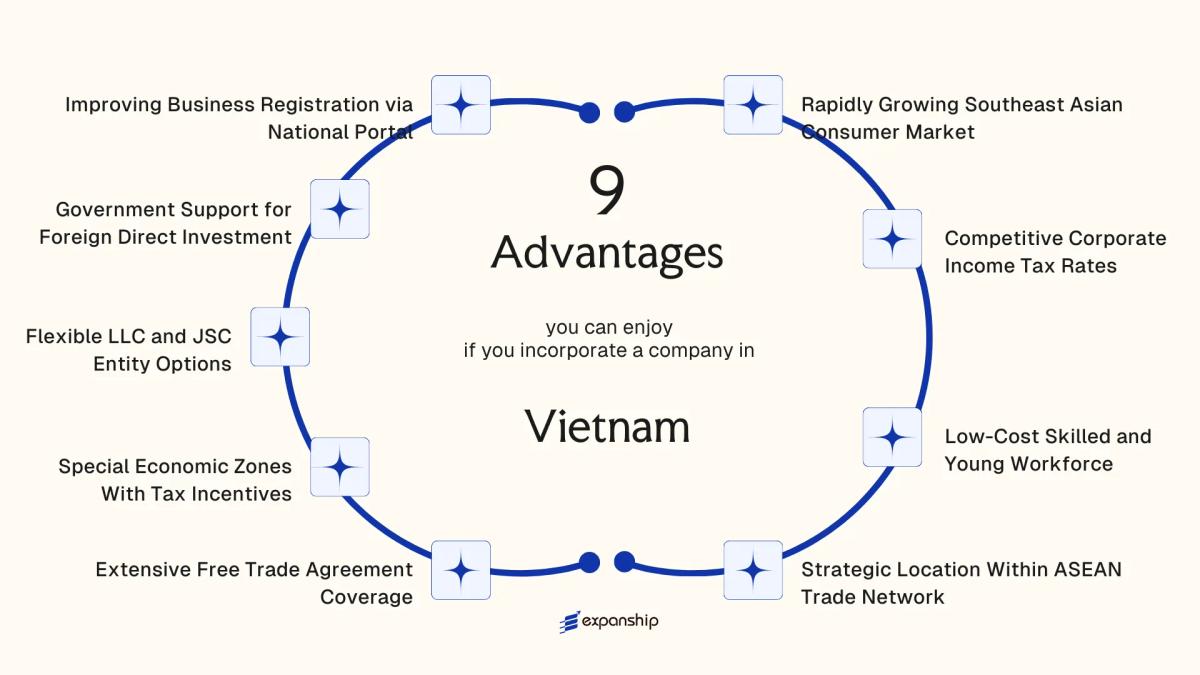
Under the Investment Law 2020 and the Enterprise Law 2020, foreign ownership is broadly permitted across most industries, though certain sectors remain subject to conditional market access requirements that cap or restrict foreign equity. The government's general posture toward foreign direct investment has been one of structured openness, with the Ministry of Planning and Investment actively administering inbound investment approvals. The benefits of incorporating in Vietnam span taxation, workforce access, trade connectivity, and entity flexibility — this article examines each of those advantages in detail.
Rapidly Growing Southeast Asian Consumer Market
Vietnam's population of approximately 100 million people, with a median age under 31, creates direct demand for goods and services across consumer electronics, retail, food and beverage, and financial products. For foreign businesses evaluating the Vietnam growing consumer market for foreign investors, this demographic scale translates into volume — not just potential.
A Middle Class Expanding at Scale
Household incomes have risen sharply over the past decade, with the middle class projected to reach 26 million people by 2026 according to World Bank estimates. Urban centers like Ho Chi Minh City and Hanoi anchor this growth, offering concentrated consumer bases where foreign-owned enterprises — established under the Law on Investment 2020 — can operate with defined market access rights.
Domestic Consumption as a Structural Driver
Private consumption accounts for a substantial share of GDP growth, making the consumer economy less dependent on export cycles. A foreign-owned retail or service firm operating under a Foreign-Invested Enterprise structure benefits from demand that is internally generated rather than tied to global trade fluctuations.
Your revenue exposure is anchored to domestic spending patterns, giving your entity a degree of insulation from external market shocks.
Competitive Corporate Income Tax Rates
Vietnam's standard corporate income tax (CIT) rate is 20%, established under the Law on Corporate Income Tax and its subsequent amendments. For foreign companies operating through a locally registered entity, this rate applies to taxable profits after allowable deductions. Compared to Singapore's headline rate of 17%, the gap is modest, but the 20% rate becomes considerably more competitive once preferential regimes are factored in.
Certain qualifying industries and investment projects can access reduced CIT rates of 10% or 15% for defined periods, with some qualifying for tax holidays of up to four years followed by 50% reductions for an additional nine years. These incentives apply under specific conditions set out in the Investment Law 2020 and supporting decrees, meaning your business must meet criteria related to sector, location, or minimum capital commitment.
Why this structure works in your favour:
- The 10% preferential rate targets high-priority sectors like technology, education, and healthcare, meaning qualifying firms face one of the lower effective tax burdens in the region
- Tax holidays reduce cash outflow precisely during the capital-intensive early years of a new operation
- Incentives are codified in law rather than granted through administrative discretion, giving foreign investors a predictable basis for financial planning

Incorporate Your Company in Vietnam
Set up a compliant legal entity in Vietnam with end-to-end support from Expanship, covering registration, documentation, and post-incorporation requirements.
Low-Cost Skilled and Young Workforce
Vietnam skilled workforce advantages for businesses are rooted in measurable demographics. The country's median age sits at approximately 31 years, meaning the working-age population is both large and relatively young by regional standards. This demographic profile translates directly into a sustained labor supply at a time when many developed economies face aging workforces and tightening talent pools.
Wage levels remain significantly below those in China, Thailand, or Malaysia, without a proportional reduction in technical capability. Manufacturing, software development, electronics assembly, and business process outsourcing have all scaled in Vietnam precisely because the cost-to-skill ratio favors foreign operators. Monthly minimum wages are set regionally under the Government's zone-based system, with higher rates in urban industrial areas such as Hanoi and Ho Chi Minh City.
| Zone | Coverage | Monthly Minimum Wage (VND) |
|---|---|---|
| Zone 1 | Hanoi, Ho Chi Minh City urban districts | 4,960,000 |
| Zone 2 | Provincial cities, selected suburban districts | 4,410,000 |
| Zone 3 | Remaining provincial towns | 3,860,000 |
| Zone 4 | Rural and remaining areas | 3,450,000 |
Literacy rates exceed 95%, and tertiary enrollment has expanded steadily over the past decade. The country produces a significant annual output of engineering, IT, and technical graduates, which supports foreign firms that require specialized roles rather than general labor. Under the Labor Code 2019, employment contracts, probation terms, and termination procedures follow a defined statutory framework, giving your firm a predictable legal basis for workforce management from the outset.
Strategic Location Within ASEAN Trade Network
Vietnam's geographic position gives your business direct access to one of the world's most active trading corridors. Sitting at the eastern edge of mainland Southeast Asia, the country shares land borders with China, Laos, and Cambodia, while its 3,260-kilometre coastline connects to major shipping lanes through the South China Sea. For businesses prioritising Vietnam strategic location ASEAN trade benefits, this physical positioning translates into shorter transit times and lower freight costs compared to interior or island-based manufacturing hubs.
As a founding member of the ASEAN Economic Community, the country operates within a framework that removes most tariffs on intra-regional goods under the ASEAN Trade in Goods Agreement. For a foreign-owned enterprise registered in Vietnam, goods manufactured locally can move into Thailand, Malaysia, Indonesia, and other member markets at preferential or zero duty rates, reducing your cost base across the supply chain.
Major deep-water ports at Hai Phong, Da Nang, and Ho Chi Minh City handle container volumes that connect directly to Northeast Asia and global shipping networks. Proximity to southern China's manufacturing clusters means component sourcing timelines are shorter than most comparable Southeast Asian destinations.
Keep in mind while structuring your operations around this advantage:
- ASEAN preferential tariff rates apply only when goods meet Rules of Origin requirements under ATIGA
- Port capacity and logistics infrastructure vary significantly between northern and southern corridors
- Land border crossings with China operate under separate bilateral trade arrangements, not solely ASEAN rules
Vietnam has more operational seaports than any other mainland Southeast Asian country, giving registered businesses unusually broad options for export routing without relying on a single gateway.
Extensive Free Trade Agreement Coverage
Vietnam free trade agreement benefits for companies extend well beyond tariff reductions. The country has concluded 16 free trade agreements, including major instruments such as the EU-Vietnam Free Trade Agreement (EVFTA), the Comprehensive and Progressive Agreement for Trans-Pacific Partnership (CPTPP), and the Regional Comprehensive Economic Partnership (RCEP). Together, these agreements create preferential access to over 60 economies, covering the EU's 27 member states, Japan, Canada, Australia, and the United Kingdom, among others.
Preferential Tariff Access as a Structural Advantage
Under the EVFTA, which entered into force in August 2020, the EU committed to eliminating approximately 99% of tariff lines on Vietnamese goods over a defined transition period. For a manufacturer or exporter incorporated locally, this translates directly into lower landed costs in European markets compared to competitors based in countries without equivalent EU access. RCEP further consolidates duty advantages across ASEAN, China, Japan, and South Korea within a single rulebook, reducing the administrative burden of managing multiple certificate-of-origin regimes.
Market Access That Compounds With Local Cost Structures
CPTPP membership adds preferential entry into Canada and Mexico, markets where Vietnamese exporters previously faced standard MFN tariff rates. An entity incorporated in Vietnam can source inputs regionally, manufacture domestically, and export under preferential terms to multiple high-income markets simultaneously. Rules-of-origin thresholds under each agreement vary, so your supply chain structure must be designed to meet the specific cumulation and value-added requirements tied to each treaty.
Structure Your Vietnam Entity to Maximise FTA Benefits
Our team can advise on how your incorporation structure, supply chain, and operational setup can qualify for preferential treatment under EVFTA, CPTPP, and RCEP.
Special Economic Zones With Tax Incentives
Vietnam special economic zone tax incentives are among the more concrete fiscal tools available to foreign investors structuring their entry into the country. Designated zones tie reduced tax rates directly to location and sector, giving your business a predictable cost advantage from the point of incorporation.
- Enterprises operating in qualifying industrial zones, export processing zones, and high-tech zones may access a preferential corporate income tax rate of 10% for up to 15 years, compared to the standard rate of 20% under the Law on Corporate Income Tax.
- Beyond the reduced rate, eligible businesses can receive a full tax exemption for the first two to four years of profitable operations, followed by a 50% reduction for the subsequent four to nine years, depending on the specific zone classification.
- High-tech zones such as Saigon Hi-Tech Park and Da Nang Hi-Tech Park apply incentives under the High Technology Law No. 21/2008/QH12, which ties benefits to R&D investment thresholds and technology transfer activities.
- Import duties on machinery, raw materials, and inputs used within export processing zones are generally exempt, which reduces your firm's effective operating costs beyond the income tax benefit alone.
- Incentive eligibility is administered through provincial investment registration certificates, meaning the specific zone authority, not the national body, determines qualifying conditions for your entity.
Flexible LLC and JSC Entity Options
Vietnam's legal framework under the Law on Enterprises 2020 provides two primary structures for foreign investors: the Limited Liability Company (LLC) and the Joint Stock Company (JSC). Each serves distinct ownership and capital needs, giving your business the ability to match its legal form to its actual operating model rather than conforming to a rigid default.
An LLC in Vietnam can be established with a single member or up to 50 members. This cap suits wholly foreign-owned subsidiaries or closely held joint ventures where ownership control matters. A JSC, by contrast, allows an unlimited number of shareholders and enables the issuance of shares, which makes it the appropriate vehicle if your growth plan involves external equity financing or a future public listing on the Ho Chi Minh Stock Exchange.
- LLCs do not issue shares, which simplifies capital structure for wholly owned foreign entities
- JSCs require a minimum of three founding shareholders but carry no maximum
- Both structures cap member liability at contributed capital
A foreign investor establishing a single-member LLC contributes USD 500,000 in charter capital. Under the Law on Enterprises 2020, their personal liability exposure is limited strictly to that amount, regardless of company debt obligations beyond contributed capital.
Government Support for Foreign Direct Investment
Vietnam government support for foreign direct investment is administered primarily through the Ministry of Planning and Investment (MPI), which serves as the central coordinating body for inbound investment policy, approval processes, and incentive allocation.
Under the Law on Investment 2020 (Law No. 61/2020/QH14), the government designates specific sectors and geographic areas as priorities for foreign capital. Businesses operating in these priority categories can access preferential tax rates, land use fee exemptions, and accelerated licensing procedures — reducing both cost and administrative lag at the entry stage.
The Investment Support Fund, established under Decree 182/2024/ND-CP, provides direct financial support mechanisms for large-scale and high-technology projects. This gives qualifying foreign firms a formal channel to recover costs related to training, research and development, and fixed-asset investment.
At the provincial level, Investment Promotion Centers operate under local Departments of Planning and Investment to assist foreign companies with site selection, regulatory introductions, and liaison with sector-specific authorities. Your firm does not need to navigate the approval environment without institutional support.
Priority sector and geographic designations under the Law on Investment 2020 are subject to periodic revision, so confirm current eligibility criteria with the MPI or a licensed investment consultant before relying on a specific incentive.
Improving Business Registration via National Portal
Vietnam National Business Registration Portal benefits foreign founders in a concrete, administrative sense: registration applications can be submitted online through the National Business Registration Portal (dangkykinhdoanh.gov.vn), managed by the Department of Planning and Investment under the Ministry of Planning and Investment.
Under the Enterprise Law 2020, the statutory processing time for a business registration certificate is three working days from the date a complete application is received. That compressed timeline reduces the pre-operational period, which directly lowers the cost of delayed market entry for foreign-invested entities.
The portal consolidates previously fragmented steps. Tax registration and seal notification can be coordinated through the same system, reducing the number of separate agency visits your firm would otherwise need to make.
Online document submission also means that minor corrections or supplementary filings can be handled remotely without requiring a local representative to attend in person at every stage. For foreign investors managing the process from abroad, that flexibility has measurable practical value.
Key registration-related functions accessible through the portal include:
- New enterprise registration for LLCs and JSCs
- Branch and representative office registration
- Changes to charter capital, ownership structure, or company name
- Business suspension and dissolution filings
- Certificate re-issuance requests
The digital company registration benefits extend to post-incorporation changes as well. Amendments that previously required multiple in-person submissions can now be initiated electronically, reducing administrative burden during the operational life of the company, not just at the point of formation.
Why Vietnam Stands Out Among Southeast Asian Incorporation Destinations
Comparing Vietnam against other Southeast Asian incorporation destinations reveals a consistent pattern: the combination of treaty coverage, tax incentives, and entity flexibility available here is not replicated in full by any single regional competitor. The jurisdictions most commonly evaluated alongside Vietnam by foreign investors are Thailand, Indonesia, and the Philippines — each targeting a similar foreign direct investment profile, each operating within ASEAN, yet each with structural differences that affect practical incorporation decisions.
Thailand imposes a 20% standard corporate income tax rate with more restrictive foreign ownership rules under the Foreign Business Act. Indonesia's capital requirements for foreign-owned entities (PT PMA) remain among the highest in the region, creating a meaningful barrier at the formation stage. The Philippines applies a 25% corporate income tax rate for most foreign firms, with additional paid-in capital thresholds that vary by sector. Against this backdrop, Vietnam's 20% headline rate, access to investment incentives under the Law on Investment 2020, and the absence of a blanket foreign ownership cap across most sectors position it as a structurally accessible option — particularly for manufacturing, technology, and export-oriented businesses.
| Parameter | Vietnam | Thailand | Indonesia | Philippines |
|---|---|---|---|---|
| Standard CIT Rate | 20% | 20% | 22% | 25% |
| Foreign Ownership Cap | Sector-specific | Restricted (Foreign Business Act) | PT PMA required | Sector-specific (60/40 rule common) |
| Minimum Paid-In Capital | No statutory minimum (most sectors) | No statutory minimum | ~USD 700,000 (PT PMA general) | Varies; USD 200,000 common for retail |
| FTA Memberships | 16 (incl. EVFTA, CPTPP, RCEP) | 13 | 10 | 10 |
| Special Economic Zones | Yes (IZs, EPZs, HTZs) | Yes (EECs) | Yes (KEKs) | Yes (PEZA zones) |
| Primary Governing Law | Law on Investment 2020 | Foreign Business Act 1999 | Law No. 25/2007 | RA 7042 (amended by RA 11647) |
Compliance Services for Companies in Vietnam
Maintain good standing with Vietnamese regulators. Our compliance team manages annual filings, licence renewals, and statutory reporting obligations under the Law on Enterprises 2020.
Conclusion
Foreign direct investment into Vietnam is backed by a legal and institutional framework that has been deliberately restructured to reduce entry barriers and improve commercial certainty. The combination of a standard corporate income tax rate of 20 percent, sector-specific incentives reaching as low as 10 percent under the Law on Corporate Income Tax, and preferential access through agreements like the EU-Vietnam Free Trade Agreement gives your business a commercially meaningful foundation from the first year of operation.
Not every foreign entity will extract equal value from these conditions. A manufacturing firm relocating production to a licensed industrial zone will benefit differently than a services company incorporated as a limited liability company under the Law on Enterprises 2020. Your industry classification, intended scale, and ownership structure all shape which incentives and treaty protections apply to your entity.
What holds across most scenarios is the underlying direction of the regulatory environment: the National Business Registration Portal has reduced administrative friction, the Investment Registration Certificate process provides a defined pathway for foreign-owned firms, and the workforce demographics support sustained operational capacity. For businesses seeking a structured, cost-competitive base with regional market access, the case for incorporation here is grounded in verifiable policy, not projection. Engaging qualified legal and corporate services professionals before filing ensures your structure is aligned with current Ministry of Planning and Investment requirements from the outset.
Let Expanship Handle Your Vietnam Company Setup
Incorporating in Vietnam involves navigating entity-specific requirements, foreign ownership thresholds under the Law on Investment (2020) and Law on Enterprises (2020), and post-registration obligations with the Department of Planning and Investment (DPI). Expanship's Vietnam company formation services cover this process from initial structure selection through to ongoing compliance, whether your business takes the form of a limited liability company, a joint-stock company, or a foreign-invested enterprise.
Expanship's scope of work across the incorporation and post-registration phases includes:
- Preparation and legalization of constitutional documents, including the company charter and investor registration application
- Provision of a registered office address and registered agent to satisfy DPI requirements
- Filing coordination with the DPI and liaison with the National Business Registration Portal
- Post-incorporation compliance management, including annual reporting and tax registration with the General Department of Taxation
- Corporate seal procurement and business license endorsement support where sector-specific sub-licenses apply
- Banking introduction assistance to support the opening of a Direct Investment Capital Account (DICA), required for foreign-invested entities to repatriate capital
Reach out to Expanship Vietnam to discuss your incorporation requirements.
Frequently Asked Questions (FAQ)
The standard corporate income tax (CIT) rate in Vietnam is 20%. Preferential rates of 10% or 17% are available to enterprises operating in qualifying sectors or locations, including high-tech industries, scientific research, and businesses established in designated economic zones or industrial parks under the CIT Law (Law No. 14/2008/QH12, as amended).
Registration timelines depend on whether your business activity requires an Investment Registration Certificate (IRC) prior to enterprise registration. The IRC process, handled by the Ministry of Planning and Investment or provincial People's Committees, generally takes 15 business days. Enterprise registration via the National Business Registration Portal is typically completed within three to five working days after the IRC is issued.
A company incorporated locally can export goods under preferential tariff rates granted by Vietnam's FTA partners, including those under the CPTPP, EVFTA, and RCEP. These agreements reduce or eliminate duties on a wide range of goods when origin requirements are met, meaning your entity can access reduced-tariff entry into markets across the EU, Japan, South Korea, and Australia. Eligibility for preferential treatment depends on satisfying the rules of origin set out in each agreement.
Under the Enterprise Law 2020, a Limited Liability Company (LLC) can have between one and fifty members and does not issue publicly tradeable shares, while a Joint Stock Company (JSC) requires at least three shareholders and can issue shares, making it suitable for businesses that may seek external investment or a future listing. Foreign investors establishing wholly owned subsidiaries or joint ventures with a defined partner set typically use the LLC structure for its simpler governance requirements. A JSC is generally preferred when the business model involves multiple investors or a planned capital raise.
Non-compliance with reporting requirements — such as failing to submit annual financial statements audited by a licensed local auditor, or missing investment activity reports required under the Investment Law 2020 — can result in administrative fines issued by the relevant provincial Department of Planning and Investment. Persistent violations may trigger a review of the enterprise's operating license. The severity of penalties scales with the nature and duration of the non-compliance.
Several economic zones and hi-tech parks operate under enhanced incentive frameworks. Enterprises established in certain special economic zones, such as those in coastal economic zones designated by the government, may qualify for the 10% preferential CIT rate for up to fifteen years, full CIT exemption for the first four years of profitable operation, and a 50% CIT reduction for the following nine years. The specific duration and conditions are governed by individual zone charters and the relevant government decrees implementing the CIT Law.
Vietnamese law does not require a foreign-invested enterprise to appoint a Vietnamese national as a director, but the legal representative named in the enterprise registration documents must either reside in Vietnam or formally authorize a resident representative to act on their behalf if they are absent from the country for more than thirty days. This requirement is established under the Enterprise Law 2020 and applies to both LLC and JSC structures. Failure to maintain a resident legal representative can affect the company's ability to execute legally binding documents and interact with regulatory authorities.
Legal Disclaimer
The information provided in this article is for general informational purposes only and does not constitute legal, tax, or professional advice. While we strive to ensure the accuracy and timeliness of the content, laws and regulations are subject to change, and the application of laws can vary widely based on specific facts and circumstances.
Readers should not act upon this information without seeking professional counsel tailored to their individual situation. Expanship and its authors disclaim any liability for actions taken or not taken based on the content of this article.
For specific advice regarding your business setup, compliance requirements, or any legal matters, please consult with qualified legal and tax professionals in the relevant jurisdiction.