
Key Takeaways
- Corporations formed under Title 13 of the Virgin Islands Code must maintain a registered agent with a physical address in the territory, as a P.O. box alone does not satisfy the residency requirement for agent designation.
- Every corporation incorporated in the U.S. Virgin Islands is subject to FinCEN's beneficial ownership reporting obligations under federal law, requiring disclosure of qualifying individuals regardless of whether the entity is domestically or foreign-owned.
- The Division of Corporations and Trademarks within the Lieutenant Governor's Office serves as the authoritative registry, meaning all formation filings must satisfy its specific naming, documentation, and structural requirements before an entity achieves legal standing.
- Failure to maintain ongoing compliance with territorial requirements — including registered agent continuity and good standing obligations — can result in the revocation of the corporation's registered status under Virgin Islands law.
Entity formation in the U.S. Virgin Islands is governed by Title 13 of the Virgin Islands Code, which establishes the legal framework for business corporations organized within the territory. The Lieutenant Governor's Office, through its Division of Corporations and Trademarks, serves as the primary registry for incorporation requirements U.S. Virgin Islands businesses must satisfy before commencing operations.
This article addresses the structural, documentary, and regulatory requirements that apply across the formation process for corporations established under territorial law.
Failure to meet these requirements results in rejection of the formation filing or, where non-compliance occurs post-registration, the potential revocation of good standing status. Specific obligations vary depending on the entity type selected, the industry in which your business operates, and the ownership structure you intend to establish.
Foreign investors and U.S.-based entrepreneurs seeking to form a corporation under territorial jurisdiction, rather than under a U.S. state regime, will find this article most directly applicable to their circumstances.
Minimum Share Capital Requirements in the U.S. Virgin Islands
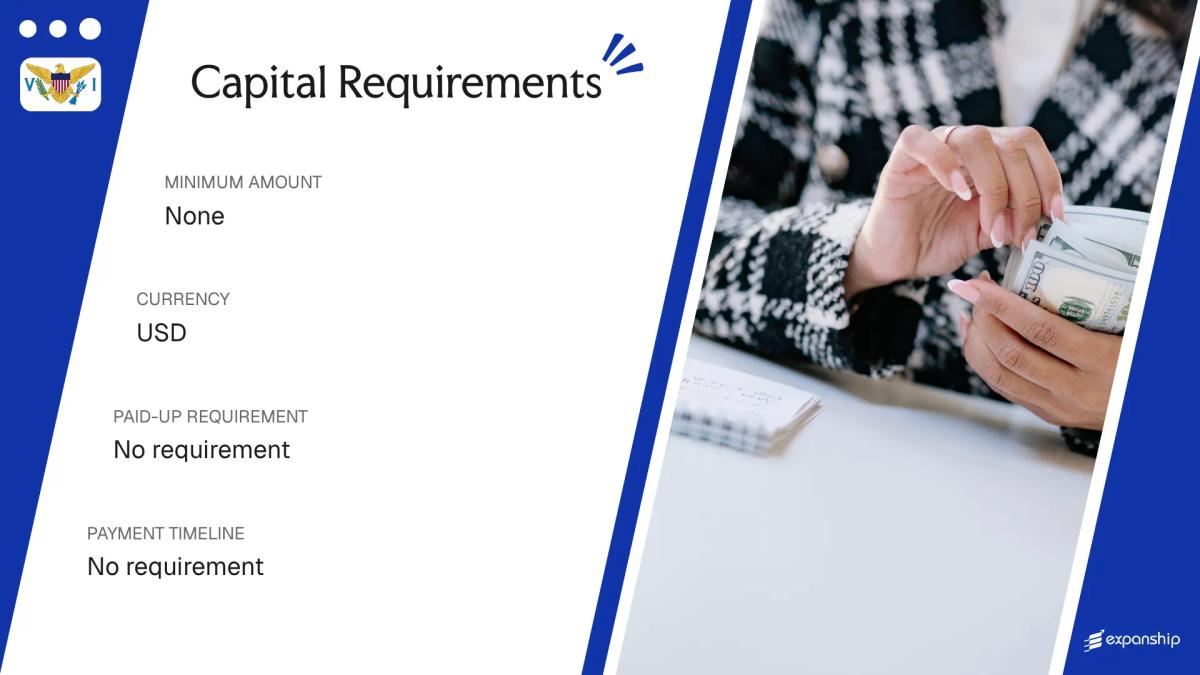
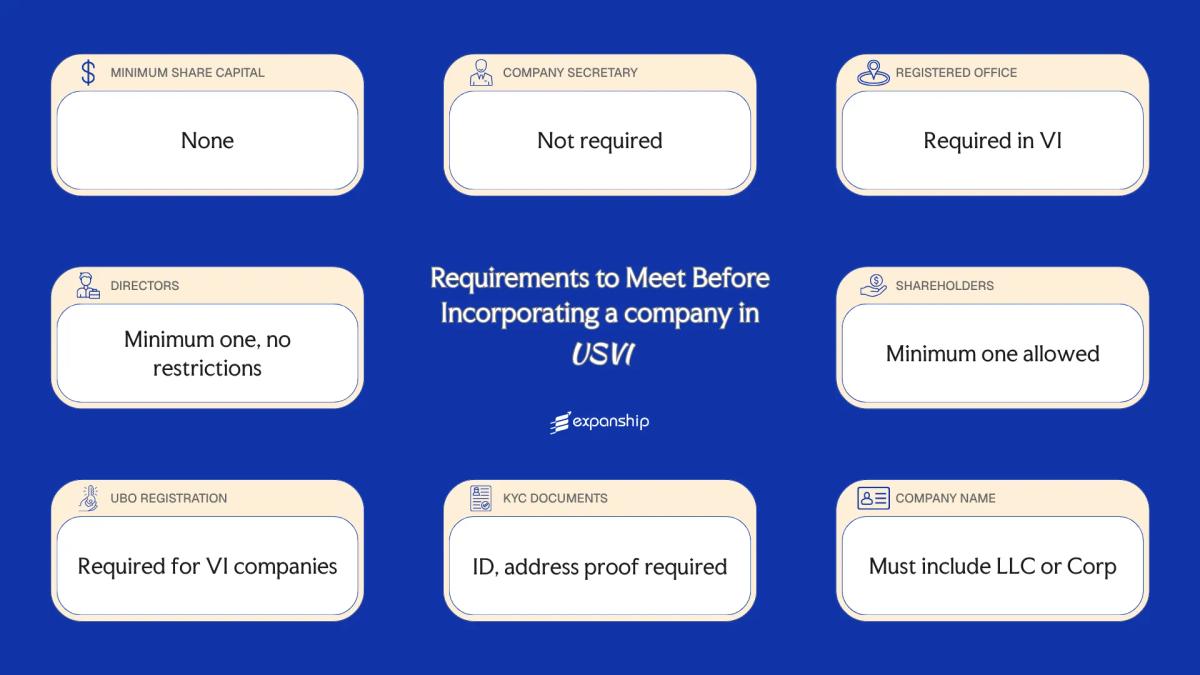
Under the U.S. Virgin Islands Business Corporation Act, corporations are not subject to a statutory minimum authorized share capital, and the territory follows a flexible framework that permits both par value and no-par value shares. U.S. Virgin Islands share capital requirements are governed at the point of incorporation by the Lieutenant Governor's Office, Division of Corporations and Trademarks, which reviews articles of incorporation but does not mandate a minimum capital threshold.
Capital structure obligations are established at incorporation and do not carry ongoing statutory maintenance requirements beyond what the articles themselves specify.
| Parameter | Detail |
|---|---|
| Minimum Authorized Share Capital | No statutory requirement |
| Maximum Authorized Share Capital | No statutory cap |
| Minimum Paid-Up Capital | No statutory requirement |
| Paid-Up Requirement at Incorporation | No statutory requirement |
| Accepted Currency | U.S. Dollar (USD) |
| Accepted Forms of Contribution | Cash, property, or services rendered |
| Timeframe to Deposit Capital | No statutory deadline |
Your articles of incorporation must still define an authorized share capital structure. Filing without specifying the class, number, and par value (or no-par value) of authorized shares will result in rejection by the Division of Corporations and Trademarks.
Registered Agent Requirements in the U.S. Virgin Islands
Every corporation formed under Title 13 of the Virgin Islands Code must designate a registered agent — this is a mandatory requirement, not an optional formality. The agent receives service of process and official government correspondence on behalf of the entity.
Under Virgin Islands statutory agent requirements, the agent bears responsibility for forwarding legal notices, court documents, and official communications to the corporation in a timely manner. Failure to maintain a continuously appointed agent can result in administrative consequences under the territorial compliance framework.
Qualification criteria for who may serve as a registered agent in the U.S. Virgin Islands:
- The agent must be a resident individual or a business entity authorized to conduct business in the territory.
- Corporate agents must maintain a physical office within the territory from which they conduct agent services.
- An individual agent must be at least 18 years of age and a resident of the U.S. Virgin Islands.
- The corporation itself cannot serve as its own registered agent.

Incorporate a Company in the U.S. Virgin Islands
Set up your business entity in the U.S. Virgin Islands with end-to-end support, from document preparation to official filing with the Lieutenant Governor's Office.
Registered Office Requirements in the U.S. Virgin Islands
Under the U.S. Virgin Islands registered office requirements, a corporation must maintain a physical office address within the territory that serves as its official location for receiving legal and governmental correspondence. Failure to maintain a compliant address can result in administrative penalties, loss of good standing, or involuntary dissolution under the Virgin Islands Business Corporation Act.
- A physical street address within the U.S. Virgin Islands is required; P.O. boxes are not acceptable as a registered office address.
- Virtual office addresses do not satisfy the physical presence requirement for a registered office.
- The address must be locally based within the territory; an address in a U.S. state or foreign jurisdiction does not qualify.
- No ownership of the premises is required, but the entity must have a verifiable right to use the address, such as through a lease or service agreement.
- The registered office address is a matter of public record and appears on filings maintained by the Lieutenant Governor's Office, which oversees corporate registrations.
- Any change to the registered office address must be formally reported to the Lieutenant Governor's Office through an amendment filing; the change does not take effect until recorded.
Director Requirements in the U.S. Virgin Islands
Under the U.S. Virgin Islands director requirements, directors of a corporation formed under Title 13 of the Virgin Islands Code assume fiduciary duties to the entity and its shareholders upon appointment. These obligations include the duty of care and the duty of loyalty, and directors can be held personally liable for actions taken in bad faith or outside their authorized capacity.
| Parameter | Detail |
|---|---|
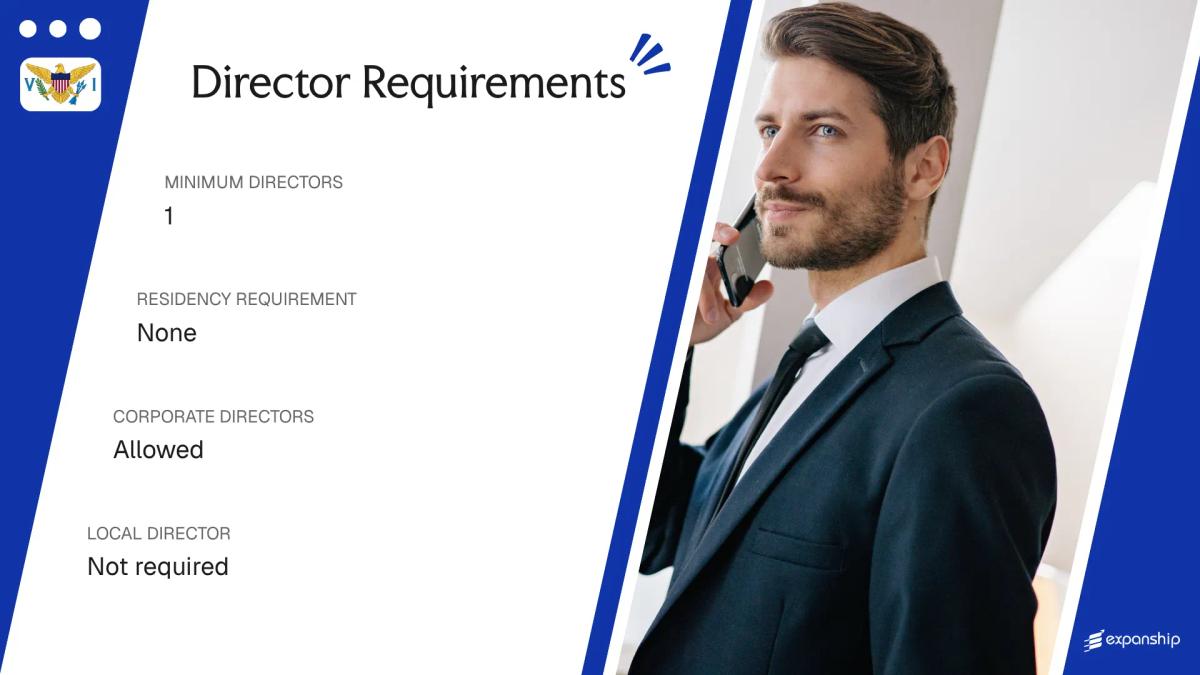
| Minimum Number of Directors | One director is required. |
| Maximum Number of Directors | No statutory maximum is prescribed. |
| Local/Resident Director Required | No residency requirement exists under Title 13. |
| Nationality Restrictions | No nationality restrictions apply. |
| Minimum Age Requirement | Directors must be at least 18 years of age. |
| Corporate Directors Permitted | Corporate directors are generally permitted under Title 13. |
| Director Must Be a Shareholder | No statutory requirement for directors to hold shares. |
| Publicly Listed on Registry | Director information is filed with the Lieutenant Governor's Office but is not always publicly searchable in a centralized online registry. |
| Disqualification Conditions | Persons convicted of fraud or financial crimes may be disqualified from serving. |
Despite being a U.S. territory, the Virgin Islands operates its own distinct corporate statute under Title 13, meaning federal U.S. corporate governance rules do not automatically govern director obligations here.
Shareholder Requirements in the U.S. Virgin Islands
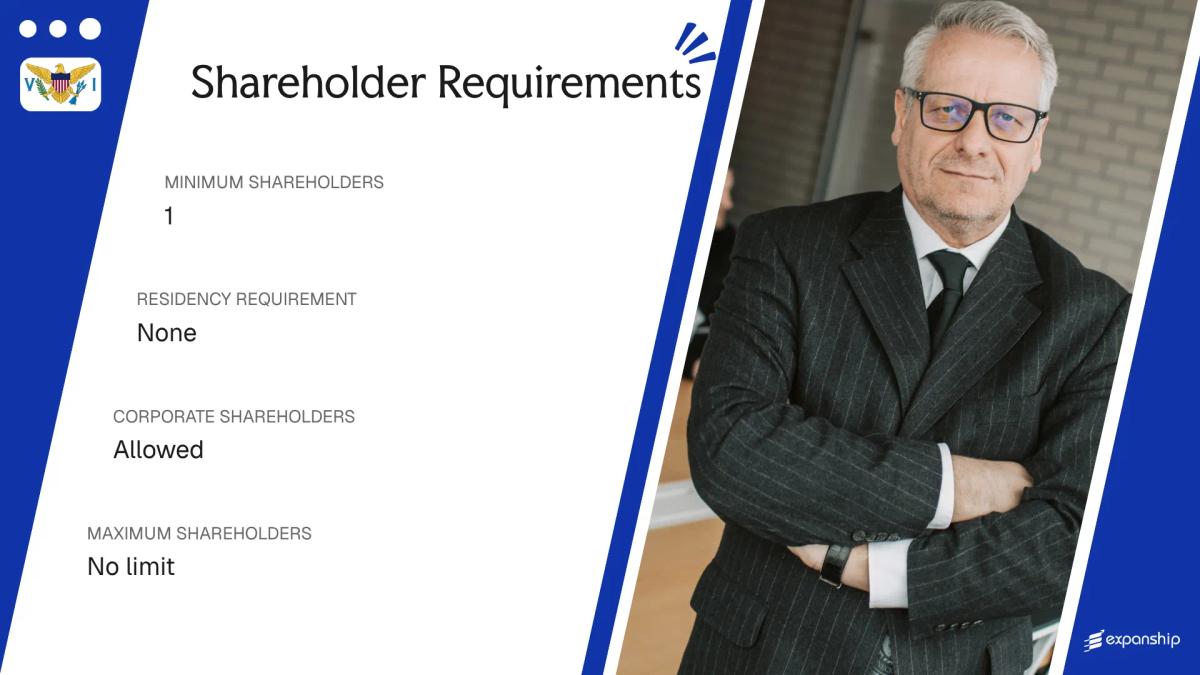
U.S. Virgin Islands shareholder requirements permit a corporation to be formed with a single shareholder, making sole-shareholder structures fully valid under the Virgin Islands Code. There is no statutory maximum on the number of shareholders a corporation may have.
Nationality and Residency Restrictions
No nationality or residency requirement applies to shareholders of a USVI corporation. Foreign nationals may hold 100% of the shares without restriction.
Corporate Shareholders
Corporate entities are permitted to act as shareholders. No conditions specific to corporate shareholding are imposed under the Virgin Islands corporate framework.
Shareholder Liability
Shareholder liability is generally limited to the amount unpaid on their shares. Circumstances such as piercing the corporate veil may expose shareholders to extended liability where courts determine the corporate form has been abused.
Register of Shareholders
A corporation is required to maintain an internal register of shareholders. This register is not filed with a public authority and is not publicly accessible, though it must be kept current and available for inspection by authorized parties.
Shareholder Compliance Support for Your U.S. Virgin Islands Corporation
Get guidance on structuring your shareholding arrangement and meeting all applicable obligations under the Virgin Islands Code.
UBO / Beneficial Ownership Disclosure Requirements in the U.S. Virgin Islands
Under U.S. Virgin Islands beneficial ownership requirements, businesses operating through entities formed under the Virgin Islands Uniform Limited Liability Company Act or the Business Corporation Act are subject to federal FinCEN obligations rather than a standalone territorial UBO statute.
- Identify all individuals who directly or indirectly own 25% or more of the entity, or who exercise substantial control over it, in accordance with the federal Corporate Transparency Act (CTA).
- Submit a Beneficial Ownership Information (BOI) report to the Financial Crimes Enforcement Network (FinCEN) via its secure online filing system.
- Update the BOI report within 30 days of any change to the reported information.
| Parameter | Detail |
|---|---|
| Ownership Threshold for UBO Status | 25% direct or indirect ownership, or substantial control |
| Filing Authority | FinCEN (Financial Crimes Enforcement Network) |
| Disclosure Deadline at Incorporation | 90 days for entities formed in 2024; 30 days for those formed from 2025 onward |
| Publicly Accessible Register | No |
| Penalties for Non-Disclosure | Civil penalties up to $591 per day; criminal penalties up to $10,000 and imprisonment |
| Ongoing Update Obligation | Within 30 days of any change |
KYC / Document Requirements in the U.S. Virgin Islands
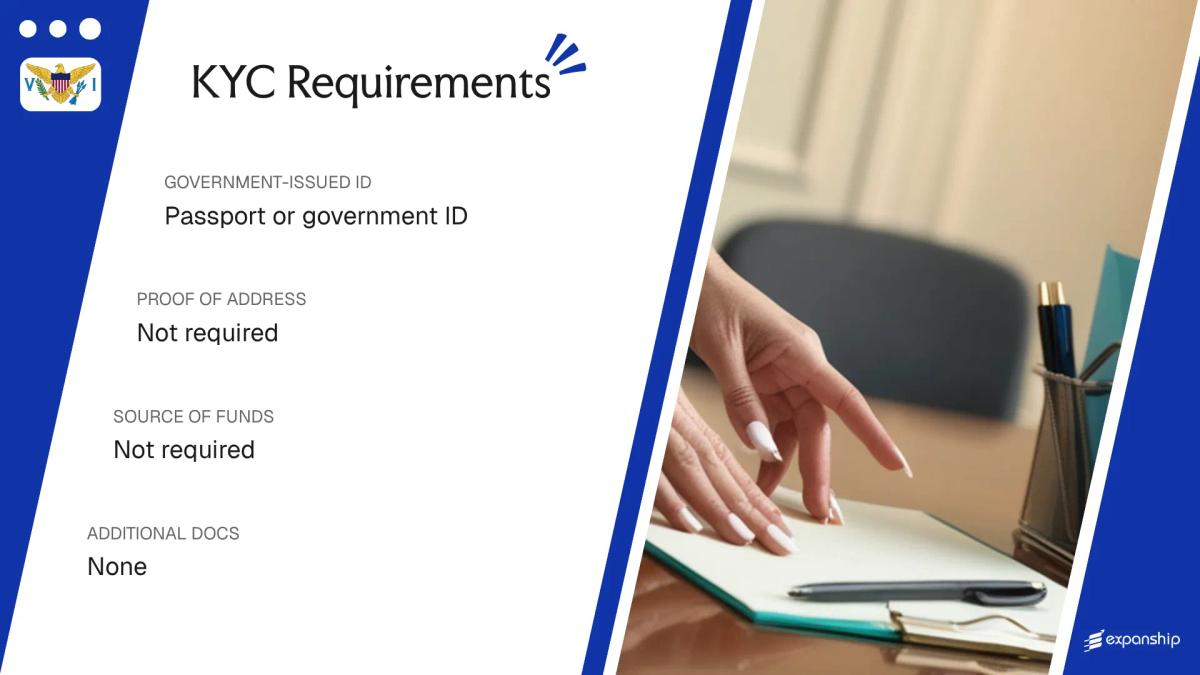
Incorporating in the U.S. Virgin Islands triggers KYC obligations under the Virgin Islands Anti-Money Laundering Act, which requires registered agents to collect and verify identity documentation from all principals before a company is formed. These requirements apply to every individual and corporate entity holding a role at the point of incorporation.
Individual / Personal Documents
- Government-issued photo identification (passport or national identity card)
- Proof of residential address dated within three months, such as a utility bill or bank statement
- Completed KYC/AML declaration or questionnaire as required by the registered agent
- Recent passport-sized photograph may be requested depending on agent policy
Corporate Documents
- Certificate of incorporation or equivalent formation document from the home jurisdiction
- Constitutional documents, including articles of association or equivalent
- Register of current directors and officers
- Proof of the corporate entity's registered address
Source of Funds Documentation
- Bank statements covering a minimum of three to six months
- Audited financial statements or management accounts where applicable
- A written declaration describing the origin of capital introduced into the entity
Notarisation and Apostille Requirements
- Documents issued outside the United States must generally be apostilled under the Hague Convention
- Certified translations are required for any document not in English
- Notarisation by a licensed notary public may be required for personal declarations
Incomplete or unnotarised foreign-issued identity documents are the most frequent cause of incorporation delays in this jurisdiction.
Company Name Requirements in the U.S. Virgin Islands
U.S. Virgin Islands company name requirements are assessed at the point of incorporation through a availability check conducted by the Lieutenant Governor's Office, Division of Corporations and Trademarks. A proposed name must be distinguishable from all existing registered entities on record.
Your chosen name must include a legal suffix denoting the entity type, such as "Corporation," "Incorporated," "Limited," or an accepted abbreviation. No specific character limit is publicly mandated, but the name must be in the English language.
Certain words are restricted. Terms suggesting a connection to government bodies, banking institutions, insurance, or financial regulation generally require prior approval from the relevant supervisory authority before the name can be accepted.
Name reservation is available through the Division of Corporations and Trademarks. A reserved name provides temporary protection while incorporation documents are prepared, though the exact reservation period should be confirmed directly with the office at the time of filing.
Compliance Services for Companies in the U.S. Virgin Islands
Maintain your entity's good standing in the U.S. Virgin Islands with ongoing compliance support, including annual report filings, registered agent maintenance, and regulatory monitoring.
Conclusion
The U.S. Virgin Islands incorporation requirements overview spans several distinct obligations, from company naming rules governed by the Office of the Lieutenant Governor to registered agent and beneficial ownership disclosure requirements. Compliance with FinCEN's beneficial ownership reporting rules carries particular weight for foreign investors, given the federal filing obligations that apply. Residency restrictions on registered agents also merit close attention. Once these requirements are understood, the practical next step is engaging local and federal filing processes to bring the entity into good standing under both territorial and U.S. federal law.
Expanship's Corporate Services for the U.S. Virgin Islands
Incorporating in the U.S. Virgin Islands involves working within a specific federal-territorial framework, where requirements around registered agents, beneficial ownership disclosure, and ongoing compliance with the Lieutenant Governor's Division of Corporations all carry real administrative weight. Expanship's U.S. Virgin Islands corporate services are structured to manage that operational load directly, so your business meets each requirement without unnecessary back-and-forth.
From initial formation through to ongoing obligations, Expanship covers the full scope of what your entity needs.
- We prepare and file all incorporation documents with the relevant USVI authorities on your behalf.
- A licensed registered agent and a qualifying registered office address in the territory are provided as part of our service.
- Our team handles government filings and liaises directly with the Division of Corporations.
- Post-incorporation compliance, including annual report obligations, is monitored and managed for your business.
- Banking introduction assistance is available to help your company establish a functional account.
- We coordinate tax registration and handle liaison with local fiscal authorities as required.
Contact Expanship VI to discuss your incorporation requirements.
Frequently Asked Questions (FAQ)
Yes, foreign nationals and non-residents can serve as directors of a USVI corporation. The Virgin Islands Business Corporation Act does not impose residency or citizenship requirements on directors. There is also no mandatory minimum number of directors specified beyond the general requirement to have at least one.
Failure to maintain a continuously appointed registered agent in the U.S. Virgin Islands can result in the Lieutenant Governor's office administratively dissolving or revoking your corporation's good standing. The registered agent must have a physical address in the territory, not a P.O. box. This requirement exists for all active corporations, regardless of whether the business operates locally or internationally.
Beneficial ownership disclosure requirements in the USVI apply at the federal level through the Corporate Transparency Act, administered by FinCEN, rather than through a territory-specific registry. Most newly formed entities must file a Beneficial Ownership Information report with FinCEN within the applicable deadline from formation. Certain exempt categories exist, including large operating companies that meet specific employee and revenue thresholds.
Your proposed company name must be distinguishable from names already on record with the USVI Lieutenant Governor's Division of Corporations and Trademarks, and it must include a corporate designator such as "Corporation," "Incorporated," or an accepted abbreviation. Names that imply a connection to a government agency or that are misleading about the entity's purpose are prohibited. A name reservation can be filed before submitting articles of incorporation to secure the name while you prepare your documents.
No, the Virgin Islands Business Corporation Act does not require that annual or special shareholder meetings be held physically within the territory. Meetings can be held outside the USVI or, where the bylaws permit, conducted by electronic means. Your articles of incorporation or bylaws should specify the procedures governing meeting location and voting to ensure compliance with the Act.
When registering a company in the USVI, your registered agent and any financial institutions involved will require identity verification documents for directors, shareholders, and beneficial owners, typically government-issued photo identification and proof of address. Corporate applicants must also provide certified constitutional documents from their home jurisdiction. The specific document standards may vary by registered agent, but they generally align with U.S. anti-money laundering compliance expectations under FinCEN guidelines.
Legal Disclaimer
The information provided in this article is for general informational purposes only and does not constitute legal, tax, or professional advice. While we strive to ensure the accuracy and timeliness of the content, laws and regulations are subject to change, and the application of laws can vary widely based on specific facts and circumstances.
Readers should not act upon this information without seeking professional counsel tailored to their individual situation. Expanship and its authors disclaim any liability for actions taken or not taken based on the content of this article.
For specific advice regarding your business setup, compliance requirements, or any legal matters, please consult with qualified legal and tax professionals in the relevant jurisdiction.