
Key Takeaways
- Businesses that qualify under the U.S. Virgin Islands Economic Development Authority program can reduce their federal corporate tax liability by 90%, a reduction that remains defensible under scrutiny because it requires substantive local operations rather than nominal presence.
- Unlike purely offshore jurisdictions, companies incorporated in the U.S. Virgin Islands retain access to U.S. dollar banking infrastructure and the broader American financial system, eliminating the correspondent banking friction common to Caribbean alternatives.
- The territory's status as an unincorporated U.S. territory means corporate structures formed here carry the legal credibility of U.S. sovereignty while remaining outside the full application of federal statutes that would otherwise erode the territorial tax advantages.
- Because the Office of the Lieutenant Governor administers company registration — including LLC formation — through its Division of Corporations and Trademarks, the formation process operates within a defined U.S.-affiliated regulatory framework rather than the less transparent systems found in many low-tax jurisdictions.
The benefits of incorporating in the U.S. Virgin Islands attract foreign investors and domestic entrepreneurs alike, largely because the territory occupies an uncommon position in global business structuring. Located in the Caribbean Sea roughly 40 miles east of Puerto Rico, it operates as an unincorporated territory of the United States, meaning it falls under U.S. sovereignty without being fully subject to all federal statutes.
Company registration is administered by the Office of the Lieutenant Governor, which oversees the Division of Corporations and Trademarks. Foreign businesses most commonly establish operations through an LLC. The territory's tax posture is low-tax by design, shaped significantly by its relationship with the U.S. Internal Revenue Code and local economic incentive programs.
Foreign ownership is broadly permitted, and the territory maintains an open stance toward foreign direct investment across most sectors. This article examines the principal advantages your business can access by forming a company here.
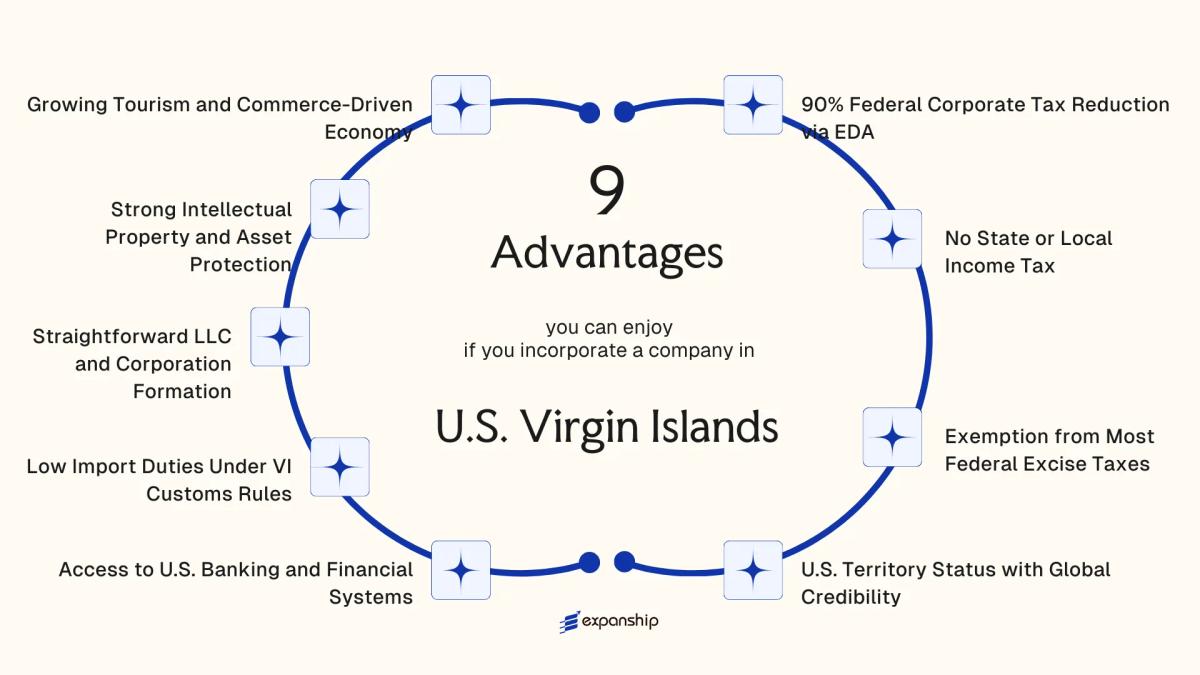
90% Federal Corporate Tax Reduction via EDA
Qualifying for the U.S. Virgin Islands EDA 90% federal tax reduction requires formal certification through the Virgin Islands Economic Development Authority, the statutory body established under Title 29 of the Virgin Islands Code to administer the territory's incentive programs.
What the Reduction Actually Covers
Certified businesses receive a 90% reduction on federal income taxes owed on income sourced within the territory. Because the USVI operates under a mirror tax system, federal tax obligations are paid to the Virgin Islands Bureau of Internal Revenue rather than the IRS, and the reduction applies directly to that liability.
Why Certification Changes the Tax Position of Your Business
For a qualifying entity, the effective federal tax rate on USVI-sourced income drops to approximately 3.5%, based on the standard 35% corporate rate applied after the 90% reduction. This is a legally structured outcome under the territorial mirror code system, not a deferral or loophole, which gives your business a predictable and defensible tax position from the start of operations.
A certified firm retaining profits from USVI-sourced income faces a federal tax burden far below what any U.S. state-based structure can legally offer.
No State or Local Income Tax
Corporations and LLCs operating in the U.S. Virgin Islands are not subject to any form of state or local income tax. This matters because it removes an entire layer of taxation that most U.S. states impose on top of federal obligations. In states like California or New York, combined corporate tax burdens can reach well above 25% when federal and state rates are combined. That layer simply does not exist here.
The absence of local income tax applies at both the corporate and, in many cases, the individual level for qualifying residents. For a foreign business owner structuring operations through a USVI entity, this means the territorial tax structure does not add a subnational charge against earned income or business profits.
This structural feature is not an incentive program with an expiration date. It reflects the jurisdiction's standing as a U.S. territory outside the scope of standard federal and state tax architecture.
What makes this particularly practical for foreign-owned firms:
- No state franchise tax eating into annual retained earnings
- No municipal-level income surcharge applied to business profits
- No requirement to file separate state income tax returns alongside federal ones
- Your entity's tax exposure is governed by a single territorial framework, reducing filing complexity

Incorporate Your Business in the U.S. Virgin Islands
Set up a compliant USVI corporation or LLC and position your business within a territorial tax framework that eliminates state and local income tax obligations.
Exemption from Most Federal Excise Taxes
The U.S. Virgin Islands federal excise tax exemption represents one of the more structurally distinct advantages available to businesses incorporated there. Under U.S. federal law, the territory sits outside the customs territory of the United States, which means many federal excise taxes that apply to domestic U.S. businesses do not automatically extend to USVI-based entities.
Federal excise taxes apply to a wide range of commercial activities on the U.S. mainland, covering fuel, communications, transportation, and certain manufactured goods. For businesses operating out of the Virgin Islands, many of these levies either do not apply or apply in a modified form, depending on where goods are produced and consumed.
| Activity or Product | U.S. Mainland Status | USVI Status |
|---|---|---|
| Domestically produced alcohol | Federal excise tax applies | Exempt if produced and sold locally |
| Fuel used in commerce | Federal fuel excise tax applies | Generally exempt for local use |
| Communications services | Federal excise tax may apply | Not automatically extended to territory |
| Goods exported to U.S. mainland | Standard import duties apply | Subject to U.S. customs entry rules |
This structural separation matters because excise taxes on the mainland can accumulate across a supply chain, adding cost layers that affect pricing and margin. A firm producing goods or delivering services within the territory avoids many of those layers. Eligibility for this treatment depends on the nature of your operations and where goods ultimately move, so the benefit applies most cleanly to businesses whose primary activity remains within or through the territory rather than directed at U.S. mainland consumers.
U.S. Territory Status with Global Credibility
U.S. Virgin Islands territory status business credibility stems from a structural fact: the USVI is an unincorporated territory of the United States, meaning companies formed there operate under U.S. federal jurisdiction and are recognized as U.S.-domiciled entities in international commerce.
For foreign investors, this distinction carries measurable weight. Counterparties, banks, and institutional clients in jurisdictions that maintain strict tiering between onshore and offshore entities treat a USVI-registered company differently than one formed in a traditional offshore center. The entity holds a U.S. address, falls under U.S. federal court jurisdiction, and is subject to U.S. federal regulatory oversight, including oversight by federal agencies such as the SEC where applicable.
Contracts governed by U.S. law, cross-border transactions requiring a recognized domicile, and supplier relationships that exclude purely offshore structures all become accessible to your business through this status.
Keep these points in mind:
- USVI companies are subject to U.S. federal law, including anti-money laundering and FINCEN reporting requirements
- The entity is not treated as a foreign company under U.S. federal contracting rules
- Recognition under U.S. jurisdiction does not automatically confer all mainland state-level protections
Learn more about the territory's status via the U.S. Department of the Interior.
A USVI LLC can be treated as a U.S. domestic entity for federal purposes while still benefiting from territorial tax incentives that mainland U.S. states cannot legally offer.
Access to U.S. Banking and Financial Systems
U.S. Virgin Islands access to U.S. banking systems is one of the most structurally significant advantages a foreign business owner can obtain without forming a company on the U.S. mainland. Because the territory operates under U.S. federal banking law, companies incorporated there can open accounts with U.S.-chartered financial institutions and transact in U.S. dollars within the domestic financial infrastructure.
Banking Within U.S. Jurisdiction
A USVI-incorporated entity is not treated as a foreign company by U.S. banks. This distinction matters because foreign businesses frequently face elevated due diligence requirements, account restrictions, or outright refusals from American financial institutions. Your firm avoids that category entirely, giving it access to ACH transfers, wire systems, and correspondent banking relationships on the same footing as a domestic U.S. entity.
Federal Deposit Insurance Corporation (FDIC) coverage applies to deposits held at qualifying institutions operating in the territory. That protection, standard for U.S.-based accounts, is not available through offshore financial centers, which means client and operating funds held through a USVI business carry a level of institutional security that most international alternatives cannot replicate.
Dollar-Denominated Operations Without Conversion Risk
All transactions operate natively in U.S. dollars, eliminating currency conversion costs and the exchange rate exposure that affects businesses banking through jurisdictions with local currencies. For companies that invoice clients in USD or hold dollar-denominated contracts, this structural alignment reduces operational friction without requiring currency hedging arrangements.
Set Up Your USVI Company to Access U.S. Banking
Find out how a properly structured U.S. Virgin Islands entity can give your business full access to U.S. financial systems, FDIC-covered accounts, and dollar-denominated banking from day one.
Low Import Duties Under VI Customs Rules
The U.S. Virgin Islands low import duties advantage stems from the territory's separate customs zone status. Although VI is a U.S. territory, it sits outside the U.S. customs territory defined under 19 U.S.C. § 1202, which means goods entering the islands are not automatically subject to standard U.S. tariff schedules.
- Goods manufactured or substantially transformed in VI and then exported to the U.S. mainland may qualify for duty-free or reduced-duty entry under specific origin rules, which lowers the landed cost of goods moving through a VI-based supply chain.
- Imports arriving into VI itself are assessed under the territory's own customs schedule, with rates that are generally lower than equivalent U.S. mainland tariff rates on many categories of goods. This directly reduces input costs for firms sourcing materials or products from abroad.
- Certain raw materials and equipment imported for qualifying manufacturing or business operations may be eligible for further duty reductions or exemptions under local Economic Development Commission incentive agreements, reinforcing the customs benefit at the operational level.
- For businesses involved in physical goods trade, the combination of reduced inbound duties and preferential treatment on exports to the mainland creates a cost structure that would not exist in a standard U.S. domestic corporate setup.
Straightforward LLC and Corporation Formation
Forming a business entity in the U.S. Virgin Islands carries a structural advantage that matters from day one: the process operates under a U.S.-based legal framework without the procedural complexity of mainland state filings. The Virgin Islands Uniform Limited Liability Company Act governs LLC formation, providing a familiar statutory foundation for U.S.-based investors while remaining accessible to foreign nationals.
There is no requirement for a local resident director or shareholder in most standard formations. That means you can own and control your company without establishing physical residency on the islands, which directly reduces overhead and operational friction for internationally based owners.
Registered agents are required, but the territory has a functional network of licensed agents operating under local law. Single-member LLCs are permitted, so a sole foreign investor can form and operate a company without bringing in additional parties to satisfy minimum ownership thresholds.
A foreign investor forming a single-member LLC in the U.S. Virgin Islands can establish full ownership and operational control without appointing a resident director, meeting no minimum capital requirement, and completing formation through a single registered agent, compared to jurisdictions like Singapore, where a locally resident director is mandatory under the Companies Act.
Strong Intellectual Property and Asset Protection
U.S. Virgin Islands asset protection benefits for businesses rest on a combination of U.S. federal law coverage and territory-specific structural advantages. Because the USVI is an unincorporated U.S. territory, intellectual property registered under federal statutes — including the Copyright Act, the Lanham Act for trademarks, and patent protections administered by the USPTO — applies fully to entities formed here.
For IP holding structures, this matters practically. A firm incorporated in the USVI can own, license, and enforce federally registered IP rights without the legal uncertainty that accompanies offshore jurisdictions outside U.S. jurisdiction.
Asset protection also operates at the entity level. USVI LLCs and corporations benefit from charging order protections under local law, which limits a creditor's ability to seize membership interests directly. This creates a structural barrier between personal liability and business assets.
- IP ownership through a USVI entity carries the enforcement weight of the U.S. federal court system.
- Licensing income generated by an IP holding company can qualify for EDA tax benefits, connecting asset structure to the territory's broader incentive framework.
EDA tax benefits on IP licensing income require that the income be directly tied to qualifying business activity conducted within the USVI, not simply booked through a shell entity.
Growing Tourism and Commerce-Driven Economy
The U.S. Virgin Islands tourism economy generates hundreds of millions of dollars annually, drawing over one million visitors each year through cruise arrivals and stopover tourists. That volume of consumer activity creates direct demand across hospitality, retail, food service, logistics, and professional services, giving businesses operating locally a built-in customer base that cycles continuously through the territory.
Tourism is not the only driver. The territory's position as a transshipment and commercial hub in the eastern Caribbean means that trade-oriented businesses also benefit from consistent commercial activity independent of seasonal fluctuations in visitor numbers.
For a foreign-owned entity, this matters for one specific reason: an active local economy supports the substance requirements tied to benefits under the Economic Development Authority (EDA) program. Demonstrating genuine economic participation, including employment, physical presence, and local revenue, becomes more feasible when underlying market demand exists.
Sectors that have historically supported foreign investment in the territory include:
- Marine and charter services
- Luxury retail and duty-free goods
- Real estate development
- Financial and professional services
- Technology and remote services firms qualifying under EDA
Establishing a business in a jurisdiction with existing commercial infrastructure reduces the practical costs of building client relationships and supply chains from the ground up. The territory's existing port facilities, airport connections to major U.S. cities, and established hospitality sector contribute to that infrastructure. For investors evaluating the USVI growing economy advantages, the relevant question is whether the sector they are entering already has demonstrated demand within the local market.
Why the U.S. Virgin Islands Stands Apart from Other Offshore and Onshore Jurisdictions
Businesses evaluating the U.S. Virgin Islands advantages over offshore jurisdictions often compare it against Cayman Islands, Puerto Rico, and Delaware, three destinations that attract similar foreign investor profiles. The Cayman Islands and USVI both offer low-tax environments, but the Cayman Islands sits outside the U.S. legal system, which creates friction with U.S. banks and counterparties. Puerto Rico operates under similar federal exemptions, and Delaware is the dominant onshore benchmark. Placing the USVI against these three reveals where its structural position is genuinely distinct rather than merely competitive.
What the comparison below reflects is that the territory occupies an unusual middle position: it carries the legal and banking credibility of U.S. jurisdiction while offering tax concessions that most onshore U.S. states cannot match. The Economic Development Authority program is the primary mechanism behind this, and no equivalent benefit structure exists in Delaware or most U.S. states.
| Parameter | U.S. Virgin Islands | Cayman Islands | Puerto Rico | Delaware |
|---|---|---|---|---|
| Federal tax standing | U.S. territory; separate tax mirror code | Non-U.S. jurisdiction | U.S. territory; IRC applies with Act 60 incentives | Full U.S. state; standard federal tax applies |
| Corporate tax incentive | Up to 90% reduction via EDA program | 0% corporate tax; no formal incentive program | 4% flat rate under Act 60 for eligible entities | Standard 21% federal rate; no territory-level reduction |
| U.S. banking access | Full access; FDIC-insured institutions present | Restricted; often requires correspondent banking | Full access | Full access |
| Perceived legal credibility | U.S. courts; UCC applies | Cayman law; separate court system | U.S. courts; UCC applies | U.S. courts; UCC applies |
| Excise tax treatment | Exempt from most federal excise taxes | N/A (separate customs territory) | Subject to federal excise taxes in most cases | Subject to federal excise taxes |
| Residency requirement for tax benefits | Required for EDA-certified businesses | Not applicable | Required under Act 60 | Not applicable |
Compliance Services for Companies in the U.S. Virgin Islands
Maintain your USVI entity's good standing with annual filings, registered agent requirements, and EDA certification renewals handled correctly.
Conclusion
The benefits of incorporating in the U.S. Virgin Islands rest on a convergence of tax, regulatory, and jurisdictional factors that are difficult to replicate elsewhere under a single U.S.-affiliated framework. The Economic Development Authority's 90% federal corporate tax reduction, combined with full exemption from local income tax, produces an effective tax position that few territories operating within the U.S. legal system can match.
For businesses with qualifying operations, the EDA program ties these reductions to substantive economic activity on the islands, which means the structure holds up to scrutiny rather than depending on opaque arrangements. Access to U.S. banking infrastructure adds a further layer of operational reliability that purely offshore jurisdictions cannot offer.
That said, the strength of this jurisdiction depends on alignment between your business model and what the territory is structured to reward. A firm that cannot satisfy EDA residency and employment criteria, or one whose industry falls outside the authority's qualifying categories, will not access the headline tax benefits. The case for incorporating here is strongest when your business can genuinely commit to a local operational presence. For those that can, the combination of federal credibility, territorial tax treatment, and U.S. dollar banking creates a structurally sound foundation that warrants careful professional evaluation before formation.
Let Expanship Handle Your U.S. Virgin Islands Company Formation
Expanship U.S. Virgin Islands company formation services cover the full incorporation process under the jurisdiction of the Office of the Lieutenant Governor, Division of Corporations and Trademarks, which oversees entity registration for LLCs, corporations, and other recognized structures. The tax advantages discussed throughout this blog, from the 90% federal corporate tax reduction under the Economic Development Authority program to exemptions from most federal excise taxes, each carry specific compliance requirements that must be satisfied on an ongoing basis to remain valid.
Expanship manages each stage of that process directly:
- Preparation and legalization of incorporation documents, including Articles of Incorporation or Articles of Organization tailored to your chosen entity type
- Registered agent and registered office provision within the territory, as required under Virgin Islands law
- Filing and liaison with the Division of Corporations and Trademarks on your behalf
- EDA application coordination and post-certification compliance support
- Post-incorporation annual reporting and good standing maintenance
- Banking introduction assistance to U.S.-chartered financial institutions operating in the territory
For businesses pursuing EDA benefits or establishing a compliant operational presence in the territory, each of these elements requires accurate execution against local statutory requirements.
Reach out to Expanship U.S. Virgin Islands to discuss your incorporation requirements.
Frequently Asked Questions (FAQ)
An EDA-approved company receives a 90% reduction on its U.S. federal corporate income tax liability, resulting in an effective federal rate of approximately 3.5% on applicable income. This reduction applies to income sourced within the territory and is tied to maintaining compliance with EDA benefit conditions throughout the benefit period. The standard federal corporate rate of 35% historically served as the baseline, though the applicable gross rate may vary depending on current federal tax law.
Physical presence requirements depend on the type of entity and whether it holds EDA benefits. Standard LLC or corporation registrations under the Virgin Islands Uniform Commercial Code and corporate statutes do not necessarily mandate that owners reside in the territory. EDA-certified businesses, however, must maintain a bona fide office and employ a minimum number of local residents to remain in good standing with their benefit agreement.
The territory operates its own customs regime separate from the U.S. federal customs system, and goods imported into the USVI are subject to local duty rates rather than standard U.S. tariff schedules. Certain categories of goods benefit from reduced or zero duty rates, and products manufactured locally may qualify for favorable treatment when exported to the U.S. mainland under applicable federal provisions. This creates a distinct cost structure for businesses involved in import-dependent operations or goods manufacturing.
Failure to maintain the employment levels, capital investment commitments, or other conditions specified in your EDA benefit agreement can result in partial or full revocation of the tax benefits. The EDA conducts periodic compliance reviews, and businesses found in breach of their benefit terms may be required to repay a portion of the taxes previously reduced. Reinstatement is not automatic and typically requires a formal application process with the Authority.
For most banking and financial regulatory purposes, the USVI is treated as a U.S. jurisdiction, meaning businesses incorporated there can access U.S. dollar-denominated accounts through domestic banks without the correspondent banking complications common to foreign offshore centers. Federal financial regulations, including those administered by the Financial Crimes Enforcement Network (FinCEN), apply to USVI-based entities. This treatment gives territory-incorporated firms a compliance profile closer to a U.S. domestic company than to a traditional offshore structure.
Formation timelines vary by entity type and the completeness of the filing submitted to the Office of the Lieutenant Governor, which oversees business registrations in the territory. A standard LLC or corporation can generally be registered within a few business days once all required documents, fees, and registered agent designations are in order. EDA certification is a separate process with a longer timeline, as it involves application review, interviews, and board approval before benefits are formally granted.
Legal Disclaimer
The information provided in this article is for general informational purposes only and does not constitute legal, tax, or professional advice. While we strive to ensure the accuracy and timeliness of the content, laws and regulations are subject to change, and the application of laws can vary widely based on specific facts and circumstances.
Readers should not act upon this information without seeking professional counsel tailored to their individual situation. Expanship and its authors disclaim any liability for actions taken or not taken based on the content of this article.
For specific advice regarding your business setup, compliance requirements, or any legal matters, please consult with qualified legal and tax professionals in the relevant jurisdiction.