
Key Takeaways
- Businesses incorporated in the U.S. Virgin Islands must navigate a dual compliance burden under both federal U.S. law and the Virgin Islands Code, creating a layered regulatory obligation that mainland U.S. entities do not face.
- Access to the Economic Development Commission's tax incentives — including reduced income tax rates — is conditional on meeting strict eligibility criteria, meaning most foreign-owned entities cannot treat those benefits as a reliable baseline assumption.
- The territory's geographic isolation and small resident population impose a structurally limited consumer base, which constrains revenue potential for businesses that depend on local market demand rather than remote or export-oriented operations.
- Recurring hurricane exposure creates a persistent operational risk for businesses maintaining physical infrastructure or inventory in the territory, with rebuilding and business interruption costs historically proving substantial following major storm events.
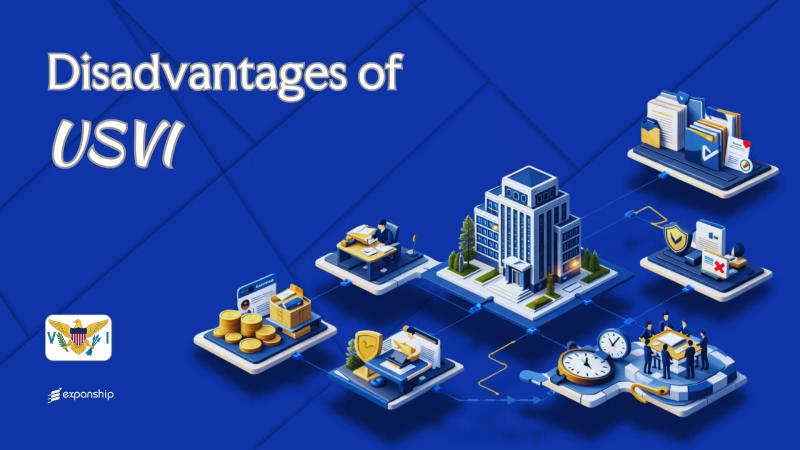
The disadvantages of incorporating in U.S. Virgin Islands span operational, fiscal, and structural categories that affect foreign-owned entities in ways that differ meaningfully from mainland U.S. incorporation. The territory operates under a dual regulatory framework — subject to federal U.S. law while maintaining its own local statutes, including the Virgin Islands Code, which governs business formation and corporate conduct at the territorial level.
The challenges examined in this article range across cost structures, workforce access, tax compliance obligations, and physical infrastructure. Not all of these will apply equally to every firm; the relevance and severity of each drawback depends on your business model, industry sector, and whether you intend to operate locally or hold assets remotely.
This article is most relevant to foreign investors and U.S.-based entrepreneurs evaluating the territory as a primary operating base or tax-advantaged structure, rather than those using it solely as a passive holding arrangement.
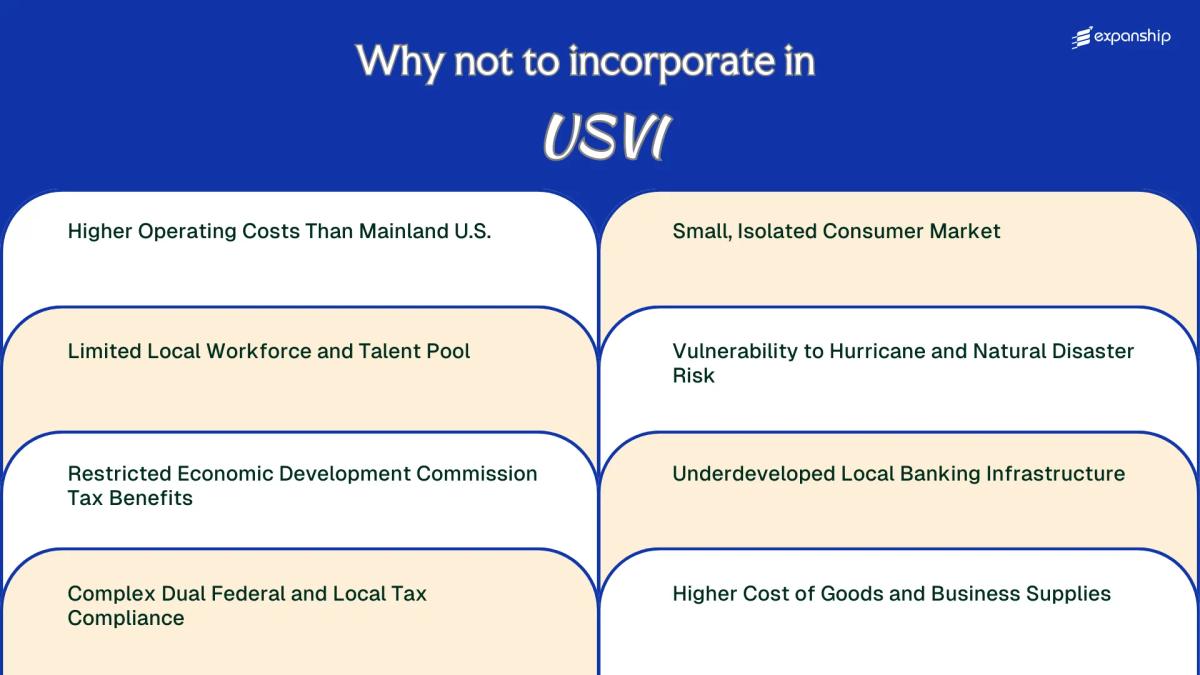
Higher Operating Costs Than Mainland U.S.
High operating costs USVI business owners face stem from a structural reality: the territory depends almost entirely on imported goods, fuel, and materials, since local production capacity is minimal.
Freight Costs and Island Logistics
All shipments destined for the U.S. Virgin Islands must comply with the Jones Act, which requires goods transported between U.S. ports to travel on U.S.-flagged vessels. This restriction reduces carrier competition and inflates freight costs well above what mainland businesses pay for comparable routes. Your firm absorbs these costs on everything from office equipment to raw materials.
Utility and Operational Overhead
Electricity rates on the islands are among the highest in any U.S. jurisdiction, supplied primarily through the Virgin Islands Water and Power Authority (WAPA), which relies heavily on imported fuel oil. A business with significant energy consumption will face utility bills that can run two to three times higher than comparable mainland operations. This cost burden applies regardless of business size or sector.
Foreign business owners should account for cumulative freight, energy, and logistics premiums that can materially erode profit margins before any revenue is generated.
Limited Local Workforce and Talent Pool
U.S. Virgin Islands workforce limitations are a structural constraint, not a temporary condition. The territory's total population sits at roughly 100,000 people, and the available labor pool is small even relative to that figure once you account for age demographics, existing employment rates, and sector concentration in tourism and hospitality.
For a foreign-owned business operating outside those dominant sectors, sourcing qualified professionals locally is genuinely difficult.
Roles requiring specialized technical, legal, financial, or engineering credentials often cannot be filled from within the territory. That forces your firm into international recruitment, which carries its own set of costs and procedural burdens.
Specifically, hiring foreign nationals to fill those gaps creates friction across several dimensions:
- Work authorization for non-U.S. nationals must still comply with federal immigration requirements, adding legal fees and processing time that mainland-based firms rarely face at the same frequency.
- Relocation packages become necessary to attract talent from the continental U.S., raising your compensation overhead significantly.
- Retaining skilled employees is harder when housing costs on the islands are high and professional community networks are thin.
- Gaps in mid-level management talent mean external contractors are often required for functions that would be handled in-house elsewhere.
Brain drain compounds the problem. Educated residents frequently relocate to the mainland for career opportunities, shrinking the local professional base over time.

Company Incorporation in the U.S. Virgin Islands
Set up your business entity in the U.S. Virgin Islands with structured support across registration, compliance, and documentation requirements.
Restricted Economic Development Commission Tax Benefits
USVI Economic Development Commission restrictions make the program far less accessible than it first appears. To qualify, a business must receive EDC certification, which requires demonstrating a tangible economic benefit to the territory — including minimum employment of full-time Virgin Islands residents and a physical operational presence in the territory.
The employment threshold alone creates a structural barrier. Your firm must hire a prescribed number of local residents as full-time employees, which ties the tax benefit directly to a workforce constraint that many foreign-owned businesses cannot realistically meet given the limited labor pool.
| Requirement | Threshold / Condition | Implication for Foreign Businesses |
|---|---|---|
| Resident employment | Minimum number of full-time VI resident employees | Forces hiring from a shallow labor market |
| Physical presence | Bona fide office and operations in the territory | Excludes remote or asset-light business models |
| Benefit retention period | Multi-year commitment to maintain operations | Exit costs arise if business conditions change |
| Annual reporting | Ongoing compliance filings with the EDC | Adds administrative cost each operating year |
Certification is not permanent. The Economic Development Commission can revoke benefits if your entity fails to maintain the qualifying conditions year over year, creating ongoing compliance exposure rather than a stable tax position.
The reduced rates — which can include significant reductions on income tax and gross receipts tax — apply only to income generated from EDC-approved activities. Revenue from non-approved operations remains taxed under standard rates, limiting the practical tax advantage for diversified businesses.
Complex Dual Federal and Local Tax Compliance
USVI dual tax compliance challenges stem from a structural anomaly that most foreign business owners don't anticipate. The territory operates under a "mirror tax code," meaning the U.S. Internal Revenue Code is applied locally, with "Virgin Islands" substituted for "United States" throughout the text. In practice, your company files tax obligations under two parallel systems simultaneously.
Under this framework, a business incorporated in the territory must file both with the Virgin Islands Bureau of Internal Revenue (VIBIR) and, depending on the company's structure and where income is sourced, potentially with the U.S. IRS as well. This dual filing obligation creates twice the administrative load compared to a standard U.S. state incorporation.
U.S. Virgin Islands federal and local tax problems frequently arise from ambiguities in how the mirror code applies to foreign-sourced income. The VIBIR and IRS do not always interpret overlapping provisions identically, which means your firm may face conflicting compliance positions across two agencies.
- VIBIR requires separate local income tax filings regardless of IRS obligations
- Businesses with U.S.-connected income may owe taxes to both the IRS and VIBIR, depending on residency and sourcing rules
- The mirror code does not replicate all IRS regulations automatically; gaps require independent legal interpretation
- Filing deadlines under VIBIR may differ from federal deadlines, requiring separate tracking
- Foreign entities are subject to withholding rules under both systems when paying dividends or royalties
USVI mirror tax code compliance difficulties are compounded for foreign-owned entities, since U.S. international tax provisions under FATCA and FBAR still apply to U.S. Virgin Islands entities with U.S. persons involved.
Despite using the U.S. dollar and mirroring the U.S. tax code, the U.S. Virgin Islands is treated as a foreign jurisdiction under many U.S. federal statutes, meaning domestic U.S. tax treaties do not extend to businesses incorporated there.
Small, Isolated Consumer Market
The U.S. Virgin Islands small market limitations present a structural constraint that few foreign business owners fully account for before incorporating. With a resident population of roughly 100,000 across three main islands, your addressable local consumer base is smaller than many mid-sized American cities.
A Consumer Base Too Small to Sustain Most Business Models
Any firm dependent on local retail volume, recurring consumer subscriptions, or domestic service demand will find the USVI isolated consumer base insufficient to support meaningful revenue on its own. Businesses that succeed locally typically do so by serving tourism traffic or exporting services off-island, not by relying on resident purchasing power.
Structural Isolation and Its Commercial Consequences
Geographic separation from the U.S. mainland compounds the limited market size, as supply chains, distribution networks, and B2B partnerships are harder to establish at scale when your business is island-based. This isolation raises customer acquisition costs for any entity targeting consumers beyond the territory, since logistics and outreach both carry premium price tags in this setting.
Addressing Market Challenges Before You Incorporate in the U.S. Virgin Islands
Understand how the territory's market size and geographic isolation may affect your business model before committing to a structure.
Vulnerability to Hurricane and Natural Disaster Risk
Hurricane risk in the U.S. Virgin Islands is not a background concern — it is a documented operational liability. The territory sits within the Atlantic hurricane belt, and major storms have caused prolonged infrastructure failures that directly interrupt business activity.
- Hurricane Maria (2017) left parts of the territory without power for months, forcing businesses to absorb extended downtime costs that no continuity plan could fully offset.
- Physical damage to commercial property triggers insurance claims under policies that typically carry higher premiums in Caribbean territories than in mainland U.S. markets, increasing your baseline operating costs.
- Post-storm supply chain disruptions compound losses, as the territory's dependence on seaport access means restocking inventory or receiving equipment takes significantly longer than in connected markets.
- FEMA disaster declarations, while available to USVI businesses, do not eliminate revenue loss during recovery periods, which can extend across multiple fiscal quarters.
Underdeveloped Local Banking Infrastructure
USVI banking infrastructure limitations present a concrete operational problem for incorporated businesses. The territory has a small number of commercial banks, with FirstBank Virgin Islands and Banco Popular among the few institutions actively serving business clients. This restricted market means fewer product options, less competitive terms, and limited access to specialized commercial lending.
Opening a business account can take significantly longer than on the U.S. mainland, and compliance requirements under the Bank Secrecy Act apply fully to VI-based entities, meaning your firm must meet the same federal AML and KYC obligations without the benefit of a deep local banking ecosystem to support that process.
Credit availability for small and mid-sized businesses is constrained. Businesses that require trade finance, multi-currency accounts, or sophisticated treasury services will typically find those products unavailable locally, requiring relationships with mainland U.S. institutions that may be reluctant to service a VI-registered entity without a demonstrated operational footprint.
A foreign-owned LLC incorporated in the USVI requiring a business line of credit, a merchant processing account, and a multi-currency facility may need to maintain banking relationships with three separate institutions across two jurisdictions, adding several thousand dollars annually in account maintenance fees, compliance costs, and wire transfer charges.
Higher Cost of Goods and Business Supplies
The high cost of goods in USVI businesses stems from a structural geographic reality: the islands import the vast majority of consumer products, raw materials, and business supplies from the U.S. mainland or abroad. Every shipment incurs ocean freight charges, container fees, and handling costs that mainland competitors simply do not face.
Unlike continental U.S. states, the Virgin Islands lack land-based logistics networks. Your firm cannot source supplies overland or benefit from proximity to major distribution hubs, which means delivery timelines are longer and costs are layered.
The Harmonized Tariff Schedule still applies to goods entering the territory, and while the U.S. Virgin Islands has certain customs advantages under its free port status, this does not eliminate freight premiums. Operational supply expenses, from office equipment to industrial materials, routinely run significantly higher than equivalent costs in Florida or Texas.
For businesses dependent on physical inventory or manufacturing inputs, this cost structure directly compresses margins. A firm that prices its services or goods against mainland benchmarks will find its cost base materially higher before accounting for labor or overhead.
The territory's free port status reduces certain import duties but does not offset ocean freight and logistics premiums, meaning supply chain cost disadvantages apply to virtually all goods-dependent businesses regardless of product category.
Navigating These Incorporation Challenges
Navigating USVI incorporation challenges requires structural preparation before the entity is formed, not after operational problems surface. The jurisdiction's combination of federal oversight and local regulatory requirements means gaps in planning carry compounding consequences.
- Confirm your business activity qualifies under the Economic Development Commission's eligible sectors before applying for EDC benefits, referencing the Virgin Islands Code for current statutory criteria.
- Establish banking relationships with mainland U.S. institutions from the outset to offset the limited correspondent banking access available through local USVI banks.
- Engage a licensed registered agent familiar with the Office of the Lieutenant Governor's filing requirements to maintain good standing under local corporate law.
- Build hurricane contingency protocols into your operational structure, including off-island data storage and supply chain redundancies that account for extended port disruptions.
- Budget for import duties and freight premiums on business supplies as fixed operational line items, not variable contingencies.
Overcoming U.S. Virgin Islands business drawbacks depends on treating federal tax compliance and local territorial obligations as parallel tracks, each with distinct filing deadlines and reporting bodies. Managing USVI company formation risks remains an ongoing process governed by both the Internal Revenue Service and the Virgin Islands Bureau of Internal Revenue.
U.S. Virgin Islands Still Worth Considering
Assessing whether incorporating in U.S. Virgin Islands is worth it depends entirely on how your business profile aligns with the territory's structural realities. The disadvantages covered in this blog are substantive, but they apply unevenly depending on your operational model, and for certain businesses, the EDC tax benefit program and U.S. legal framework still represent a credible combination.
| Pros | Cons |
|---|---|
| EDC-approved businesses can access significant corporate income tax reductions under Title 29 of the Virgin Islands Code. | EDC benefits are conditional on strict employment, capital investment, and physical presence requirements that many businesses cannot meet. |
| The territory operates under U.S. federal law, giving businesses access to familiar legal protections and court systems. | Maintaining compliance requires managing both IRS federal obligations and the Virgin Islands Bureau of Internal Revenue simultaneously. |
| Incorporation follows established U.S.-style corporate structures, including LLCs and corporations. | Local banking infrastructure is underdeveloped, with limited institutional options and restricted access to standard commercial credit facilities. |
| Geographic position supports maritime and logistics-oriented operations within the Caribbean. | The local consumer base is small and geographically isolated, limiting domestic revenue potential. |
| No state-level income tax applies, unlike mainland U.S. jurisdictions. | High costs for goods, supplies, and general operations reflect the territory's import-dependent economy. |
Hurricane exposure and a constrained local talent pool add further operational weight to any assessment of long-term viability in the territory.
Corporate Compliance Services in the U.S. Virgin Islands
Maintain good standing with both the Virgin Islands Bureau of Internal Revenue and federal requirements through structured compliance support for registered entities.
Conclusion
The U.S. Virgin Islands incorporation drawbacks summary is straightforward: the territory offers specific federal tax advantages but carries structural costs that affect day-to-day viability. Workforce constraints, the banking infrastructure gaps, and hurricane exposure represent some of the more consequential friction points for businesses considering formation here. Compliance across both federal Internal Revenue Code provisions and local Virgin Islands Bureau of Internal Revenue obligations adds an administrative layer that many jurisdictions do not require. Structural challenges of this kind warrant careful due diligence before your firm commits to registration.
Expanship's U.S. Virgin Islands Incorporation Support
Expanship U.S. Virgin Islands incorporation support is structured around the specific compliance demands this territory places on foreign and domestic businesses alike. From coordinating with the Virgin Islands Bureau of Internal Revenue on tax registration to managing Economic Development Commission qualification requirements, the operational burden of maintaining good standing in the USVI is considerable. Expanship's role is to reduce that burden, not to change the underlying requirements your business faces.
Our U.S. Virgin Islands business registration help covers the full incorporation lifecycle and beyond.
- Your company registration and document preparation are handled from the ground up.
- We provide a registered agent and a local office address as required under USVI law.
- Government filings and direct liaison with the relevant USVI regulatory bodies are managed on your behalf.
- Post-incorporation compliance management keeps your entity in good standing over time.
- Banking introduction assistance connects your business with institutions operating in the territory.
- Tax registration and liaison with local authorities, including the BIR, are coordinated for you.
Reach out to discuss your situation through Expanship U.S. Virgin Islands.
Frequently Asked Questions (FAQ)
No, the impact varies significantly by sector. Knowledge-intensive industries, including finance, technology, and professional services, face the steepest shortfall because the resident workforce is small and specialized roles often require recruiting from the mainland or internationally, which adds relocation costs and visa considerations even within U.S. territorial boundaries. Hospitality and trade-oriented businesses have somewhat more access to local labor, though competition for reliable workers remains tight across the board.
The territory has a narrow commercial banking sector with limited local institutions, meaning businesses frequently encounter restricted access to credit facilities, fewer treasury management options, and slower correspondent banking relationships compared to mainland U.S. financial centers. Some firms find that mainland U.S. banks are reluctant to extend commercial lending to USVI-based entities due to the territory's geographic and perceived risk profile. This creates practical friction for companies that need working capital lines, trade finance, or multi-currency accounts.
USVI businesses file under the federal "mirror code" system, which replicates the Internal Revenue Code but is administered locally through the Virgin Islands Bureau of Internal Revenue rather than the IRS. This means your firm is subject to two separate administrative regimes, and any ambiguity between federal tax law and its USVI mirror application can require legal interpretation at additional expense. Companies with cross-border operations between the USVI and the mainland face particularly complex reporting obligations, including transfer pricing considerations that would not arise within a single U.S. state structure.
The USVI sits within one of the most active Atlantic hurricane corridors, and the territory's experience during the 2017 season, when Hurricanes Irma and Maria caused catastrophic infrastructure damage in rapid succession, illustrates the severity of exposure. Many competing Caribbean jurisdictions share similar geographic risk, but the USVI's recovery was notably protracted due to infrastructure dependencies and federal coordination timelines. For businesses relying on physical operations, warehousing, or continuous connectivity, this risk carries real operational and insurance cost implications.
The Economic Development Commission can revoke benefits if a business fails to maintain the employment, residency, and investment conditions stipulated in its EDC certificate. Revocation results in the retroactive loss of tax benefits for the non-compliant period, exposing the business to back taxes, interest, and potential penalties assessed by the Virgin Islands Bureau of Internal Revenue. The compliance audit process is ongoing rather than a one-time review, so businesses must maintain documentation continuously rather than only at the point of application.
Because the USVI has no land connection to the mainland and is not covered by the Jones Act in the same way as Puerto Rico, most goods arrive by air freight or ocean shipping with additional handling costs layered on top. Price premiums on commercial supplies, equipment, and everyday operational inputs commonly run 20 to 40 percent above mainland U.S. equivalents, depending on the category. For businesses with high physical input costs, this markup compounds across every procurement cycle and meaningfully erodes margins that might otherwise appear attractive on paper.
A business incorporated in the USVI but selling primarily to external markets can sidestep the territory's limited local consumer base, but doing so requires structuring operations carefully to satisfy EDC residency and employment requirements while generating revenue elsewhere. The practical difficulty is that EDC-qualifying businesses must demonstrate genuine local economic activity, meaning a purely export-oriented model with minimal local presence may not satisfy the commission's criteria. Companies that structure this way without adequate legal guidance risk losing their EDC status while retaining all the operational cost disadvantages of a USVI base.
Legal Disclaimer
The information provided in this article is for general informational purposes only and does not constitute legal, tax, or professional advice. While we strive to ensure the accuracy and timeliness of the content, laws and regulations are subject to change, and the application of laws can vary widely based on specific facts and circumstances.
Readers should not act upon this information without seeking professional counsel tailored to their individual situation. Expanship and its authors disclaim any liability for actions taken or not taken based on the content of this article.
For specific advice regarding your business setup, compliance requirements, or any legal matters, please consult with qualified legal and tax professionals in the relevant jurisdiction.