

Key Takeaways
- Entity formation in Vatican City operates outside conventional commercial law frameworks, requiring applicants to navigate governance structures administered by the Governorate of Vatican City State rather than a standard corporate registry.
- Beneficial ownership disclosure obligations are enforced by the Autorità di Informazione Finanziaria (AIF), meaning entities must satisfy Vatican financial intelligence reporting requirements as a condition of lawful operation.
- The Fundamental Law of Vatican City State (2000) serves as the foundational legal instrument governing institutional authority, and any entity formation must align with the administrative competencies it establishes.
- Foreign investors seeking to establish a presence under pontifical legal authority must secure qualified local representation and engage with Vatican administrative channels, as the jurisdiction does not operate a self-service or publicly accessible commercial registration process.
Vatican City presents one of the most atypical incorporation environments in the world, as its legal and economic structure is governed not by a commercial code in the conventional sense, but by the Fundamental Law and a series of pontifical laws administered through the Governorate of Vatican City State. Vatican City incorporation requirements are shaped by this unique sovereign framework, which differs substantially from civil law or common law jurisdictions.
This article covers the structural, documentary, and governance requirements applicable to entity formation under Vatican authority.
Failure to satisfy these requirements results in rejection of registration or the inability to operate within the jurisdiction's legal framework. Requirements may also differ depending on the nature of the entity, its intended activity, and whether it maintains any connection to the Holy See's institutional bodies.
Foreign investors or business owners with specific ties to Vatican-affiliated organisations, or those exploring formation under pontifical legal authority, will find this article most directly relevant.
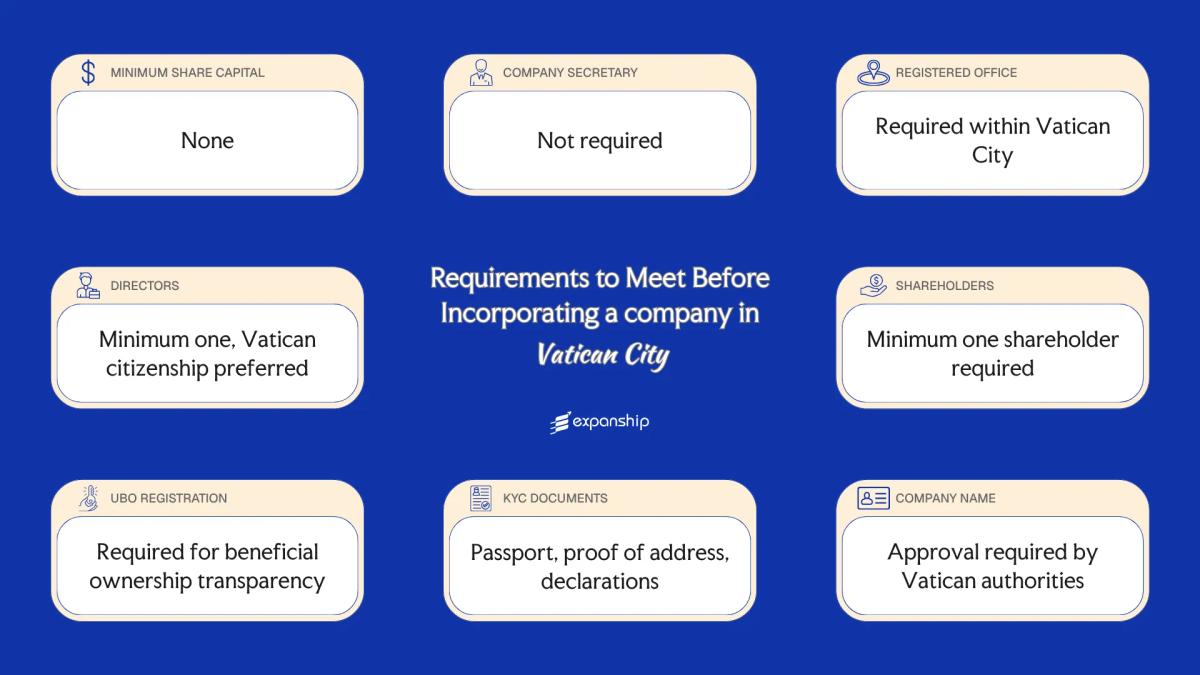
Minimum Share Capital Requirements in Vatican City

Vatican City minimum share capital requirements are not governed by a conventional corporate statute in the way most jurisdictions operate. The Holy See's legal framework, rooted in canon law and supplemented by pontifical legislation, does not publish standardized capital thresholds for commercial entities in the manner typical of civil law systems.
Because formal private commercial incorporation within the city-state is effectively restricted, the Governorate of Vatican City State functions as the primary administrative authority overseeing any entity formation, rather than a dedicated companies registry with standard capital verification procedures. Share capital obligations, where applicable, are assessed on a case-by-case basis under pontifical authorization rather than through a uniform statutory framework.
| Parameter | Detail |
|---|---|
| Minimum Authorized Share Capital | No statutory minimum established under general legislation |
| Maximum Authorized Share Capital | No statutory ceiling |
| Minimum Paid-Up Capital | No statutory requirement |
| Paid-Up Requirement at Incorporation | Determined by pontifical authorization on a case-by-case basis |
| Accepted Currency | Euro (EUR) |
| Accepted Forms of Contribution | Cash; non-cash contributions subject to pontifical approval |
| Timeframe to Deposit Capital | No standardized statutory timeframe |
The absence of a statutory minimum does not exempt your entity from establishing a defined capital structure. Any authorized activity requires explicit approval from the Governorate, and capital arrangements form part of that review.
Company Secretary Requirements in Vatican City
Vatican City company secretary requirements differ substantially from standard corporate jurisdictions, given that the Holy See operates under canon law and a unique civil legal framework administered by the Governorate of Vatican City State. The concept of a conventional corporate secretary, as understood in common law systems, does not map directly onto the Vatican's governance structure.
For entities operating within or connected to the Holy See's economic activities, designated administrative representatives fulfill functions broadly analogous to a secretary's obligations under Holy See corporate secretary obligations. These include maintaining internal records, ensuring regulatory correspondence is handled, and liaising with the relevant pontifical or governorate authorities.
Qualification criteria for those serving in this administrative capacity generally follow these principles:
- Only individuals or entities formally recognized by the Governorate of Vatican City State may hold such a role.
- The appointee must be of documented trustworthiness, consistent with the Holy See's ethical and canonical standards.
- Residency within or formal affiliation with Vatican institutions is typically expected.
- No separate commercial licensing framework for corporate secretaries exists; eligibility is assessed on a case-by-case basis by competent authorities.

Incorporate an Entity in Vatican City
Understand the structure and requirements for establishing a presence under the Vatican's unique legal and ecclesiastical framework.
Registered Office Requirements in Vatican City
Vatican City registered office requirements are governed by the Holy See's internal legal order, which does not operate a standard commercial company registry in the way secular jurisdictions do. Any entity permitted to establish a legal presence within Vatican territory must maintain a physical address that falls within the sovereign boundaries of the Holy See.
- A physical address within Vatican City territory is required; postal addresses outside the Vatican walls do not satisfy this obligation.
- Virtual offices are not recognised as compliant registered addresses under Vatican legal practice.
- The address must be locally based; no foreign or extraterritorial address is accepted as a legal address for an entity domiciled in the Vatican.
- Occupancy must be supported by documented authorisation, whether through ownership title or a formal lease arrangement sanctioned by the relevant Vatican authority.
- Given the absence of a public commercial register, address information is not publicly searchable in the manner typical of secular jurisdictions.
- Any change to the registered legal address must be formally communicated to the competent Vatican administrative body to maintain standing.
- Operating from a non-compliant or unauthorised address may result in the entity losing its recognised legal status within the Holy See's jurisdiction.
Director Requirements in Vatican City

Vatican City director requirements are governed not by a conventional corporate statute but by the legal framework administered through the Governorate of Vatican City State, which applies canon law principles alongside specific pontifical legislation. Upon appointment, directors assume fiduciary duties toward the entity and bear personal liability for acts undertaken outside their authorized mandate.
| Parameter | Detail |
|---|---|
| Minimum Number of Directors | No statutory minimum has been codified under a general commercial law, as Vatican City does not operate a standard corporate registry. |
| Maximum Number of Directors | No statutory maximum is prescribed. |
| Local/Resident Director Required | There is no formal statutory requirement for a locally resident director, though operational ties to the Holy See are generally expected. |
| Nationality Restrictions | No publicly codified nationality restrictions apply under pontifical legislation. |
| Minimum Age Requirement | No statutory minimum age is prescribed under Vatican corporate law. |
| Corporate Directors Permitted | No statutory provision explicitly permits or prohibits corporate directors. |
| Director Must Be a Shareholder | No statutory requirement obliges directors to hold shares. |
| Publicly Listed on Registry | No public commercial registry exists within Vatican City. |
| Disqualification Conditions | Individuals acting contrary to Holy See institutional interests or under canonical censure may be excluded from directorial roles. |
Vatican City has no public commercial registry, meaning director appointments are not disclosed in any searchable national database accessible to the general public.
Shareholder Requirements in Vatican City

Vatican City shareholder requirements do not follow a conventional commercial framework, as the Holy See's economic structure is ecclesiastical rather than market-driven. Private commercial entities operating under Vatican jurisdiction generally require at least one shareholder, though sole shareholder structures are uncommon given the institutional nature of most entities formed there.
Nationality and Residency Restrictions
Foreign ownership is effectively constrained by the Vatican's governance model. Most economic activity is conducted through Holy See-affiliated institutions, which limits participation by non-ecclesiastical or non-Vatican-affiliated parties.
Corporate Shareholders
Corporate entities may serve as shareholders in principle, though any such arrangement must align with the Governorate of Vatican City State's oversight requirements. Ecclesiastical legal persons recognized under canon law are the most common form of corporate shareholder.
Shareholder Liability
Shareholder liability is generally limited to the extent of each party's capital contribution. Canon law and Vatican civil ordinances do not provide for broad piercing of this structure under ordinary circumstances.
Register of Shareholders
Entities operating under Vatican City ownership structure requirements are expected to maintain internal records of shareholders. No publicly accessible commercial registry comparable to those in civil law jurisdictions exists within Vatican administrative practice.
Guidance on Shareholder Compliance for Your Vatican City Entity
Get jurisdiction-specific advice on meeting Holy See company shareholder rules and structuring your ownership arrangement correctly from the outset.
UBO / Beneficial Ownership Disclosure Requirements in Vatican City
No statutory framework for Vatican City beneficial ownership disclosure exists. The Holy See has not enacted UBO registration legislation, and no formal regulatory body administers a beneficial ownership register for entities established within the jurisdiction.
KYC / Document Requirements in Vatican City

Vatican City KYC requirements apply at the point of incorporation and are governed by the Holy See's AML framework, administered through the Financial Intelligence Authority (AIF), established under Law No. XVIII of 2013.
Individual / Personal Documents
- Valid government-issued photo ID (passport or national identity card) for each individual director, shareholder, or beneficial owner
- Proof of residential address dated within three months, such as a utility bill or bank statement
- Completed personal declaration form as required by AIF onboarding procedures
- Tax identification number or equivalent from the individual's country of residence
Corporate Documents
- Certificate of incorporation or equivalent constitutional document for any corporate shareholder or director
- Register of directors and register of shareholders, current and certified
- Proof of the corporate entity's registered address, issued by a competent authority
- Articles of association or equivalent constitutional document
Source of Funds Documentation
- Recent bank statements covering a minimum of three months prior to incorporation
- Audited financial accounts where the introducing entity is an established business
- Written declaration of the origin of capital if no audited accounts are available
Notarisation and Apostille Requirements
- Documents issued outside the Holy See generally require apostille under the 1961 Hague Convention
- Official translations into Italian must be provided for documents not already in Italian or Latin
- Notarisation by a civil notary is required for corporate constitutional documents
Incomplete or unapostilled foreign-issued identity documents are the most common cause of incorporation rejection by the AIF.
Company Name Requirements in Vatican City
Vatican City company name requirements are assessed by the Governorate of Vatican City State, the administrative body responsible for overseeing all civil and commercial matters within the territory. Names are reviewed for uniqueness and general suitability before an entity may be registered.
All business names must appear in Italian, which is the official administrative language. A legally recognized suffix corresponding to the chosen entity type is required.
Certain words implying sovereign authority, religious governance, or a connection to the Holy See are restricted and require explicit authorization before use.
Name reservation procedures in Vatican City are not publicly codified in the same manner as in larger jurisdictions; applicants should confirm current reservation availability and duration directly with the Governorate during the registration process.
Compliance Services for Companies in Vatican City
Maintain your Vatican City entity's good standing with ongoing compliance support, from annual filings to regulatory reporting obligations.
Conclusion
Vatican City incorporation requirements reflect a framework shaped by the Governatorato's direct oversight and the absence of conventional corporate law structures available in most sovereign states. Beneficial ownership disclosure operates under Vatican financial intelligence rules enforced by the AIF, while the Holy See's broader canonical governance informs entity formation at every stage. Foreign investors who have mapped these obligations are then positioned to assess operational feasibility, identify qualified local representation, and engage with Vatican authorities through the appropriate administrative channels.
Expanship's Corporate Services for Vatican City Expansion
Expanship's Vatican City company formation services are structured around the specific constraints that define entity establishment under Holy See governance, including the absence of a conventional commercial registry and the requirement for Pontifical authorization. Our role is to reduce the operational burden of preparing documentation, liaising with Vatican authorities, and maintaining compliance within this uniquely governed jurisdiction.
Beyond initial registration, Expanship supports your business across the full formation and post-incorporation cycle:
- We prepare and coordinate all company registration documentation in accordance with Vatican requirements.
- Registered agent and office provision is arranged to satisfy Vatican address obligations.
- Our team handles government filings and direct liaison with the relevant Vatican regulatory bodies.
- Post-incorporation compliance management keeps your entity in good standing on an ongoing basis.
- We facilitate introductions to banking institutions that accept Vatican-connected entities.
- Tax registration and local authority liaison are coordinated as part of your setup process.
Reach out to discuss your requirements with Expanship Vatican City.
Frequently Asked Questions (FAQ)
No equivalent to a national commercial register exists within Vatican City. The Governorate administers civil and administrative functions of the territory, but there is no public-facing registry through which a private firm can be incorporated in the conventional sense.
The 1929 Lateran Treaty established Vatican City as an independent sovereign state under the governance of the Holy See, which shapes every aspect of its legal and administrative structure. Because its institutions exist to serve ecclesiastical rather than commercial purposes, the treaty framework does not provide for private commercial entity formation by outside parties.
The Vatican's financial regulator, the Financial Information Authority (AIF), enforces anti-money laundering and transparency requirements on entities operating within the Holy See's financial system, including the Institute for the Works of Religion. Any entity with a financial relationship subject to Vatican jurisdiction falls under AIF oversight, which includes beneficial ownership disclosure obligations aligned with FATF standards.
Non-compliance with AIF regulations can result in administrative sanctions, suspension of financial activities, and referral for criminal prosecution under Vatican law. The AIF has authority to impose measures on institutions and individuals operating within the Vatican's financial perimeter, and enforcement has increased significantly following international pressure for greater transparency since the early 2010s.
Vatican City is not comparable to Monaco or Liechtenstein as a corporate domicile. Both Monaco and Liechtenstein have functioning commercial company laws, public registries, and defined pathways for foreign investors to establish entities, whereas Vatican City has no such framework because its entire institutional purpose is ecclesiastical administration rather than commercial facilitation.
Legal Disclaimer
The information provided in this article is for general informational purposes only and does not constitute legal, tax, or professional advice. While we strive to ensure the accuracy and timeliness of the content, laws and regulations are subject to change, and the application of laws can vary widely based on specific facts and circumstances.
Readers should not act upon this information without seeking professional counsel tailored to their individual situation. Expanship and its authors disclaim any liability for actions taken or not taken based on the content of this article.
For specific advice regarding your business setup, compliance requirements, or any legal matters, please consult with qualified legal and tax professionals in the relevant jurisdiction.