

Key Takeaways
- Vatican City's Legal Order (Legge CCCXLVII of 16 March 2023) was structured to govern ecclesiastical and civil administration, not commercial enterprise, leaving private businesses without a recognized statutory foundation for incorporation.
- The absence of standard corporate entity types — such as limited liability companies or joint-stock structures — means foreign investors cannot establish a business vehicle that maps to internationally accepted legal and accounting frameworks.
- Because Vatican City is not a member of the European Union and has no bilateral investment treaties with major trading partners, companies domiciled there cannot access EU single market privileges or standard investor protections.
- The lack of a commercial banking system or independent central bank creates a structural barrier to routine business operations, including account opening, payment processing, and access to credit facilities.
Vatican City operates under an ecclesiastical governance structure, placing it outside the regulatory categories that typically apply to commercial jurisdictions. The Legal Order of the Vatican City State governs civil and administrative matters, but it was not designed to facilitate private enterprise.
The disadvantages of incorporating in Vatican City span structural, legal, financial, and operational dimensions. How significantly each affects your business depends on the type of entity you intend to form, the industry you operate in, and the level of foreign involvement in your ownership structure.
This article is most relevant to foreign investors and international business owners who are evaluating Vatican City as a potential corporate domicile for commercial, financial, or operational purposes.
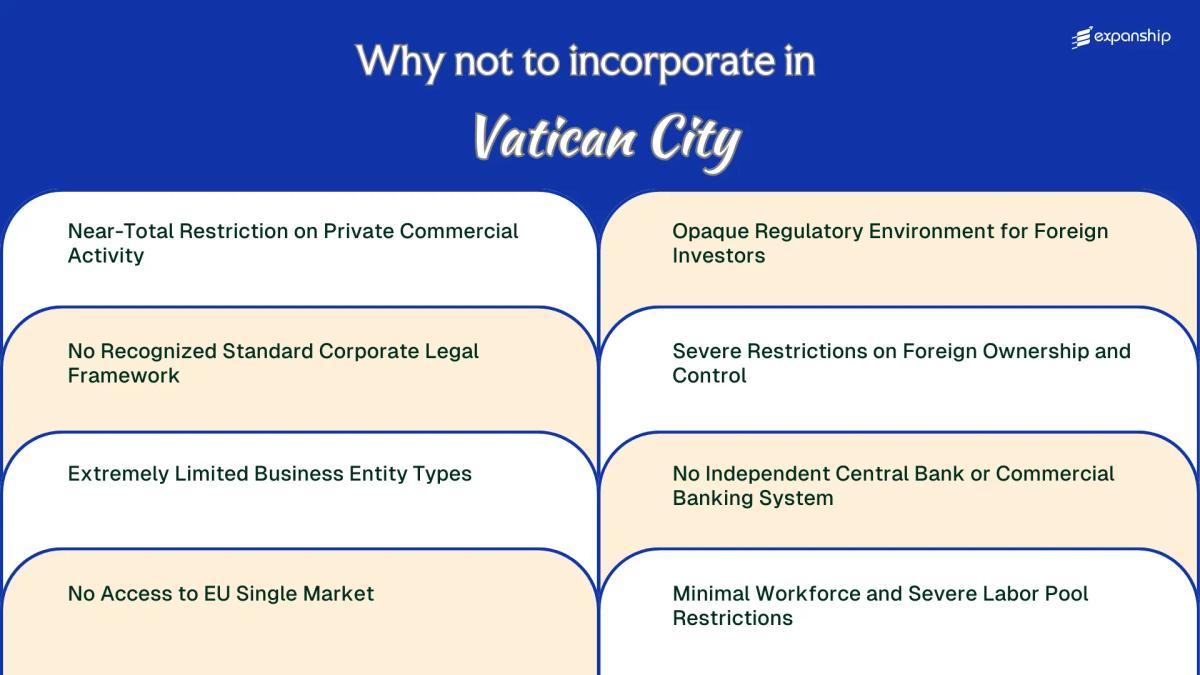
Near-Total Restriction on Private Commercial Activity
Vatican City private commercial activity restrictions make this jurisdiction functionally incompatible with private enterprise. The Holy See's governance structure treats commercial activity as incidental to its religious mission, not as a legitimate independent purpose.
Commercial Activity Is Structurally Prohibited for Private Actors
Under the governance framework administered by the Pontifical Commission for Vatican City State, private individuals and foreign entities have no recognized right to establish or operate commercial businesses within the territory. Economic activity is reserved for institutions directly serving the Vatican's operational and ecclesiastical functions. For your business, this means no legal pathway exists to register a private firm, execute commercial contracts under local law, or generate revenue from a Vatican-based operation.
The Scope of Restrictions on Commerce in Vatican City
The few operating entities within the territory, such as Vatican Media and the Vatican Pharmacy, function as Vatican-controlled bodies, not independent commercial actors. Private enterprise limitations extend even to basic trade, since retail and service activity is tightly controlled and generally inaccessible to foreign operators. No exemption exists for foreign investment that would otherwise bypass these structural prohibitions.
There is no legal mechanism by which a foreign business owner can establish or operate a private commercial entity within Vatican City's jurisdiction.
No Recognized Standard Corporate Legal Framework
No codified commercial legislation governs private enterprise within Vatican City. The Vatican's legal order derives primarily from canon law, supplemented by pontifical laws enacted by the Holy See, none of which establish a recognizable corporate law framework equivalent to those found in civil or common law jurisdictions. For your business, this absence means there is no statutory definition of a limited liability company, no incorporation procedure, and no registered agent system to rely on.
The Vatican City corporate legal framework problems extend beyond gaps in legislation. Without a defined legal personality for commercial entities, foreign investors cannot establish a structure that offers liability separation, equity division, or transferable ownership. These are foundational requirements for any investor seeking enforceable protections.
The lack of corporate law in Vatican City creates direct operational consequences:
- You cannot form a legal entity with capped liability, exposing principals to unlimited personal risk
- Contract enforcement depends on ecclesiastical or Italian legal channels, adding jurisdictional complexity and cost
- Equity cannot be formally issued or transferred, making investor participation structurally unworkable
- No articles of incorporation can be filed, preventing recognition by foreign banks or counterparties
No Vatican City legal structure limitations for business are qualified by any bilateral treaty that substitutes a functional corporate law equivalent for private commercial actors.

Company Incorporation in Vatican City
Understand the structural constraints before committing to a Vatican City expansion strategy.
Extremely Limited Business Entity Types
Vatican City business entity types limitations stem from a structural reality: the state does not function as a commercial jurisdiction. Private enterprise is not a recognized purpose within its legal order, which means no standard corporate registry, no company law in the conventional sense, and no pathway for a foreign investor to establish a recognized legal entity.
| Entity Type | Available in Vatican City | Practical Impact on Foreign Investor |
|---|---|---|
| Limited Liability Company (LLC) | No | Cannot limit personal liability through a local structure |
| Joint Stock Company (SA/PLC) | No | Equity-based investment vehicles are unavailable |
| Branch of Foreign Company | No recognized framework | No registration mechanism exists for foreign branches |
| Partnership (General or Limited) | No civil commercial equivalent | Contractual arrangements have no statutory legal basis |
| Sole Proprietorship | Effectively unavailable to non-citizens | Foreign nationals have no legal standing to trade |
With no corporate structures available, your business has no recognized legal personality within the territory. This absence makes standard commercial activities, including contracting, holding assets, and employing staff locally, legally unanchored.
The restricted legal entity options reflect the jurisdiction's governance by the Pontifical Commission for Vatican City State, which administers law through Pontifical legislation rather than commercial statutes. No equivalent to a Companies Act or Civil Commercial Code exists.
Even entities with indirect Vatican connections, such as the Institute for the Works of Religion (IOR), operate under sui generis ecclesiastical mandates, not frameworks accessible to private foreign capital.
No Access to EU Single Market
Vatican City no EU single market access is not a peripheral concern — it is a structural barrier that makes the territory fundamentally unsuitable for trade-oriented incorporation. Although geographically encircled by Italy, the Holy See is not a member of the European Union and does not participate in the EU's internal market under any formal association agreement comparable to the EEA or the EU-Switzerland bilateral treaties.
Your business cannot passport financial services, benefit from mutual recognition of professional qualifications, or rely on CE-marked product approvals to circulate goods across EU member states. Every cross-border transaction with EU counterparts must be treated as third-country trade.
The EU-Vatican relationship is governed by limited bilateral arrangements relating primarily to ecclesiastical and diplomatic matters, not commercial exchange. No customs union framework or free trade agreement currently covers commercial goods or services between the territory and the EU bloc.
For any firm targeting European clients or supply chains, this creates unavoidable structural friction — additional customs procedures, regulatory duplication, and the absence of any EU dispute resolution mechanism.
- All goods exported to EU member states are subject to third-country customs and tariff treatment
- No EU passporting rights apply to financial or professional services operated from this jurisdiction
- No mutual recognition agreements cover product standards or conformity assessments
- EU VAT rules do not automatically apply, requiring separate tax compliance arrangements for each member state market
Despite being physically inside Rome, any business registered under Vatican authority receives no preferential EU trade access that Italian-registered firms automatically enjoy.
Opaque Regulatory Environment for Foreign Investors
The Vatican City opaque regulatory environment risks are not theoretical. Governance over commercial activity falls under the Governorate of Vatican City State, an administrative body that operates without public legislative databases, transparent rulemaking procedures, or formal channels for regulatory inquiry by external parties.
Absence of Public Regulatory Frameworks
No published commercial code, foreign investment statute, or regulatory register exists that your business can consult before committing resources. This forces any prospective investor to operate without the baseline legal certainty that even minimally developed jurisdictions provide.
Practical Consequences for Foreign Investors
Vatican City compliance barriers for foreign investors are compounded by the absence of an independent judiciary for commercial disputes and no administrative appeals process recognizable under international standards. Decisions affecting your entity's standing can be reversed or modified without formal notice or procedural recourse.
The Pontifical Commission for Vatican City State holds supreme legislative authority, meaning regulatory interpretations are subject to ecclesiastical governance structures rather than civil legal principles. For a foreign firm, this creates an environment where standard due diligence methods produce no actionable findings.
Understanding Your Options Before Entering Vatican City
Speak with our team about the regulatory challenges facing foreign businesses in Vatican City and what alternatives may better serve your expansion objectives.
Severe Restrictions on Foreign Ownership and Control
Vatican City foreign ownership restrictions are among the most absolute of any territory in the world. No general legal framework exists to accommodate foreign private investment, which means your business has no recognized pathway to establish or hold ownership.
- All commercial activity within the territory operates under the exclusive authority of the Holy See, leaving no legal mechanism through which a foreign investor can hold an ownership stake in a locally registered entity.
- The Governorate of Vatican City State, which administers civil functions, does not recognize or process foreign business registration applications from private individuals or corporations.
- Foreign control over any operational function is structurally prohibited because every economic activity is either ecclesiastically managed or conducted through entities directly sanctioned by the Holy See.
- No bilateral investment treaty grants foreign nationals ownership protections within this jurisdiction, removing the standard legal recourse available in most other territories.
- Even entities with a religious or charitable mandate face direct institutional oversight that precludes independent foreign control over governance or financial decisions.
No Independent Central Bank or Commercial Banking System
Vatican City has no commercial banking system in the conventional sense. For any foreign business owner, this means standard financial infrastructure — corporate accounts, credit facilities, payment processing — simply does not exist within the territory.
The only financial institution operating there is the Institute for the Works of Religion (IOR), commonly known as the Vatican Bank. The IOR is not a commercial bank. Its mandate restricts it to serving Catholic institutions, clergy, and Vatican employees, which means your business cannot open an account or access credit through it.
Without access to a domestic banking system, your firm must rely entirely on foreign financial institutions for all transactional needs. Cross-border payment flows, foreign currency management, and even routine payroll require external banking relationships, adding cost and administrative complexity to every financial operation.
Vatican City banking restrictions for business extend to the absence of a central bank with monetary policy authority. The Holy See uses the euro under a monetary agreement with the EU, but the European Central Bank does not extend its supervisory framework there in the standard sense.
Hypothetical scenario: A foreign entity needing to process EUR 500,000 in annual transactions while operating within Vatican City would have no domestic correspondent banking option, requiring all funds to route through Italian or other EU-based institutions. Depending on bank fees and compliance requirements for non-resident corporate accounts in Italy, administrative and compliance costs could realistically exceed EUR 8,000–12,000 annually before a single business transaction is conducted.
Minimal Workforce and Severe Labor Pool Restrictions
Vatican City labor pool restrictions represent one of the most structurally prohibitive barriers any foreign business owner will encounter anywhere in the world. The entire resident population is approximately 800 people, almost all of whom are clergy, members of the Pontifical Swiss Guard, or Vatican employees under Holy See employment arrangements.
Employment within the city-state is governed by the Regulations for Vatican City State Employees and related Holy See directives, not by any commercial labor code applicable to private enterprise. This means there is no legal architecture for standard employer-employee relationships of the kind your business would rely on.
Nearly all workers commute from Italy under bilateral arrangements tied to the Lateran Treaty framework, and their status is defined by specific accords rather than by any open labor market. Accessing this workforce as a private foreign firm would require navigating agreements that were never designed to accommodate commercial employers.
- No local labor market exists to recruit from independently
- Hiring employees in Vatican City through conventional HR processes has no defined legal pathway
- Workforce size is structurally capped by the city-state's physical and institutional boundaries
Private foreign employers have no recognized standing under Vatican employment regulations, meaning your firm cannot independently contract workers through any standard legal mechanism.
How to Navigate These Obstacles Effectively
Navigating Vatican City business obstacles requires accepting one foundational reality: the jurisdiction does not function as a commercial environment, and structural workarounds operate outside its borders rather than within them.
- Register your operating entity in an EU member state to access the single market that Vatican City cannot provide.
- Structure any activity tied to the Holy See through concordat-based or canonical legal frameworks governed by the Governorate, the sole administrative authority.
- Open commercial banking relationships through Italian or other European institutions, given the absence of an independent central banking system.
- Source your workforce through Italian labor contracts, since the local labor pool is constitutionally restricted to clergy and select Holy See personnel.
- Conduct all regulatory correspondence through the Secretariat of State, as no independent foreign investment authority exists.
These steps address the structural gaps at a general level, but none remove the underlying canonical and civil law constraints that govern all activity within this jurisdiction. Foreign ownership restrictions and the absence of a recognized corporate legal framework remain absolute barriers that cannot be resolved through procedural compliance alone.
Vatican City's Viability as a Business Destination
Vatican City presents one of the most constrained environments for private commercial activity of any jurisdiction globally, and the disadvantages covered in this blog reflect structural realities, not incidental barriers. For a narrowly defined category of operators, primarily those with formal ties to the Holy See or its affiliated institutions, some form of sanctioned commercial presence may be feasible.
| Pros | Cons |
|---|---|
| No independent tax authority imposes corporate income tax on private entities | Private commercial activity is subject to near-total restriction by the Holy See |
| The jurisdiction operates under a stable, centralized governance structure | No recognized standard corporate legal framework exists for commercial entity formation |
| Vatican's use of the euro provides currency stability without eurozone membership obligations | Foreign businesses have no access to EU Single Market rights or passporting |
| Physical proximity to Italian financial and legal infrastructure | No independent central bank or commercial banking system serves private clients |
| Governed by clear, if restrictive, legal authority under the Lateran Treaty | Foreign ownership and control face severe institutional and canonical constraints |
As a practical destination for standard company formation, Vatican City incorporation feasibility risks are not marginal but foundational. The absence of a commercial legal framework, restricted labor pool, and opaque regulatory environment for foreign investors collectively make this jurisdiction non-viable for conventional business structures.
Compliance Services for Companies in Vatican City
Understand the regulatory obligations and institutional requirements that apply to entities operating within or in connection with Vatican City.
Conclusion
Vatican City presents one of the most restrictive environments for private commercial activity of any jurisdiction covered in this blog. The Vatican City company incorporation cons documented here are structural, not incidental: the absence of a commercial legal framework, the lack of a domestic banking system open to private firms, and near-absolute exclusion of foreign ownership collectively make private enterprise formation functionally impossible for most applicants. These conditions reflect the Holy See's ecclesiastical governance model rather than any regulatory oversight. For businesses requiring a viable incorporation path, specialist guidance on alternative jurisdictions remains the practical course.
Expanship's Support for Your Vatican City Expansion
Expanship works with businesses that have already reviewed the Vatican City expansion challenges outlined across this blog — the absence of a civil commercial code, restrictions on private enterprise, and the Holy See's control over all economic activity within the 0.44 km² territory. Our role is to help you assess feasibility, prepare documentation where any legitimate pathway exists, and manage the administrative burden that comes with engaging an ecclesiastical regulatory environment.
Beyond initial assessment, Expanship offers a range of practical corporate services:
- We prepare company registration documents and coordinate required filings with the relevant ecclesiastical authorities.
- Our team provides registered agent and office provision where applicable under Vatican frameworks.
- We handle government liaison and any required regulatory correspondence on your behalf.
- Post-incorporation compliance obligations are tracked and managed to keep your entity in good standing.
- We facilitate introductions to banking partners familiar with Vatican-adjacent structures.
- Tax registration and liaison with local financial authorities are coordinated through our network.
Reach out directly to discuss your situation with Expanship Vatican City.
Frequently Asked Questions (FAQ)
Vatican City's position is significantly more restrictive than other European micro-states. Monaco and San Marino both maintain formal commercial codes, registered agent systems, and defined corporate entity types open to foreign investors. Vatican City has none of these structures, making it categorically non-comparable as a commercial jurisdiction.
The absence of a conventional commercial banking system affects all transactional activity. The Vatican Bank, formally the Istituto per le Opere di Religione, serves the Holy See and affiliated Catholic institutions exclusively. No foreign business entity can open a commercial account or access trade finance facilities through that institution.
Vatican City is not an EU member state, so any entity incorporated there carries no EU passporting rights, no access to the EU Single Market, and no standing under EU trade agreements. This exclusion applies regardless of the nature of the business activity, and there is no bilateral arrangement that compensates for this gap.
The resident population of Vatican City is approximately 800 people, the majority of whom are clergy or individuals in religious service. Civil employment is tightly controlled by Vatican authorities, and there is no open labor market a foreign employer could access. Sourcing operational staff locally is not a viable option under any realistic business model.
Without a published commercial regulatory framework, foreign investors have no way to assess compliance costs, approval timelines, or enforcement standards in advance. This opacity creates unquantifiable financial exposure, since any commercial activity would be subject to discretionary oversight by Holy See authorities rather than a codified regulatory body with transparent procedures.
Operating without explicit authorization from the Governorate of Vatican City State would expose the entity to immediate cessation of activity, since the Governorate holds exclusive administrative and regulatory authority within the territory. There is no independent appeals body or commercial court where a foreign firm could contest such a decision, leaving the investor with no enforceable recourse.
The restriction is effectively absolute for commercial, for-profit activity. Any economic function within Vatican City serves the institutional mission of the Holy See, and there is no sector designated for foreign private ownership or investment. No concession, free zone, or special economic arrangement exists that would create an exception to this general prohibition.
Legal Disclaimer
The information provided in this article is for general informational purposes only and does not constitute legal, tax, or professional advice. While we strive to ensure the accuracy and timeliness of the content, laws and regulations are subject to change, and the application of laws can vary widely based on specific facts and circumstances.
Readers should not act upon this information without seeking professional counsel tailored to their individual situation. Expanship and its authors disclaim any liability for actions taken or not taken based on the content of this article.
For specific advice regarding your business setup, compliance requirements, or any legal matters, please consult with qualified legal and tax professionals in the relevant jurisdiction.