

Key Takeaways
- Entities incorporated under pontifical authority operate outside EU tax harmonisation directives and standard multilateral regulatory frameworks, a structural position rooted in the Lateran Treaty of 1929 that has remained legally stable for nearly a century.
- Canon Law governance and the absence of public corporate registry disclosure requirements place qualifying organisations beyond the conventional transparency mechanisms enforced across most European and offshore jurisdictions.
- The Holy See's institutional standing delivers a level of international diplomatic and credibility infrastructure that commercially incorporated jurisdictions, regardless of their tax positioning, cannot structurally replicate.
- Formation through a canonical juridical entity — subject to specific pontifical authorisation via the Governorate of Vatican City State — restricts access to organisations whose purposes genuinely align with the jurisdiction's legal and mission-driven framework, making selective entry a structural feature rather than a limitation.
Situated within Rome, Italy, the benefits of incorporating in Vatican City draw from a distinctly unusual legal foundation — an independent sovereign state of 44 hectares governed under pontifical authority rather than any national or supranational framework. As the world's smallest internationally recognized state, it operates outside the jurisdiction of the European Union, Italian commercial law, and standard multilateral regulatory agreements. Oversight of permissible commercial and financial activity falls under the governance of the Governorate of Vatican City State, the administrative body responsible for the territory's civil affairs.
Foreign businesses seeking a presence here most commonly do so through a canonical juridical entity. The territory's tax posture is broadly exempt from the conventional international tax frameworks that apply to EU member states and most treaty-based jurisdictions. Foreign ownership and investment are subject to specific pontifical authorization, making this an access-controlled environment rather than an open-market one. This article examines the concrete advantages that a Vatican City business incorporation can offer to qualifying organizations and their principals.
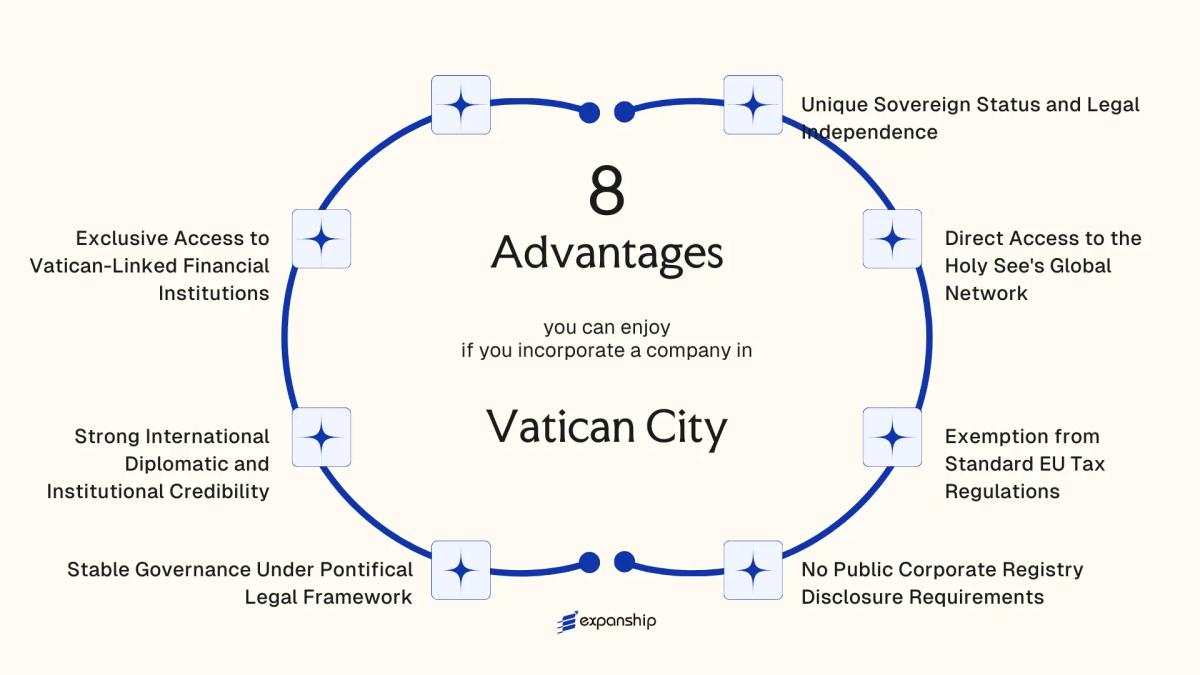
Unique Sovereign Status and Legal Independence
Vatican City sovereign status business advantages stem from a singular legal reality: this entity operates as a fully independent state under no external legislative authority, including that of Italy or the European Union.
Sovereignty as a Structural Insulation
Governed by the Fundamental Law of Vatican City State (2000), the territory functions under a distinct constitutional order where the Supreme Pontiff holds executive, legislative, and judicial authority. For your business, this means the regulatory environment is not subject to revision by foreign parliaments, supranational directives, or bilateral pressure from neighboring states. No EU regulation, including those governing corporate disclosure or financial reporting, applies by default.
Holy See Legal Independence as a Practical Distinction
The Holy See holds permanent observer status at the United Nations as a sovereign subject of international law, separate from the Vatican City State territory itself. This dual-entity structure means a firm operating under pontifical legal authority exists within a framework that no standard national regulator can claim jurisdiction over unilaterally. That structural separation is legally meaningful, not merely symbolic.
Your company operates under a sovereign legal order that is constitutionally insulated from EU regulatory frameworks and foreign legislative interference.
Direct Access to the Holy See's Global Network
Holy See global network access for businesses represents one of the more structurally distinctive features of operating under pontifical jurisdiction. The Holy See maintains formal diplomatic relations with over 180 states and holds Permanent Observer status at the United Nations. For an entity operating under this framework, that institutional reach translates into a degree of international recognition that few micro-jurisdictions can offer.
This network is not merely symbolic. The Holy See's diplomatic missions, known as Apostolic Nunciatures, function as sovereign representations across every major continent. A business connected to this framework operates within an environment that commands institutional respect from governments, intergovernmental bodies, and multilateral organizations.
Practical access to this network carries specific structural advantages:
- The Holy See's UN Observer status provides proximity to multilateral policy discussions without the bureaucratic weight of full member-state obligations
- Apostolic Nunciatures are present in regions where conventional diplomatic infrastructure is limited or politically sensitive
- Institutional credibility derived from pontifical association can open channels with faith-aligned foundations, development organizations, and humanitarian bodies globally
Access to these channels is governed by the internal legal order of the Holy See, rooted in the Lateran Treaty of 1929, which established full sovereign independence from Italy.

Company Incorporation in Vatican City
Establish your business presence under the pontifical legal framework and access the Holy See's unique international standing.
Exemption from Standard EU Tax Regulations
Vatican City EU tax regulation exemption benefits stem directly from its status as an independent sovereign state under the Lateran Treaty of 1929. That treaty established the Holy See as a subject of international law entirely separate from Italy and, by extension, from the European Union. No EU directive on corporate taxation, VAT harmonization, or financial reporting applies within its territory.
| Regulatory Area | EU Member State Obligation | Vatican City Position |
|---|---|---|
| VAT Compliance | Subject to EU VAT Directive (2006/112/EC) | Not bound; no EU VAT framework applies |
| Corporate Tax Directives | Subject to Anti-Tax Avoidance Directives (ATAD I & II) | Outside EU legislative scope |
| Financial Reporting Standards | IFRS or national GAAP under EU endorsement | Governed by internal Pontifical norms |
| Automatic Tax Information Exchange | Mandatory under DAC6 and DAC7 | Not an EU member; obligations differ |
For your business, this means that EU-level directives such as ATAD I and ATAD II, which impose controlled foreign company rules and hybrid mismatch arrangements on EU-based firms, carry no direct legislative authority here. Tax matters are instead governed by internal Pontifical instruments and bilateral arrangements the Holy See negotiates independently.
This Holy See non-EU tax status gives incorporated entities a structural position outside the standard EU compliance architecture. Access to that position depends on the nature of the entity, its activities, and any applicable bilateral agreements the Holy See maintains with other states.
No Public Corporate Registry Disclosure Requirements
Vatican City no public corporate registry disclosure obligations represent one of the most structurally distinct features of its corporate framework. Unlike jurisdictions that mandate filing beneficial ownership data with a publicly searchable register, the Holy See operates under pontifical law rather than civil or commercial statutory systems derived from EU directives. There is no equivalent to a Companies House or a BOPCOM-style registry accessible to the general public.
Entities operating under Vatican authority are governed by the Lateran Treaty framework and internal pontifical legislation, neither of which incorporates the EU's Anti-Money Laundering Directives that compel public beneficial ownership disclosure across member states. Your company's ownership structure, directors, and capital details are not exposed through any open-access database.
For businesses where confidentiality of ownership is operationally or commercially significant, this absence of mandated public disclosure provides a structural layer of privacy unavailable in most EU or OECD-aligned jurisdictions.
Keep these points in mind:
- Confidentiality is structural, not contractual; it derives from the absence of applicable public disclosure law
- Vatican-linked entities are still subject to internal oversight by the AIF (Autorità di Informazione Finanziaria)
- This privacy does not extend to exemption from financial crime reporting obligations
- Access to this framework is limited to entities with a recognized operational or institutional nexus to the Holy See
The Vatican's financial regulator, the AIF, was only established in 2010, meaning formal financial oversight of Holy See-linked entities is relatively recent by international standards.
Stable Governance Under Pontifical Legal Framework
The pontifical legal framework business stability benefits stem from a governance structure with no electoral cycles, no parliamentary shifts, and no changes in administrative policy driven by competing political parties. Legal authority in Vatican City flows from the Pope as sovereign, codified through instruments such as the Fundamental Law of Vatican City State (2000), which establishes the constitutional basis for all civil and administrative matters. For a foreign business owner, this vertical structure means the regulatory environment does not pivot with each change of government.
Consistency in Legislative Authority
Laws governing commercial activity within the jurisdiction are enacted through Pontifical Laws and Apostolic Constitutions, documents that carry a degree of institutional continuity rare in elected systems. Amendments to foundational statutes require deliberate ecclesiastical processes, which structurally limits abrupt regulatory change. Your entity operates within a legal architecture that has remained fundamentally stable across decades.
Administrative Oversight Without Political Volatility
The Pontifical Commission for Vatican City State functions as the governing administrative body, applying civil law based on Italian legal principles adopted by reference, supplemented by canon law where applicable. This layered but coherent system means regulatory interpretation follows established doctrinal and civil precedents rather than shifting policy agendas. Short legislative cycles and ideological swings in national parliaments do not affect how commercial regulations are applied here.
Understand the Governance Advantages for Your Business in Vatican City
Speak with an Expanship specialist to understand how the pontifical legal framework applies to your corporate structure and long-term compliance obligations.
Strong International Diplomatic and Institutional Credibility
The Holy See holds permanent observer status at the United Nations and maintains formal diplomatic relations with over 180 states. For a business entity associated with this jurisdiction, that network represents a form of institutional credibility that is structurally distinct from what any commercial jurisdiction can offer. Vatican City international institutional credibility benefits are not derived from trade agreements or financial ratings, but from centuries of recognized sovereign authority and a unique position in international law.
- The Holy See's status under the 1929 Lateran Treaty gives it recognized sovereignty independent of any regional bloc, meaning your firm is not subject to the political volatility that affects EU or OECD-member jurisdictions.
- The Holy See exchanges diplomatic missions with states across Africa, Asia, Latin America, and Europe, providing an indirect reputational context that commercial offshore centers cannot replicate.
- Recognition by the International Court of Justice and participation in multilateral treaty frameworks signals a rule-of-law environment, which carries weight in counterparty due diligence processes.
- Institutional partners, including religious, humanitarian, and academic organizations operating under pontifical authority, treat Vatican-linked entities with a degree of deference not extended to firms incorporated in conventional low-tax jurisdictions.
This credibility is institutional by nature and does not automatically transfer to any commercial activity; the association must be legitimate and structurally grounded.
Exclusive Access to Vatican-Linked Financial Institutions
Vatican City financial institutions access benefits are, in practice, highly restricted. The Institute for the Works of Religion (IOR), commonly referred to as the Vatican Bank, does not operate as a commercial bank and does not offer general business accounts to incorporated entities. Access is governed by the IOR's own statutes, which limit clientele to Catholic institutions, clergy, members of religious orders, and Vatican employees.
For most foreign-incorporated entities, this means direct IOR access is not available as a practical benefit. What does carry weight, however, is the broader network of Catholic financial institutions and foundations that maintain formal relationships with Holy See-linked bodies. Entities with demonstrated ecclesiastical or charitable purposes may qualify for introductions to these networks.
- Access to IOR is statute-restricted and not available to standard commercial entities
- Relationships with Vatican-affiliated financial bodies typically require a canonical or charitable nexus
- Holy See-linked financial services for companies are more accessible through ecclesiastical legal structures than standard corporate forms
Hypothetical scenario: A foundation incorporated under Vatican canonical law with a documented charitable mission, operating with an annual budget of EUR 2 million, may qualify for correspondent relationships with Catholic-affiliated financial institutions across 50+ countries, reducing cross-border transaction friction in jurisdictions where those institutions hold preferential banking status.
Why Vatican City Stands Apart from Other Jurisdictions
Few jurisdictions share the structural profile of the Holy See: full sovereign recognition under international law, non-membership in the EU, and a governance framework rooted in pontifical rather than national legislation. The competitors most relevant to this comparison are Liechtenstein, Monaco, and San Marino — three micro-states that similarly attract foreign entities on the basis of sovereign autonomy, limited disclosure requirements, and treaty-based relationships with larger neighbours. What the comparison reveals is less about tax rates and more about the nature of institutional standing: the Holy See's status as a permanent observer at the United Nations and its bilateral diplomatic relations with over 180 states give incorporated entities an associative credibility that geographically comparable micro-states do not replicate. That distinction carries practical weight when a business operates across multiple jurisdictions where institutional perception affects counterparty relationships.
On parameters such as public registry disclosure and EU regulatory reach, the Holy See's position is structurally distinct rather than merely competitive. Liechtenstein, while offering strong privacy frameworks, operates within the European Economic Area and applies EEA financial regulations. Monaco maintains a tax convention with France that introduces external oversight. San Marino, though sovereign, has adopted alignment agreements with the EU that constrain certain fiscal structures. The Holy See operates outside all of these frameworks by constitutional design, not by exception or treaty carve-out.
| Parameter | Holy See / Vatican City | Liechtenstein | Monaco | San Marino |
|---|---|---|---|---|
| EU / EEA Membership | None | EEA Member | Non-EU (France convention applies) | Non-EU (EU alignment agreements apply) |
| Public Corporate Registry | No public disclosure requirement | Public register exists | Public register exists | Public register exists |
| UN Permanent Observer Status | Yes | No | No | No |
| Bilateral Diplomatic Relations | 180+ states | Limited | Limited | Limited |
| Governing Legal Framework | Pontifical / Holy See law | Liechtenstein national law | Monégasque national law | Sammarinese national law |
| External Fiscal Oversight | None by design | EEA financial rules apply | French tax convention applies | EU alignment obligations apply |
Compliance Services for Companies in Vatican City
Maintain your Vatican City entity's standing under pontifical legal frameworks with structured compliance support tailored to the Holy See's regulatory environment.
Conclusion
The benefits of incorporating in Vatican City rest on a structural reality that few jurisdictions can replicate: sovereign independence from the EU regulatory framework, combined with the institutional weight of the Holy See's global standing. Entities formed under pontifical authority operate within a legal environment shaped by Canon Law and the Lateran Treaty of 1929, neither of which subjects them to the disclosure and tax harmonisation pressures that govern standard European corporate structures.
Access to Vatican-linked financial institutions, including the Institute for the Works of Religion, and the absence of public corporate registry requirements, position qualifying organisations outside the conventional transparency mechanisms that apply in most incorporated territories. For businesses where confidentiality and institutional credibility carry operational significance, those two features alone distinguish this jurisdiction from typical offshore or onshore alternatives.
Fit depends on your business's nature, its relationship to mission-driven or ecclesiastical activity, and whether your structure can satisfy the conditions that pontifical incorporation requires. Not every foreign entity will qualify, and the pathway to formation remains narrow by design. For those whose purposes align with the jurisdictional framework, the case is grounded in legal architecture that has remained stable across decades. Understanding whether that architecture serves your specific structure is the necessary first step before any formation process begins.
Start Your Vatican City Incorporation Journey with Expanship
Expanship supports foreign investors pursuing Vatican City incorporation services across the full scope of what this jurisdiction demands. Given that corporate activity within the Holy See falls under Pontifical legal instruments and is subject to oversight by the Secretariat of State, the formation process differs materially from standard civil law jurisdictions. Expanship's engagement covers each stage of that process, from initial entity structuring under applicable Pontifical regulations through to ongoing compliance management.
For clients establishing a presence here, the services Expanship provides include:
- Preparation and legalization of incorporation documents in accordance with Holy See requirements
- Registered agent and registered office provision within the jurisdiction
- Liaison with relevant Pontifical authorities during the government filing process
- Post-incorporation compliance management, including any applicable reporting obligations
- Banking introduction assistance, including engagement with Vatican-linked financial institutions such as the Institute for the Works of Religion (IOR)
Each item above addresses a concrete step your firm must complete to maintain standing under the Pontifical legal framework. Document legalization alone involves specific authentication requirements that differ from those applicable in EU member states, and errors at that stage can delay or invalidate registration.
Reach out to Expanship Vatican City to discuss your corporate establishment requirements in detail.
Frequently Asked Questions (FAQ)
Entities operating under the Pontifical legal framework are subject to laws promulgated by the Pope or delegated to the Pontifical Commission for Vatican City State, which provides a stable and centralized source of legal authority. Because this framework is not subject to EU legislative processes, it is insulated from regulatory changes that affect member states. That said, formal protections are tied to entities with a recognized institutional relationship to the Holy See rather than independent commercial firms.
Vatican City is not an EU member state, meaning EU directives on corporate taxation, VAT, and financial reporting do not apply within its territory. In practice, this applies to institutions canonically or governmentally affiliated with the Holy See, not to general commercial businesses. Independent commercial entities seeking EU tax exemption benefits through this jurisdiction would not find a recognized legal basis for doing so.
The Institute for the Works of Religion, commonly known as the IOR, is the primary financial institution operating within Vatican City and serves entities and individuals with a formal institutional connection to the Catholic Church. It is not a commercial bank open to private businesses or foreign investors. Access is determined by canonical or institutional status, not by corporate registration.
No public corporate registry equivalent to those in standard commercial jurisdictions exists within Vatican City. Entities operating under the Holy See's authority are governed through internal ecclesiastical and governmental structures rather than through a publicly searchable commercial register. This absence of public disclosure is structural, not a deliberate confidentiality feature available to private incorporators.
The comparison is largely inapplicable because Vatican City does not function as an offshore incorporation destination in the commercial sense. Jurisdictions such as the Cayman Islands or British Virgin Islands have codified commercial company laws designed for private foreign entities, whereas Vatican City's legal structure under the Pontifical Commission for Vatican City State serves institutional and ecclesiastical purposes. A business seeking tax efficiency or confidentiality through incorporation would need to look to jurisdictions with formal statutory frameworks for commercial entities.
Entities operating under Vatican City's legal framework are expected to align their activities with the purposes recognized by the Pontifical Commission for Vatican City State or the relevant Holy See authority. Activity outside that sanctioned scope would fall outside the protections and governance of that framework and could be subject to scrutiny under applicable international regulations, particularly given the Holy See's commitments to financial transparency standards it has adopted in cooperation with bodies such as the Council of Europe's MONEYVAL committee.
Legal Disclaimer
The information provided in this article is for general informational purposes only and does not constitute legal, tax, or professional advice. While we strive to ensure the accuracy and timeliness of the content, laws and regulations are subject to change, and the application of laws can vary widely based on specific facts and circumstances.
Readers should not act upon this information without seeking professional counsel tailored to their individual situation. Expanship and its authors disclaim any liability for actions taken or not taken based on the content of this article.
For specific advice regarding your business setup, compliance requirements, or any legal matters, please consult with qualified legal and tax professionals in the relevant jurisdiction.