

Key Takeaways
- Foreign investors incorporating in Uruguay must register their entity with the Registro Nacional de Comercio and satisfy all structural and documentary requirements under Law No. 16,060 before the company can operate as a legally recognized entity.
- Beneficial ownership information must be disclosed to the SARO registry, a compliance obligation that carries direct legal weight and cannot be treated as an administrative formality.
- The choice of entity type — whether a Sociedad Anónima or a Sociedad de Responsabilidad Limitada — determines which specific formation requirements apply, meaning structural decisions have direct regulatory consequences from the outset.
- Maintaining a physical registered office within Uruguay is a mandatory ongoing requirement, not a one-time filing condition, and has implications for operational planning that extend beyond the incorporation process itself.
Incorporating a business entity in Uruguay is governed primarily by Law No. 16,060 (the Commercial Companies Law), administered through the Auditoría Interna de la Nación (AIN) and registered with the Registro Nacional de Comercio. Meeting all incorporation requirements in Uruguay is a prerequisite for obtaining legal standing, and failure to satisfy them results in rejected registration or an inability to operate as a formally recognized entity.
Requirements covered in this article span structural, documentary, and compliance categories, with specific obligations varying based on the chosen entity type and the investor's country of origin or industry sector. Uruguay company formation requirements applicable to a Sociedad Anónima, for instance, differ in certain respects from those governing a Sociedad de Responsabilidad Limitada. The governing framework is set out in Law 16,060.
This article is most directly relevant to foreign investors and non-resident business owners who intend to establish a locally incorporated entity and need to understand what registering a company in Uruguay formally entails before initiating the process.
Minimum Share Capital Requirements in Uruguay

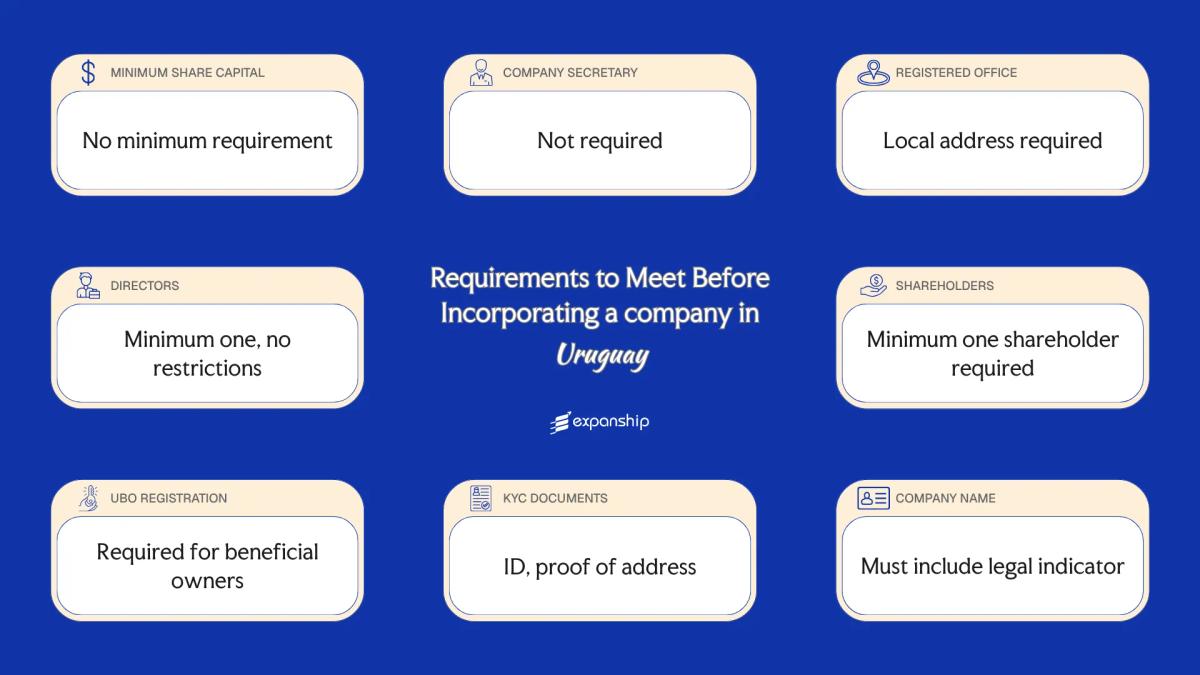
Uruguay minimum share capital requirements differ by entity type and are governed by the Auditoría Interna de la Nación (AIN) and the Registro Nacional de Comercio, which oversees company registration filings. Shares in Uruguayan entities carry par value, meaning each share must have a stated nominal value recorded in the company's estatutos.
Capital obligations are generally a structural requirement at incorporation rather than an annually recalculated statutory threshold, though the AIN monitors ongoing compliance for regulated entities.
| Parameter | Detail |
|---|---|
| Minimum Authorized Share Capital | No statutory minimum for SA or SRL entities |
| Maximum Authorized Share Capital | No statutory maximum |
| Minimum Paid-Up Capital | No statutory minimum |
| Paid-Up Requirement at Incorporation | 25% of subscribed capital must be paid up at incorporation for an SA |
| Accepted Currency | Uruguayan Peso (UYU); foreign currency permitted under applicable exchange regulations |
| Accepted Forms of Contribution | Cash or in-kind contributions; in-kind assets require independent valuation |
| Timeframe to Deposit Capital | Remaining subscribed capital must be paid within two years of incorporation |
The absence of a statutory minimum does not eliminate the requirement to define an authorized capital structure in the estatutos. An SA without a properly documented capital structure will not pass scrutiny at the Registro Nacional de Comercio.
Company Secretary Requirements in Uruguay
Uruguay company secretary requirements differ from common-law frameworks. There is no statutory obligation to appoint a "company secretary" as a distinct corporate officer under Uruguayan law, but entities must designate a legal representative who fulfills analogous secretary compliance functions.
That representative manages official correspondence with the Auditoría Interna de la Nación (AIN) and the Registro Nacional de Comercio, maintains statutory books, and ensures timely filing of annual financial statements.
Qualification criteria for who may serve in this representative capacity:
- Natural persons only may act as legal representative; corporate entities cannot hold this role directly.
- No mandatory professional licensing is required, though the individual must have full legal capacity under Uruguayan civil law.
- Non-residents may serve, though at least one locally accessible contact is generally expected for regulatory correspondence.
- The representative must not be subject to commercial disqualification or legal incapacity orders.
- A single individual may simultaneously hold director and representative functions within the same entity.

Incorporate a Company in Uruguay
Set up your legal entity in Uruguay with structured support across registration, documentation, and regulatory compliance.
Registered Office Requirements in Uruguay
Uruguay registered office requirements mandate that every company maintain a designated domicilio social within the country's territory, serving as the official address for correspondence with the Auditoría Interna de la Nación (AIN) and other public authorities, with non-compliance potentially resulting in administrative sanctions or difficulties in maintaining good standing.
- A physical address located within Uruguay is required; P.O. boxes do not satisfy the domicilio social obligation.
- Virtual office addresses are generally not accepted as a compliant registered address under Uruguayan corporate law.
- The address must be based within Uruguay; foreign addresses cannot serve as the company's domicilio social.
- Supporting documentation, such as a lease agreement or proof of ownership, is typically required to evidence use of the address.
- The registered address is publicly listed in the commercial registry records held by the Registro Nacional de Comercio.
- Any change to the registered address must be formally notified to the Registro Nacional de Comercio through a deed or equivalent instrument, and the update must be registered to take legal effect.
Director Requirements in Uruguay

Upon appointment, directors of a Sociedad Anónima assume fiduciary duties toward the company and its shareholders, with personal liability exposure under the Ley de Sociedades Comerciales No. 16.060 for acts of negligence, fraud, or ultra vires conduct.
| Parameter | Detail |
|---|---|
| Minimum Number of Directors | A minimum of one director is required for an SA. |
| Maximum Number of Directors | No statutory maximum is prescribed under Law 16.060. |
| Local/Resident Director Required | No residency requirement exists for directors of an SA. |
| Nationality Restrictions | No nationality restrictions apply; foreign nationals may serve as directors. |
| Minimum Age Requirement | Directors must have full legal capacity, which under Uruguayan civil law requires being at least 18 years of age. |
| Corporate Directors Permitted | Corporate directors are generally not permitted; directors must be natural persons. |
| Director Must Be a Shareholder | No statutory requirement for directors to hold shares in the company. |
| Publicly Listed on Registry | Director details are filed with the Auditoría Interna de la Nación (AIN) and appear in public commercial registry records. |
| Disqualification Conditions | Persons declared legally incapable, bankrupt, or convicted of certain commercial offences may be disqualified from serving. |
Unlike many jurisdictions, Uruguay imposes no residency or nationality requirement on SA directors, meaning the entire board can be composed of non-resident foreign nationals without any local representative obligation at the director level.
Shareholder Requirements in Uruguay

Uruguay shareholder requirements for incorporation vary by entity type. A Sociedad Anónima (SA) requires a minimum of two shareholders, and no statutory maximum applies under the Commercial Companies Law (Law 16,060).
Nationality and Residency Restrictions
Foreign nationals face no restrictions on holding shares in a Uruguayan company. There is no minimum local ownership threshold, and non-residents may hold 100% of the share capital.
Corporate Shareholders
Legal entities, including foreign corporations, are permitted to act as shareholders in a Uruguayan SA. No special authorization is required solely on the basis of the shareholder being a corporate body.
Shareholder Liability
In an SA, shareholder liability is limited strictly to the amount of capital each party has subscribed. Extended personal liability does not arise under ordinary circumstances.
Register of Shareholders
An SA must maintain an internal share registry recording ownership and transfers. This register is not publicly accessible, though the Auditoría Interna de la Nación (AIN) may require disclosure under beneficial ownership regulations.
Shareholder Structure Guidance for Your Uruguayan Entity
Get tailored advice on meeting ownership and shareholder obligations when setting up a company in Uruguay.
UBO / Beneficial Ownership Disclosure Requirements in Uruguay
Uruguay beneficial ownership disclosure requirements are governed primarily by Law No. 19,484 (Fiscal Transparency Law) and its regulatory decree, which define a beneficial owner as any natural person who, directly or indirectly, holds or controls 15% or more of the capital or voting rights of a legal entity.
- Identify all natural persons meeting the 15% ownership or control threshold within the entity's structure.
- Submit beneficial ownership information to the Banco Central del Uruguay (BCU) through the designated online registry platform.
- File the initial disclosure within 30 days of incorporation or of any subsequent change in ownership.
- Report any changes to the registered beneficial ownership data within 30 days of the triggering event.
| Parameter | Detail |
|---|---|
| Ownership Threshold for UBO Status | 15% of capital or voting rights |
| Filing Authority | Banco Central del Uruguay (BCU) |
| Disclosure Deadline at Incorporation | Within 30 days of incorporation |
| Publicly Accessible Register | No; information is held by the BCU and SENACLAFT but not publicly searchable |
| Penalties for Non-Disclosure | Fines and potential suspension of tax identification under Law No. 19,484 |
| Ongoing Update Obligation | Yes; changes must be reported within 30 days |
KYC / Document Requirements in Uruguay
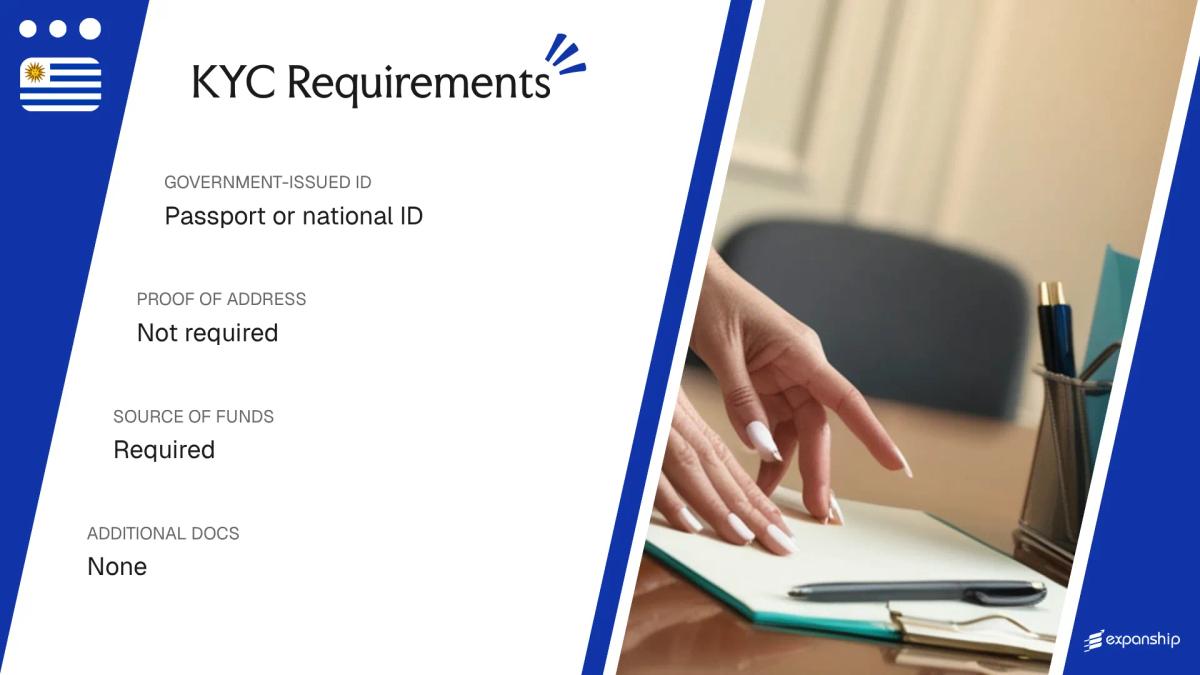
Uruguay KYC document requirements for incorporation are governed by Law No. 19.574 (the Anti-Money Laundering Law), which obliges service providers and registering authorities to conduct due diligence on all parties before an entity is formed. The SENACLAFT is the regulatory body responsible for overseeing AML compliance in this jurisdiction.
Individual / Personal Documents
- Valid government-issued photo ID (passport or national identity card) for each director, shareholder, and beneficial owner
- Proof of residential address dated within the last 90 days, such as a utility bill or bank statement
- Completed KYC form disclosing the individual's role and ownership percentage
- Curriculum vitae or professional profile may be requested for directors in regulated sectors
Corporate Documents
- Certificate of incorporation or equivalent constitutional document for the corporate shareholder or director
- Articles of association or bylaws, certified by the issuing authority
- Current register of directors and shareholders of the corporate entity
- Proof of registered office address for the corporate entity
Source of Funds Documentation
- Bank statements from the preceding three to six months evidencing the origin of capital
- Audited financial statements or accountant-certified accounts where bank statements are insufficient
- Written declaration explaining the source of funds if capital originates from asset sales or inheritance
Notarisation and Apostille Requirements
- Foreign documents must carry an apostille under the Hague Convention or be legalised through the relevant consulate
- All documents not in Spanish require a certified translation by a sworn translator registered in Uruguay
- Notarisation of identity documents is generally required when originals cannot be presented in person
The most common reason for incorporation delays is the submission of apostilled documents that have not been accompanied by a certified Spanish translation.
Company Name Requirements in Uruguay
Uruguay company name requirements are assessed during the incorporation registration process, where the proposed denomination is reviewed for uniqueness and compliance with applicable rules. No two registered entities may share an identical or deceptively similar name.
The business name must be written in Spanish and include a legal suffix that reflects the chosen entity type, such as "S.A." for a sociedad anónima or "S.R.L." for a sociedad de responsabilidad limitada.
Certain words are restricted from use without prior authorization from the relevant supervisory authority. Terms implying government affiliation, financial regulation, or professional licensing fall into this category and require supporting documentation or approval before use.
Name reservation is available prior to formal incorporation. A reservation secures the proposed denomination for a defined period while the remaining registration process is completed, and applications are submitted through the national commercial registry.
Compliance Services for Companies in Uruguay
Ongoing compliance support for Uruguayan entities, covering statutory filings, regulatory reporting, and maintenance obligations under local law.
Conclusion
Uruguay company incorporation requirements span several regulated areas, each governed by specific local rules. Beneficial ownership disclosure under the SARO registry carries real compliance weight, and the obligation to maintain a physical registered office within the country affects operational planning. Director residency rules, while not absolute, interact with tax residency considerations in ways that matter for structuring decisions. Once these requirements are understood, the practical work of engaging local notaries, filing with the Auditoría Interna de la Nación, and meeting ongoing reporting obligations becomes the focus for any foreign investor.
Expanship's Corporate Services for Uruguay Expansion
Expanship supports your Uruguay corporate services company formation by managing the procedural steps that tend to slow down international clients, particularly coordinating with the Registro de Personas Jurídicas, securing a registered address, and meeting the BCU's UBO disclosure requirements on your behalf.
Our services across the incorporation and post-registration lifecycle include:
- We prepare and file all incorporation documentation, including the estatutos and relevant government forms.
- A registered agent and local office address in Uruguay are provided to satisfy statutory requirements.
- We liaise directly with the Auditoría Interna de la Nación and other regulatory bodies for government filings.
- Ongoing compliance obligations, including annual filings and UBO updates, are managed after incorporation.
- Banking introduction assistance is available to help your business establish a local account.
- We handle tax registration with the Dirección General Impositiva and coordinate with relevant local authorities.
To discuss your requirements, contact Expanship Uruguay.
Frequently Asked Questions (FAQ)
Uruguay's beneficial ownership disclosure obligations, established under Law 19,484, apply broadly across corporate structures, including SAs and SRLs. All entities must report their ultimate beneficial owners to the Banco Central del Uruguay (BCU) and keep that information current whenever ownership changes.
Failure to report or update beneficial ownership data under Law 19,484 can result in fines and restrictions on the company's ability to distribute dividends or access certain public contracts. The BCU has authority to impose sanctions, and non-compliant entities may also face suspension of tax identification status through the Dirección General Impositiva (DGI).
An SRL in Uruguay can be formed with a minimum of two shareholders, and the maximum is capped at fifty. If your ownership structure involves a single person, an SA may be the more appropriate vehicle, as bearer share restrictions have been fully eliminated following Law 18,930.
A physical registered office address in Uruguay is mandatory; a foreign address does not satisfy this requirement. The address must be a real, locatable premises within Uruguayan territory, as it is used by the AIN and DGI for official correspondence and compliance monitoring.
When a shareholder is a corporate entity rather than an individual, the KYC documentation required expands to include the parent company's incorporation certificate, constitutional documents, and beneficial ownership details traceable to natural persons. Uruguay's anti-money laundering framework, reinforced by SENACLAFT (Secretaría Nacional para la Lucha contra el Lavado de Activos y el Financiamiento del Terrorismo), requires this chain of ownership to be fully documented before registration proceeds.
Yes, a company's registered office address and its operational address can differ. The registered office fulfills a legal and administrative function for regulatory correspondence, while the business can operate from a separate location, provided both addresses are properly documented with the relevant authorities.
Legal Disclaimer
The information provided in this article is for general informational purposes only and does not constitute legal, tax, or professional advice. While we strive to ensure the accuracy and timeliness of the content, laws and regulations are subject to change, and the application of laws can vary widely based on specific facts and circumstances.
Readers should not act upon this information without seeking professional counsel tailored to their individual situation. Expanship and its authors disclaim any liability for actions taken or not taken based on the content of this article.
For specific advice regarding your business setup, compliance requirements, or any legal matters, please consult with qualified legal and tax professionals in the relevant jurisdiction.