

Key Takeaways
- Under Uruguay's Ley de Sociedades Comerciales (Law No. 16,060), forming a Sociedad Anónima requires mandatory public notary involvement at multiple stages, adding procedural delays and costs that purely digital incorporation processes in competing jurisdictions do not impose.
- DGI tax registration timelines extend the period before a company can legally invoice or operate, creating a structural lag that affects cash flow planning for foreign-owned entities with active business models.
- Employers operating in Uruguay carry social security contribution burdens that meaningfully increase the total cost of local hiring beyond the base salary figure, a factor that weighs particularly on labor-intensive business models.
- Foreign exchange reporting obligations apply to companies repatriating profits or managing cross-border transactions, requiring documented compliance with Uruguay's financial monitoring framework that adds recurring administrative overhead for non-resident owners.
Uruguay operates under a moderately regulated corporate framework, with multiple government bodies overseeing company formation, taxation, and ongoing compliance. The disadvantages of incorporating in Uruguay span procedural, financial, and structural categories — each examined in detail across the sections that follow.
The specific challenges you encounter will depend heavily on your business structure, whether you're forming a Sociedad Anónima (SA) or a Sociedad de Responsabilidad Limitada (SRL), and the industry in which your firm operates. Foreign investors who plan to hire local staff, maintain active operations, or repatriate profits will generally face a broader set of compliance obligations than purely holding structures.
Uruguay's primary company legislation is consolidated under the Ley de Sociedades Comerciales, Law No. 16,060. This article is most relevant to non-resident entrepreneurs and foreign-owned entities seeking to establish an operational presence with ongoing regulatory exposure.
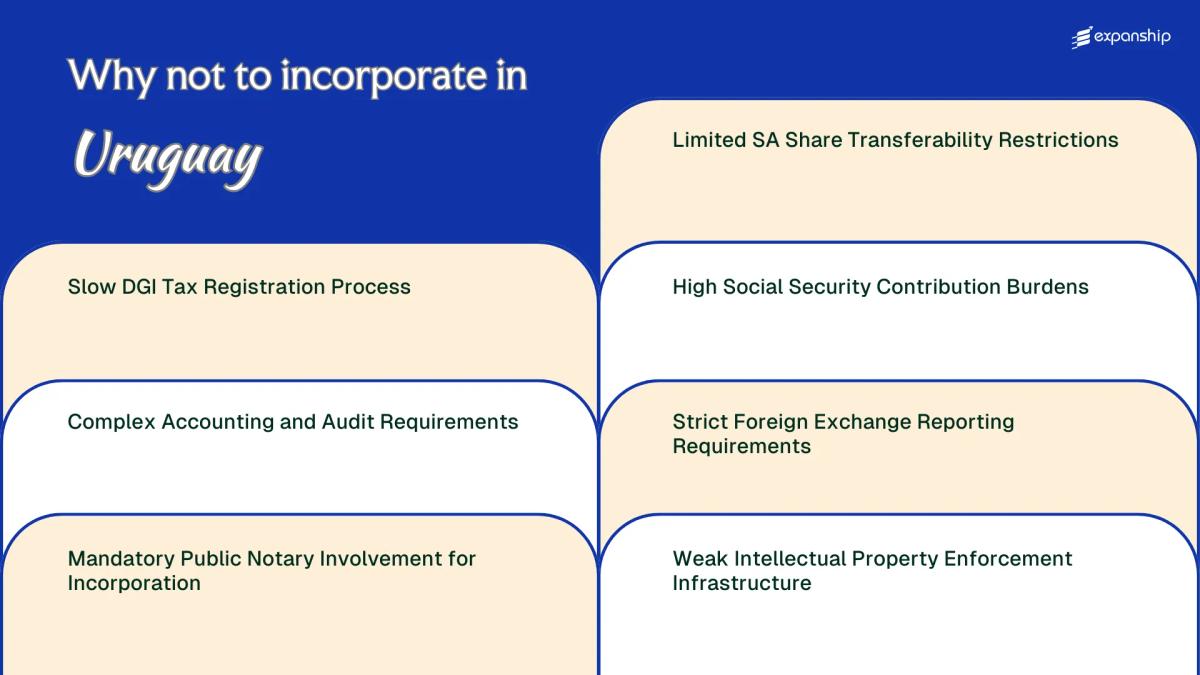
Slow DGI Tax Registration Process
Uruguay DGI tax registration delays affect foreign-owned companies more acutely than domestic ones, primarily because the process requires prior completion of several legal steps before the Dirección General Impositiva will assign a RUT (Registro Único Tributario) number.
Bureaucratic Sequencing Creates Compulsory Waiting Periods
Registration with the DGI cannot proceed independently. Your entity must first be constituted before a public notary, registered with the Registro Nacional de Comercio, and published in the official gazette, Diario Oficial, before tax registration becomes accessible. Each stage depends on the previous one clearing, which means a delay in any single step pushes the entire timeline further out.
Operational Paralysis Before the RUT Is Issued
Without a valid RUT number, your business cannot issue invoices, open a local bank account, or enter formal commercial contracts with Uruguayan counterparties. This gap can run several weeks and represents a direct loss of trading time during what should be an operational launch window. Businesses that rely on immediate revenue generation absorb this delay as a concrete financial cost.
Until the RUT is formally issued by the DGI, your entity has no legal standing to conduct taxable transactions in Uruguay, meaning any commercial activity undertaken in that period carries regulatory exposure.
Complex Accounting and Audit Requirements
Uruguay accounting compliance burdens are more demanding than foreign business owners typically anticipate. Companies registered as Sociedades Anónimas (SAs) or Sociedades de Responsabilidad Limitada (SRLs) must maintain accounting records in accordance with local GAAP standards, which do not fully align with IFRS, creating parallel reporting obligations for multinationals that already report under international standards.
Firms exceeding certain revenue thresholds must submit audited financial statements to the Auditoría Interna de la Nación (AIN), the state's internal audit authority. Engaging a locally certified contador público is not optional, and finding qualified professionals with bilingual capacity adds cost and recruitment friction for foreign-owned entities.
Beyond audit filings, your business must separately reconcile payroll records with the Banco de Previsión Social (BPS) for social contribution reporting, a process that runs on its own accounting logic. Discrepancies between BPS records and DGI tax filings trigger compliance reviews that can stall routine operations.
Specific ways this creates operational friction for foreign firms:
- Local GAAP divergence from IFRS forces your finance team to maintain two distinct sets of records simultaneously
- AIN submission deadlines impose fixed annual reporting cycles that require local accountant engagement even in low-activity years
- BPS payroll accounting operates on a separate schedule from corporate tax filings, doubling administrative coordination points
- Errors in either BPS or DGI records can trigger cross-agency audits, extending resolution timelines significantly
Smaller SRLs below statutory thresholds may avoid full external audit requirements, but the underlying bookkeeping obligations under the Código de Comercio remain regardless of company size.

Company Incorporation in Uruguay
Set up your business in Uruguay with full compliance support across accounting, registration, and regulatory filings.
Mandatory Public Notary Involvement for Incorporation
Incorporating a company through Uruguay notary requirements means your formation process cannot be completed without the physical involvement of a licensed escribano público (public notary). Under Uruguayan law, notarial intervention is mandatory for drafting and certifying the foundational documents of a Sociedad Anónima or Sociedad de Responsabilidad Limitada. This is not an administrative formality you can handle remotely or through a lawyer alone.
The escribano must personally authenticate the articles of incorporation, certify shareholder identities, and attest signatures before the deed is submitted to the Registro Nacional de Comercio. Each of these steps generates notarial fees calculated as a percentage of the company's declared share capital, meaning higher-capitalized entities face proportionally steeper upfront costs.
| Declared Share Capital (USD) | Estimated Notarial Fee Range | Fee as % of Capital |
|---|---|---|
| 10,000 | USD 400 – 700 | 4% – 7% |
| 50,000 | USD 900 – 1,500 | 1.8% – 3% |
| 100,000 | USD 1,500 – 2,500 | 1.5% – 2.5% |
| 250,000 | USD 2,800 – 4,500 | 1.1% – 1.8% |
For foreign founders who are not physically present in the country, this requirement forces either an expensive international trip or the execution of a notarized and apostilled power of attorney in the founder's home jurisdiction. That secondary notarization adds both cost and delay before the Uruguayan process can even begin.
Mandatory public notary involvement in Uruguay company formation also means your timeline is subject to the notary's availability and the Registro Nacional de Comercio's processing queue. Errors or omissions in the escritura pública require formal corrective deeds, each triggering additional notarial fees.
Limited SA Share Transferability Restrictions
Uruguay SA share transfer restrictions create a structural friction that foreign investors frequently underestimate at the point of incorporation. Law 18.930 and subsequent anti-money laundering regulations effectively dismantled the practical utility of bearer shares, requiring that beneficial ownership of all sociedades anónimas be declared and registered with the Banco Central del Uruguay (BCU).
Registered shares in a closed SA must follow transfer procedures governed by the company's bylaws and, in many cases, require notarial formalization. This adds cost and delay to every ownership change, which undermines the flexibility that foreign shareholders typically expect from a corporate vehicle.
Pre-emptive rights clauses are common in Uruguayan SA bylaws and, unless explicitly waived, obligate existing shareholders to approve or match any transfer before an outside party can acquire shares. For a foreign investor managing a multi-party or time-sensitive deal, this procedural requirement can obstruct restructurings or exits.
- Beneficial ownership must be reported to the BCU under Law 18.930 obligations
- Share transfers in closed SAs may require notarial intervention and bylaw compliance
- Pre-emptive rights held by existing shareholders can delay or block third-party transfers
- Non-compliance with beneficial ownership registration carries administrative sanctions
- Each transfer event may trigger fresh disclosure obligations to the BCU
Uruguay's mandatory beneficial ownership registry applies even to dormant SAs with no active operations, meaning a shelf company still generates ongoing compliance obligations.
High Social Security Contribution Burdens
Uruguay social security contribution burdens fall primarily under the administration of the Banco de Previsión Social (BPS), and the combined cost to employers can significantly exceed what foreign businesses are accustomed to paying in their home jurisdictions.
Employer Contribution Rates and Statutory Obligations
Employers in Uruguay are generally required to contribute approximately 7.5% of payroll toward social security, along with additional charges covering health insurance (FONASA) and other mandatory funds, pushing the effective employer burden considerably higher. For a foreign firm establishing a local subsidiary or branch with salaried staff, this layered structure means payroll costs are materially higher than the gross salary figure alone.
Practical Cost Implications for Foreign-Owned Entities
BPS audits payroll compliance with some regularity, and underreporting or misclassification of workers can trigger retroactive assessments plus penalties, adding financial exposure beyond the ongoing contribution costs. High payroll taxes in Uruguay disproportionately affect businesses in labor-intensive sectors, where headcount scales faster than revenue and contribution obligations compound accordingly. Employers utilizing independent contractors must also assess whether BPS would reclassify those arrangements as employment relationships, a determination that carries significant retroactive liability.
Managing Payroll and Compliance Obligations in Uruguay
Get guidance on structuring your workforce and understanding your BPS obligations before establishing operations in Uruguay.
Strict Foreign Exchange Reporting Requirements
Uruguay foreign exchange reporting restrictions add a distinct compliance layer that many foreign-incorporated entities underestimate until operations are underway.
- The Banco Central del Uruguay (BCU) requires companies to report foreign currency transactions above specified thresholds, meaning your finance team must track and document cross-border flows on an ongoing basis rather than periodically.
- Firms operating with non-resident shareholders or foreign parent structures face additional scrutiny under BCU currency reporting requirements, since intercompany transfers can trigger mandatory disclosure obligations.
- Failure to comply with BCU foreign exchange regulations can result in administrative sanctions, creating direct financial exposure for directors who may not be physically present in the country.
- Uruguay foreign exchange compliance burdens fall disproportionately on businesses in export-intensive or import-dependent sectors, where transaction volumes generate a high frequency of reportable events.
- Strict FX regulations apply even to routine dividend remittances abroad, so repatriating profits to a foreign parent company requires documented BCU-compliant procedures rather than a straightforward bank transfer.
Weak Intellectual Property Enforcement Infrastructure
Uruguay intellectual property enforcement problems stem largely from institutional capacity gaps rather than absent legal frameworks. The country has IP legislation in place, including Law No. 17.616 on copyright and Law No. 17.011 governing trademarks, but having laws on the books does not translate into reliable enforcement.
The National Directorate of Industrial Property (DNPI) handles trademark and patent registrations, yet the agency operates with limited resources relative to the volume of filings and disputes. For a foreign firm holding registered IP, this means contested rights may take years to resolve through administrative or judicial channels.
Counterfeiting and unauthorized use of trademarks in local markets can persist without swift legal response, exposing your business to ongoing brand dilution. Judicial proceedings involving IP infringement tend to move slowly through the general court system, as there are no dedicated IP tribunals.
- Trademark opposition and cancellation proceedings can extend beyond 12 months
- Civil enforcement actions require local legal representation with associated ongoing costs
- Criminal enforcement for IP violations remains rarely pursued
A foreign software company that registers its trademark with DNPI but later discovers unauthorized commercial use may wait 18 to 24 months or more for civil court resolution, during which the infringing activity continues without injunctive interruption.
Strategies to Overcome These Challenges
Overcoming Uruguay incorporation challenges requires structural preparation before engaging with local regulatory bodies, not reactive fixes after problems emerge.
- Appoint a escribano público before initiating any incorporation to satisfy mandatory notarial requirements under Uruguayan commercial law and avoid procedural delays at source.
- Engage a contador público registered with the Auditoría Interna de la Nación to ensure audit thresholds and financial reporting obligations are met from the entity's first fiscal year.
- File for DGI tax registration immediately upon completing incorporation, treating it as a parallel process rather than a sequential one to reduce cumulative timeline.
- Establish a compliant foreign exchange reporting protocol with the Banco Central del Uruguay from the outset to satisfy ongoing currency transaction disclosure requirements.
- Structure SA share transfer provisions explicitly in the estatutos to pre-empt transferability disputes under the Ley de Sociedades Comerciales No. 16.060.
- Calculate BPS social security contribution obligations before finalising payroll structures to avoid cash flow shortfalls in the first operating period.
These steps operate within a regulatory environment administered by multiple independent bodies, including the DGI, BPS, and BCU, each with distinct compliance timelines. Coordination across these agencies is a structural feature of doing business in this jurisdiction, not an anomaly.
Uruguay's Overall Investment Appeal
Weighing the disadvantages covered in this blog against the jurisdiction's underlying strengths produces a more accurate picture than either figure alone. Uruguay maintains treaty relationships, a stable banking sector regulated by the Banco Central del Uruguay, and a legal system grounded in civil law that foreign investors have operated within for decades.
| Pros | Cons |
|---|---|
| No restrictions on foreign ownership of local entities | DGI tax registration timelines extend the pre-operational period significantly |
| Political and macroeconomic stability supports long-term planning | Mandatory public notary involvement adds cost and procedural weight to incorporation |
| Free trade zone regime offers meaningful tax exemptions for qualifying activities | High employer social security contributions increase the cost of maintaining local payroll |
| BCU-regulated banking environment provides institutional credibility | Strict foreign exchange reporting obligations under BCU rules create ongoing compliance work |
| No exchange controls on capital repatriation | SA share transfer restrictions limit structural flexibility for certain ownership arrangements |
| Civil law framework offers a predictable legal foundation | Intellectual property enforcement gaps present real risk for IP-dependent business models |
The friction points documented across this blog are real and recurring. For businesses whose models depend on speed, lean payroll structures, or strong IP protection mechanisms, these constraints carry material weight.
Compliance Services for Companies in Uruguay
Maintain your Uruguayan entity in good standing with the DGI, BCU, and other regulatory bodies through structured compliance support.
Conclusion
The Uruguay company formation disadvantages summary is clear: this is a jurisdiction with genuine structural friction for foreign businesses. DGI tax registration delays, mandatory notarial involvement at incorporation, and the social security contribution burden on employers represent the most operationally significant barriers identified. These are not incidental inconveniences — they affect timelines, cost structures, and ongoing compliance obligations. Professional legal, accounting, and payroll support specific to the Uruguayan regulatory environment remains a practical prerequisite for any entity established there.
Expanship's Uruguay Expansion Services
From managing DGI tax registration timelines to coordinating with public notaries and maintaining foreign exchange reporting obligations under Banco Central del Uruguay rules, the compliance demands of a Uruguayan incorporation add up quickly. Uruguay expansion services Expanship provides are designed to absorb these operational burdens on your behalf, so your team can focus on business activity rather than regulatory administration. Expanship does not eliminate these structural requirements, but it does reduce the internal resources you need to manage them.
Beyond incorporation, Expanship supports the full establishment process across a defined scope of services.
- Your company is registered with all required documentation prepared to local standards.
- A registered agent and office address are provided to satisfy DGI and notarial requirements.
- Government filings are handled and regulatory bodies are liaised with directly on your behalf.
- Post-incorporation compliance obligations are managed on an ongoing basis.
- Banking introductions are facilitated to support your entity's operational setup.
- Tax registration is completed and local authority coordination is managed throughout.
To discuss your Uruguay incorporation, contact Expanship Uruguay.
Frequently Asked Questions (FAQ)
It applies broadly across the most common structures used by foreign investors, including the Sociedad Anónima (SA) and Sociedad de Responsabilidad Limitada (SRL). Uruguayan law requires notarial certification for the articles of incorporation, and any subsequent amendments to those documents also require notary intervention, adding recurring cost and delay beyond the initial setup.
Failures to report transactions through the Banco Central del Uruguay (BCU) reporting framework can result in administrative fines and increased regulatory scrutiny of your entity. The BCU holds authority to sanction firms that do not comply with foreign currency declaration requirements, and repeated non-compliance can affect your company's standing with local financial institutions.
Employer contributions to the Banco de Previsión Social (BPS) currently sit at approximately 7.5% of gross salary for social security, with additional contributions for health insurance (FONASA) bringing the total employer burden to roughly 12-13% on top of gross wages. For businesses scaling a local team, this meaningfully increases the true cost of each hire compared to gross salary alone.
Uruguay has ratified major international IP treaties, including the TRIPS Agreement, but its domestic enforcement infrastructure lags behind larger regional economies such as Chile or Brazil. Court proceedings involving IP infringement tend to be slow, and the practical deterrent effect of filing a complaint with the Dirección Nacional de la Propiedad Industrial (DNAPI) is limited when the opposing party is willing to absorb procedural delays.
Restrictions can be written into the company's estatutos (bylaws), but the default SA framework under Law 16.060 includes provisions that complicate private transfers without board or shareholder approval. These restrictions are not simply contractual preferences that can be waived informally; they require formal bylaw amendments, which again involve notarial certification and registration with the Auditoría Interna de la Nación (AIN).
Under Law 16.060 and subsequent regulatory developments, Sociedades Anónimas that exceed certain thresholds related to revenue, assets, or public interest classification are subject to mandatory external audit requirements. Foreign-owned SAs are frequently classified in ways that bring them within scope sooner than their owners anticipate, making it advisable to assess audit obligations before finalizing your corporate structure rather than after your first full fiscal year.
Legal Disclaimer
The information provided in this article is for general informational purposes only and does not constitute legal, tax, or professional advice. While we strive to ensure the accuracy and timeliness of the content, laws and regulations are subject to change, and the application of laws can vary widely based on specific facts and circumstances.
Readers should not act upon this information without seeking professional counsel tailored to their individual situation. Expanship and its authors disclaim any liability for actions taken or not taken based on the content of this article.
For specific advice regarding your business setup, compliance requirements, or any legal matters, please consult with qualified legal and tax professionals in the relevant jurisdiction.