

Key Takeaways
- Uruguay's territorial tax system excludes foreign-source income from IRAE entirely, meaning a holding company or international trading entity can operate without incurring local corporate tax on offshore revenues.
- Under Law No. 15,921, businesses operating within Uruguay's Free Trade Zones receive full exemptions from income tax, VAT, and customs duties, making these zones a structurally distinct option for export-oriented or logistics-focused operations.
- The Sociedad de Responsabilidad Limitada carries no minimum capital requirement and permits 100% foreign ownership without a domestic partner, removing two barriers that complicate entity formation in comparable Latin American jurisdictions.
- Incorporation under the oversight of the Auditoría Interna de la Nación places foreign-owned entities within a codified civil law framework that has remained legally stable, offering a degree of regulatory predictability that matters for long-term structural planning.
Situated on the southeastern coast of South America, Uruguay is an independent republic bordered by Brazil and Argentina. Company registration falls under the oversight of the Auditoría Interna de la Nación, the government body responsible for the supervision and registration of commercial entities. Foreign businesses most commonly establish a presence through an SA or SRL structure.
Operating a territorial tax system, the country taxes only income generated within its borders, leaving foreign-source earnings outside the scope of local taxation. This posture makes it a practical jurisdiction for international holding and trading activity. Foreign nationals face no structural barriers to ownership, and the government has maintained a consistent policy of openness toward foreign direct investment across most sectors.
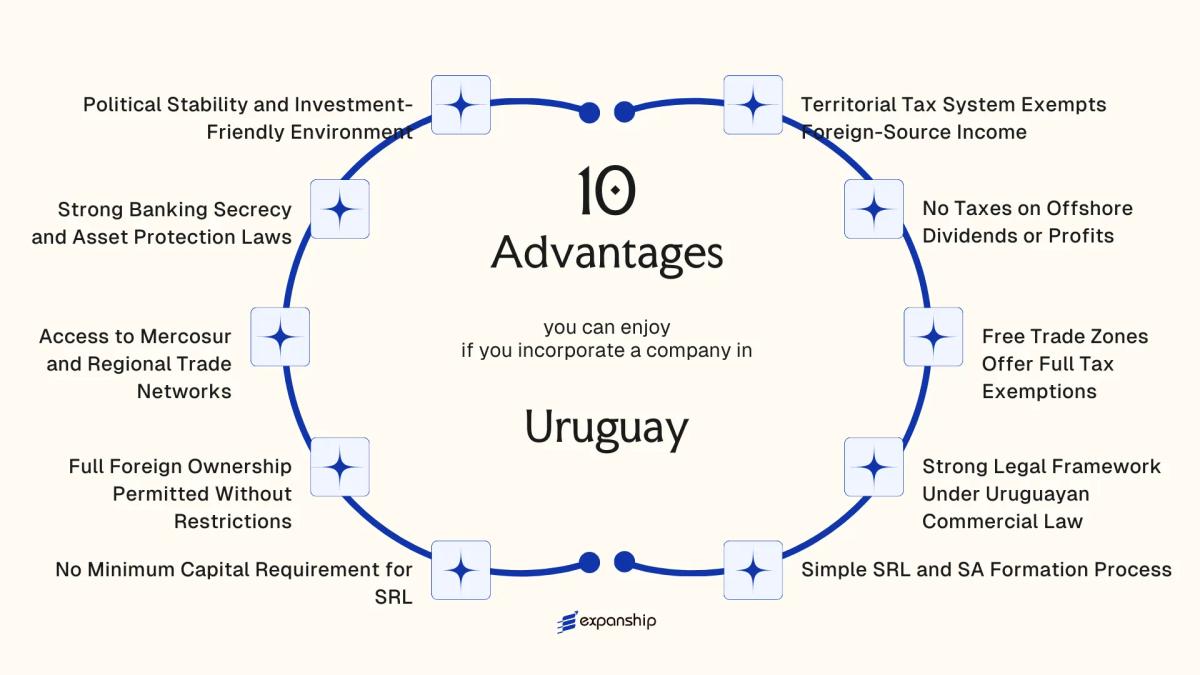
The benefits of incorporating in Uruguay span tax treatment, legal structure, and access to regional markets. This article examines the principal Uruguay company formation advantages relevant to foreign investors and business operators considering establishing an entity here.
Territorial Tax System Exempts Foreign-Source Income
Uruguay's territorial tax system means that income generated outside the country's borders is not subject to local taxation. Under this principle, codified in the Tax Code (Código Tributario) and reinforced through the IRAE (Impuesto a las Rentas de las Actividades Económicas) framework, only Uruguayan-source income falls within the tax base.
How the Territorial Principle Is Defined in Practice
IRAE applies at a standard rate of 25% — but exclusively to income with a Uruguayan economic source. Foreign-source income sits entirely outside this scope, meaning a firm conducting operations abroad owes no corporate income tax on those earnings to Uruguayan authorities.
What This Means for Internationally Active Businesses
For a holding company or a business with clients and contracts distributed across multiple markets, this structure creates a clear separation between domestic and foreign revenue. Your entity can accumulate offshore income without triggering a local tax liability on those amounts, which directly affects after-tax margins on international operations.
Foreign-source income your company earns abroad is fully excluded from Uruguay's corporate tax base under IRAE, leaving those earnings untouched by local taxation.
No Taxes on Offshore Dividends or Profits
Dividends paid from foreign-source income are not subject to tax in Uruguay. Under the territorial tax system established by the Tax Reform Law (Law 18.083 of 2006), income generated outside the country falls outside the scope of both Corporate Income Tax (IRAE) and the Dividend Withholding Tax (Impuesto a la Renta de No Residentes, or IRNR). For a holding company channeling profits from international operations, this means distributions from overseas subsidiaries reach the parent entity without a local tax charge applied on top.
The practical implication is direct: your firm can accumulate and redistribute offshore profits without triggering a secondary layer of taxation at the Uruguayan entity level.
This treatment benefits investors in several ways that go beyond a simple rate reduction:
- Foreign dividends are excluded from IRAE's taxable base by statutory definition, not by discretionary exemption
- No minimum holding period or ownership threshold is required to qualify for the exclusion on foreign-source dividends
- The rule applies equally to Sociedades Anónimas (SA) and Sociedades de Responsabilidad Limitada (SRL), giving structural flexibility
One condition applies: income must genuinely originate outside the country. Mixed-source income requires allocation between Uruguayan and foreign components, and only the latter qualifies for exclusion.

Company Incorporation in Uruguay
Set up an SA or SRL in Uruguay and position your business to benefit from the territorial tax treatment on offshore dividends and foreign-source profits.
Free Trade Zones Offer Full Tax Exemptions
Uruguay's free trade zone regime, established under Law No. 15,921, grants qualifying businesses a full exemption from virtually all national taxes. This includes corporate income tax (IRAE), value-added tax (IVA), wealth tax (IP), and customs duties on goods entering or leaving the zone. For a foreign business owner, Uruguay free trade zone tax exemptions translate directly into a lower operational cost base that remains legally protected under a dedicated statutory framework rather than a discretionary administrative arrangement.
| Tax Type | Standard Rate Outside ZFU | Rate Inside ZFU |
|---|---|---|
| Corporate Income Tax (IRAE) | 25% | 0% |
| Value-Added Tax (IVA) | 22% | 0% |
| Net Wealth Tax (IP) | Up to 1.5% | 0% |
| Import/Export Duties | Variable | 0% |
Entities operating within a zona franca are also exempt from any future taxes that may be introduced during the term of their operating contract, providing a degree of fiscal certainty that fixed-rate regimes rarely offer. Zone users are permitted to conduct activities including logistics, manufacturing, software development, and financial services, giving your business meaningful flexibility in how it structures its operations.
Free zone status is granted through a concession agreement with an authorized zone operator and is subject to oversight by the Free Trade Zone Area (Área de Zonas Francas) within the Ministry of Economy and Finance. Maintaining active operations within the zone is a condition of continued exemption, so the benefit is tied to genuine economic activity.
Strong Legal Framework Under Uruguayan Commercial Law
Uruguay's commercial law framework is codified primarily in Ley 16.060, the Ley de Sociedades Comerciales, enacted in 1989 and subsequently amended. This statute governs the formation, operation, and dissolution of commercial entities, providing a defined legal structure that your business can rely on without uncertainty about regulatory interpretation.
Predictability is a concrete advantage here. Corporate governance rules, shareholder rights, and director liability are all explicitly defined under Ley 16.060, which means disputes between parties are resolved against a clear statutory framework rather than discretionary judicial interpretation. For foreign investors, this reduces the legal risk associated with entering an unfamiliar jurisdiction.
Contract enforcement follows standard civil law principles, and the judiciary operates independently from executive influence. Commercial disputes can also be resolved through arbitration, which is recognized and enforceable under domestic law.
Keep the following in mind when relying on this framework:
- Ley 16.060 applies to both Sociedad Anónima (SA) and Sociedad de Responsabilidad Limitada (SRL) structures
- Shareholder agreements must align with the statutory provisions to be enforceable
- Foreign judgments may require recognition proceedings before local enforcement
Uruguay ratified the New York Convention on the Recognition and Enforcement of Foreign Arbitral Awards, meaning arbitration clauses in your contracts carry cross-border enforceability that many comparable Latin American jurisdictions still lack.
Simple SRL and SA Formation Process
Uruguay SRL SA formation advantages begin where many jurisdictions end: with a formation process designed to generate minimal friction for foreign investors. Both the Sociedad de Responsabilidad Limitada and the Sociedad Anónima are governed by Law No. 16,060 (the Commercial Companies Law), which establishes clear, codified procedures that apply uniformly regardless of the founder's nationality.
SRL Formation Is Structurally Direct
An SRL can be incorporated with as few as two partners and does not require notarized foreign documents beyond standard apostille certification. Registration is handled through the Auditoría Interna de la Nación (AIN) and the Registro de Comercio, and the process typically concludes within a predictable timeframe once documentation is complete. For foreign investors, this means you can establish a legal commercial presence without coordinating across multiple regulatory agencies or satisfying pre-approval conditions.
SA Incorporation Provides Structural Flexibility Without Bureaucratic Overhead
A Sociedad Anónima can be incorporated using a public deed executed before a Uruguayan notary, with shares structured as nominative or bearer instruments depending on your compliance posture under current AML regulations. The company's shares can be held by foreign individuals or corporate entities without restriction, which directly reduces the structural complexity typically required in jurisdictions that mandate local shareholder participation. Both entity types require registration with the Dirección General Impositiva (DGI) for tax identification, a process that runs concurrently with commercial registration rather than sequentially.
Structure Your Uruguay Company the Right Way
Get tailored guidance on choosing between an SRL and SA, navigating registration requirements, and ensuring your entity is correctly structured from day one.
No Minimum Capital Requirement for SRL
Uruguayan law sets no statutory minimum capital requirement for a Sociedad de Responsabilidad Limitada, which directly removes one of the most common financial barriers to company formation. For foreign entrepreneurs, the Uruguay SRL no minimum capital requirement means you can legally constitute and register a functioning entity without committing a fixed sum upfront.
- Capital can be set at whatever amount the founders determine is operationally appropriate, giving your business full control over its initial financial structure from day one.
- Unlike jurisdictions that require paid-in capital to be deposited and verified before registration proceeds, an SRL can be formed without that pre-registration liquidity obligation, reducing the administrative lead time before your entity is active.
- The Sociedad de Responsabilidad Limitada is governed under Law No. 16.060 (the Uruguayan Commercial Companies Law), which codifies this flexibility and gives it a clear legal basis rather than leaving it to regulatory discretion.
- For a foreign-owned entity operating across multiple markets, not tying up capital in a statutory reserve at incorporation preserves working capital for actual operations, payroll, or cross-border transactions from the outset.
- This structure suits both holding companies and trading entities, since neither type faces a threshold that would otherwise price out smaller or early-stage businesses from establishing a presence.
Full Foreign Ownership Permitted Without Restrictions
Uruguay full foreign ownership benefits stem directly from a legal framework that places foreign and domestic investors on equal footing. Under Law No. 16,906 (the Investment Promotion Law of 1998), foreign nationals are granted the same ownership rights as Uruguayan citizens, with no sectoral caps, no mandatory local partner requirements, and no government approval needed to hold 100 percent of shares in an SA or SRL.
This parity has a direct practical consequence: you retain full control over governance, profit distribution, and exit decisions without dilution imposed by local ownership rules.
- An SA can issue shares to foreign shareholders without restriction
- An SRL allows foreign members to hold the entirety of quota capital
- No prior authorization from the Comisión de Aplicación (COMAP) is required solely on the basis of foreign nationality
A foreign investor incorporating a Uruguay SRL with USD 50,000 in paid-in capital retains 100% ownership and receives 100% of distributed profits. Under the same structure in a jurisdiction requiring 51% local ownership, that same investor would receive at most USD 24,500 of a USD 50,000 distribution. The difference is USD 25,500 per distribution cycle, without any operational change.
Access to Mercosur and Regional Trade Networks
Uruguay Mercosur trade access benefits are direct and structural. As a full member of Mercosur since its founding in 1991, the country operates within a customs union covering Argentina, Brazil, and Paraguay — a combined market of over 290 million consumers with largely eliminated internal tariffs on qualifying goods.
For a foreign-owned entity incorporated locally, this membership translates into preferential treatment that an offshore holding structure simply cannot replicate. Goods produced or substantially processed within the country can move across Mercosur borders under the bloc's Common External Tariff framework, avoiding the full duties applied to non-member imports.
Beyond Mercosur, the bloc has signed trade agreements with third-party regions, including:
- A trade agreement with the Southern African Customs Union (SACU)
- A preferential trade arrangement with India
- An agreement with Egypt covering tariff reductions on select product categories
Each of these extends the effective reach of a Uruguay-based business beyond South America.
Preferential tariff treatment under Mercosur applies to goods meeting the bloc's rules of origin requirements — your products must satisfy specific local content thresholds to qualify.
Strong Banking Secrecy and Asset Protection Laws
Uruguay banking secrecy asset protection benefits are grounded in formal legislation, not administrative practice. Law No. 15,322 on the Banking Activity Charter establishes confidentiality as a legal obligation for financial institutions, prohibiting the disclosure of client information to third parties without explicit legal authorization. This creates a statutory layer of protection that goes beyond internal bank policy.
Under this framework, your account details and transaction records are protected by default. Disclosure is only permitted under specific judicial orders or where international tax information exchange obligations apply, which means the threshold for access is defined in law rather than left to institutional discretion.
Uruguay is a signatory to the Common Reporting Standard (CRS) and maintains tax information exchange agreements with a number of jurisdictions. For foreign investors, this matters because the protections under Law No. 15,322 apply within the bounds of those obligations rather than being overridden by them entirely.
Asset protection is also reinforced through the country's corporate structure rules. Shares in a Sociedad Anónima (SA) can be held in registered or bearer form, subject to registration requirements introduced under Law No. 18,930 and subsequent amendments that created the Registry of Shareholders. Beneficial ownership must be disclosed to the Central Bank of Uruguay (BCU), but this information is not publicly accessible.
- Banking secrecy is a statutory obligation under Law No. 15,322
- Judicial authorization is required before any disclosure can be made
- SA shareholder data is held by the BCU, not in a public registry
- CRS compliance defines the scope of information exchange obligations
Political Stability and Investment-Friendly Environment
Uruguay's political stability investment advantages are among the most concrete in Latin America. The country has maintained uninterrupted democratic governance since 1985, and consecutive governments across different political parties have preserved consistent macroeconomic policies. For a foreign investor, this continuity means the regulatory environment you enter is unlikely to shift dramatically between election cycles.
Ranked among the highest in the region on Transparency International's Corruption Perceptions Index, Uruguay consistently outperforms its Mercosur neighbors on institutional reliability. The judiciary operates independently from the executive branch, which gives foreign-owned entities genuine recourse through local courts without the political interference that affects contract enforcement in several surrounding markets.
The Central Bank of Uruguay (Banco Central del Uruguay, or BCU) maintains monetary oversight with a track record of measured inflation management relative to regional peers. That institutional discipline directly affects your ability to repatriate capital and hold assets without sharp currency devaluation eroding value.
Key structural features that reinforce stability for foreign business operations include:
- Uruguay is a signatory to the International Centre for Settlement of Investment Disputes (ICSID) convention, giving investors access to international arbitration outside local courts
- The country has signed bilateral investment treaties (BITs) with over 30 countries, establishing legal protections against expropriation and guaranteeing fair treatment
- Foreign and domestic investors receive equal treatment under Uruguayan law, with no sector reserved exclusively for local capital
- The Investment Law (Law No. 16,906) provides a statutory framework for investment promotion that has remained structurally intact since 1998
Why Uruguay Stands Out Against Competing Jurisdictions
Comparing Uruguay incorporation advantages against competing jurisdictions reveals a consistent pattern: the combination of territorial taxation, unrestricted foreign ownership, and Mercosur access is difficult to replicate within the same region at comparable cost. Panama and the British Virgin Islands are frequently evaluated alongside Uruguay by foreign investors, yet each serves a structurally different purpose. Panama suits transaction-heavy holding structures; the BVI is oriented toward confidentiality and offshore asset holding. Neither offers the same degree of access to South American trade infrastructure or the credibility that comes with OECD engagement and FATF membership.
What distinguishes this jurisdiction in practice is not any single feature but the combination of regulatory legitimacy and tax efficiency operating under the same framework. Jurisdictions that offer comparable tax treatment often carry elevated due diligence burdens with correspondent banks or fall on international grey lists. Uruguay's compliance with international transparency standards means your entity is less likely to encounter banking friction, which has become a practical obstacle for structures incorporated in lower-reputation offshore centres.
| Parameter | Uruguay | Panama | British Virgin Islands |
|---|---|---|---|
| Territorial tax system | Yes | Yes | Yes |
| Foreign-source income taxed | No | No | No |
| Corporate tax on local income | 25% IRAE | 25% | 0% (no local operations) |
| Foreign ownership restriction | None | None (with exceptions) | None |
| Mercosur / regional trade access | Yes | No | No |
| FATF status | Compliant | Monitored (grey list history) | Compliant |
| Recognised onshore legal system | Yes (Civil law, SA/SRL) | Yes | No (offshore-only profile) |
| Banking access ease | High | Moderate | Moderate to low |
Compliance Services for Companies in Uruguay
Maintain your Uruguayan entity in good standing with annual filing, accounting, and regulatory reporting obligations handled end to end.
Conclusion
Uruguay's territorial tax system and the structural flexibility of its corporate law make a practical case for incorporating here that goes beyond surface-level comparisons. Foreign-source income remains outside the scope of IRAE entirely, and Free Trade Zone operators benefit from exemptions across income tax, VAT, and customs duties under Law No. 15,921. For a business whose revenues derive primarily from international operations, these two features alone substantially reduce the effective tax burden.
The benefits of incorporating in Uruguay carry different weight depending on how your business generates and distributes income. A holding company routing offshore dividends faces a fundamentally different calculus than a manufacturing firm seeking Mercosur market access. Full foreign ownership under Uruguayan commercial law removes one structural barrier, but the relevance of remaining advantages depends on your entity type, your industry, and where your counterparties are located.
What the framework consistently offers is legal predictability. The Auditoría Interna de la Nación provides regulatory oversight within a well-established civil law system, and the Sociedad de Responsabilidad Limitada remains one of the more accessible foreign-owned corporate structures available in Latin America without a domestic partner requirement. For businesses at the stage of evaluating incorporation, the next step is matching these structural features against your specific operational model to determine whether the fit holds under scrutiny.
Start Your Uruguay Company Formation With Expanship Today
Expanship assists foreign business owners with Uruguay company formation, handling entity structuring, registration with the Auditoría Interna de la Nación (AIN), and ongoing compliance under the Ley de Sociedades Comerciales No. 16.060. Whether your structure is an SRL or an SA, the benefits covered in this blog, from territorial taxation to Free Trade Zone access, are the practical framework within which Expanship operates on your behalf.
Expanship's service scope for incorporating in Uruguay includes:
- Preparation and legalization of incorporation documents, including estatutos and deed notarization
- Registered agent and registered office provision within Uruguay
- Filing coordination with the AIN and the Registro Nacional de Comercio
- Post-incorporation compliance management, including annual reporting and shareholder obligations
- Banking introduction assistance to facilitate account opening with local financial institutions
- Liaison with the Dirección General Impositiva (DGI) for tax registration and RUT number issuance
Reach out to Expanship Uruguay to begin your incorporation.
Frequently Asked Questions (FAQ)
Yes, foreign nationals may hold 100% ownership in both an SRL and an SA under Uruguayan commercial law, with no requirement for a local shareholder or partner. The Ley de Sociedades Comerciales (Law 16.060) does not impose nationality-based ownership restrictions on either entity type. Residency is also not a condition of ownership, though certain director appointment rules may apply depending on the chosen structure.
Under Uruguay's territorial tax regime, income generated outside the country is generally exempt from corporate income tax (IRAE), regardless of where the company is incorporated or managed. This exemption covers trading profits, royalties, and dividends sourced from foreign operations, provided the income does not arise from activities conducted within Uruguayan territory. The precise classification of income source is assessed by the Dirección General Impositiva (DGI), the national tax authority.
No statutory minimum capital is required to incorporate an SRL in Uruguay. Subscribers determine the capital amount and divide it into quotas, which do not need to meet any floor set by law. This contrasts with the SA structure, where capital is represented by shares and certain formalities around capital subscription apply under Law 16.060.
Incorporation timelines vary by entity type and the completeness of documentation submitted to the Auditoría Interna de la Nación (AIN), which oversees company registration. An SRL can generally be registered within a few weeks once all required documents are in order, while an SA involves additional steps, including deed notarization and publication requirements, which can extend the timeline. Delays typically arise from apostille processing or document translation rather than the registration procedure itself.
Companies operating within a Free Trade Zone under Law 15.921 are exempt from virtually all national taxes, including IRAE, VAT, and import duties, on activities conducted within the zone. This exemption applies to both Uruguayan and foreign-owned entities, provided they obtain authorization to operate under the Free Trade Zone regime. Sales of goods or services into the local Uruguayan market from within the zone are not covered by the exemption and are subject to standard tax treatment.
Uruguay is a full member of Mercosur, the South American trade bloc that also includes Argentina, Brazil, and Paraguay. Membership provides companies incorporated in the country with preferential tariff access to these markets under the bloc's common external tariff framework, which can reduce import duties on qualifying goods traded among member states. The practical benefit depends on the nature of the business and the specific product categories involved, as Mercosur's tariff schedule contains exceptions and safeguard provisions for certain sectors.
Law 16.906, the Investment Promotion and Protection Law, grants foreign investors the same legal treatment as domestic investors and prohibits discriminatory measures based on the investor's nationality. The law also permits repatriation of capital and profits without restriction, subject to standard foreign exchange reporting. Uruguay has additionally signed bilateral investment treaties with several countries, which provide additional layers of protection including access to international arbitration in the event of a dispute with the state.
Uruguay's banking secrecy framework, governed by Law 15.322, restricts disclosure of account information to third parties without a court order or the account holder's consent. However, Uruguay has committed to the OECD Common Reporting Standard (CRS) and has signed Tax Information Exchange Agreements (TIEAs) with numerous jurisdictions, which creates formal channels for sharing financial information with foreign tax authorities upon request. Secrecy protections therefore apply in private disputes and domestic contexts, but do not shield account information from legitimate international tax inquiries conducted through treaty mechanisms.
Legal Disclaimer
The information provided in this article is for general informational purposes only and does not constitute legal, tax, or professional advice. While we strive to ensure the accuracy and timeliness of the content, laws and regulations are subject to change, and the application of laws can vary widely based on specific facts and circumstances.
Readers should not act upon this information without seeking professional counsel tailored to their individual situation. Expanship and its authors disclaim any liability for actions taken or not taken based on the content of this article.
For specific advice regarding your business setup, compliance requirements, or any legal matters, please consult with qualified legal and tax professionals in the relevant jurisdiction.