

Key Takeaways
- Every US state maintains its own incorporation statute and company registry, meaning formation requirements — including filing procedures, officer rules, and naming restrictions — must be assessed at the state level rather than against a single federal standard.
- Under the Corporate Transparency Act, beneficial owners of most newly formed US entities are required to report identifying information to FinCEN within strict deadlines, with civil penalties applying to non-compliant companies.
- Regardless of where a business physically operates, every entity formed or registered in a US state must continuously maintain a registered agent with a physical address in that state to receive official legal and government correspondence.
- Foreign investors and non-resident entrepreneurs must account for entity type, state of formation, and industry sector when assessing which structural, documentary, and director eligibility requirements apply to their specific situation.
Entity formation in the United States is governed at the state level, meaning there is no single federal incorporation statute. Each state maintains its own corporate law and company registry; for example, Delaware's General Corporation Law and the Delaware Division of Corporations are widely referenced benchmarks, while other states operate under their own distinct frameworks. The Model Business Corporation Act has been adopted in whole or in part by many states, providing some consistency across jurisdictions.
Meeting US incorporation requirements determines whether a company can be legally formed, maintain good standing, and operate without regulatory exposure.
This article addresses the formation requirements applicable to entities registering in the United States, spanning structural, documentary, and compliance obligations. Failure to satisfy these requirements can result in rejection of the registration filing, loss of good standing, or personal liability for directors and owners.
Specific requirements vary depending on the entity type selected, the state of formation, the industry sector, and whether the applicant is a domestic or foreign national.
This article is most relevant to foreign investors, non-resident entrepreneurs, and multinational firms evaluating a US market entry through a formal legal entity.
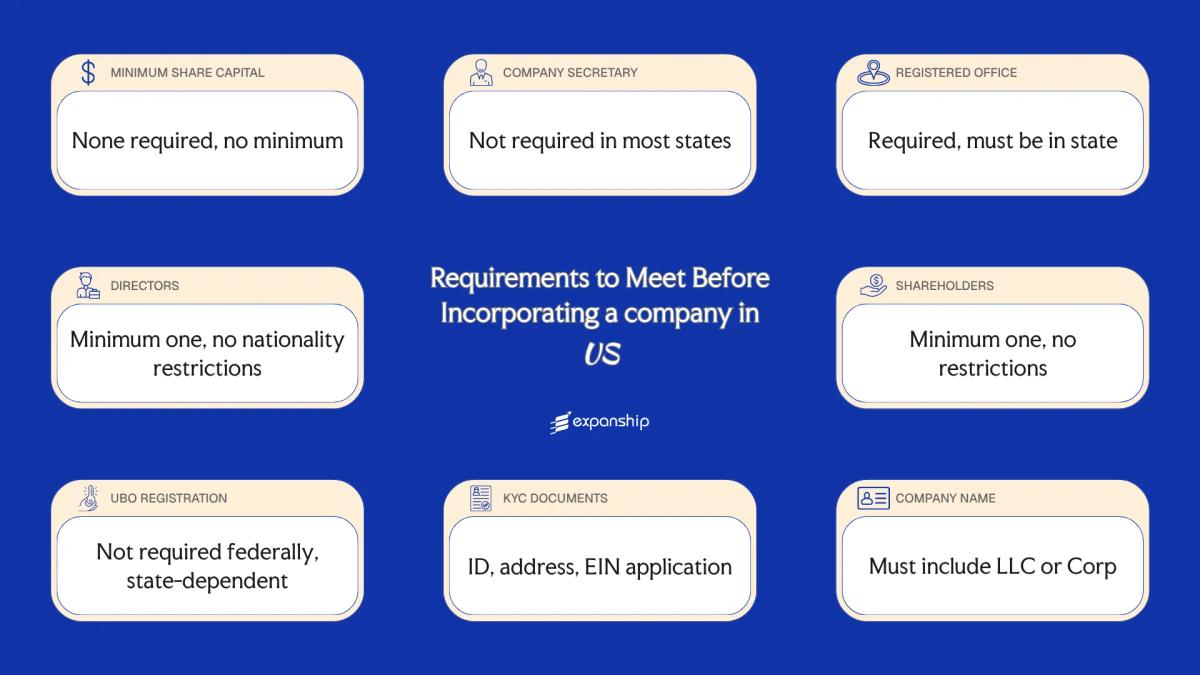
Minimum Share Capital Requirements in the United States

US minimum share capital requirements are governed at the state level, meaning there is no single federal standard that applies uniformly to all corporations. Each state's corporate statute sets its own rules, though in practice the majority impose no statutory minimum.
Most states, including Delaware under the Delaware General Corporation Law and Nevada under NRS Chapter 78, permit corporations to issue shares with or without par value. No central federal authority verifies capitalization at incorporation; the relevant state's Division of Corporations or Secretary of State processes the formation filing without confirming that any specific capital amount has been deposited.
| Parameter | Detail |
|---|---|
| Minimum Authorized Share Capital | No statutory requirement in most states |
| Maximum Authorized Share Capital | No statutory maximum; authorized share structure is set in the Articles of Incorporation |
| Minimum Paid-Up Capital | No statutory requirement |
| Paid-Up Requirement at Incorporation | No statutory requirement |
| Accepted Currency | US Dollar (USD) |
| Accepted Forms of Contribution | Cash, property, services rendered, or other consideration permitted under applicable state statute |
| Timeframe to Deposit Capital | No statutory deadline in most states |
Even where no minimum is required, your corporation must still authorize a defined number of shares in its Articles of Incorporation. Authorizing zero shares is not a valid filing in any state.
Registered Agent Requirements in the United States
Every US state requires corporations and LLCs to designate a registered agent as a condition of formation or qualification to do business. Meeting the registered agent requirements United States statutes impose is a baseline obligation, not an optional administrative step.
The agent receives service of process, official state correspondence, and legal notices on behalf of the entity. Specific duties vary slightly by state, but all agents must be available at a physical address during standard business hours on every business day.
Qualification criteria differ by state but generally follow these conditions:
- An individual agent must be a resident of the state where the entity is registered.
- A commercial registered agent must be authorized to conduct business in that state.
- The agent must maintain a physical street address in the relevant state; a P.O. box does not satisfy state statutory agent obligations.
- Corporations may serve as their own registered agent only if they are incorporated and have a physical presence in that state.
- Some states maintain a list of approved commercial registered agents that entities may select from.

Incorporate a Company in the United States
Set up your US business entity with support across all 50 states, from state filing to registered agent designation.
Registered Office Requirements in the United States
Registered office requirements in the United States are governed at the state level, meaning the rules your business must follow depend on the state of formation or qualification. Failing to maintain a compliant registered office address can result in administrative dissolution, loss of good standing, or the inability to bring legal action in that state's courts.
- A physical street address is required; P.O. boxes are not accepted as a registered office address.
- Virtual office addresses are permitted in most states, provided they supply a real street address where documents can be received.
- The address must be located within the state where the entity is formed or registered to do business.
- No ownership or lease agreement is mandated by statute, but the address must be one where the company or its agent can reliably receive service of process.
- The registered office address is publicly listed on the state company registry, such as the Secretary of State's records, and is accessible to third parties.
- A formal notification to the Secretary of State is required when the address changes, typically filed through an amendment or statement of change form specific to that state.
Director Requirements in the United States
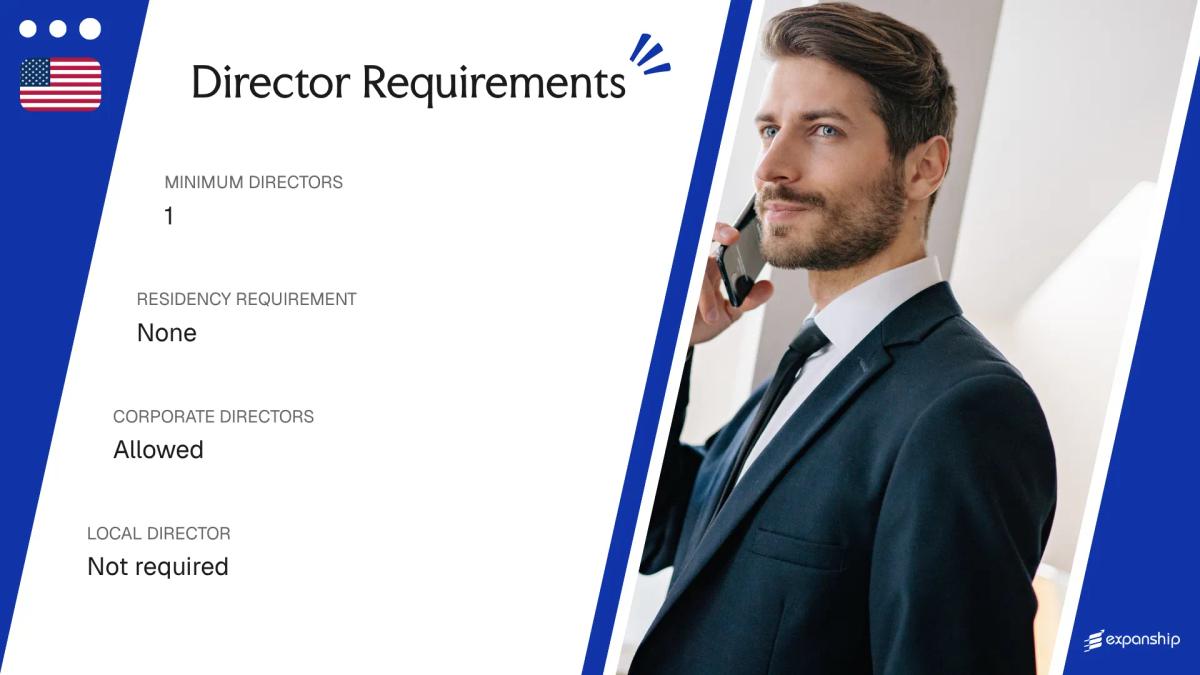
Director requirements for a US corporation are governed at the state level, meaning the rules you follow depend on where your entity is incorporated. Upon appointment, directors assume fiduciary duties under state corporate law, principally the duty of care and the duty of loyalty, which expose them to personal liability for decisions made in bad faith or in conflict with the corporation's interests.
| Parameter | Detail |
|---|---|
| Minimum Number of Directors | One director is sufficient in most states, including Delaware, Wyoming, and Nevada. |
| Maximum Number of Directors | No statutory maximum; the number is typically set by the corporation's bylaws. |
| Local/Resident Director Required | No state imposes a residency requirement for directors of a standard corporation. |
| Nationality Restrictions | No nationality restrictions apply; foreign nationals may serve as directors. |
| Minimum Age Requirement | Most states require directors to be at least 18 years of age. |
| Corporate Directors Permitted | Generally not permitted; most states require directors to be natural persons. |
| Director Must Be a Shareholder | No statutory requirement; directors are not required to hold shares in the corporation. |
| Publicly Listed on Registry | Director information is generally not listed on public state registry filings. |
| Disqualification Conditions | Directors may be disqualified through court order or under federal law, such as SEC enforcement actions or bankruptcy restrictions. |
Unlike many jurisdictions, the United States does not maintain a centralized public register of company directors at the federal level, meaning director identities are largely shielded from routine public disclosure under standard state incorporation filings.
Shareholder Requirements in the United States
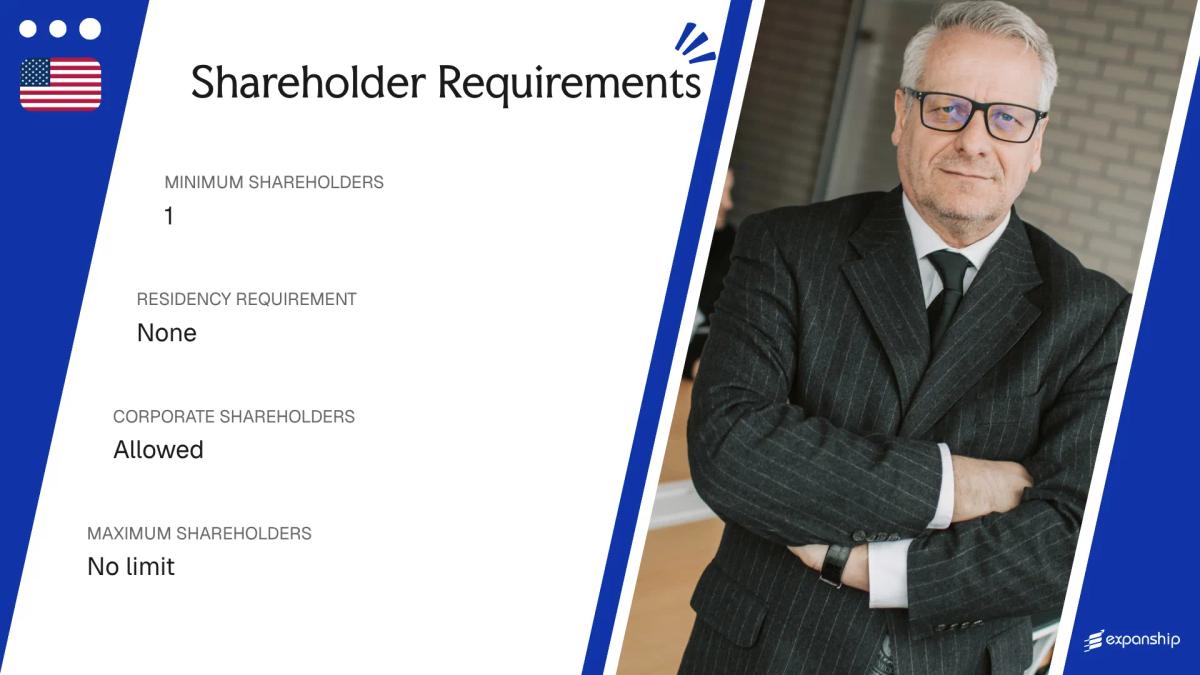
Most US states permit a corporation to be formed with a single shareholder, making sole-shareholder structures fully valid. There is no statutory maximum on the number of shareholders for standard C-corporations, though S-corporations are capped at 100 shareholders under the Internal Revenue Code.
Nationality and Residency Restrictions
Shareholder requirements for a US corporation impose no nationality or residency conditions at the state level for C-corporations. Foreign nationals and non-resident entities may hold shares without restriction, though certain federally regulated industries — such as broadcasting and domestic airlines — maintain foreign ownership limits under sector-specific statutes.
Corporate Shareholders
Corporate entities, including foreign companies, are permitted to act as shareholders in a C-corporation. S-corporations, however, restrict corporate shareholding; eligible shareholders are generally limited to individuals, certain trusts, and estates under IRC Section 1361.
Shareholder Liability
Liability is ordinarily limited to each shareholder's capital contribution. Courts may pierce the corporate veil and extend personal liability where a firm is found to be a mere alter ego of its owners or where statutory formalities have been persistently disregarded.
Register of Shareholders
Corporations are generally required to maintain an internal register of shareholders under state corporate statutes, such as the Delaware General Corporation Law. This register is not publicly filed with state authorities, though ownership information may be reportable to FinCEN under the Corporate Transparency Act.
Shareholder Structuring Support for US Incorporation
Get guidance on structuring your shareholding arrangement to meet federal and state requirements when registering a corporation in the United States.
UBO / Beneficial Ownership Reporting Requirements in the United States
Under the Corporate Transparency Act (CTA), enacted in 2021 and administered by the Financial Crimes Enforcement Network (FinCEN), beneficial ownership reporting requirements in the US apply to most domestic and foreign entities registered to do business in any US state.
- Determine whether your entity qualifies as a "reporting company" under the CTA, noting that large operating companies, regulated financial institutions, and certain other categories are exempt.
- Identify each beneficial owner, defined as any individual who directly or indirectly owns or controls 25% or more of the entity, or who exercises substantial control over it.
- Submit a Beneficial Ownership Information (BOI) report to FinCEN through its secure online filing system.
- Report any changes to previously submitted information within 30 days of the change occurring.
| Parameter | Detail |
|---|---|
| Ownership Threshold for UBO Status | 25% ownership or substantial control |
| Filing Authority | FinCEN |
| Disclosure Deadline at Incorporation | 90 days for entities formed in 2024; 30 days for entities formed from 2025 onward |
| Publicly Accessible Register | No |
| Penalties for Non-Disclosure | Civil penalties up to $591 per day; criminal penalties up to $10,000 and two years imprisonment |
| Ongoing Update Obligation | Yes, within 30 days of any change |
KYC / Document Requirements in the United States
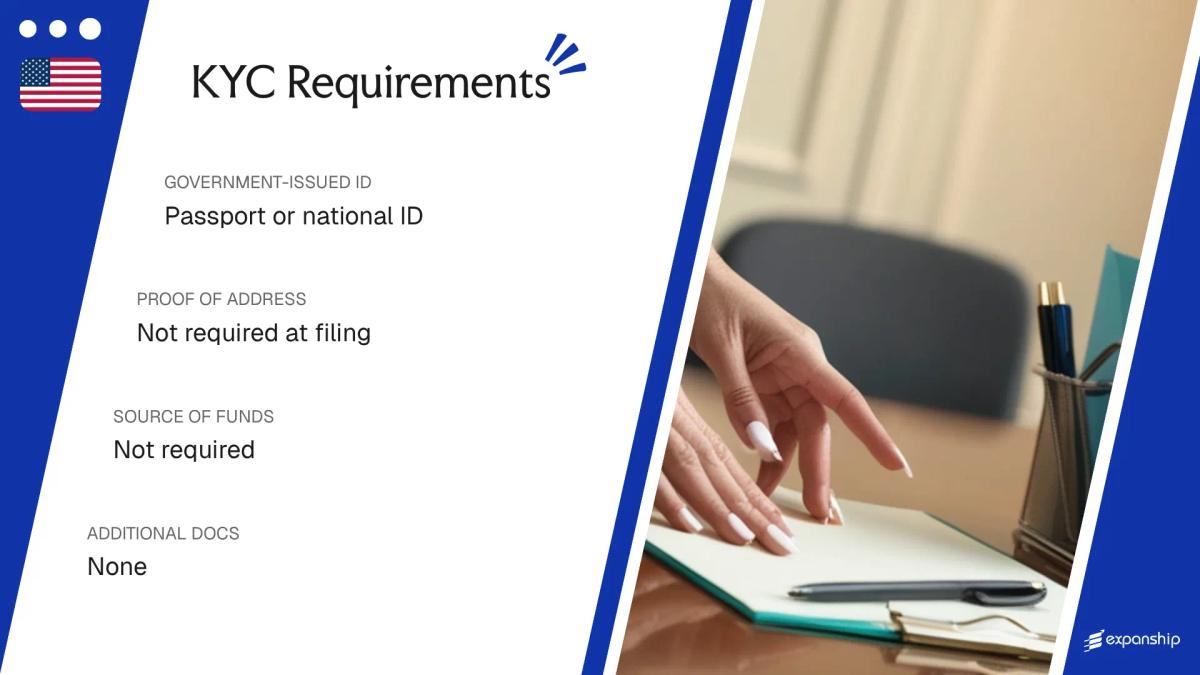
KYC requirements US company registration obligations at the incorporation stage are governed primarily by the Bank Secrecy Act (BSA), administered by the Financial Crimes Enforcement Network (FinCEN).
Individual / Personal Documents
- Government-issued photo identification (passport or state-issued ID) for each individual director, shareholder, or beneficial owner
- Proof of residential address dated within three months, such as a utility bill or bank statement
- Date of birth and tax identification number where applicable
Corporate Documents
- Certificate of incorporation or equivalent formation document for any corporate shareholder or director
- Articles of incorporation or bylaws confirming the entity's constitutional structure
- Register of directors and proof of the corporate entity's registered address
Source of Funds Documentation
- Recent bank statements (typically covering the last three to six months) evidencing the origin of capital
- Audited financial statements or accountant-certified accounts where available
- A written explanation of the source of funds may be requested if the documentary evidence is insufficient
Notarisation and Apostille Requirements
- Foreign-issued identity documents are generally required to be notarised by a licensed notary public
- Documents originating outside the US may require an apostille under the Hague Apostille Convention
- Official translation into English is required for any document not originally issued in English
Incomplete or inconsistent beneficial ownership documentation is the most common cause of incorporation delays under FinCEN filing review.
Company Name Requirements in the United States
Each state's filing authority independently evaluates proposed company names against its own availability database, so a name accepted in Delaware may still be unavailable in Texas or California. Names are assessed at the point of incorporation for distinctiveness from existing registered entities.
Structural rules require a legal suffix indicating entity type, such as "Inc.", "LLC", or "Corp.", and names must be in the Roman alphabet. No federal character limit applies universally, though individual states may impose practical constraints.
Certain words are either prohibited outright or require additional regulatory consent before use. Terms suggesting federal affiliation, banking functions, or licensed professions typically fall into the restricted category.
Name reservation is available in most states, with reservation periods commonly ranging from 30 to 120 days depending on the jurisdiction. Your business can apply directly through the relevant state filing office, usually online or by mail.
Compliance Services for Companies in the United States
Manage your ongoing US compliance obligations, from annual report filings to registered agent maintenance, across all active states of registration.
Conclusion
The US incorporation requirements overview spans entity selection, registered agent and office obligations, director and shareholder rules, beneficial ownership reporting under the Corporate Transparency Act, and company naming restrictions. Among the most consequential requirements is the FinCEN beneficial ownership reporting obligation, which carries strict deadlines and civil penalties for non-compliance. State-level registered agent mandates also apply without exception, regardless of where your business actually operates.
Once these requirements are understood, the practical work of selecting a formation state, appointing a registered agent, and filing the necessary documents with the relevant state authority begins.
Expanship's Corporate Services for US Expansion
Expanship's US company formation corporate services cover the full scope of what incorporating in the United States actually requires — from state-level entity selection and registered agent appointment to FinCEN's Beneficial Ownership Information reporting under the Corporate Transparency Act. Each engagement is structured around reducing the operational burden these federal and state obligations place on your team, not abstracting them away.
Beyond formation, Expanship supports your business across the entire setup process:
- We prepare and file your formation documents with the relevant state authority, handling entity structuring from the outset.
- Registered agent and registered office services are provided in the state of incorporation to satisfy statutory presence requirements.
- We liaise directly with government agencies and regulatory bodies on your behalf throughout the filing process.
- Post-incorporation compliance management keeps your entity in good standing with ongoing state obligations.
- Banking introduction assistance connects your business with institutions familiar with foreign-owned US entities.
- Tax registration and coordination with federal and state revenue authorities is handled as part of your setup.
To discuss your requirements, contact Expanship United States.
Frequently Asked Questions (FAQ)
Most small LLCs and corporations are required to file Beneficial Ownership Information (BOI) reports with FinCEN under the Corporate Transparency Act, unless they qualify for one of the 23 statutory exemptions. Exemptions generally apply to large operating companies meeting specific employee count and revenue thresholds, regulated entities such as banks, and certain inactive entities. A single-member LLC does not automatically qualify for an exemption simply because of its size or structure.
Willful failure to file or update a BOI report with FinCEN can result in civil penalties of up to $500 per day for each day the violation continues, as well as criminal penalties of up to $10,000 and imprisonment of up to two years. These penalties apply under the Corporate Transparency Act and extend to individuals who cause a reporting company to fail to comply. Correction of an inaccurate report must be filed within 30 days of the error being identified.
Yes, US federal law does not prohibit foreign nationals from serving as the sole director and shareholder of a corporation or LLC. State-level laws govern formation requirements, and most states impose no citizenship or residency restrictions on directors or shareholders. Certain regulated industries, such as domestic airlines or broadcast licensees, are subject to federal restrictions on foreign ownership, but these are sector-specific rules rather than general incorporation requirements.
No statutory minimum share capital is required at the federal level or in most US states to form a corporation or LLC. Delaware, one of the most commonly used states for incorporation, allows companies to be formed with nominal authorized capital. While some states charge franchise taxes or fees based on authorized share capital, this is a tax calculation mechanism rather than a true paid-in capital requirement.
State business name registrations are jurisdiction-specific, so a name unavailable in one state may be available in another. Each state's Secretary of State office maintains its own name database, and a name check in your chosen state of incorporation is a separate process from federal trademark searches. If you plan to operate across multiple states, a federal trademark registration through the USPTO provides broader protection than a state-level name reservation alone.
Foreign directors and shareholders are generally required to provide a certified copy of a government-issued passport, proof of residential address such as a recent utility bill or bank statement, and in some cases a background or compliance check depending on the registered agent or bank involved. These requirements are tied to anti-money laundering obligations under the Bank Secrecy Act and FinCEN guidance rather than state incorporation statutes. Additional documentation may be required when opening a US bank account, which operates under separate due diligence standards.
Yes, the filing deadlines differ based on when the company was formed. Entities formed before January 1, 2024, had until January 1, 2025, to file their initial BOI report with FinCEN, while entities formed on or after January 1, 2024, are required to file within 90 days of receiving notice of their formation becoming effective. Companies formed on or after January 1, 2025, have a 30-day filing window from the date of formation.
Legal Disclaimer
The information provided in this article is for general informational purposes only and does not constitute legal, tax, or professional advice. While we strive to ensure the accuracy and timeliness of the content, laws and regulations are subject to change, and the application of laws can vary widely based on specific facts and circumstances.
Readers should not act upon this information without seeking professional counsel tailored to their individual situation. Expanship and its authors disclaim any liability for actions taken or not taken based on the content of this article.
For specific advice regarding your business setup, compliance requirements, or any legal matters, please consult with qualified legal and tax professionals in the relevant jurisdiction.