
Key Takeaways
- C corporations incorporated in the United States face taxation at both the corporate level (currently a flat 21% federal rate under the Internal Revenue Code) and again at the shareholder level when dividends are distributed, creating a structural double-taxation burden that LLCs and S corporations are designed to avoid but cannot always access for foreign owners.
- Businesses registered in one state but operating across multiple states trigger separate foreign qualification requirements, franchise taxes, and reporting obligations in each active state, multiplying compliance costs beyond the initial formation jurisdiction.
- The Securities and Exchange Commission enforces disclosure, registration, and anti-fraud requirements under the Securities Act of 1933 and the Securities Exchange Act of 1934 that apply broadly to capital-raising activities, meaning even early-stage companies can face federal securities compliance obligations before generating revenue.
- US employment law obligations — spanning federal statutes such as the Fair Labor Standards Act, the Family and Medical Leave Act, and state-level equivalents — impose layered compliance requirements on businesses with employees that vary significantly by headcount, industry, and state, adding material administrative cost as the workforce grows.
Incorporating in the United States places your business within one of the most extensively regulated corporate environments globally, governed by an overlapping framework of federal statutes, state-level codes, and agency rulemaking. The Internal Revenue Code sits at the center of federal tax obligations, while entity formation and ongoing compliance are simultaneously shaped by individual state laws.
The disadvantages of incorporating in the US span taxation, regulatory burden, litigation exposure, and securities compliance, among other categories. How heavily these drawbacks affect your business depends on the entity type you select, the state where you register, and the industry you operate in.
This article is most relevant to foreign investors and non-resident entrepreneurs considering a US corporation or LLC who have not yet accounted for the full scope of American regulatory obligations.
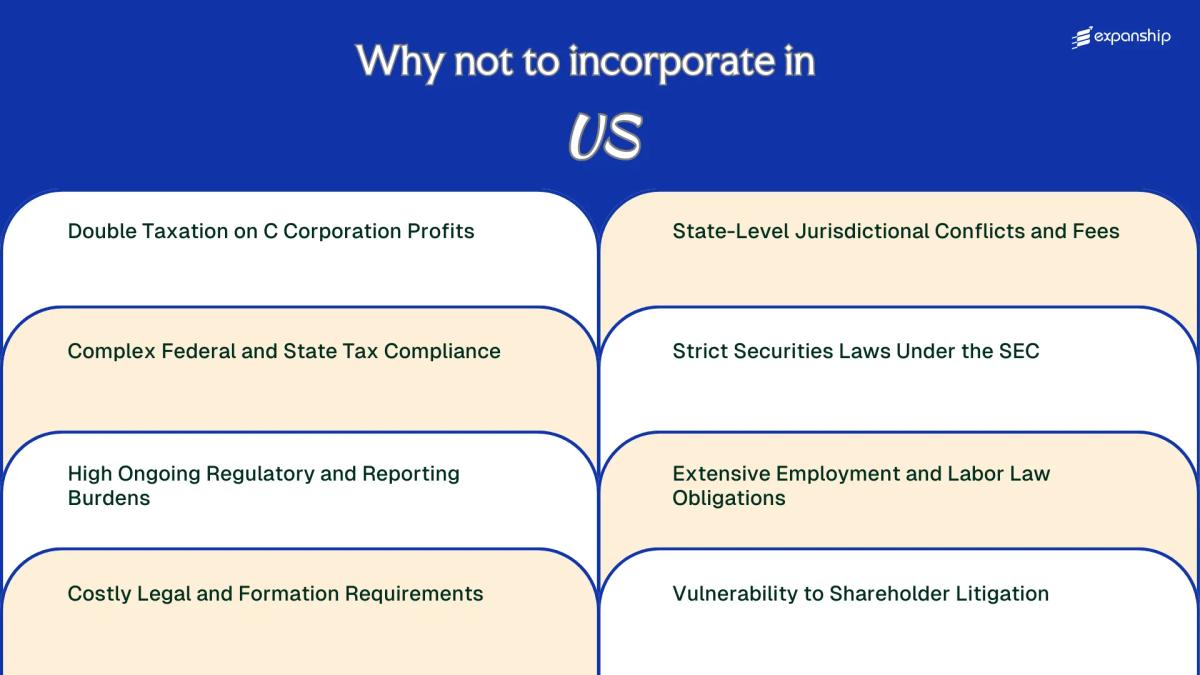
Double Taxation on C Corporation Profits
The US C corporation double taxation problem is one of the most structurally punishing aspects of incorporating as a C corp. Profits are taxed twice before reaching shareholders, creating a layered tax burden that directly reduces what foreign investors actually receive.
Corporate-Level Taxation Under IRC Section 11
Under the Internal Revenue Code, a C corporation pays federal income tax on its net profits at a flat 21% rate, established by the Tax Cuts and Jobs Act of 2017. That rate applies before any distribution is made, meaning retained earnings are already reduced before shareholders see a cent.
When the corporation then distributes those after-tax profits as dividends, shareholders pay a second round of tax, either at the qualified dividend rate of up to 20% or at ordinary income rates, depending on their holding period and income bracket.
The Compounding Impact on Foreign Shareholders
Foreign shareholders face an additional layer: a 30% withholding tax on dividends under IRC Section 1441, though applicable tax treaties may reduce this rate. For a foreign business owner without an applicable treaty, the combined effective tax rate across corporate and shareholder levels can exceed 60% of original profits.
S corporation or LLC structures avoid this dual-taxation mechanism through pass-through treatment, but those entity types carry ownership restrictions that often disqualify non-resident foreign nationals entirely.
Foreign shareholders without an applicable US tax treaty may face a combined effective tax burden exceeding 60% of C corporation profits before repatriation is complete.
Complex Federal and State Tax Compliance
The US federal and state tax compliance burden on corporations is structural, not incidental. A C Corporation must file Form 1120 with the IRS annually, calculate estimated quarterly tax payments, and maintain records that satisfy federal audit standards. For a foreign-owned entity, this creates immediate costs in accounting infrastructure before a single dollar of revenue is earned.
Each state where your business has "nexus" — a sales, payroll, or property presence — triggers separate filing obligations. Some states impose franchise taxes, others use gross receipts taxes, and several apply their own definitions of taxable income that diverge from federal rules.
The practical friction this creates includes:
- Reconciling state-specific depreciation schedules that differ from federal MACRS rules, requiring parallel bookkeeping systems
- Tracking nexus thresholds across multiple states, where a single sales representative can trigger a filing obligation
- Managing apportionment formulas that vary by state, forcing allocation of income across jurisdictions using different weighting methods
- Paying for state-registered agents and local tax counsel in each state where the firm operates
Smaller foreign-owned firms rarely anticipate that the complexity of US corporate tax filing multiplies with each additional state of operation. IRS compliance challenges for corporations also extend to transfer pricing documentation requirements under IRC Section 482 when transactions occur between related foreign entities.

Company Incorporation in the United States
Understand the full compliance requirements before incorporating a US entity, including federal and multi-state tax obligations.
High Ongoing Regulatory and Reporting Burdens
US corporation ongoing reporting requirements extend well beyond a one-time filing. Once incorporated, your entity faces a permanent calendar of federal, state, and in some cases local obligations that collectively demand significant time and professional resources to maintain.
Publicly traded companies fall under the Securities and Exchange Commission's continuous disclosure regime, which includes annual Form 10-K filings, quarterly Form 10-Q reports, and event-driven Form 8-K submissions. Even private companies registered in states like Delaware or California must file annual reports and pay franchise taxes regardless of whether the business generated any revenue that year.
| Obligation | Governing Body / Law | Frequency | Burden for Foreign Owners |
|---|---|---|---|
| Annual Report Filing | State Secretary of State | Annually | Required in every state where registered |
| Federal Corporate Tax Return (Form 1120) | IRS / Internal Revenue Code | Annually | Mandatory even with zero US revenue |
| Foreign Bank Account Reporting (FBAR) | FinCEN / BSA | Annually | Applies to non-US accounts exceeding $10,000 |
| Beneficial Ownership Reporting | FinCEN / Corporate Transparency Act | One-time + updates | New requirement; non-compliance carries criminal penalties |
| State Franchise Tax | State Revenue Authority | Annually | Due regardless of profitability |
The Corporate Transparency Act, which took effect in January 2024, added a new layer by requiring most incorporated entities to report beneficial ownership information to FinCEN. Failure to comply carries penalties of up to $591 per day, a threshold that scales quickly for foreign owners unfamiliar with the requirement.
Operating across multiple states multiplies these obligations. Each state where your business is "doing business" may require a separate foreign qualification filing, its own annual report, and independent tax registration.
Costly Legal and Formation Requirements
The high costs of US company formation extend well beyond a simple registration fee. Depending on the state of incorporation, filing fees alone can range from under $100 to over $500, but attorney fees for drafting foundational documents such as articles of incorporation, bylaws, or operating agreements routinely add several thousand dollars to the initial outlay.
Foreign business owners face additional expenses that domestic founders often avoid. Federal Employer Identification Number registration through the IRS is required before the entity can open a bank account or hire staff, and obtaining one from outside the country historically required a paper application process, creating delays that stall operations.
Registered agent services are legally mandatory in every US state for foreign-registered entities. This generates a recurring annual cost, typically between $100 and $300 per state, that compounds if your firm operates across multiple jurisdictions.
- Each state imposes its own formation and annual report fees, which are non-negotiable regardless of revenue or activity level.
- Legal counsel is effectively required to draft compliant organizational documents, particularly for corporations issuing shares.
- Foreign entities must appoint and maintain a registered agent in each state of operation, at continuous cost.
- An EIN from the IRS is a prerequisite for most banking and tax functions, and the process differs for non-resident applicants.
Even a single-member LLC with no employees and zero US revenue may still owe state minimum franchise taxes annually, regardless of whether the business conducted any activity in that state.
State-Level Jurisdictional Conflicts and Fees
US state jurisdictional conflicts and fees create a layered compliance burden that compounds as your business expands beyond its home state.
The Mechanics of Multi-State Registration
Operating in a state where your entity was not incorporated triggers a foreign qualification requirement under that state's statutes. Each state charges its own filing fees, imposes its own annual report obligations, and may subject your company to separate franchise or privilege taxes, regardless of whether your firm turns a profit there.
Delaware charges $50 for foreign qualification, while California's Secretary of State charges $100 plus a minimum $800 franchise tax from the first year of doing business in the state. Maintaining registered agents in each state adds recurring annual costs on top of these fees.
Why This Burdens Foreign-Owned Entities Specifically
For a foreign business owner managing multiple state registrations, compliance calendars fragment across dozens of independent regulatory deadlines with no federal harmonization mechanism. Missing a single annual report filing can result in administrative dissolution or penalties under the relevant state's business corporation act.
Some states apply economic nexus thresholds that trigger registration obligations even without a physical presence, meaning your entity may face unexpected compliance exposure as revenue grows.
Managing Multi-State Registration Challenges in the United States
Operating across multiple US states creates overlapping filing obligations, recurring fees, and compliance deadlines that vary by jurisdiction. Expanship can help you assess your registration exposure and manage ongoing state-level requirements.
Strict Securities Laws Under the SEC
SEC securities law restrictions on US corporations extend well beyond public companies. Any business that raises capital from investors, even through private placements, must contend with Securities Act of 1933 exemptions, Regulation D filing requirements, and ongoing SEC oversight that adds legal cost and procedural complexity from the outset.
- Selling securities without registering under the Securities Act of 1933 or qualifying for an exemption such as Regulation D exposes your firm to federal enforcement action, including disgorgement of funds and civil penalties.
- Regulation D Rule 506(b) restricts general solicitation, limiting how your business can market investment opportunities to potential backers.
- Foreign founders who trigger SEC reporting thresholds face Exchange Act obligations, including Forms 10-K and 10-Q, requiring ongoing disclosure infrastructure that is both expensive and technically demanding.
- The SEC's whistleblower program under Dodd-Frank Act Section 21F incentivizes internal reporting, increasing the likelihood that any compliance gap will result in a formal investigation.
- State-level "Blue Sky" securities laws add a parallel layer of registration or exemption filings that vary by state, compounding the federal compliance burden.
Extensive Employment and Labor Law Obligations
US employment law obligations for corporations extend across multiple federal statutes, each enforced by a separate regulatory body with independent audit and litigation authority. A foreign business owner hiring even a single employee triggers a web of federal requirements before the first paycheck is issued.
The Fair Labor Standards Act (FLSA) mandates minimum wage, overtime pay at 1.5 times the regular rate for hours exceeding 40 per week, and strict recordkeeping standards. Non-compliance carries back pay liability plus an equal amount in liquidated damages.
The Equal Employment Opportunity Commission (EEOC) enforces Title VII of the Civil Rights Act, the Americans with Disabilities Act, and the Age Discrimination in Employment Act. Each statute carries its own filing procedures, response timelines, and potential civil liability.
Firms with 50 or more employees face additional obligations under the Family and Medical Leave Act (FMLA), and those with 100 or more must file annual EEO-1 demographic reports with the EEOC. Smaller headcounts reduce some federal thresholds, but state-level equivalents often apply at lower employee counts.
A foreign-owned corporation with 15 employees in California would face simultaneous obligations under federal FLSA and EEOC requirements, California's Fair Employment and Housing Act (FEHA), the California Family Rights Act, and state-mandated paid sick leave — requiring either a dedicated HR compliance function or ongoing outside counsel, conservatively estimated at $15,000–$30,000 annually before any litigation exposure.
Vulnerability to Shareholder Litigation
Shareholder litigation risks US corporations face are structurally embedded in state corporate law, particularly in Delaware, where a significant share of American corporations are registered. Under Delaware General Corporation Law, shareholders can file derivative lawsuits on behalf of a corporation against directors or officers for alleged breaches of fiduciary duty. For a foreign business owner, this creates personal legal exposure that may not exist under the corporate law of their home jurisdiction.
Class action mechanisms under Federal Rule of Civil Procedure 23 allow shareholders to aggregate claims, dramatically increasing the scale and cost of any dispute. Securities fraud class actions, often filed in federal court under Rule 10b-5 of the Securities Exchange Act of 1934, can be initiated with relatively low procedural barriers compared to many other legal systems.
Litigation costs in the US are notoriously high, and legal fees alone, absent a settlement, can reach millions of dollars. Even a claim that is ultimately dismissed imposes substantial defense costs on the entity.
- Derivative suits require shareholders to first make a demand on the board, but courts can waive this under the "demand futility" doctrine
- Minority shareholders hold meaningful standing to sue, regardless of their ownership percentage
If your corporation is incorporated in a US state, foreign ownership does not exempt directors or officers from personal liability under state fiduciary duty law or federal securities regulations.
Overcoming These Incorporation Challenges
Overcoming these challenges requires structural decisions made at the formation stage, not adjustments applied after problems arise.
- Elect S corporation status with the IRS to eliminate entity-level federal income tax and avoid C corporation double taxation on distributed profits.
- Register only in your primary operating state to reduce multi-state franchise tax exposure and conflicting foreign qualification fee obligations.
- File a Regulation D exemption with the SEC before any private securities offering to remain outside full public registration requirements.
- Adopt a written employment policy manual aligned with the Fair Labor Standards Act and applicable state wage laws before hiring any staff.
- Establish corporate governance documents, including bylaws and shareholder agreements, that include indemnification provisions and dispute resolution clauses at formation.
- Maintain a registered agent and calendar all state annual report deadlines to avoid administrative dissolution under state corporate statutes.
Each of these steps operates within a federal-state regulatory structure that does not permit informal workarounds. Structural compliance, applied consistently, is the only reliable method of managing ongoing obligations.
The US Still a Viable Option
Despite the disadvantages covered in this blog, is incorporating in the US still worth it for a foreign business? For many, the answer depends on a clear-eyed assessment of the tradeoffs. Access to the world's largest consumer market, deep capital markets, and a mature legal system continue to draw foreign founders to Delaware, Wyoming, and other formation-friendly states.
| Pros | Cons |
|---|---|
| Delaware and Wyoming offer flexible corporate statutes and well-established case law. | C Corporations face double taxation at both the federal corporate rate and the shareholder dividend level. |
| The US legal system provides predictable contract enforcement and property rights. | Federal and state tax compliance requires navigating overlapping obligations across multiple agencies, including the IRS. |
| Access to US venture capital and public markets through SEC-registered offerings is broadly available. | SEC registration and ongoing disclosure requirements carry substantial legal and administrative costs. |
| Incorporation can typically be completed at the state level within days. | Foreign-qualified entities operating in multiple states face separate registration fees and franchise tax obligations in each state. |
| US entities can sponsor employee visas and access a large domestic labor pool. | Federal and state employment laws impose layered obligations around wages, benefits, classification, and termination. |
Shareholder litigation exposure and the cost of maintaining ongoing compliance add recurring financial pressure that compounds over time.
Corporate Compliance Services for US Companies
Maintain your US entity in good standing across federal and state requirements, from annual reports and registered agent obligations to tax filings and regulatory submissions.
Conclusion
The cons of US incorporation summary are clear: operating through an American entity carries a compliance burden that many businesses underestimate before formation. Double taxation at the C corporation level, combined with layered federal and state filing obligations enforced by bodies such as the IRS and individual state revenue agencies, creates sustained administrative cost. Shareholder litigation exposure adds further financial risk. For businesses weighing these disadvantages of forming a company in the United States, professional guidance specific to your structure, state of incorporation, and industry sector will determine how manageable those obligations ultimately become.
Expanship's US Expansion Support Services
Incorporating in the US brings well-documented compliance demands, from SEC registration thresholds and state-by-state franchise tax obligations to federal employment law requirements that activate the moment you hire. Expanship's US business expansion support services are structured around the specific operational weight these obligations create, helping your business stay on track without absorbing the full administrative load internally.
Our team works across the full formation and maintenance cycle. Services include:
- Preparing and filing incorporation documents with the relevant state authority on your behalf
- Providing a registered agent and office address to satisfy state residency requirements
- Liaising with government bodies, including the IRS and state agencies, for filings and correspondence
- Managing post-incorporation compliance obligations such as annual reports and renewals
- Introducing your business to banking partners familiar with foreign-owned US entities
- Handling federal and state tax registrations, including EIN applications and sales tax setup
Reach out to Expanship US to discuss how we can support your incorporation process.
Frequently Asked Questions (FAQ)
The Securities and Exchange Commission's full reporting obligations apply primarily to publicly traded companies, but private firms are not exempt from federal securities law. Any private company that issues securities — including equity offered to investors — must comply with the Securities Act of 1933, which requires either registration or a valid exemption such as Regulation D. Non-compliance can result in rescission rights for investors and civil or criminal liability for company officers.
Penalties vary by state but typically include late fees, interest on unpaid taxes, and administrative dissolution of the entity. In Delaware, for example, a corporation that fails to pay its franchise tax loses its good standing, which can invalidate contracts and block financing. Reinstatement requires paying all outstanding taxes, penalties, and fees before the state restores the company's active status.
The US has one of the most plaintiff-friendly corporate litigation environments in the world. Class action lawsuits under federal securities laws, including the Securities Exchange Act of 1934, allow shareholders to sue directors and officers for alleged misrepresentation or breach of fiduciary duty, and contingency-fee arrangements mean plaintiffs face little financial barrier to filing. Comparable jurisdictions like the UK or Singapore have higher procedural thresholds and cost-shifting rules that significantly reduce frivolous litigation.
Annual compliance costs for a foreign-owned C Corporation commonly run between $5,000 and $20,000 or more, depending on the number of states in which the entity operates and the complexity of its activity. This figure covers registered agent fees, state annual reports, federal and state tax filings, and any required Foreign Bank Account Reports under the Bank Secrecy Act if the entity holds foreign financial accounts. Legal counsel for corporate governance, contracts, and employment matters adds further cost on top of that baseline.
Only registering in one state does not shield a foreign-owned business from tax obligations in other states where it conducts business. If your company has employees, property, or sufficient sales in a state, that state may assert nexus and require registration, tax filings, and payment of state corporate income or franchise tax — a standard reinforced by the Supreme Court's 2018 ruling in South Dakota v. Wayfair, which broadened economic nexus standards. Operating across multiple states without registering in each one exposes the company to back taxes, interest, and penalties.
Non-compliance with the Fair Labor Standards Act can result in back pay liability, liquidated damages equal to the unpaid amount, and civil penalties enforced by the Department of Labor's Wage and Hour Division. The Family and Medical Leave Act adds a separate layer of exposure, with employees able to sue for lost wages, benefits, and additional liquidated damages if leave rights are denied. These liabilities are not capped in a straightforward way, meaning a single enforcement action can produce costs that far exceed the cost of initial compliance.
Using a shelf company or nominee arrangement does not eliminate the underlying compliance obligations and introduces its own risks. Under the Corporate Transparency Act, which took effect in January 2024, most US entities are required to file beneficial ownership information with the Financial Crimes Enforcement Network, making nominee structures legally transparent and potentially subject to penalties if used to obscure true ownership. Formation shortcuts that reduce upfront costs typically increase long-term legal exposure rather than reduce it.
Legal Disclaimer
The information provided in this article is for general informational purposes only and does not constitute legal, tax, or professional advice. While we strive to ensure the accuracy and timeliness of the content, laws and regulations are subject to change, and the application of laws can vary widely based on specific facts and circumstances.
Readers should not act upon this information without seeking professional counsel tailored to their individual situation. Expanship and its authors disclaim any liability for actions taken or not taken based on the content of this article.
For specific advice regarding your business setup, compliance requirements, or any legal matters, please consult with qualified legal and tax professionals in the relevant jurisdiction.