
Key Takeaways
- Foreign founders structuring through a US LLC benefit from pass-through taxation under the Internal Revenue Code, meaning business income is taxed only at the individual level and avoids the double taxation applied to C-Corporation distributions.
- Delaware's Court of Chancery and Wyoming's privacy provisions give international incorporators meaningful state-level options for controlling how capital is structured and how ownership information is disclosed.
- The United States maintains tax treaties with over 60 countries, directly shaping how cross-border income is classified and reducing withholding exposure for foreign founders operating through a US entity.
- Institutional investors operating under Securities and Exchange Commission oversight expect the C-Corporation structure, which means choosing that vehicle reduces friction when raising venture capital from US-based funds.
Incorporating a business in the United States places your entity within a federal republic composed of 50 states, each functioning as a distinct regulatory environment under a unified national legal framework. Company registration is administered at the state level, with each state maintaining its own filing authority — the Secretary of State office being the most common point of registration across jurisdictions. For foreign founders, the LLC and C-Corporation are the most frequently used vehicles for establishing a legal presence.
From a tax standpoint, the federal system operates on a residence-and-source basis, with treaty networks covering over 60 countries that affect how cross-border income is treated. Foreign nationals face no ownership restrictions in most entity types, and the country ranks consistently among the top destinations for foreign direct investment, reflecting an open and largely unrestricted entry environment for international capital.
This article examines the concrete advantages your business gains through US company formation — from structural flexibility to investor access and intellectual property enforcement.
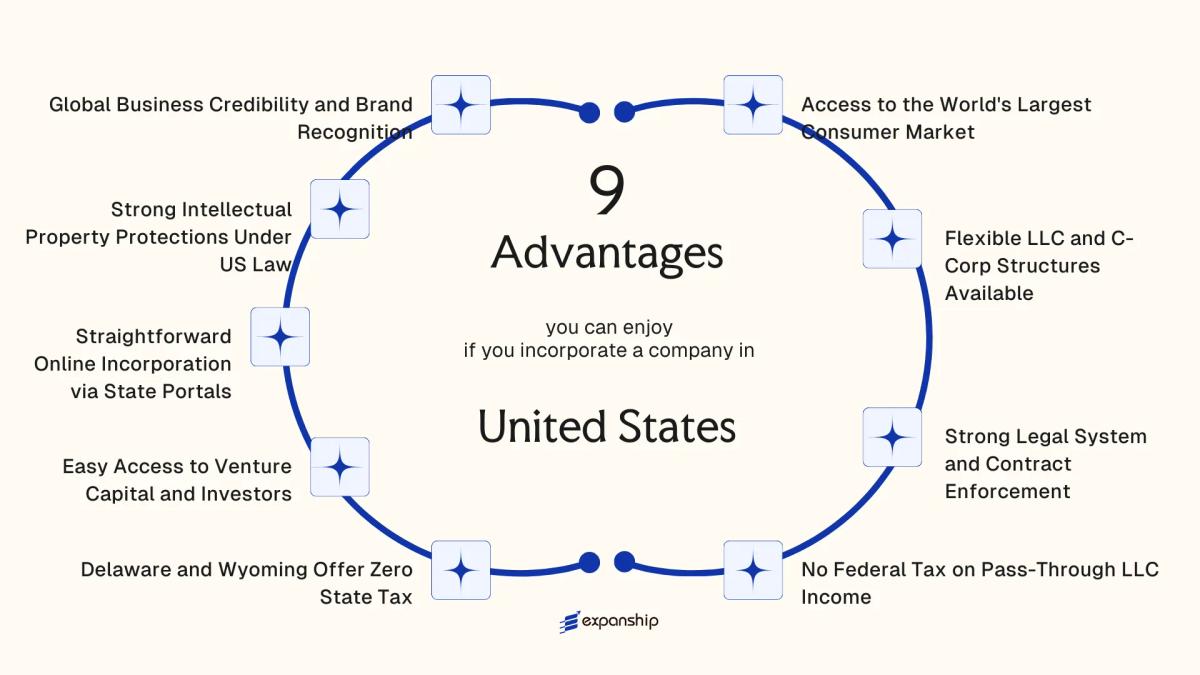
Access to the World's Largest Consumer Market
The US consumer market generates over $18 trillion in annual personal consumption expenditure, according to Bureau of Economic Analysis data. For a foreign business seeking US market access benefits, incorporating domestically removes a significant layer of friction that cross-border selling typically imposes.
Selling Directly Into the Market You're Targeting
A US-registered entity can enter into contracts, hold inventory, and collect payments under American commercial law without routing transactions through a foreign parent structure. This matters because US retailers, distributors, and enterprise buyers routinely require a domestic counterparty before engaging in supplier agreements.
What Local Incorporation Changes for Revenue Access
Platforms such as Amazon, Stripe, and major wholesale networks impose residency or domestic entity requirements to access full seller functionality and payment processing. A registered US company, whether a Delaware C-Corp or a Wyoming LLC, satisfies those requirements and places your business on equal footing with domestic competitors.
One condition applies: foreign-owned entities must obtain an Employer Identification Number (EIN) from the IRS to open business bank accounts and process domestic payroll or payments.
A US-registered entity lets you sell, contract, and collect revenue domestically without the restrictions placed on foreign companies operating from outside the country.
Flexible LLC and C-Corp Structures Available
Both the LLC and C-Corp are creatures of state law, yet they operate within a federal framework that gives foreign investors predictable, well-documented rules rather than discretionary administrative processes. That combination is central to understanding US LLC and C-Corp structure benefits.
LLCs are governed by individual state statutes, most notably the Delaware Limited Liability Company Act (6 Del. C. § 18-101 et seq.) and Wyoming's LLC Act. Both allow substantial flexibility in drafting the operating agreement, meaning members can define profit allocations, management authority, and voting rights in ways that deviate from default statutory rules. For a foreign investor structuring equity arrangements across multiple parties, this contractual freedom reduces reliance on rigid statutory defaults.
C-Corporations, by contrast, follow a more standardized model that institutional investors and venture firms recognize immediately. Shares are divisible into multiple classes, and authorized share structures can be tailored to accommodate preferred stock, convertible instruments, and option pools.
Several structural features make both entity types accessible to non-US owners:
- No federal restriction prevents a foreign national from holding 100% ownership in an LLC or C-Corp
- Neither entity type requires a US-resident director or manager at the federal level
- Operating agreements and corporate bylaws are private documents, not public filings
- Both structures can be formed without minimum capital requirements under state law

Company Incorporation in the United States
Form a US LLC or C-Corp with Expanship's guided incorporation service across all major states.
Strong Legal System and Contract Enforcement
The US legal system benefits for businesses stem largely from a foundation that has been tested, interpreted, and refined over centuries of commercial activity. Federal courts, combined with well-developed state court systems, apply common law principles that place significant weight on prior judicial decisions. For a foreign business owner, this means contract disputes are resolved against a predictable body of case law rather than arbitrary administrative discretion.
Contract enforcement advantages in the United States are reinforced by the Uniform Commercial Code (UCC), which governs commercial transactions across most states. When your firm enters a supply agreement, licensing deal, or service contract, the UCC provides a standardized framework for interpreting obligations and remedies. Courts regularly enforce liquidated damages clauses, arbitration provisions, and choice-of-law terms, giving parties meaningful control over how disputes are handled before they arise.
| Framework | Scope | Practical Relevance |
|---|---|---|
| Uniform Commercial Code (UCC) | Commercial sales and transactions | Standardizes contract terms across states |
| Federal Arbitration Act (FAA) | Arbitration agreements | Ensures arbitration clauses are enforceable in federal and state courts |
| Restatement (Second) of Contracts | Contract interpretation | Guides courts on obligations, breach, and remedies |
US common law business protections extend to intellectual property assignments, non-compete enforceability, and shareholder agreements, though state-level variations apply. Delaware's Court of Chancery, for example, handles corporate disputes without jury trials, producing commercially sophisticated rulings on governance matters. That specialization gives entities incorporated there access to a judiciary experienced in complex commercial litigation, which directly reduces legal uncertainty for cross-border investors.
No Federal Tax on Pass-Through LLC Income
One of the most significant US LLC pass-through taxation benefits is that the entity itself pays no federal income tax. Under the Internal Revenue Code, a single-member LLC is treated as a disregarded entity, while a multi-member LLC defaults to partnership taxation. In both cases, profits pass directly to the members, who report income on their personal returns.
For a foreign business owner, this eliminates a layer of taxation that exists in many corporate structures elsewhere. A standard C-Corp, by contrast, faces a 21% federal corporate tax rate under the Tax Cuts and Jobs Act before any distributions are made.
Non-resident LLC members are generally subject to US tax only on income that is "effectively connected" with a US trade or business. Passive foreign members receiving certain categories of income may face withholding under the Foreign Investment in Real Property Tax Act or other provisions, so the tax profile depends on the nature of operations.
Keep these points in mind:
- LLC pass-through status is governed by IRS default classification rules, not a separate election
- Foreign members must still obtain an Individual Taxpayer Identification Number (ITIN) or Employer Identification Number (EIN)
- The IRS Form 1065 is required for multi-member LLCs regardless of tax liability
- Pass-through treatment does not automatically exempt foreign members from withholding obligations
A single-member LLC owned entirely by a foreign national with no US-sourced income may owe zero federal income tax, yet the entity remains fully valid and operational under US law.
Delaware and Wyoming Offer Zero State Tax
Two states drive most of the conversation around Delaware and Wyoming zero state tax benefits: Delaware and Wyoming. Both impose no state income tax on corporations or LLCs that conduct their business activities outside the state. For foreign-owned entities with no in-state operations, this structure eliminates an entire layer of taxation that would otherwise apply in most other US states.
Delaware's Franchise Tax Trade-Off
Delaware levies no corporate income tax on companies that are incorporated there but do not operate within its borders. The state does impose an annual franchise tax on corporations, calculated either by the Authorized Shares Method or the Assumed Par Value Capital Method, with the latter often producing a significantly lower figure for startups with high share counts. For a foreign founder, this means predictable, manageable annual costs rather than a percentage-based tax on revenue or profit.
Wyoming's Cleaner Tax Profile
Wyoming charges no corporate income tax and no personal income tax, making it a straightforward environment for LLC structures where income passes through to non-US owners. The Wyoming LLC no state income tax advantage is particularly relevant when combined with the federal tax position of a foreign-owned single-member LLC, which may have no US tax liability if the business generates no effectively connected income. Wyoming also imposes no franchise tax on LLCs, which reduces the fixed annual compliance cost compared to Delaware.
State-level tax treatment does not override federal obligations under the Internal Revenue Code, and your specific tax position depends on the nature and source of your business income.
Understand Your Tax Position Before You Incorporate in the US
Expanship can walk you through how Delaware and Wyoming state tax rules apply to your specific ownership structure and business model before you make a formation decision.
Easy Access to Venture Capital and Investors
US venture capital access benefits for startups are closely tied to one structural choice: forming a C-Corporation, typically in Delaware. Institutional investors, including venture capital firms and angel networks, strongly prefer the C-Corp because it supports multiple share classes, stock option plans under Section 422 of the Internal Revenue Code, and clean cap table mechanics that align with standard term sheet expectations.
- Delaware C-Corps allow the issuance of preferred stock with liquidation preferences, anti-dilution provisions, and voting rights structures that most VC term sheets require by default.
- The National Venture Capital Association publishes standardized model legal documents drafted specifically around Delaware corporate law, reducing legal costs and negotiation time during funding rounds.
- Your company can grant incentive stock options (ISOs) to employees and advisors under IRC Section 422, which carries favorable tax treatment and is a standard tool for attracting talent alongside equity financing.
- Y Combinator, Sequoia, Andreessen Horowitz, and most major US funds operate investment mandates that either require or default to Delaware C-Corps, meaning incorporating in another structure or jurisdiction can disqualify your firm from consideration before due diligence begins.
- Foreign founders are not excluded from forming a Delaware C-Corp or receiving VC investment, though visa status and CFIUS review may apply depending on the founder's nationality and business sector.
Straightforward Online Incorporation via State Portals
Most states process online incorporation filings within one to three business days, and several — including Delaware, Wyoming, and Florida — offer same-day or next-day approval through their official division of corporations portals. For a foreign business owner, this compresses what once required weeks of physical paperwork, notarization, and in-person appearances into a single digital submission. The US online incorporation benefits via state portals are particularly significant because no residency, physical presence, or in-country agent visit is required to complete the formation itself.
Your Articles of Incorporation or Articles of Organization are submitted directly through state-run portals such as Delaware's Division of Corporations filing system or Wyoming's Secretary of State Business Center. These are government platforms, not intermediaries, which means your filing status is legally traceable from submission to approval.
Filing fees are also fixed and publicly listed. Delaware charges $90 for a standard LLC, while Wyoming charges $100. These fees do not vary by business size or foreign ownership status.
A foreign founder incorporating a Wyoming LLC remotely pays a flat $100 state filing fee and can receive a confirmed, active entity within 24 hours through the Wyoming Secretary of State's expedited online service — with no attorney appearance or notarization required under Wyoming Stat. § 17-29-201.
Strong Intellectual Property Protections Under US Law
US intellectual property protection benefits stem from a federal legal framework that treats IP rights as enforceable property, not administrative privileges. Registration with the USPTO grants trademark owners nationwide priority from the filing date, which means a foreign business entering the market has a clear legal claim that preempts conflicting state-level uses.
Copyright protection attaches automatically at the moment of creation under the Copyright Act of 1976, but federal registration through the U.S. Copyright Office is required before initiating infringement litigation in federal court. That registration also unlocks statutory damages of up to $150,000 per willful infringement, removing the burden of proving actual losses.
Patent protection under the America Invents Act (AIA) follows a first-inventor-to-file system, giving your business a direct incentive to file early through the USPTO rather than rely on prior use.
- Trademarks registered with the USPTO can be recorded with U.S. Customs and Border Protection to block infringing imported goods at the border.
- The U.S. is a signatory to the Madrid Protocol, allowing a USPTO-registered mark to serve as the basis for international filing across 130+ member countries.
USPTO trademark registration requires active commercial use in U.S. interstate commerce, either before filing or within a set period after a Notice of Allowance.
Global Business Credibility and Brand Recognition
A US-registered entity signals institutional legitimacy to clients, suppliers, and financial institutions in ways that few other jurisdictions replicate. US incorporation global business credibility benefits are, in large part, structural: American corporate law is among the most studied and referenced in the world, and counterparties across Asia, Europe, and the Middle East are accustomed to contracting with US-registered firms.
Perception Among International Clients and Partners
A Delaware or Wyoming business address carries immediate recognition for procurement teams and enterprise clients that apply vendor screening processes. Many Fortune 500 companies have internal policies that favour or require contracting with entities incorporated in recognised jurisdictions, and the US consistently qualifies.
Banking and Payment Infrastructure Access
A US-incorporated entity can open accounts with major commercial banks and access payment processors, including Stripe, Braintree, and others, that restrict or exclude foreign-registered businesses. This access directly determines which markets and revenue channels your business can serve.
Domain and Digital Credibility Signals
Operating under a .com domain registered to a US business entity, combined with a US Employer Identification Number issued by the Internal Revenue Service, produces a verifiable identity trail that builds trust with online customers.
- A US address on contracts and invoices reduces friction during due diligence reviews
- EIN registration confirms the entity is recognised by a federal authority
- US-registered status satisfies compliance requirements on platforms like Amazon, Google Ads, and Shopify for certain seller and advertiser categories
Why the US Stands Out Against Other Incorporation Destinations
Comparing the US against other incorporation destinations commonly considered by foreign founders reveals a consistent pattern: the structural and legal features that make a US entity attractive are difficult to replicate elsewhere at the same scale. The competitors most worth examining are the United Kingdom, Singapore, and the Cayman Islands, each targeting a similar profile of internationally mobile businesses and investors.
What the comparison surfaces is not simply a difference in tax rates or filing fees, but a difference in what incorporation actually unlocks. A UK Ltd offers credibility and EU market adjacency, yet lacks the depth of US venture capital networks or the privacy protections available in states like Wyoming. Singapore's territorial tax system is competitive, but its smaller domestic market and distance from US dollar capital pools create structural limits for companies seeking American customers or institutional funding. The Cayman Islands suits holding structures and fund vehicles, though operating businesses registered there routinely incorporate a US entity as the primary commercial presence for contracting and banking purposes.
| Parameter | United States | United Kingdom | Singapore | Cayman Islands |
|---|---|---|---|---|
| Corporate Tax Rate | 21% federal (state varies) | 25% (main rate) | 17% | 0% (no corporate tax) |
| Pass-Through Taxation Available | Yes (LLC, S-Corp) | Limited (LLP only) | No direct equivalent | No |
| Venture Capital Ecosystem | Largest globally | Significant, London-focused | Regional hub | Minimal |
| Investor Recognition | Universally accepted | High | High in Asia-Pacific | Limited for operating companies |
| Privacy (Beneficial Ownership) | Strong in Wyoming, New Mexico | Public register mandatory | Partially public | Varies by structure |
| US Bank Account Access | Direct | Requires US nexus | Requires US nexus | Requires US nexus |
| Common Law Legal System | Yes | Yes | Yes (English-based) | Yes |
| Non-Resident Formation Permitted | Yes | Yes | Yes | Yes |
Compliance Services for US Companies
Maintain good standing with federal and state requirements, including annual reports, registered agent obligations, and tax filings.
Conclusion
The benefits of incorporating in the United States rest on a combination of structural, legal, and financial advantages that few other jurisdictions can match in aggregate. Access to pass-through taxation under the Internal Revenue Code, combined with state-level options like Delaware's Court of Chancery and Wyoming's privacy provisions, gives foreign founders a degree of flexibility that directly affects how capital is structured and retained.
Your choice of entity type shapes everything from investor eligibility to tax treatment. The C-Corporation remains the standard vehicle for venture-backed businesses precisely because it aligns with the expectations of institutional investors operating under Securities and Exchange Commission oversight. That alignment reduces friction at the point of raising capital, which is a material operational advantage.
Not every business will extract the same value from a US incorporation. A firm with no US-based customers, no interest in dollar-denominated investment, and strong intellectual property protections available domestically may find the fit less compelling. For businesses where market access, investor credibility, and enforceable contract law are priorities, the structural case holds.
The decision to incorporate is the starting point, not the endpoint. Maintaining compliance across federal and state requirements, including annual filings, registered agent obligations, and tax reporting under the Internal Revenue Service's rules, requires ongoing attention. The strength of the US framework only translates into a lasting advantage when that compliance infrastructure is properly managed from the outset.
Start Your US Company Formation With Expanship Today
US company formation with Expanship covers the full scope of what foreign founders and investors encounter when entering the American market — from selecting between a Delaware LLC or a C-Corporation to meeting ongoing compliance obligations with the Internal Revenue Service, the Securities and Exchange Commission where applicable, and individual state agencies. Each entity type discussed in this blog carries distinct filing, reporting, and tax treatment implications that Expanship manages on your behalf.
Incorporating in the United States through Expanship includes the following services:
- Registered agent and registered office provision in your chosen state
- Articles of Organization or Articles of Incorporation preparation and state portal filing
- EIN (Employer Identification Number) application with the IRS
- Apostille and document legalization where required for cross-border use
- Post-incorporation compliance management, including annual reports and state fee filings
- Banking introduction assistance to support your entity's operational setup
Expanship US business registration services are structured for founders who do not reside in the country and need a reliable local presence from day one. Non-resident directors and members face specific documentation requirements, and state registrars such as the Delaware Division of Corporations operate on defined filing standards that leave little room for incomplete submissions.
To discuss your incorporation requirements, contact Expanship US directly.
Frequently Asked Questions (FAQ)
A single-member LLC owned by a foreign individual is treated as a disregarded entity for federal income tax purposes by default, the same as it would be for a US owner, but additional reporting obligations apply. Foreign owners must file Form 5472 alongside a pro forma Form 1120 to disclose reportable transactions with related parties. Failure to file carries a penalty of $25,000 per form under the Internal Revenue Code.
Standard processing in Delaware typically takes one to three business days, while Wyoming's Secretary of State office can approve filings within a similar window under normal conditions. Both states offer expedited processing options for an additional fee, reducing turnaround to as little as one business day or, in Delaware's case, same-day service for certain filings. Timelines apply to state-level formation only and do not include obtaining a federal Employer Identification Number from the IRS, which is a separate process.
Neither Delaware nor Wyoming imposes a minimum capital contribution requirement to form an LLC or C-Corporation. Shares in a C-Corp can be issued at the par value stated in the Certificate of Incorporation, which Delaware permits to be set as low as $0.0001 per share. Practical considerations around operational funding are separate from the statutory formation requirements.
An LLC provides limited liability protection to its members under state law, meaning members are generally not personally responsible for the debts or legal judgments against the entity. This protection can be lost through a legal doctrine called "piercing the corporate veil," which courts may apply when the LLC is used as an extension of an individual's personal finances, lacks proper documentation, or fails to maintain separation between personal and business funds. Maintaining an operating agreement, separate bank accounts, and consistent compliance filings helps preserve that protection.
The US maintains an extensive network of bilateral income tax treaties that can reduce the standard 30% withholding tax rate applied to certain payments, including dividends and royalties, made to non-resident foreign persons. The applicable rate depends on the specific treaty between the US and the owner's country of residence, and not all countries have a treaty in force with the US. Treaty benefits are claimed by submitting the appropriate IRS Form W-8BEN or W-8BEN-E to the withholding agent.
A US-registered business can seek trademark protection through the United States Patent and Trademark Office, patent protection for inventions under Title 35 of the United States Code, and copyright protection administered through the US Copyright Office. Federal registration of a trademark grants nationwide priority rights and access to US federal courts for infringement claims. Trade secrets are protected at both federal level under the Defend Trade Secrets Act of 2016 and through individual state statutes, providing overlapping layers of legal recourse.
Delaware's Court of Chancery is a specialized court that adjudicates corporate and business disputes without a jury, relying instead on judges with deep expertise in corporate law. This structure produces more predictable outcomes in disputes involving shareholder rights, fiduciary duties, and contract enforcement, which is particularly relevant for foreign investors who may be unfamiliar with US litigation processes. The court's extensive body of precedent, built over more than a century, gives legal counsel and investors a reliable framework for assessing risk in transactions and governance matters.
Legal Disclaimer
The information provided in this article is for general informational purposes only and does not constitute legal, tax, or professional advice. While we strive to ensure the accuracy and timeliness of the content, laws and regulations are subject to change, and the application of laws can vary widely based on specific facts and circumstances.
Readers should not act upon this information without seeking professional counsel tailored to their individual situation. Expanship and its authors disclaim any liability for actions taken or not taken based on the content of this article.
For specific advice regarding your business setup, compliance requirements, or any legal matters, please consult with qualified legal and tax professionals in the relevant jurisdiction.