

Key Takeaways
- Under the Companies Act 2006, every UK private limited company must maintain a Person of Significant Control (PSC) register and update it whenever ownership or control structures change, making this an ongoing compliance obligation rather than a one-time formation requirement.
- Companies House will reject an incorporation application that does not satisfy all statutory requirements across director eligibility, registered office, share capital, and shareholder structure before the entity can legally operate.
- Foreign nationals appointing non-resident directors must ensure those individuals meet UK director eligibility rules, as there is no residency requirement but disqualification orders and age restrictions still apply.
- A UK registered office address must be a physical address in the same country of incorporation within the United Kingdom — England and Wales, Scotland, or Northern Ireland — and must be maintained throughout the company's existence, not only at the point of registration.
Company formation in Great Britain is governed by the Companies Act 2006, with Companies House serving as the statutory registrar responsible for incorporating and dissolving companies, as well as maintaining the public register of corporate entities.
UK company incorporation requirements span several distinct categories, from director eligibility and share capital to registered office obligations and beneficial ownership disclosure.
Failure to satisfy Companies House registration requirements will result in rejection of the incorporation application, and operating without proper registration exposes a business to civil and criminal liability under the Act.
Specific requirements differ depending on the entity type chosen, whether a private limited company, public limited company, or limited liability partnership, as well as the sector in which your business intends to operate.
This article is most relevant to non-resident founders, foreign-owned holding structures, and international investors establishing a UK-registered entity for the first time.
Minimum Share Capital Requirements in the United Kingdom

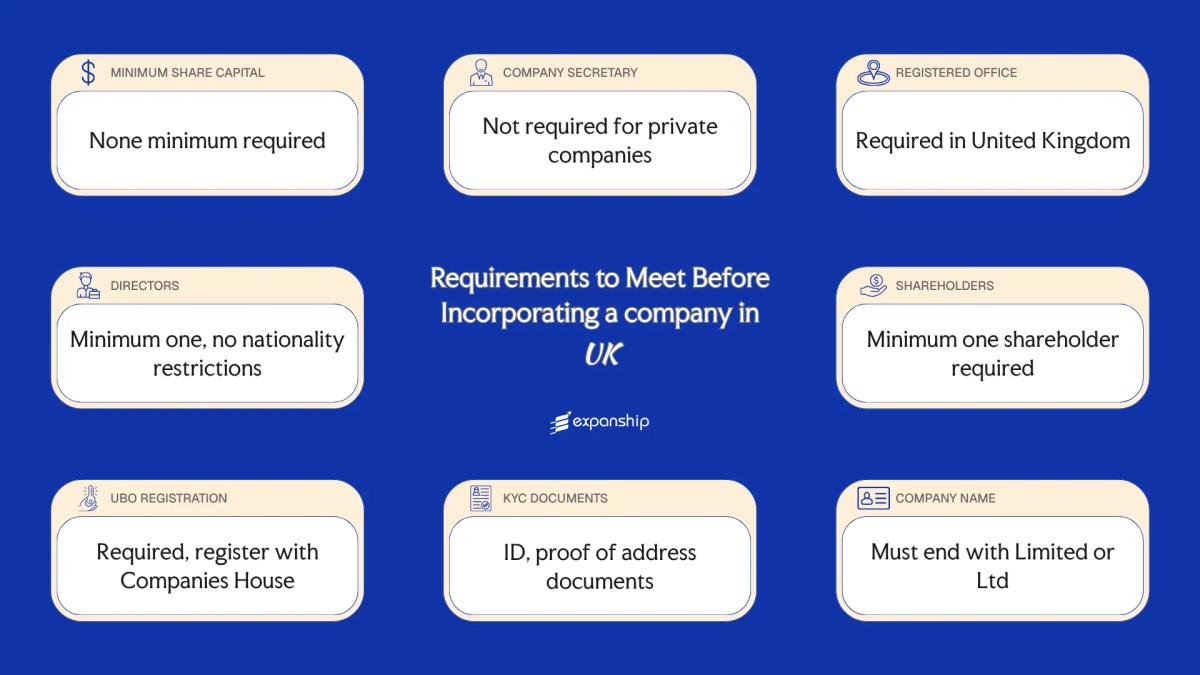
UK minimum share capital requirements for a private limited company (Ltd) are among the most permissive in any major economy. Under the Companies Act 2006, there is no statutory minimum authorized or paid-up capital, meaning a company can be incorporated with a single share of £0.01.
Shares in a UK Ltd are issued on a par value basis. Companies House, the executive agency of the Department for Business and Trade, processes incorporation filings and records the stated share capital, though it does not verify or enforce a minimum threshold at the point of registration.
| Parameter | Detail |
|---|---|
| Minimum Authorized Share Capital | No statutory requirement |
| Maximum Authorized Share Capital | No statutory requirement |
| Minimum Paid-Up Capital | No statutory requirement |
| Paid-Up Requirement at Incorporation | No statutory requirement |
| Accepted Currency | Pound Sterling (GBP); foreign currencies permitted |
| Accepted Forms of Contribution | Cash or non-cash consideration (assets, goodwill, intellectual property) |
| Timeframe to Deposit Capital | No statutory deadline |
No minimum capital requirement does not mean share capital structure is optional. Every UK company must still allot at least one share with a stated nominal value at incorporation, and this information must appear on the statement of capital filed with Companies House.
Company Secretary Requirements in the United Kingdom
Since 2006, private limited companies in the UK have not been legally required to appoint a company secretary. Under the Companies Act 2006, this obligation applies only to public limited companies, for which a qualified secretary remains mandatory.
For private firms that choose to appoint one voluntarily, the secretary carries defined responsibilities under company secretary rules United Kingdom governance frameworks, including maintaining statutory registers, filing confirmation statements, and ensuring documents are submitted to Companies House on time.
Qualification criteria for serving as a company secretary in a UK private or public limited company:
- There is no minimum age requirement beyond general legal capacity to act.
- A company secretary can be an individual or a corporate body.
- For public limited companies, the secretary must hold a recognised professional qualification or demonstrate relevant experience and knowledge.
- No residency requirement applies; the secretary does not need to be ordinarily resident in the UK.
- A sole director of a private company cannot simultaneously serve as the sole company secretary.

Incorporate a Company in the United Kingdom
Set up a UK private limited company with full support on statutory requirements, Companies House filings, and ongoing compliance.
Registered Office Requirements in the United Kingdom
Every company registered in England, Wales, Scotland, or Northern Ireland must maintain a UK registered office requirements-compliant address that falls within the same constituent nation where the entity was incorporated.
- A physical street address is required; PO boxes alone are not accepted by Companies House.
- Virtual office addresses are permitted, provided the service provider can receive and forward official correspondence at that address.
- The address must be located in the same constituent nation as the company's place of incorporation (e.g., a Scottish-registered firm must have a Scottish address).
- No ownership or lease in the company's name is required, but the address must be one where legal documents can be formally served.
- The registered office address is publicly listed on the Companies House register and is accessible to anyone.
- Any change of registered office address must be notified to Companies House via form AD01, and the change takes effect only upon registration.
- Failure to maintain a valid address can result in Companies House initiating compulsory strike-off proceedings under the Companies Act 2006.
Director Requirements in the United Kingdom

Under the Companies Act 2006, UK company director requirements establish that every appointed director assumes statutory duties including acting within their powers, promoting the success of the company, exercising reasonable care and skill, and avoiding conflicts of interest.
| Parameter | Detail |
|---|---|
| Minimum Number of Directors | A private limited company (Ltd) must have at least one director; a public limited company (PLC) requires a minimum of two. |
| Maximum Number of Directors | There is no statutory maximum; the number is typically governed by the company's articles of association. |
| Local/Resident Director Required | No statutory requirement exists for a UK-resident or domiciled director. |
| Nationality Restrictions | No nationality restrictions apply; directors of any nationality may be appointed. |
| Minimum Age Requirement | Directors must be at least 16 years of age at the time of appointment, as set out in the Companies Act 2006. |
| Corporate Directors Permitted | Corporate directors are permitted, though at least one director of a private company must be a natural person. |
| Director Must Be a Shareholder | No requirement exists for a director to hold shares in the company. |
| Publicly Listed on Registry | Director details, including name and correspondence address, are filed with Companies House and form part of the public register. |
| Disqualification Conditions | Under the Company Directors Disqualification Act 1986, a director may be disqualified for misconduct, persistent filing failures, or insolvency-related offences, for a period of up to 15 years. |
Despite being listed on the public Companies House register, a director can provide a service address instead of their residential address, keeping their home address from appearing on the public record.
Shareholder Requirements in the United Kingdom
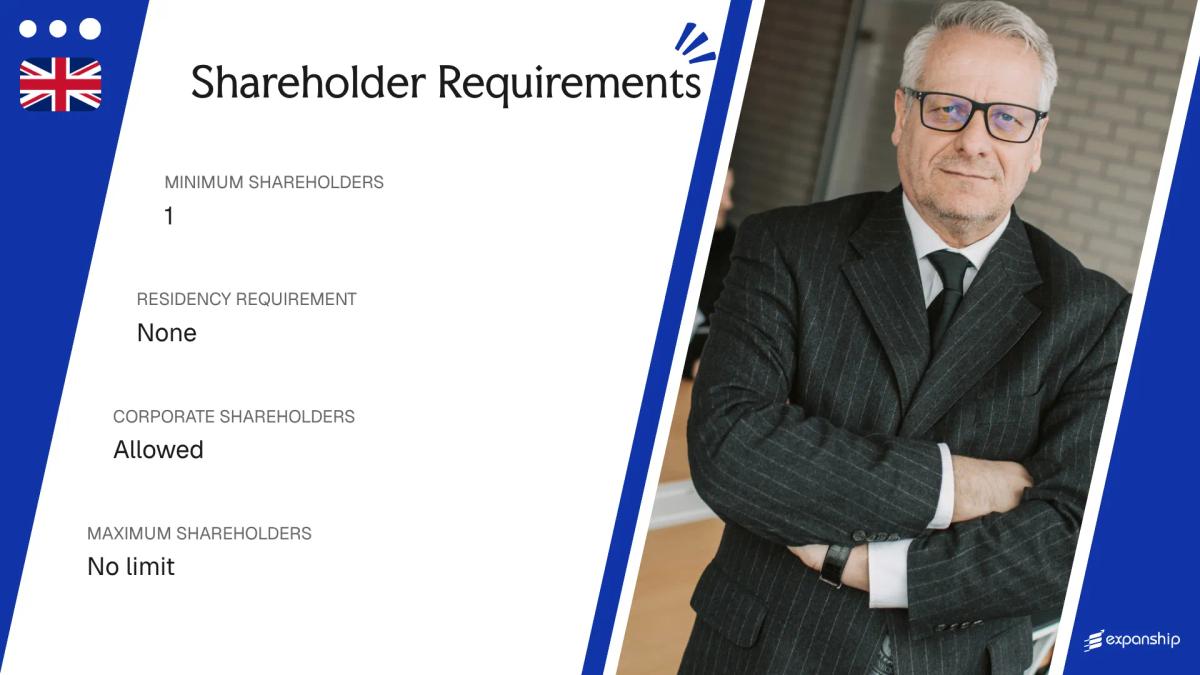
A private limited company (Ltd) registered under the Companies Act 2006 requires at least one shareholder. There is no statutory maximum for private companies, allowing structures ranging from a sole shareholder to hundreds of members.
Nationality and Residency Restrictions
UK company shareholder requirements impose no nationality or residency conditions on individual shareholders. Foreign nationals and overseas residents may hold shares in a private limited company without restriction on ownership percentage.
Corporate Shareholders
Corporate entities are permitted to act as shareholders in a private limited company. No special conditions are attached solely by virtue of the shareholder being a corporate body, though the entity must be capable of holding property under its governing law.
Shareholder Liability
Liability is limited to the amount unpaid on a member's shares. Outside of fraudulent trading or wrongful trading provisions under the Insolvency Act 1986, shareholders are not personally liable for company debts.
Register of Shareholders
Under the Companies Act 2006, every private limited company must maintain a register of members. Your business must keep this register either at its registered office or at an alternative inspection location notified to Companies House, and it must be updated to reflect any changes in membership.
Shareholder Structure Guidance for Your UK Company Formation
Get tailored advice on meeting shareholder criteria when setting up a private limited company in the United Kingdom.
UBO / Beneficial Ownership Registration Requirements in the United Kingdom
UK beneficial ownership registration requirements are governed by the Companies Act 2006, as amended by the Small Business, Enterprise and Employment Act 2015, which introduced the Persons with Significant Control (PSC) regime. A PSC is defined as any individual holding more than 25% of shares or voting rights, or who otherwise exercises significant influence or control over the entity.
- Identify all PSCs before or at the point of incorporation.
- Record each PSC's details in the company's internal PSC register within 14 days of incorporation.
- File PSC information with Companies House within 28 days using the confirmation statement or incorporation filing.
- Update the register within 14 days whenever a change in PSC status occurs, then notify Companies House within a further 14 days.
| Parameter | Detail |
|---|---|
| Ownership Threshold for UBO Status | More than 25% of shares or voting rights |
| Filing Authority | Companies House |
| Disclosure Deadline at Incorporation | Within 28 days of incorporation |
| Publicly Accessible Register | Yes, via the Companies House public register |
| Penalties for Non-Disclosure | Criminal offence; fines and potential imprisonment under the Companies Act 2006 |
| Ongoing Update Obligation | Within 14 days of any change to PSC details |
KYC / Document Requirements in the United Kingdom
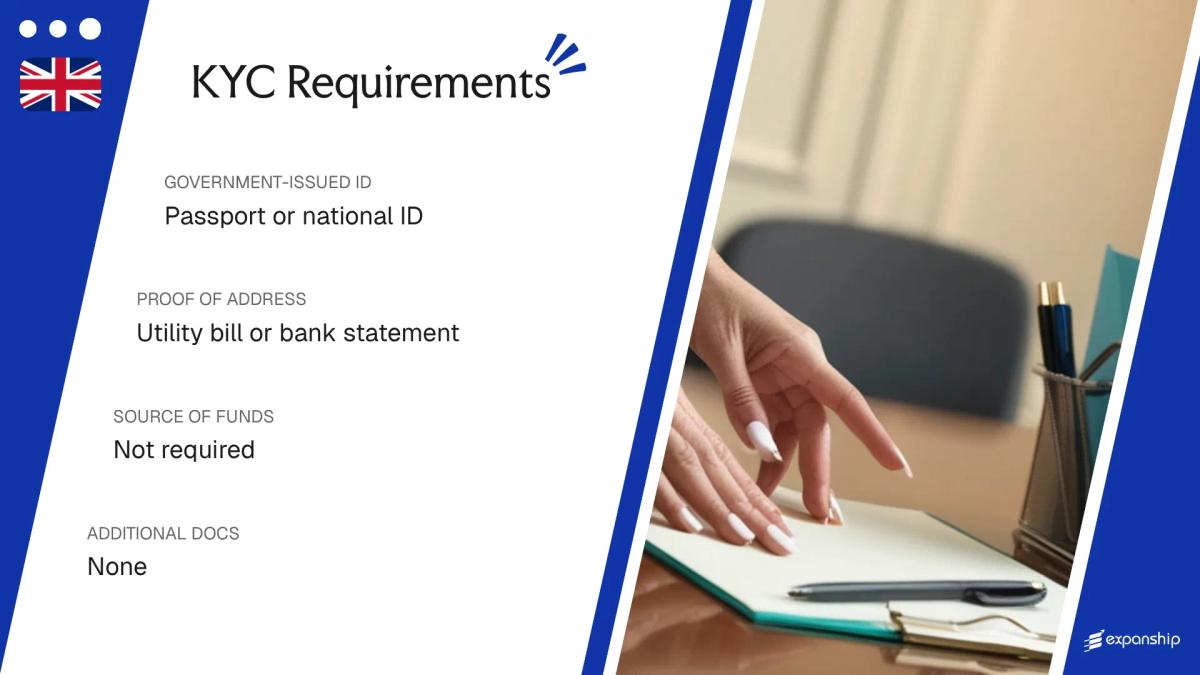
UK company formation KYC requirements are governed primarily by the Money Laundering, Terrorist Financing and Transfer of Funds (Information on the Payer) Regulations 2017, administered by HMRC as a supervisory authority for many formation agents. Collecting prescribed identity and source of funds documentation from all principals is a condition of compliant incorporation, not a discretionary step.
Individual / Personal Documents
- Valid government-issued photo ID (passport or national identity card) for each director, shareholder, and beneficial owner
- Proof of residential address dated within three months, such as a utility bill or bank statement
- For non-UK nationals, a copy of the relevant visa or right-to-reside documentation may be requested
- Full name, date of birth, and nationality details as they appear on official identity documents
Corporate Documents
- Certificate of incorporation for each corporate shareholder or director
- Constitutional documents, such as articles of association or equivalent instrument
- Current register of directors for the corporate entity
- Proof of the corporate entity's registered office address
Source of Funds Documentation
- Recent bank statements evidencing the capital being introduced
- Audited accounts or management accounts where the source is business revenue
- A signed declaration of source of funds may be required where bank evidence is insufficient
Notarisation and Apostille Requirements
- Documents originating outside the UK may require apostille certification under the Hague Convention 1961
- Official translations into English are required for any document not originally issued in English
- Notarisation requirements vary by formation agent; confirm the specific standard before submitting
Mismatched names between identity documents and the proposed incorporation details is the most common cause of rejection or delay at Companies House.
Company Name Requirements in the United Kingdom
All proposed company names submitted to Companies House are assessed against a set of statutory criteria before registration is approved. UK company name requirements are governed by the Companies Act 2006 and associated regulations, which grant the registrar authority to reject names deemed unacceptable.
Every private limited company must end with "Limited" or "Ltd," and public companies must use "Public Limited Company" or "PLC." Names must be in Latin alphabet characters, though certain symbols and punctuation are permissible under specific conditions.
Certain words require prior approval from a relevant government body or are prohibited outright. These include terms implying royal patronage, government affiliation, or regulated activity, such as "bank," "trust," or "insurance."
Name reservation is available through Companies House via an application to reserve a name for a limited period, typically 56 days, with the option to extend. The reservation is filed before incorporation to protect the chosen name while the business prepares its formation documents.
Compliance Services for Companies in the United Kingdom
Maintain your UK company's good standing with ongoing compliance support, from confirmation statements to statutory filing obligations.
Conclusion
Incorporating a private limited company under the Companies Act 2006 involves a defined set of UK company incorporation requirements administered by Companies House. Among the requirements covered, the PSC register stands out as a compliance obligation that extends well beyond the initial formation stage, requiring ongoing updates whenever ownership or control structures change. Director eligibility rules also carry weight, particularly for foreign nationals appointing non-resident directors. Once these requirements are understood, the practical focus shifts to preparing documentation, selecting a registered office address, and coordinating the filing process with Companies House.
Expanship's UK Company Formation Services
Expanship's UK company formation services cover the full scope of requirements that Companies House imposes on newly incorporated entities, from confirming your registered office address to preparing statutory documents that meet the Companies Act 2006 standards. Our role is to reduce the administrative load these obligations place on your team, particularly during the incorporation window when errors in filings can cause delays or rejections.
Beyond registration, we support your business across the wider compliance cycle.
- We prepare and file all incorporation documents with Companies House on your behalf.
- A registered office address is provided to satisfy the UK's statutory address requirements.
- We liaise with regulatory bodies and handle government filings as they arise.
- Ongoing post-incorporation compliance, including confirmation statements, is managed for your entity.
- Banking introduction assistance is available to help your business establish a UK account.
- We coordinate tax registration and liaise with HMRC on your behalf.
To discuss your requirements, contact Expanship United Kingdom.
Frequently Asked Questions (FAQ)
No residency or nationality requirement applies to directors of a UK private limited company under the Companies Act 2006. At least one director must be a natural person aged 16 or older, but that individual can be a foreign national living abroad. The sole restriction is that the person must not be disqualified from acting as a director under UK law.
Failure to maintain accurate PSC information is a criminal offence under the Companies Act 2006, and both the company and its officers can face prosecution. Convicted individuals may receive an unlimited fine or, in serious cases, a custodial sentence. Companies House can also annotate the register to flag non-compliance, which is publicly visible and can affect the firm's credibility with banks and counterparties.
Yes, a corporate entity registered outside the UK can hold shares in a UK private limited company without restriction. There is no requirement for any shareholder to be a UK resident or locally incorporated business. However, if that corporate shareholder meets the threshold for significant control, it must be disclosed on the PSC register as a relevant legal entity (RLE).
A company secretary is not legally required for a UK private limited company under the Companies Act 2006, though public limited companies (PLCs) must appoint one. Private companies that choose to appoint a secretary are not subject to formal qualification requirements, unlike PLCs where the secretary must meet specific professional criteria set out in the Act.
Companies House itself does not collect KYC documents such as passports or proof of address at the point of incorporation; the filing is made digitally through the IN01 form or via the online registration service. Identity verification obligations are being introduced under the Economic Crime and Corporate Transparency Act 2023, which will require directors and PSCs to verify their identity directly with Companies House. Until the relevant provisions are fully in force, KYC document collection remains primarily a requirement of the formation agent or bank rather than the registrar.
Several restrictions apply under the Companies Act 2006 and the Company, Limited Liability Partnership and Business (Names and Trading Disclosures) Regulations 2015. Names that are identical or too similar to an existing registered name will be rejected, and certain words such as "Royal", "Bank", or "Chartered" require prior approval from the relevant authority before use. Sensitive or misleading names that imply government affiliation or regulated status can also be refused by Companies House.
Legal Disclaimer
The information provided in this article is for general informational purposes only and does not constitute legal, tax, or professional advice. While we strive to ensure the accuracy and timeliness of the content, laws and regulations are subject to change, and the application of laws can vary widely based on specific facts and circumstances.
Readers should not act upon this information without seeking professional counsel tailored to their individual situation. Expanship and its authors disclaim any liability for actions taken or not taken based on the content of this article.
For specific advice regarding your business setup, compliance requirements, or any legal matters, please consult with qualified legal and tax professionals in the relevant jurisdiction.