

Key Takeaways
- Under the Companies Act 2006, directors of UK limited companies must have personal information — including service addresses and, in some cases, residential details — publicly accessible through the Companies House register, creating an ongoing disclosure burden with no opt-out for the underlying obligation.
- The UK corporation tax rate of 25% (applicable to profits above £250,000) places a measurable cost on mid-sized and larger businesses that may have structured their affairs around the previous 19% flat rate.
- Employers face National Insurance Contributions on top of gross salary costs, adding a recurring payroll liability that compounds as headcount grows and directly increases the cost of employment beyond the agreed wage.
- IR35 off-payroll working rules impose a compliance and reclassification risk on companies engaging contractors, requiring medium and large businesses to assess worker status and bear the associated tax liability where HMRC determines that a deemed employment relationship exists.
Incorporating under the Companies Act 2006 places your business within one of the world's more heavily regulated corporate environments, where statutory obligations begin at the point of registration and expand as the company grows. The disadvantages of incorporating in UK jurisdictions span tax, employment, disclosure, and compliance categories — each examined separately in this article.
Not every obligation will apply equally to all business types. A small private limited company faces a different compliance burden than a group structure with overseas subsidiaries or a firm operating in a regulated sector such as financial services.
Foreign investors and non-resident directors establishing a UK limited company are the audience most likely to encounter these drawbacks in their full weight, particularly those unfamiliar with HM Revenue & Customs requirements or Companies House procedures.
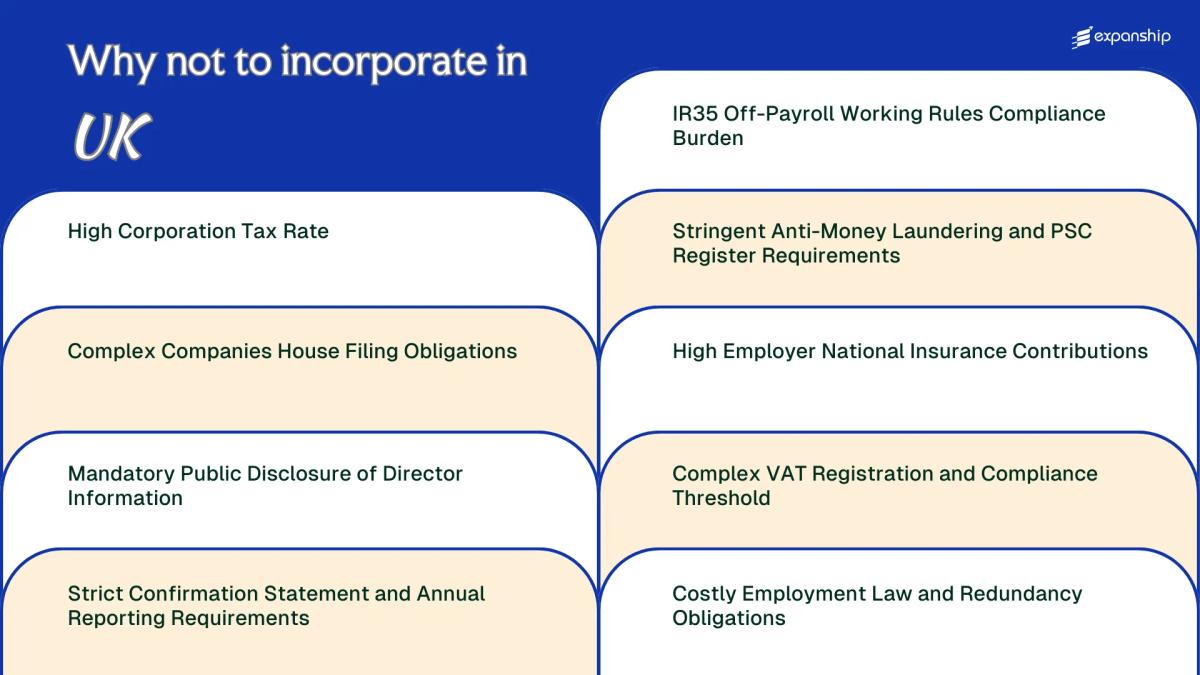
High Corporation Tax Rate
UK corporation tax rate drawbacks have become more pronounced since the rate increase took effect in April 2023, when the main rate rose from 19% to 25% for companies with profits above £250,000.
A Rate That Compounds Costs for Foreign Investors
The 25% main rate applies under the Corporation Tax Act 2010, and for foreign-owned subsidiaries repatriating profits, this rate directly reduces the capital available after withholding considerations. Small profit relief tapers the rate between £50,000 and £250,000, meaning many mid-size foreign entities still face an effective rate above 19%.
This marginal relief calculation adds administrative complexity that a foreign business owner must account for during financial planning.
What the 25% Corporation Tax UK Burden Means in Practice
Compared to Ireland's 12.5% standard rate for trading income, the 25% UK main rate represents a significant cost differential for holding structures or regional headquarters decisions. The UK corporate tax disadvantages for small businesses are particularly acute when combined with other obligatory costs.
A foreign-owned company distributing dividends to an overseas parent must also factor in the domestic rate before any treaty relief is applied.
Foreign business owners should model their effective tax position under the marginal relief taper before committing to a UK corporate structure, as the actual rate may exceed 19% even for businesses with modest profit levels.
Complex Companies House Filing Obligations
The Companies House filing obligations burden placed on UK private limited companies goes well beyond a simple annual return. Your company must file confirmation statements, statutory accounts, and any changes to officers or share structures as separate submissions, each with its own deadline and formatting requirements. Missing a deadline triggers automatic penalties under the Companies Act 2006.
Accounts must be prepared in a format acceptable to Companies House, and depending on your company's size, an audit may be required. For a foreign owner unfamiliar with UK accounting standards such as FRS 102 or FRS 105, this typically means mandatory engagement with a local accountant.
The filing burden creates specific friction points:
- Confirmation statement deadlines are separate from your accounts filing deadline, doubling your compliance calendar management
- Late accounts attract tiered penalties starting at £150 and rising to £1,500 for private companies, with separate penalties for consecutive late filings
- Overseas directors must ensure UK-specific signatory requirements are met, which creates coordination delays across time zones
- Any change to directors, shareholders, or the registered office requires a separate, timely notification to Companies House
Small company exemptions exist, but qualifying thresholds still require you to meet two of three financial criteria under the Companies Act 2006, limiting who actually benefits.

Company Incorporation in the United Kingdom
Set up your UK limited company with full support for Companies House filings, registered office requirements, and ongoing compliance obligations.
Mandatory Public Disclosure of Director Information
UK director information public disclosure risks are an immediate concern for founders who value personal privacy. Under the Companies Act 2006, every appointed director's full name, month and year of birth, nationality, country of residence, and service address must be filed with Companies House and made freely available on the public register. Anyone can search that register at no cost.
| Data Field | Publicly Visible | Who Can Access It |
|---|---|---|
| Full legal name | Yes | Anyone, no login required |
| Month and year of birth | Yes | Anyone, no login required |
| Country of residence | Yes | Anyone, no login required |
| Service address | Yes | Anyone, no login required |
| Residential address (if used as service address) | Yes | Anyone, no login required |
A residential address can be suppressed if a separate service address is provided, but even then, Companies House director details remain exposed at a level many foreign directors find uncomfortable. For high-profile individuals or those operating in politically sensitive environments, this level of visibility creates genuine personal security exposure.
The UK company director register drawbacks extend beyond privacy. Competitors, litigants, and data brokers routinely harvest this information. There is no mechanism to restrict access based on the requester's identity or purpose, meaning your personal details are accessible globally and indefinitely once filed.
Strict Confirmation Statement and Annual Reporting Requirements
The UK confirmation statement requirements burden falls on every private limited company, regardless of size or trading activity. Under the Companies Act 2006, each firm must file a confirmation statement with Companies House at least once every 12 months, confirming that all registered information is current and accurate.
Missing the deadline carries real consequences. Failure to file can result in Companies House initiating a strike-off process, which means your business could be dissolved even if it is otherwise solvent and trading.
For foreign directors managing entities remotely, this creates an ongoing administrative obligation that cannot be delegated away entirely. Someone with legal authority over the company must sign off on the filing, and that person remains personally accountable to the registrar.
- The confirmation statement must be filed within 14 days of the review period end date
- All changes to share capital, shareholder details, and registered office must be reflected before filing
- Annual accounts must be filed separately with Companies House and HMRC, creating parallel annual reporting obligations
- Dormant companies are not exempt from the confirmation statement requirement
- Late or missing filings remain on the public record and can affect the firm's credibility with banks and counterparties
A dormant UK company with zero transactions still faces the same annual filing obligations as an active trading entity, including both a confirmation statement and dormant company accounts.
IR35 Off-Payroll Working Rules Compliance Burden
Since April 2021, medium and large private-sector businesses engaging contractors through personal service companies must determine whether those contractors fall inside IR35 under the off-payroll working rules. This IR35 compliance burden sits directly with the hiring entity, not the contractor.
Scope of Liability Under Chapter 10, ITEPA 2003
Chapter 10 of the Income Tax (Earnings and Pensions) Act 2003 requires that your business issue a Status Determination Statement for each contractor engagement and accept formal challenge responses within 45 days. Errors in status determination expose your firm to unpaid PAYE income tax and National Insurance Contributions, which HMRC recovers from the fee-payer in the contractual chain.
Operational Cost for Foreign Entrants
For a foreign business entering the UK market without established HR or payroll infrastructure, building the internal processes to assess contractor status correctly represents a significant upfront cost. HMRC's Check Employment Status for Tax tool provides guidance but does not guarantee protection from reclassification during an audit. Small companies fall outside the Chapter 10 obligations, though that exemption disappears as the business scales beyond the Companies Act 2006 small company thresholds.
Managing IR35 and Off-Payroll Compliance in the United Kingdom
Understand how the off-payroll working rules affect your contractor engagements and what your UK entity is liable for under HMRC enforcement.
Stringent Anti-Money Laundering and PSC Register Requirements
UK PSC register compliance drawbacks extend well beyond a simple registration step, placing ongoing identification and disclosure obligations on every company incorporated under the Companies Act 2006.
- Under the PSC regime, your business must identify any individual holding more than 25% of shares or voting rights, exercising significant influence or control, and record that person in a statutory register maintained at your registered office before filing it publicly at Companies House.
- Foreign owners who hold shares through layered corporate structures must trace and disclose the ultimate beneficial owner, which often requires legal analysis of ownership chains across multiple jurisdictions.
- Anti-money laundering requirements under the Money Laundering, Terrorist Financing and Transfer of Funds Regulations 2017 mean that UK-regulated service providers, including accountants and company formation agents, must conduct ongoing due diligence on your entity.
- Failure to maintain an accurate PSC register is a criminal offence carrying personal liability for directors, not merely an administrative penalty.
- The PSC register is publicly searchable, meaning beneficial ownership information is accessible to anyone, with only limited exemptions available in cases of serious risk of harm.
High Employer National Insurance Contributions
The UK employer National Insurance contributions burden is one of the more direct payroll costs a foreign business owner will face when hiring in the country. Under the National Insurance Contributions Act 2014 and the Social Security Contributions and Benefits Act 1992, employers pay Class 1 secondary NICs on each employee's earnings above a threshold.
From April 2025, the employer NIC rate increased to 15%, applied on earnings above a reduced Secondary Threshold of £5,000 per year. This threshold reduction, announced in the October 2024 Autumn Budget, means more of each employee's salary is now subject to the charge.
For a foreign-owned firm building a local workforce, these high NIC costs represent a significant addition to headline salary costs. Hiring even a modest team pushes total employment costs materially above the agreed gross wage.
The Employment Allowance offers some relief, but its eligibility conditions and annual cap mean it does not meaningfully offset NIC exposure for larger payrolls or multi-director firms.
A business hiring five employees each on £40,000 annual salary would owe approximately £26,250 per year in employer NICs at 15% on earnings above £5,000, before any other payroll obligations are considered.
Complex VAT Registration and Compliance Threshold
UK VAT registration threshold challenges begin the moment your taxable turnover crosses £90,000 in any rolling 12-month period. At that point, registration with HMRC becomes mandatory, and the administrative obligations that follow are not trivial for a foreign-owned entity unfamiliar with the UK system.
Once registered, your business must file VAT returns, typically quarterly, through Making Tax Digital (MTD)-compatible software. MTD for VAT is not optional; HMRC requires all VAT-registered businesses to maintain digital records and submit returns via approved software, adding a recurring technology and accounting cost that many overseas operators underestimate.
The VAT compliance burden for a UK company compounds if your firm trades across multiple categories with different rates, such as standard-rated, zero-rated, and exempt supplies. Misclassification carries penalty risk under the VAT Act 1994, and HMRC audits can reach back up to four years.
- Reverse charge rules apply to certain B2B services received from overseas suppliers, creating additional reporting obligations.
- Partial exemption calculations are required if your firm makes both taxable and exempt supplies, requiring specialist input.
If your business is based outside the UK but sells goods or services to UK customers, the £90,000 registration threshold may not apply, and you may be required to register for VAT from the first sale.
Costly Employment Law and Redundancy Obligations
UK employment law redundancy obligations costs represent a significant structural burden for foreign-owned businesses, particularly those unaccustomed to statutory dismissal frameworks. Under the Employment Rights Act 1996, employees with two or more years of continuous service qualify for statutory redundancy pay, calculated by age band and length of service, up to a weekly cap that HMRC adjusts annually.
That cap stood at £643 per week as of April 2024, with a maximum statutory payment of £19,290. For a firm making multiple redundancies simultaneously, this liability compounds quickly before any process costs are factored in.
Collective redundancy rules add further obligation. Dismissing 20 or more employees within 90 days triggers mandatory consultation periods under the Trade Union and Labour Relations (Consolidation) Act 1992, requiring a minimum of 30 days' notice to the Insolvency Service via HR1 form.
Failure to comply exposes your business to protective awards of up to 90 days' pay per affected employee.
Strategies to Overcome These Disadvantages
Overcoming UK company formation drawbacks requires structural decisions made before and during incorporation, not reactive adjustments after compliance gaps emerge. The challenges covered in this blog span tax, disclosure, payroll, and reporting obligations that collectively demand a considered setup from the outset.
- Elect the most tax-efficient remuneration split between salary and dividends to reduce exposure to Employer National Insurance Contributions under the current Class 1 thresholds.
- Register for VAT voluntarily before reaching the £90,000 threshold if your business model involves VAT-recoverable costs, using HMRC's VAT registration service.
- Conduct an IR35 status assessment for each contractor engagement before work begins, in line with the off-payroll working rules under Chapter 10, ITEPA 2003.
- Implement a PSC identification and verification process at incorporation to meet the People with Significant Control register obligations under the Companies Act 2006.
- Establish a filing calendar aligned to Companies House deadlines for confirmation statements and accounts to avoid automatic penalties.
These steps address distinct statutory obligations across HMRC, Companies House, and the PSC register. No single measure resolves the full compliance scope that a UK private limited company carries.
The United Kingdom Still Worth Considering
Despite the compliance burden and cost pressures documented in this blog, UK company formation despite disadvantages remains a practical choice for many foreign businesses. The jurisdiction's legal infrastructure, well-established case law, and international treaty network give incorporated entities a credible standing that fewer low-tax alternatives can match.
| Pros | Cons |
|---|---|
| Companies House registration is straightforward and completed digitally, often within 24 hours. | Director names, addresses, and other personal details are publicly accessible via the Companies House register. |
| The UK holds an extensive network of double taxation treaties, which can reduce withholding tax exposure on cross-border income. | Corporation tax now stands at 25%, removing the competitive rate advantage the jurisdiction held for over a decade. |
| A UK-registered company carries strong reputational weight with banks, suppliers, and international counterparties. | Employer National Insurance Contributions create a meaningful cost premium when hiring staff locally. |
| The legal system provides predictable contract enforcement under established common law principles. | IR35 and off-payroll working rules add administrative complexity for businesses using contractor arrangements. |
| Sterling-denominated accounts and access to UK financial institutions remain accessible to foreign-owned entities. | Annual confirmation statements, accounts filings, and PSC register obligations require consistent year-round attention. |
Businesses that prioritise legal credibility, banking access, and treaty coverage may find the cost and disclosure trade-offs acceptable. For others, the cumulative weight of VAT thresholds, employment obligations, and public transparency requirements will tip the assessment in a different direction.
Compliance Services for Companies in the United Kingdom
Manage your UK statutory obligations, from Companies House filings and confirmation statements to PSC register maintenance and annual accounts preparation.
Conclusion
The UK incorporation drawbacks summary is straightforward: this is a well-regulated, high-compliance jurisdiction with real structural costs. Employer National Insurance Contributions at 15% from April 2025, the IR35 off-payroll rules, and mandatory public disclosure through Companies House represent material obligations that affect both operating costs and administrative capacity. Structural risks are not theoretical. For businesses where these obligations intersect — particularly those engaging contractors while scaling headcount — the cumulative burden becomes a primary factor in entity planning decisions. Professional guidance on UK corporate structure risks remains a practical necessity rather than an optional resource.
Expanship's Support for Your UK Expansion
Expanship's UK company formation support services are specifically structured around the compliance demands that make operating through a UK limited company operationally intensive. From satisfying Companies House filing schedules and maintaining an accurate PSC Register to managing Confirmation Statements and employer-side National Insurance obligations, the firm helps reduce the administrative load these requirements place on your team.
Expanship's service scope covers the full formation and post-incorporation cycle for UK entities.
- Your company is registered with Companies House, with all formation documents prepared and filed correctly.
- A registered office address in the UK is provided to satisfy statutory requirements.
- Filings and correspondence with HMRC and Companies House are handled on your behalf.
- Ongoing compliance obligations are monitored and managed after your entity is active.
- Introductions to UK banking institutions are facilitated to support account opening.
- VAT and corporation tax registration with HMRC is coordinated alongside any required local authority liaison.
Reach out to Expanship United Kingdom to discuss your UK incorporation requirements.
Frequently Asked Questions (FAQ)
IR35 applies when HMRC determines that a contractor's working relationship resembles employment rather than genuine self-employment, regardless of the contractual structure used. Since the 2021 off-payroll reforms under the Finance Act 2020, the responsibility for determining IR35 status shifted to medium and large private sector clients, meaning your business could face unexpected tax liabilities if a client makes an incorrect determination. Small businesses are partially exempt from the client-side rules, but the contractor themselves remains responsible for status decisions in those engagements.
Failing to file a confirmation statement is a criminal offence under the Companies Act 2006, and both the company and its directors can be prosecuted and fined. Companies House also has the power to strike off a company it believes is no longer active if filings are persistently missed. Reinstatement after a strike-off is a costly and time-consuming legal process involving a court order or administrative application.
Employers pay National Insurance Contributions at 15% on earnings above the secondary threshold, which sits at £5,000 per year from April 2025. On a £40,000 salary, that represents roughly £5,250 in employer NICs annually, before any other payroll costs are factored in. For businesses with multiple employees, this quickly becomes one of the largest non-salary labour costs on the payroll.
The UK's disclosure requirements are among the more extensive for a major economy, with directors' names, nationalities, months and years of birth, and registered addresses visible on the public register. Many offshore and even some EU jurisdictions allow nominee director arrangements or restrict public access to personal data without a formal request. The introduction of the Register of Overseas Entities under the Economic Crime (Transparency and Enforcement) Act 2022 extended similar transparency obligations to foreign entities holding UK property.
No. Any individual who holds more than 25% of shares or voting rights, or who otherwise exercises significant influence or control, must be registered as a Person with Significant Control under the Companies Act 2006. This obligation applies regardless of the owner's nationality or country of residence. Failure to maintain an accurate PSC register is a criminal offence carrying an unlimited fine and, in serious cases, imprisonment for up to two years.
A business that exceeds the £90,000 VAT registration threshold and fails to register on time becomes liable to HMRC for all VAT that should have been charged from the date it was first required to register. HMRC can assess back VAT without the business having collected it from customers, meaning the liability comes directly from company funds. Penalties and interest are applied on top of the unpaid VAT, and persistent non-compliance can trigger a formal HMRC investigation.
Statutory redundancy pay is a legal entitlement under the Employment Rights Act 1996, calculated by reference to the employee's age, weekly pay, and length of service. For businesses that need to reduce headcount rapidly, the combination of statutory notice periods, consultation requirements, and redundancy payments creates both a financial and procedural burden that cannot be bypassed without risk of unfair dismissal claims. Where 20 or more redundancies are proposed within 90 days, collective consultation rules under the Trade Union and Labour Relations (Consolidation) Act 1992 impose additional obligations.
Legal Disclaimer
The information provided in this article is for general informational purposes only and does not constitute legal, tax, or professional advice. While we strive to ensure the accuracy and timeliness of the content, laws and regulations are subject to change, and the application of laws can vary widely based on specific facts and circumstances.
Readers should not act upon this information without seeking professional counsel tailored to their individual situation. Expanship and its authors disclaim any liability for actions taken or not taken based on the content of this article.
For specific advice regarding your business setup, compliance requirements, or any legal matters, please consult with qualified legal and tax professionals in the relevant jurisdiction.