
Key Takeaways
- Non-resident founders can hold 100% of shares in a UK private limited company without a local partner requirement, making the UK one of the most accessible major economies for foreign direct investment.
- The Companies Act 2006 provides a private limited company structure that carries institutional recognition across global financial counterparties, reducing friction when opening accounts or entering commercial agreements abroad.
- With no minimum share capital requirement and flexible share issuance rules under Companies House registration, early-stage businesses can structure ownership and raise capital without mandatory upfront financial commitments.
- A 25% corporation tax rate combined with one of the world's most extensive double taxation treaty networks means businesses with significant cross-border income flows can materially reduce their international tax exposure through treaty relief.
Incorporating a company in the United Kingdom places your business within one of the world's most established common law systems, operating under a transparent regulatory environment that applies consistent rules to both domestic and foreign-owned entities. The UK is an independent sovereign nation comprising England, Wales, Scotland, and Northern Ireland, with company registration overseen by Companies House, the statutory registrar responsible for incorporating and dissolving companies under the Companies Act 2006.
Foreign entrepreneurs most commonly form a private limited company when establishing a presence here. The tax framework is treaty-based, with a broad network of double taxation agreements shaping how corporate income is treated across borders.
Ownership of a UK-registered entity carries no nationality restrictions — non-residents may hold 100% of shares without requiring a local partner or government approval. This openness to foreign direct investment is reflected in how straightforward the registration process is for overseas founders.
This article examines the concrete advantages that UK company formation offers to international businesses considering this jurisdiction.
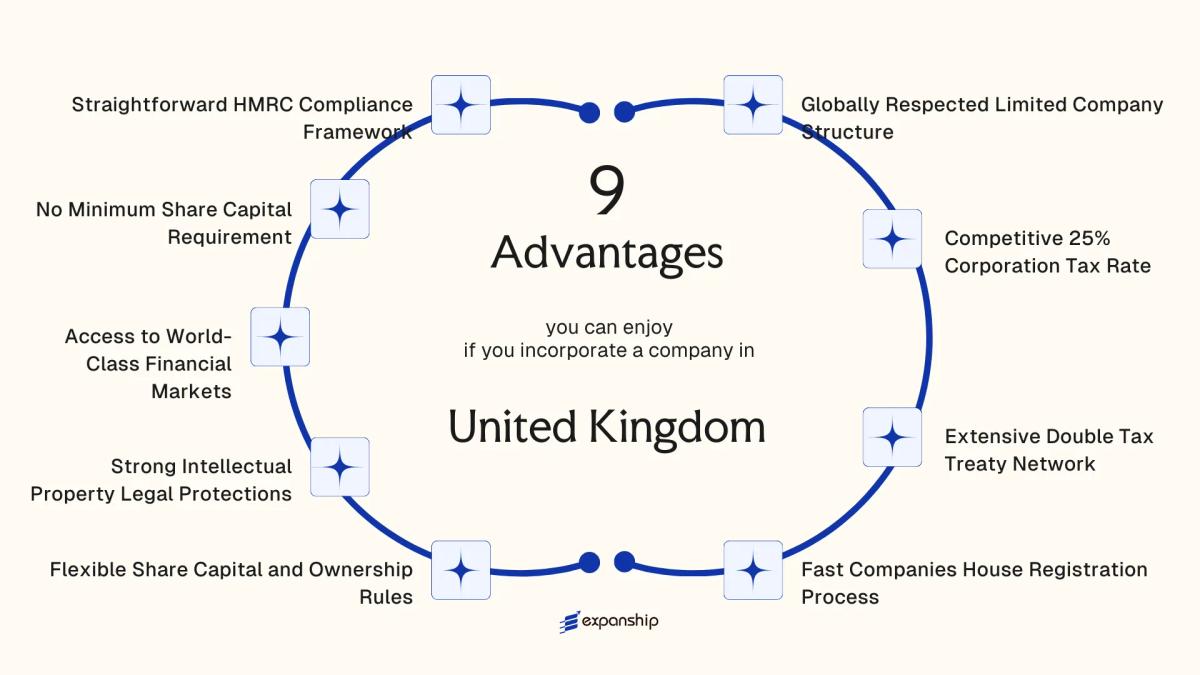
Globally Respected Limited Company Structure
The private limited company, or "Ltd", is one of the most recognised corporate structures in international commerce. Incorporated under the Companies Act 2006 and registered through Companies House, it carries a degree of institutional familiarity that few equivalent structures elsewhere can match.
Recognised Across Financial and Legal Systems
UK limited company global reputation benefits are, in practical terms, rooted in how counterparties respond to the structure. Banks, institutional investors, and commercial partners across Asia, North America, and the Middle East routinely accept a UK Ltd without requiring supplementary legal explanations or additional due diligence on the entity type itself.
This recognition reduces friction when opening corporate bank accounts abroad or entering cross-border contracts.
Credibility Built Into the Structure
The prestige of UK Ltd company structure derives partly from Companies House's public register, which makes ownership, filing history, and accounts verifiable by any third party online. That transparency is a credibility signal.
For a foreign business owner, UK private limited company credibility means your entity arrives pre-vetted in the eyes of many professional counterparties, without additional certification steps.
A UK Ltd is structurally recognised across major international markets, reducing the onboarding friction you would typically face with a less familiar corporate form.
Competitive 25% Corporation Tax Rate
At 25%, the UK corporation tax rate sits above the headline rates of some low-tax jurisdictions, yet this figure carries structural advantages that matter more than the number itself. For foreign business owners, the credibility that comes with paying tax in a respected OECD jurisdiction often outweighs the appeal of a nominally lower rate elsewhere. The rate applies to profits, not revenue, meaning your taxable base reflects actual commercial performance.
Rate-related considerations that work in your favour:
- Small profits under £50,000 remain taxed at 19% under the small profits rate, reducing the effective burden for early-stage or leaner operations
- The marginal relief taper between £50,000 and £250,000 means mid-sized businesses avoid a hard tax cliff at the threshold
- Capital allowances under the Capital Allowances Act 2001 let you deduct qualifying asset expenditure, reducing taxable profits in the year of investment
- Patent box provisions allow profits from patented inventions to be taxed at a reduced rate of 10%, making IP-holding structures commercially viable
Corporations governed by HMRC pay tax on worldwide profits if UK-resident, but non-resident companies are generally liable only on UK-source income. This distinction is relevant when structuring cross-border operations through a UK entity.

Incorporate a Company in the United Kingdom
Set up a UK limited company through Expanship with full compliance support from registration through to ongoing HMRC obligations.
Extensive Double Tax Treaty Network
The UK double tax treaty network benefits any foreign business owner who needs to move money across borders without facing taxation in two jurisdictions simultaneously. With over 130 bilateral tax treaties in force, the UK holds one of the largest such networks globally. These agreements govern how income, dividends, royalties, and capital gains are taxed when they flow between the UK and a treaty partner country.
| Treaty Partner | Dividends (%) | Royalties (%) | Interest (%) |
|---|---|---|---|
| United States | 0–15 | 0 | 0 |
| Germany | 0–15 | 0 | 0 |
| India | 15 | 15 | 10 |
| Singapore | 0–15 | 8 | 5 |
| United Arab Emirates | 0–15 | 0 | 0 |
Each treaty is given legal effect in the UK through the Taxation (International and Other Provisions) Act 2010, which incorporates the terms of individual agreements into domestic law. This means treaty protections are not discretionary; they are enforceable through statute.
For a foreign investor, the practical consequence is reduced withholding tax on cross-border payments. A business routing royalties from a treaty-partner jurisdiction into its UK entity may face a significantly lower tax rate than the domestic withholding rate that would otherwise apply. Treaty eligibility typically requires that your company is genuinely tax resident in the UK, which HMRC determines based on central management and control, not solely on registration.
Fast Companies House Registration Process
Companies House registration speed advantages are, in practical terms, a direct operational benefit. A private limited company (Ltd) can be incorporated digitally in as little as 24 hours once the application is submitted through the Companies House online portal. For a foreign business owner, this means your entity has a legal identity, a registered number, and the ability to open bank accounts or sign contracts within a working day of applying.
Most jurisdictions require notarised documents, multi-agency approvals, or in-person filings. England and Wales operate under the Companies Act 2006, which allows a paperless incorporation process through Companies House's Web Incorporation Service. No physical presence is required at any stage.
Speed here is not merely administrative convenience. A faster legal existence means earlier VAT registration eligibility, earlier HMRC enrollment, and earlier access to business banking, all of which directly affect your operational timeline.
Keep these points in mind:
- The registered office address must be a physical UK address, not a PO Box.
- At least one director must be a natural person; no nationality restriction applies.
- Your Memorandum and Articles of Association must be filed at incorporation.
- Same-day registration is typically available via the premium same-day service for an additional fee.
A UK limited company receives its Certificate of Incorporation the moment Companies House approves the application, meaning the company legally exists before any physical document is printed or posted.
Flexible Share Capital and Ownership Rules
UK flexible share capital ownership advantages begin at the structural level. Under the Companies Act 2006, a private limited company (Ltd) can issue multiple classes of shares, each carrying distinct rights around voting, dividends, and capital distribution. This gives founders and investors the ability to allocate economic interests and control independently of one another.
Share Class Architecture
Ordinary shares, preference shares, and alphabet shares (A, B, C class structures) are all permissible within a single Ltd. Alphabet share structures, in particular, allow dividend payments to be directed to specific shareholders in varying amounts, which can have meaningful tax planning implications depending on a shareholder's personal circumstances and residency.
Foreign Ownership and Directorship
No restriction exists on foreign nationals holding shares in a UK Ltd. A non-resident individual or an overseas corporate entity can own 100% of the shares without triggering any special approval process or requiring a local co-owner. Combined with the absence of restrictions on foreign directors under the Companies Act 2006, this gives international investors full structural control from outside the jurisdiction. A company secretary is no longer mandatory for private companies under the same Act, reducing administrative overhead without compromising structural integrity.
Structure Your UK Company for Maximum Ownership Flexibility
Speak with an Expanship specialist about designing a share structure that aligns with your ownership, tax, and investor requirements under UK company law.
Strong Intellectual Property Legal Protections
UK intellectual property protection advantages stem from a legal framework that has developed over more than a century, giving your business enforceable rights across patents, trademarks, copyright, and design.
- The Intellectual Property Act 1862, Trade Marks Act 1994, Patents Act 1977, and Copyright, Designs and Patents Act 1988 form the statutory backbone of IP rights in Great Britain. Each statute defines ownership, duration, and enforcement mechanisms with precision, reducing ambiguity in commercial disputes.
- The Intellectual Property Office (IPO) administers trademark and patent registrations domestically. A registered UK trademark grants exclusive rights for ten years, renewable indefinitely, meaning your brand is protected as long as you maintain the registration.
- Since Brexit, the UK operates its own IP register independently from the EU Intellectual Property Office (EUIPO). Trademarks registered via the EUIPO before January 2021 were automatically cloned into equivalent UK rights, but new filings now require separate UK registration, giving your entity a distinct, nationally enforceable asset.
- The UK is a signatory to the Patent Cooperation Treaty (PCT) and the Paris Convention, so a UK patent application can serve as the priority filing date for subsequent applications in over 150 member states.
- For foreign investors, UK courts have a strong record of enforcing IP rights, and the Intellectual Property Enterprise Court (IPEC) provides a cost-capped route for smaller businesses to pursue infringement claims without disproportionate litigation costs.
Access to World-Class Financial Markets
UK financial markets access benefits extend well beyond prestige. A company incorporated in England or Wales can apply to list on the London Stock Exchange's Main Market or its growth-focused AIM (Alternative Investment Market), both regulated under the Financial Services and Markets Act 2000 and overseen by the Financial Conduct Authority.
AIM operates under a more flexible admission framework than the Main Market, making it accessible to smaller foreign firms seeking public capital without meeting the full listing requirements of a premium segment. For businesses that remain private, the UK's deep institutional investor base, including major asset managers, private equity funds, and venture capital firms concentrated in London, creates significant off-market funding opportunities.
Foreign-owned UK entities are treated on equal terms with domestic firms for capital markets purposes. There are no nationality-based restrictions on accessing debt or equity instruments through UK-regulated venues.
A company listed on AIM benefits from a dedicated Nominated Adviser (Nomad) framework rather than direct FCA pre-vetting, reducing the time and cost of going public compared to Main Market requirements. As of 2023, AIM had over 700 companies listed, with a combined market capitalisation exceeding £80 billion. (London Stock Exchange, AIM Market Statistics, 2023)
No Minimum Share Capital Requirement
Under the Companies Act 2006, a private limited company in the UK can be incorporated with a share capital of just £1. This is a statutory position, not an administrative concession, meaning there is no minimum threshold a founder must meet before the entity is legally valid.
For foreign investors, this matters in a direct way: capital that would otherwise sit locked in a corporate account to satisfy a statutory minimum can instead be deployed operationally from day one. Many jurisdictions in continental Europe and the Gulf impose minimum paid-up capital requirements ranging from several thousand to tens of thousands of euros or dirhams before a company can conduct business.
The UK no minimum share capital advantage is particularly relevant for early-stage ventures, holding structures, and special purpose vehicles where functional capital requirements are low. A single £1 ordinary share fully satisfies the Companies House registration requirement. Your ownership structure determines what you issue, at what value, and to whom.
- Subscription price and nominal value are set by the founding shareholders, not by statute
- Additional shares can be issued later under authority granted in the articles of association
- No minimum paid-in capital requirement applies at the point of filing
While a £1 share capital is legally sufficient for incorporation, certain regulated activities, banking relationships, or visa-linked business applications may require demonstrable financial substance beyond the minimum.
Straightforward HMRC Compliance Framework
The HMRC compliance framework advantages available to UK-incorporated companies stem from a reporting structure that is codified, predictable, and digitally administered. For foreign business owners, predictability in tax administration reduces the cost of legal and accounting oversight, which in many jurisdictions represents a significant operational overhead.
Self-Assessment and Corporation Tax Filing
UK companies file their Corporation Tax return using a CT600 form, submitted to HMRC alongside statutory accounts within 12 months of the accounting period end. Tax payments are due within nine months and one day of that same period. This separation of the payment deadline from the filing deadline gives your finance team a defined window to reconcile accounts before submission.
Making Tax Digital
HMRC's Making Tax Digital (MTD) initiative mandates digital record-keeping and electronic submission for VAT-registered businesses, with planned expansion to Corporation Tax. For foreign investors, MTD-compatible software integrates with most international accounting platforms, reducing the friction of cross-border financial management.
PAYE and Payroll Administration
If your UK entity employs staff, PAYE obligations are administered through HMRC's Real Time Information (RTI) system, which requires payroll data to be submitted each time employees are paid. RTI eliminates year-end payroll reconciliation backlogs that remain common in several EU member states.
Annual Compliance Obligations
Your UK company's core annual obligations include:
- Corporation Tax return (CT600) filed with HMRC
- Statutory accounts filed with Companies House
- Confirmation Statement submitted to Companies House
- VAT returns (if VAT-registered, typically quarterly)
Why the UK Stands Out Against Competing Jurisdictions
Evaluated against its most realistic competitors, a UK Ltd company holds a distinct position for foreign founders. Ireland, the Netherlands, and Singapore are the three jurisdictions most commonly considered alongside the UK by internationally mobile businesses and investors. Each targets a similar profile of cross-border operator, and each offers genuine advantages, yet the comparison across registration mechanics, tax transparency, and treaty access consistently shows the UK occupying a neutral or favourable position across the parameters that matter most operationally.
What the table below makes visible is not simply a list of numbers, but a pattern: the UK's combination of no minimum share capital, a 25% statutory rate applied with relatively broad treaty relief, and a registration process administered entirely through Companies House without mandatory notarisation, removes several friction points that equivalent jurisdictions still impose. For a foreign owner managing multiple markets, the absence of structural barriers at entry, and the absence of ambiguity in the compliance framework, carries measurable practical weight.
| Parameter | UK | Ireland | Netherlands | Singapore |
|---|---|---|---|---|
| Standard Corporation Tax Rate | 25% | 12.5% (trading) | 25.8% | 17% |
| Minimum Share Capital | None | None | None | SGD 1 |
| Double Tax Treaties | 130+ | 74+ | 100+ | 90+ |
| Online Registration | Yes (Companies House) | Yes (CRO) | Partial (notary required) | Yes (ACRA) |
| Public Beneficial Ownership Register | Yes | Yes | Yes | No |
| Accounting Standards | UK GAAP / IFRS | Irish GAAP / IFRS | Dutch GAAP / IFRS | SFRS / IFRS |
Compliance Services for UK Companies
Stay on top of your Companies House filings, confirmation statements, and HMRC obligations with structured compliance support for UK-registered entities.
Conclusion
The benefits of incorporating in the United Kingdom rest on a combination of structural, fiscal, and legal factors that hold practical weight for foreign business owners. A 25% corporation tax rate, paired with one of the world's most extensive double tax treaty networks, reduces the cost of operating internationally in ways that directly affect your bottom line. The Companies Act 2006 underpins a private limited company framework that is recognised and trusted across financial institutions and counterparties globally.
Not every business will extract equal value from these features. A firm with significant cross-border royalty flows will benefit disproportionately from treaty protections under UK intellectual property law. One raising external capital will find the absence of a minimum share capital requirement and the flexibility of the Companies House share structure particularly useful.
What makes a UK limited company formation a considered choice is less any single feature and more the consistency between them. The regulatory architecture, from HMRC's compliance obligations to the speed of Companies House registration, functions in a way that reduces administrative friction without compromising legal standing. The right fit will depend on your business model, the jurisdictions you trade with, and your ownership structure. Determining how these factors align with what the UK framework offers is the logical next step.
Start Your UK Company Formation With Expanship Today
Expanship assists foreign entrepreneurs and investors in forming private limited companies (Ltd) and public limited companies (Plc) under the Companies Act 2006, handling the full registration process with Companies House. The benefits covered throughout this blog, from the corporation tax rate to the double tax treaty network and the absence of minimum share capital, are each addressed within Expanship's service scope.
For each engagement, Expanship manages the practical and administrative requirements that arise from Companies House filings and HMRC registration obligations:
- Preparation and notarization of incorporation documents, including the Memorandum and Articles of Association
- Registered office and registered agent provision at a recognized UK address
- Filing of the IN01 incorporation form and liaison directly with Companies House
- Post-incorporation compliance management, including confirmation statement and annual accounts obligations
- HMRC registration support for Corporation Tax and, where applicable, VAT
- Banking introduction assistance to support account opening with UK-based financial institutions
Expanship GB is available to discuss your specific formation requirements.
Frequently Asked Questions (FAQ)
Companies House typically processes electronic incorporations submitted through its WebFiling service within 24 hours, and in many cases within a few hours during business days. Postal applications take longer, usually three to five business days. Once approved, the Certificate of Incorporation is issued immediately, and the company legally exists from that date.
Since April 2023, the main corporation tax rate is 25%, but this rate applies only to companies with annual profits above £250,000. Businesses with profits at or below £50,000 qualify for the small profits rate of 19%, and a marginal relief calculation applies for profits between those two thresholds. These thresholds are divided among associated companies, so group structures affect which rate applies.
Many of the treaties within the UK's double tax treaty network, which covers over 130 countries, reduce or eliminate withholding tax on dividends, interest, and royalties paid to residents of treaty partner jurisdictions. The specific rate depends on the applicable bilateral agreement and the recipient's country of residence. Where no treaty exists, domestic UK law generally does not impose withholding tax on dividends paid by a UK company.
Unregistered intellectual property can still attract protection under common law passing off principles, but enforcement is significantly harder without formal registration. The Trade Marks Act 1994 governs registered trademark protection, and registration with the Intellectual Property Office grants exclusive statutory rights enforceable across the UK. Without registration, a business must prove acquired reputation and actual misrepresentation to bring a claim, which is a higher evidential burden.
No minimum share capital is required under the Companies Act 2006 for a private limited company. A company can be incorporated with a single share valued at £0.01, and no paid-up capital requirement must be met before trading begins. This differs from many civil law jurisdictions that mandate minimum capital deposits before a company can be registered or commence operations.
After incorporation, a company must notify HMRC that it is active, typically within three months of commencing trade, which triggers registration for corporation tax. The company then files an annual Company Tax Return using form CT600, accompanied by statutory accounts prepared under the Companies Act 2006 framework. Payment of any corporation tax liability is due nine months and one day after the end of the accounting period, though large companies operate under a quarterly instalment regime.
Legal Disclaimer
The information provided in this article is for general informational purposes only and does not constitute legal, tax, or professional advice. While we strive to ensure the accuracy and timeliness of the content, laws and regulations are subject to change, and the application of laws can vary widely based on specific facts and circumstances.
Readers should not act upon this information without seeking professional counsel tailored to their individual situation. Expanship and its authors disclaim any liability for actions taken or not taken based on the content of this article.
For specific advice regarding your business setup, compliance requirements, or any legal matters, please consult with qualified legal and tax professionals in the relevant jurisdiction.