
Key Takeaways
- Foreign investors incorporating on the UAE mainland must account for the expanded foreign ownership provisions introduced under Federal Decree-Law No. 26 of 2020, which removed the historical 51% local sponsor requirement across a broad range of commercial activities.
- Free zone entities are regulated by their respective free zone authority rather than the Ministry of Economy, meaning incorporation requirements — including share capital thresholds, licence conditions, and office obligations — are determined at the free zone level and vary between jurisdictions.
- Failure to satisfy the prescribed formation requirements, whether related to share capital, registered office, or local agent arrangements, results in rejection of the registration application or potential suspension of the trade licence post-incorporation.
- The primary legislative framework governing mainland company formation is Federal Decree-Law No. 32 of 2021 on Commercial Companies, administered federally through the Ministry of Economy, and compliance with its requirements is a prerequisite to lawful registration and operation.
UAE incorporation requirements are governed primarily by Federal Decree-Law No. 32 of 2021 on Commercial Companies, administered at the federal level through the Ministry of Economy, while free zone entities fall under the regulatory authority of their respective free zone bodies. This article covers the formation-related requirements you must satisfy before a business can be legally registered and operational.
Failure to meet the prescribed requirements results in rejection of the registration application or, in cases of non-compliance post-incorporation, potential suspension of the company's trade licence. Requirements vary depending on entity type, free zone versus mainland jurisdiction, and the nature of your business activity.
Refer to Federal Law No. 32 of 2021 for the primary legislative text governing company formation requirements UAE.
This article is most relevant to foreign investors and multinational firms evaluating mainland or free zone structures under UAE business registration requirements for the first time.
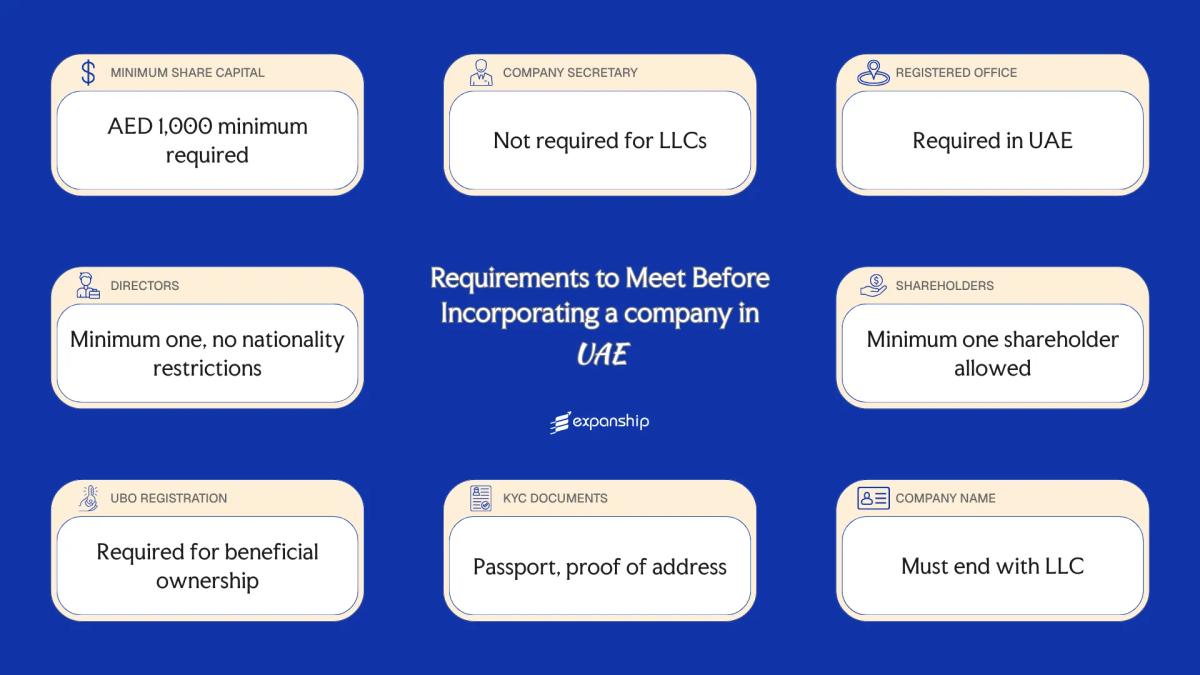
Minimum Share Capital Requirements in the United Arab Emirates
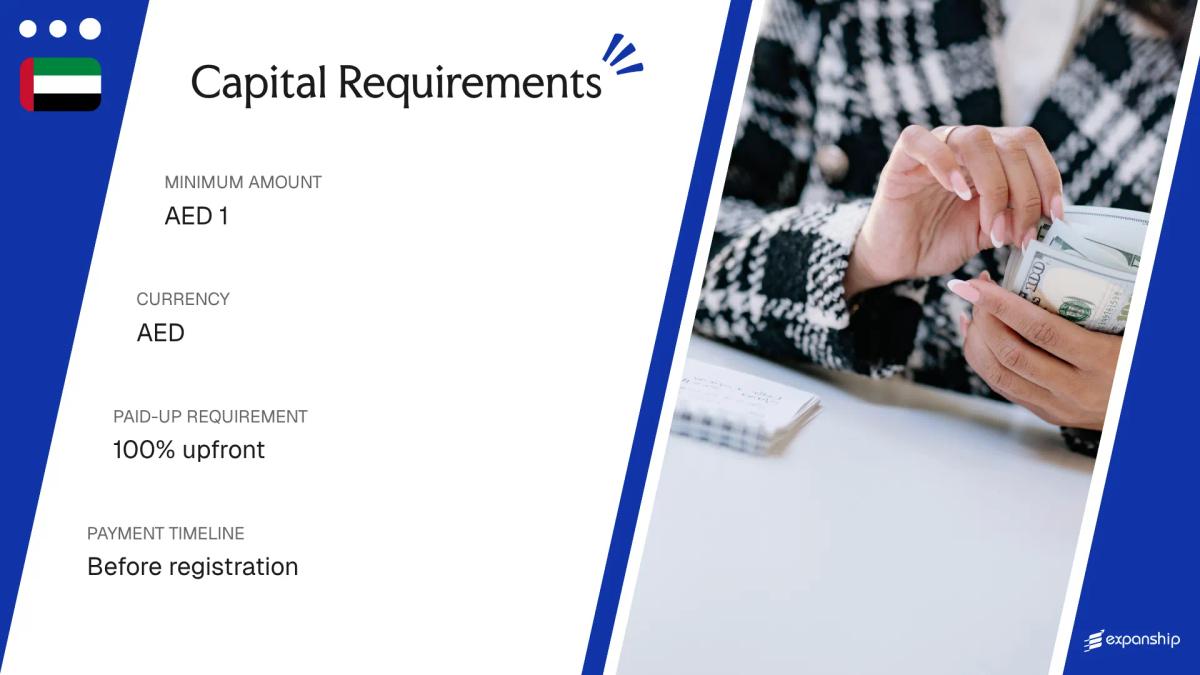
UAE minimum share capital requirements vary significantly depending on the legal structure chosen and whether the entity is established on the mainland or within a free zone. Mainland limited liability companies are governed by Federal Decree-Law No. 32 of 2021 on Commercial Companies, which removed the previously mandated AED 300,000 minimum for LLCs, leaving capital determination to the shareholders.
Free zone authorities set their own paid-up capital requirements independently, and figures differ across zones. The Department of Economic Development (DED) oversees mainland commercial registrations, while each free zone authority acts as its own registrar and regulator for entities incorporated within its boundaries.
| Parameter | Detail |
|---|---|
| Minimum Authorized Share Capital | No statutory minimum for mainland LLCs under Federal Decree-Law No. 32 of 2021; free zone requirements vary by authority |
| Maximum Authorized Share Capital | No statutory maximum |
| Minimum Paid-Up Capital | No statutory minimum for mainland LLCs; free zone authorities set their own thresholds |
| Paid-Up Requirement at Incorporation | No mandatory deposit required for mainland LLCs at the point of incorporation |
| Accepted Currency | UAE Dirham (AED) |
| Accepted Forms of Contribution | Cash contributions; in-kind contributions are permissible subject to independent valuation |
| Timeframe to Deposit Capital | No statutory timeframe for mainland LLCs; free zone rules vary |
Absence of a mainland minimum does not eliminate capital obligations entirely. If you incorporate in a free zone, the relevant free zone authority will specify its own paid-up capital requirement, which must be satisfied before a licence is issued.
Local Agent Requirements in the United Arab Emirates
Under the UAE's commercial licensing framework, foreign-owned mainland entities are subject to UAE local agent requirements that differ depending on the legal structure and activity type. A Local Service Agent (LSA) is required for sole establishments and civil companies wholly owned by foreign nationals, while branch offices of foreign firms must also appoint a local service agent registered with the relevant emirate's Department of Economic Development.
The LSA does not hold an equity stake in the business. Their role is administrative: facilitating government approvals, liaising with licensing authorities, and signing off on permit applications on behalf of the foreign entity.
Qualification criteria for a UAE national agent include:
- The agent must be a UAE national holding a valid Emirates ID.
- Corporate agents must be entities wholly owned by UAE nationals.
- The agent cannot hold shares or profit interests in the business they represent.
- No professional licensing requirement applies to the agent personally, though some emirates may impose registration conditions.
- The agent must be of legal age and not disqualified from commercial activities under federal law.

Incorporate a Company in the United Arab Emirates
Set up your business entity in the UAE with guidance on licensing, structure selection, and regulatory compliance across mainland and free zone options.
Registered Office Requirements in the United Arab Emirates
UAE registered office requirements differ significantly depending on whether your entity is established on the mainland or within a free zone, with each authority setting its own address standards and enforcement mechanisms.
- A physical address is required; P.O. box numbers alone do not satisfy the registered office requirement under mainland and most free zone regulations.
- Virtual office arrangements are permitted in certain free zones and some mainland jurisdictions, provided the provider holds the appropriate licensing from the relevant authority.
- The registered address must be located within the same emirate or free zone in which the company is licensed.
- Proof of premises is required at incorporation, typically in the form of a tenancy contract registered with the relevant emirate's real estate authority, such as Ejari in Dubai.
- The registered address is publicly recorded on the commercial licence and visible through official trade registries, including those administered by the Department of Economic Development in each emirate.
- Any change of business address must be formally notified to the licensing authority, and operating from an unlisted address can result in licence suspension or non-renewal by the relevant Department of Economic Development or free zone authority.
Director Requirements in the United Arab Emirates
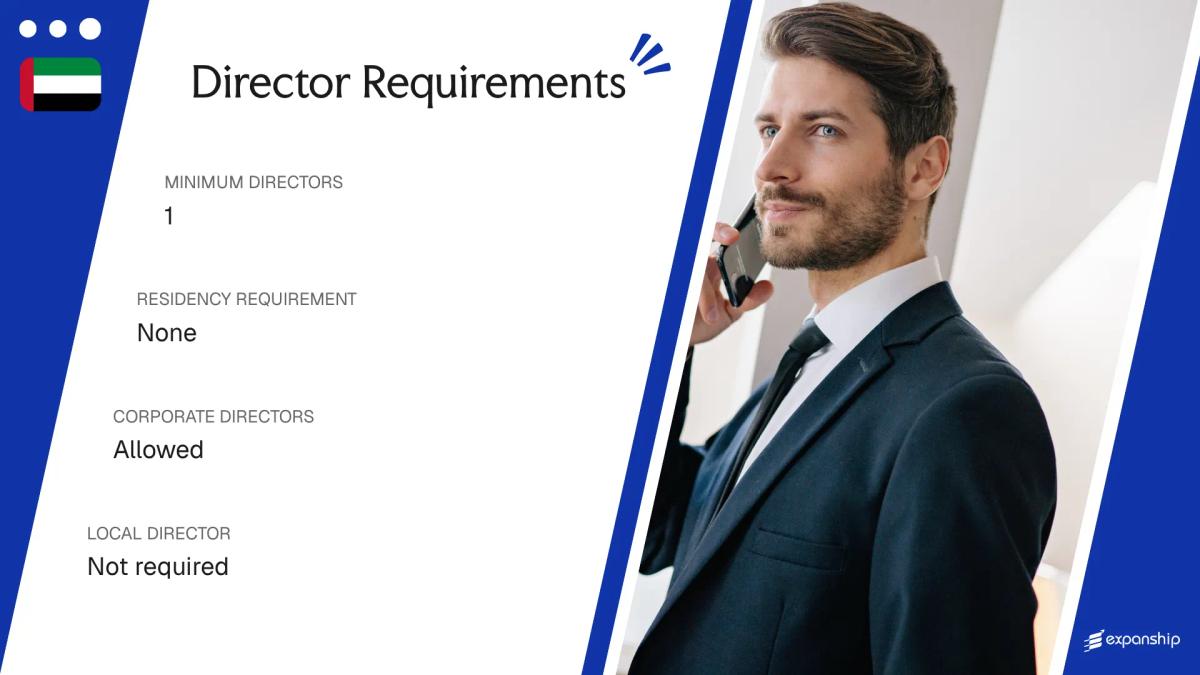
Upon appointment, directors of a UAE LLC assume statutory duties under Federal Decree-Law No. 32 of 2021 on Commercial Companies, including fiduciary obligations toward shareholders and personal liability for losses arising from fraud, misuse of authority, or violations of the company's memorandum of association. UAE director requirements incorporation rules are governed at the federal level, with additional layer-specific regulations applying across free zones and the mainland.
| Parameter | Detail |
|---|---|
| Minimum Number of Directors | One manager is required for an LLC on the mainland. |
| Maximum Number of Directors | No statutory maximum is prescribed under Federal Decree-Law No. 32 of 2021. |
| Local/Resident Director Required | No mandatory UAE residency requirement exists for mainland LLC managers. |
| Nationality Restrictions | No nationality restrictions apply to managers under federal commercial companies law. |
| Minimum Age Requirement | Directors must have full legal capacity, which requires a minimum age of 21 years. |
| Corporate Directors Permitted | Corporate directors are not permitted; managers must be natural persons. |
| Director Must Be a Shareholder | No statutory requirement for a manager to hold shares in the company. |
| Publicly Listed on Registry | Manager details are recorded in the commercial register held by the relevant emirate's Department of Economic Development. |
| Disqualification Conditions | A person declared bankrupt or convicted of a financial crime may be disqualified from serving as a manager. |
Despite common assumptions about local ownership rules, UAE mainland law does not require the company manager to be an Emirati national or even a UAE resident.
Shareholder Requirements in the United Arab Emirates
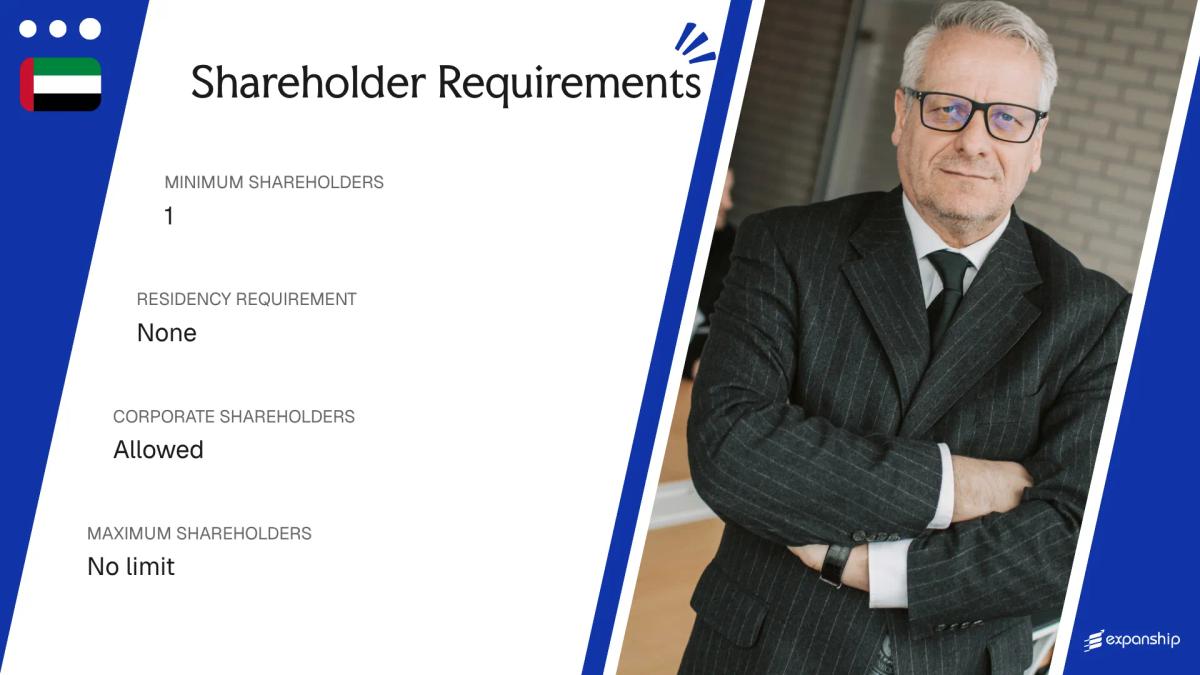
UAE shareholder requirements for incorporation vary by entity type under Federal Decree-Law No. 32 of 2021 on Commercial Companies. A Limited Liability Company (LLC) requires a minimum of one shareholder and permits up to fifty, making sole-shareholder structures permissible.
Nationality and Residency Restrictions
Amendments introduced through Federal Decree-Law No. 26 of 2020 removed the mandatory 51% Emirati ownership requirement for most onshore business activities, allowing 100% foreign ownership in eligible sectors. Certain strategic and regulated activities remain subject to foreign ownership restrictions as determined by the relevant licensing authority.
Corporate Shareholders
Corporate entities may hold shares in a UAE company without restriction on their country of incorporation. No additional conditions are imposed solely on the basis of a shareholder being a legal entity rather than a natural person.
Shareholder Liability
In an LLC, shareholder liability is limited to each party's capital contribution. No general circumstances under the Commercial Companies Law extend personal liability beyond the subscribed share amount.
Register of Shareholders
Companies are required to maintain a register of shareholders, which must be updated to reflect any ownership changes. This register is filed with the relevant emirate-level authority, such as the Department of Economic Development, and is not publicly accessible in the way that some common law registries are.
Shareholder Structuring Support for Your UAE Incorporation
Get guidance on meeting ownership and shareholder eligibility requirements when setting up your business in the UAE.
UBO / Beneficial Ownership Registration Requirements in the United Arab Emirates
UAE beneficial ownership registration requirements are governed by Cabinet Decision No. 58 of 2020, which defines a beneficial owner as any natural person who directly or indirectly owns or controls 25% or more of a company's shares or voting rights, or who otherwise exercises effective control over the entity.
- Identify all natural persons meeting the 25% ownership or effective control threshold and compile their personal details, including full name, nationality, date of birth, and residential address.
- Submit a Beneficial Owner Register and a Nominee Director Register to the relevant licensing authority within 60 days of incorporation.
- Maintain both registers at the company's registered address and update them within 15 days of any change in beneficial ownership.
- File an annual confirmation with the licensing authority affirming the accuracy of the registered information.
| Parameter | Detail |
|---|---|
| Ownership Threshold for UBO Status | 25% of shares or voting rights, or effective control |
| Filing Authority | Relevant emirate-level licensing authority (e.g., DED, free zone authority) |
| Disclosure Deadline at Incorporation | Within 60 days of incorporation |
| Publicly Accessible Register | No; registers are maintained internally and filed with the licensing authority |
| Penalties for Non-Disclosure | Administrative fines under Cabinet Decision No. 58 of 2020; amounts vary by authority |
| Ongoing Update Obligation | Within 15 days of any change in beneficial ownership |
KYC / Document Requirements in the United Arab Emirates
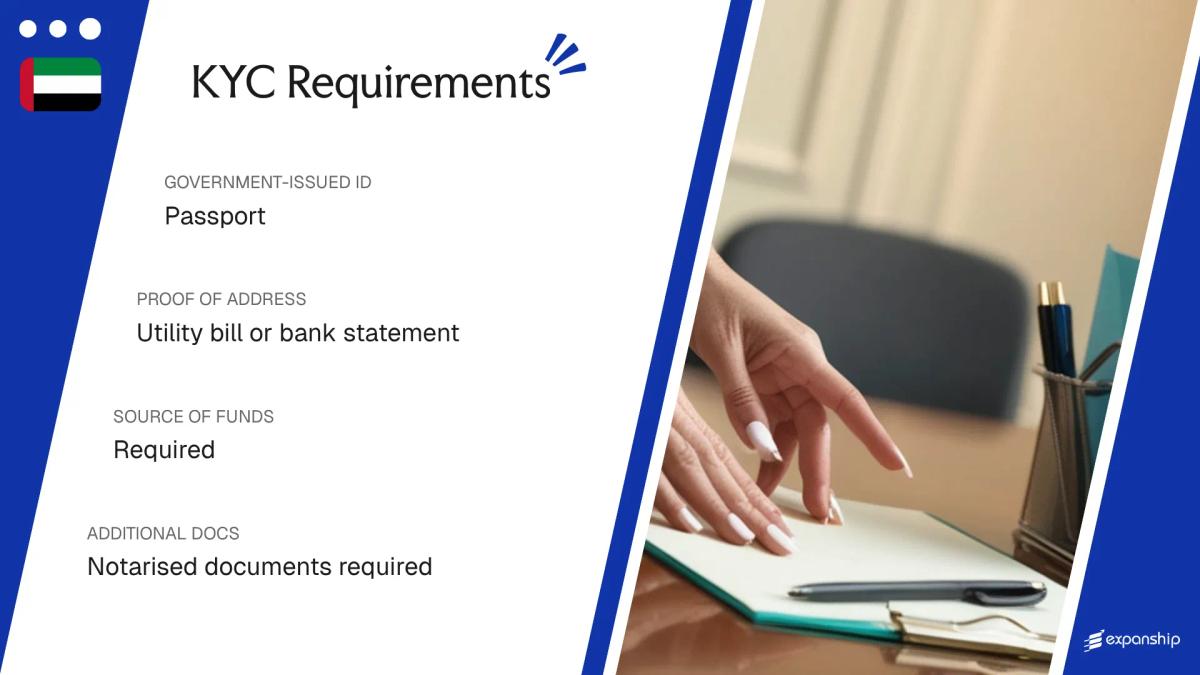
UAE KYC requirements for company formation are governed by Federal Decree-Law No. 20 of 2018 on Anti-Money Laundering and Combating the Financing of Terrorism, administered by the Financial Intelligence Unit. All incorporating entities must submit identity and source of funds documentation before registration is approved.
Individual / Personal Documents
- Passport copy, valid for at least six months, for each individual shareholder, director, and beneficial owner
- Proof of residential address dated within three months, such as a utility bill or official bank statement
- Recent passport-sized photograph, where required by the relevant authority or free zone registrar
- Signed and completed KYC declaration or personal information form as prescribed by the registrar
Corporate Documents
- Certificate of incorporation or equivalent constitutional document for the corporate shareholder or director
- Register of directors and register of shareholders, certified as current
- Proof of the corporate entity's registered office address
- Certificate of good standing or equivalent, typically issued within the past six months
Source of Funds Documentation
- Bank statements covering a minimum of three to six months for the introducing shareholder
- Audited financial statements where the shareholder is an established trading entity
- A written source of funds declaration signed by the relevant individual or authorised officer
Notarisation and Apostille Requirements
- Foreign-issued documents generally require notarisation in the country of origin followed by apostille or UAE embassy legalisation
- Arabic translation by a UAE Ministry of Justice certified legal translator is required for non-Arabic and non-English documents
- Free zone authorities may accept notarised English-language documents without Arabic translation depending on the zone's own rules
Mismatched or inconsistent name spellings across identity documents are the most frequent cause of incorporation delays in this jurisdiction.
Company Name Requirements in the United Arab Emirates
Trade name approval in the UAE is handled at the emirate level through the relevant Department of Economic Development, with additional oversight from federal authorities where regulated activities are involved. UAE company name requirements prohibit names that are already registered, phonetically similar to existing names, or contrary to public order.
Names must be written in Arabic, though a translated or transliterated version in another language may be permitted alongside it. Each entity type requires the corresponding legal suffix, such as "LLC" for a Limited Liability Company or "PJSC" for a Public Joint Stock Company.
Certain words are subject to restriction or outright prohibition. References to governments, religions, or regional bodies require prior approval from the relevant authority, while offensive or misleading terms are banned entirely under trade name regulations.
Name reservation is available prior to formal incorporation. Reservations are submitted through the relevant emirate's Department of Economic Development portal and are typically valid for a limited period, after which the reserved name lapses if the incorporation process is not completed.
Trade Name Compliance Services in the UAE
Expanship assists businesses with trade name registration, reservation, and ongoing compliance with naming regulations across UAE jurisdictions.
Conclusion
UAE incorporation requirements span multiple regulatory layers, from free zone authority rules to mainland licensing under the Ministry of Economy and emirate-level departments. Ownership structures carry particular weight: mainland entities historically required a local sponsor holding 51% equity, though Federal Decree-Law No. 26 of 2020 expanded full foreign ownership across many commercial activities. Registered office requirements are tied directly to your licence type and jurisdiction of registration. Once these requirements are understood, the practical next step is engaging the relevant authorities and preparing documentation to advance the registration process.
Expanship's Corporate Services for UAE Expansion
Incorporating in the UAE involves a layered compliance framework, from free zone authority requirements to mainland licensing conditions and UBO registration obligations under Cabinet Decision No. 58 of 2020. Expanship's UAE company formation compliance services are structured to help your business manage these requirements accurately, reducing the administrative burden without obscuring the responsibilities that remain yours as a shareholder or director.
Our team supports the full incorporation and post-incorporation cycle across mainland and free zone structures. Services include:
- Preparing and filing incorporation documents with the relevant authority, whether the DED, a free zone regulator, or ADGM/DIFC.
- Providing registered agent and office solutions that satisfy local presence requirements.
- Liaising with government bodies and regulatory authorities on your behalf throughout the registration process.
- Managing ongoing compliance obligations, including annual renewals and statutory filings, after your entity is established.
- Facilitating introductions to banking institutions familiar with UAE corporate structures.
- Handling VAT registration with the FTA and coordinating with local authorities for trade licensing.
To discuss your UAE setup, contact Expanship UAE.
Frequently Asked Questions (FAQ)
The 2021 Commercial Companies Law introduced full foreign ownership for many mainland activities, but certain strategically sensitive sectors remain subject to the 51% Emirati ownership requirement. The Cabinet Negative List specifies which activities are restricted, and businesses operating in those sectors must partner with a UAE national or a company wholly owned by UAE nationals. Confirming which list your intended activity falls under before proceeding with registration is essential.
Under Federal Decree-Law No. 32 of 2021, a corporate entity can be appointed as a manager of a Limited Liability Company, though the specific rules vary by company type. A Public Joint Stock Company, for instance, requires its board members to be natural persons. The licensing authority and the company's constitutional documents will ultimately govern what is permissible for your chosen structure.
Failure to comply with Cabinet Resolution No. 58 of 2020 on Beneficial Ownership Procedures can result in administrative penalties imposed by the relevant licensing authority, including fines and potential suspension of the company's licence. The regulations place the obligation on the company itself to maintain an accurate internal register and submit the required data to the competent authority within prescribed timeframes. Non-compliance is treated as a regulatory breach, not a minor administrative oversight.
The answer depends on the jurisdiction within the UAE and the company type. Most mainland DED-licensed entities must demonstrate a physical tenancy contract registered through the Ejari system to obtain and renew a trade licence. Some Free Zones offer flexi-desk or shared workspace packages that satisfy their own registered office requirements, but these arrangements are not transferable to mainland licensing conditions.
The required paid-up capital varies significantly by Free Zone; some zones set no minimum capital requirement while others mandate amounts ranging from AED 10,000 to AED 1,000,000 depending on the licence category and activity. Capital is generally not required to be deposited in a UAE bank account before incorporation, though proof of capital may be needed at the time of share allotment. Confirming the specific requirement with the relevant Free Zone Authority before submitting your application avoids delays.
Foreign individual shareholders typically need to provide a valid passport copy, proof of residential address, and a source-of-funds declaration, while corporate shareholders must submit constitutional documents such as certificates of incorporation and memoranda of association. These foreign documents generally must be notarised in the country of origin and either apostilled under the Hague Convention or attested through the UAE embassy in that country, depending on whether the originating state is a signatory. The specific attestation route required will depend on the Free Zone or mainland authority processing the application.
Legal Disclaimer
The information provided in this article is for general informational purposes only and does not constitute legal, tax, or professional advice. While we strive to ensure the accuracy and timeliness of the content, laws and regulations are subject to change, and the application of laws can vary widely based on specific facts and circumstances.
Readers should not act upon this information without seeking professional counsel tailored to their individual situation. Expanship and its authors disclaim any liability for actions taken or not taken based on the content of this article.
For specific advice regarding your business setup, compliance requirements, or any legal matters, please consult with qualified legal and tax professionals in the relevant jurisdiction.