
Key Takeaways
- Under Federal Decree-Law No. 26 of 2020, foreign investors can hold 100% ownership of a UAE company across most sectors, eliminating the need for a local partner and the governance complications that come with one.
- Free zone entities benefit from zero corporate tax on qualifying income, and the UAE's network of over 100 bilateral double tax treaties further reduces the risk of income being taxed twice as it moves across borders.
- The UAE dirham's fixed peg to the US dollar removes exchange rate volatility from long-term financial planning, giving foreign-owned entities a predictable currency environment that many competing jurisdictions cannot offer.
- Because the Central Bank of the UAE imposes no restrictions on profit repatriation, shareholders can move capital out of a UAE entity without the withholding layers that routinely apply in many Asian and European markets.
The benefits of incorporating in UAE attract foreign investors across a broad range of industries, and the structural reasons for that interest are grounded in the country's legal and regulatory architecture. A federal nation comprising seven emirates, the UAE operates as a sovereign state under a constitutional framework that gives individual emirates authority to establish their own free zones and financial centers. Company registration at the federal level falls under the oversight of the Ministry of Economy, though many foreign businesses incorporate through emirate-level authorities or specialized financial centers. The most common legal vehicle used by foreign investors is the Free Zone Limited Liability Company.
From a tax standpoint, the jurisdiction maintains a broadly favorable posture, combining zero or low corporate tax rates in designated zones with an extensive network of double tax treaties. Foreign direct investment is explicitly encouraged through legislation permitting full foreign ownership across a wide range of sectors under Federal Decree-Law No. 26 of 2020. This article examines the principal advantages your business gains by establishing a presence here.
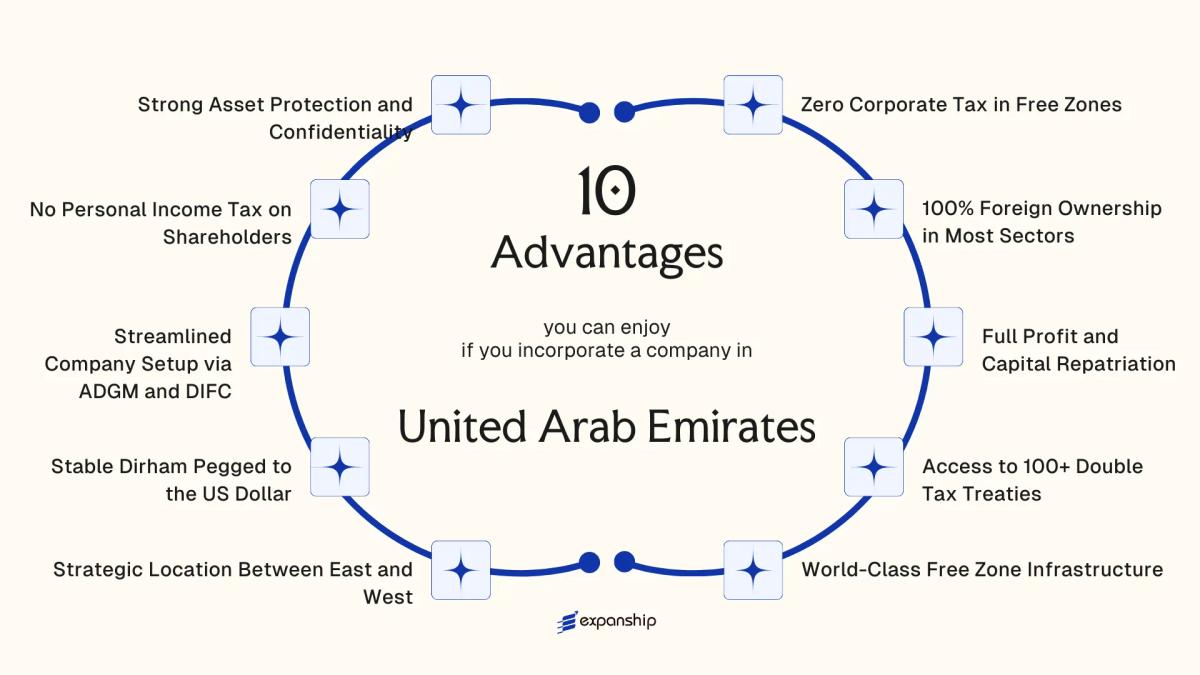
Zero Corporate Tax in Free Zones
Free zone entities in the UAE can access a 0% corporate tax rate under the UAE Corporate Tax Law (Federal Decree-Law No. 47 of 2022), provided they meet the criteria for a Qualifying Free Zone Person (QFZP). This designation makes UAE free zone zero corporate tax one of the most structurally defined tax advantages available through any jurisdiction worldwide.
What Qualifies Your Business for the 0% Rate
To maintain QFZP status, your entity must earn "Qualifying Income," which broadly covers transactions with other free zone businesses and certain internationally sourced revenue. Income derived from mainland UAE customers is generally subject to the standard 9% rate, so the structure of your client base directly affects which rate applies.
Why the Rate Structure Matters Operationally
For a foreign-owned business generating revenue from international clients or from within the free zone ecosystem, the 0% rate means profits are not eroded before repatriation. Over a five-year period, the compounding effect of retaining full pre-tax earnings is significant compared to jurisdictions applying rates of 20% or above.
Structuring your free zone entity to earn predominantly qualifying income preserves the 0% rate and directly increases the capital available for reinvestment or distribution.
100% Foreign Ownership in Most Sectors
Prior to the 2020 reform of Federal Law No. 2 of 2015 (the UAE Companies Law), most mainland businesses required a local Emirati sponsor holding 51% ownership. The amendment introduced by Federal Decree-Law No. 26 of 2020 removed that requirement across the majority of commercial and industrial activities, making 100% foreign ownership UAE company structures available on the mainland without a local equity partner.
This change is significant in practical terms. You retain full decision-making authority, dividend entitlement, and exit rights without negotiating around a mandatory minority stakeholder. For sectors that previously required joint ventures purely to satisfy ownership rules, the structural overhead has been eliminated.
Certain activities remain subject to restrictions. The UAE Cabinet publishes a list of strategic sectors, including defence, utilities, and some professional services, where foreign ownership caps or licensing conditions still apply. Outside that list, foreign nationals can own mainland entities outright.
What makes the current framework particularly functional for international operators:
- No mandatory local partner dilutes your equity or governance rights
- Profit distribution follows your actual shareholding without a statutory override
- Business succession and share transfers are governed by your own articles rather than a sponsor agreement
- Onshore registration qualifies your firm for government contracts unavailable to free zone entities

Incorporate Your Company in the UAE
Set up a mainland or free zone entity in the UAE with full foreign ownership and direct access to local and regional markets.
Full Profit and Capital Repatriation
UAE full profit repatriation for investors is guaranteed by federal law, not left to administrative discretion. Under the UAE Commercial Companies Law (Federal Decree-Law No. 32 of 2021) and the regulatory frameworks governing free zones, there are no statutory restrictions on transferring dividends, retained earnings, or sale proceeds out of the country. For a foreign shareholder, this means the return on your investment is not trapped by exchange controls or bureaucratic approval processes before it reaches you.
| Company Type | Repatriation of Profits | Repatriation of Capital | Currency Restrictions |
|---|---|---|---|
| Free Zone Entity | 100% permitted | 100% permitted | None |
| Mainland LLC | 100% permitted | 100% permitted | None |
| DIFC/ADGM Entity | 100% permitted | 100% permitted | None |
Free zone authorities such as JAFZA, DMCC, and ADGM explicitly codify this right within their own licensing frameworks, reinforcing the federal position at the zone level. When you dissolve a company or exit an investment, the recovered capital faces no withholding tax on repatriation, and no approval from the Central Bank of the UAE is required for standard commercial transfers.
The dirham's peg to the US dollar at a fixed rate of 3.6725 AED/USD, maintained since 1997, removes currency conversion risk from the repatriation calculation itself. What you transfer out reflects the dollar value you built, without erosion from exchange rate volatility between the time of earning and the time of withdrawal.
Access to 100+ Double Tax Treaties
UAE double tax treaty benefits extend to one of the widest treaty networks among capital-light jurisdictions globally. As of 2024, the country has ratified over 130 bilateral tax treaties, with several more in negotiation. For a foreign business owner, this means income flows — dividends, royalties, interest, and service fees — between treaty-partner countries and your UAE entity can be taxed at reduced or zero withholding rates, rather than being taxed in full by both jurisdictions.
Treaty access is available to entities that establish genuine tax residency under UAE law, supported by a Tax Residency Certificate issued by the Federal Tax Authority. This certificate is the primary document used to claim treaty relief in the counterpart country.
Treaty partners span key markets across South Asia, Africa, Europe, and the Far East — regions where withholding taxes on cross-border payments can otherwise reach 20–30%.
Keep these points in mind:
- Tax Residency Certificates must be renewed annually through the Federal Tax Authority portal
- Substance requirements apply; a mailbox entity may not qualify for treaty protection
- Each treaty has its own definitions for residency, permanent establishment, and covered income types
- Mainland and free zone entities are treated differently under some treaty provisions
The UAE's treaty with India — one of its most utilized — reduces dividend withholding tax to as low as 10%, making UAE structures particularly efficient for Indian-origin business owners managing cross-border income.
World-Class Free Zone Infrastructure
UAE free zone infrastructure advantages extend well beyond tax incentives. Each of the country's 45-plus free zones operates as a self-contained business district with its own regulatory authority, licensing body, and physical facilities — meaning your firm operates within a purpose-built environment rather than a generalist commercial framework.
Dedicated Physical and Regulatory Ecosystems
Jebel Ali Free Zone (JAFZA), established in 1985, sits adjacent to one of the world's busiest ports and offers direct access to bonded warehousing, logistics corridors, and container-handling infrastructure. Dubai Multi Commodities Centre (DMCC) provides Grade A office towers, vaulted commodity storage, and a trading floor purpose-built for precious metals and energy markets. Each zone maintains its own company registry and dispute resolution processes, reducing the administrative distance between your business and its regulator.
Sector-Specific Infrastructure Drives Operational Efficiency
Free zones are structured around specific industries — media production in Dubai Media City, financial services in DIFC, technology in Dubai Internet City — so the physical premises, licensing categories, and co-located service providers align with your actual operational requirements. Shared infrastructure costs are distributed across thousands of resident entities, which lowers your overhead compared to establishing equivalent facilities independently.
Connectivity between zones and international markets is reinforced by Al Maktoum International Airport located within JAFZA's catchment area, giving logistics-dependent businesses direct cargo access from their registered address.
Identify the Right Free Zone for Your Business in the UAE
Expanship's advisors assess your industry, operational model, and licensing requirements to match your entity to the free zone infrastructure that fits.
Strategic Location Between East and West
Situated at the crossroads of Europe, Asia, and Africa, the UAE strategic location business advantage is geographic in nature but financial in consequence. Dubai sits within a four-hour flight of roughly 2.3 billion people, and within eight hours of nearly two-thirds of the world's population. For a company moving goods, capital, or people across regions, that proximity translates directly into reduced transit times and lower logistics costs.
- Dubai International Airport and Jebel Ali Port, the largest port in the Middle East, operate within the same metropolitan corridor, giving businesses direct access to both air freight and sea cargo infrastructure from a single base.
- Time zone alignment matters operationally. Gulf Standard Time (UTC+4) overlaps with business hours in both Asian markets and European afternoons, allowing a single team to manage communications across both directions without relay offices.
- As a UAE gateway between East and West for business, the country has signed bilateral trade agreements and transport accords that facilitate customs clearance and goods movement across the GCC, South Asia, and East Africa.
- The UAE trade hub location benefits firms that rely on re-export models. Goods entering through free zones such as Jebel Ali Free Zone (JAFZA) can be processed and redistributed across multiple markets without triggering import duties at the point of entry.
Stable Dirham Pegged to the US Dollar
The UAE dirham USD peg has been fixed at 3.6725 AED per dollar since 1997, maintained by the UAE Central Bank under a currency board arrangement. For a foreign business operating across borders, this eliminates exchange rate risk on dollar-denominated contracts, invoices, and financing entirely.
Most international commodity trade, logistics agreements, and cross-border service contracts are priced in US dollars. Because the AED moves in lockstep with the dollar, your firm avoids the hedging costs and accounting complications that typically arise when operating through currencies subject to float or managed depreciation.
Currency stability also affects financing. Banks and institutional lenders treat AED-denominated borrowing as structurally equivalent to dollar exposure, which simplifies credit arrangements for entities with dollar revenues or dollar-denominated liabilities.
Hypothetical scenario: A UAE-based trading company invoices $500,000 monthly to a US client. With the AED/USD rate fixed at 3.6725, the dirham equivalent remains constant at AED 1,836,250 each month. A comparable firm operating through a currency subject to 5% annual depreciation would absorb roughly AED 91,812 in annual exchange losses on the same revenue stream, without any change in underlying business performance.
Streamlined Company Setup via ADGM and DIFC
Both the Abu Dhabi Global Market (ADGM) and the Dubai International Financial Centre (DIFC) operate as independent financial free zones with their own civil and commercial legal frameworks, each based on English common law. This matters because it eliminates the legal ambiguity that foreign investors often face in civil law jurisdictions, giving your contracts and corporate structures a familiar, enforceable foundation.
ADGM incorporation advantages for foreign investors include direct access to the ADGM Registration Authority, which processes company applications entirely online. DIFC company formation follows a similarly structured digital process through the DIFC Registrar of Companies.
Key structural features that reduce setup friction:
- Both zones permit single-shareholder companies
- Minimum capital requirements are defined and disclosed upfront
- Legal documentation follows English-language common law standards, reducing translation and interpretation costs
For businesses in financial services, fintech, or professional services, these zones offer regulated environments under the Financial Services Regulatory Authority (FSRA) in ADGM and the Dubai Financial Services Authority (DFSA) in DIFC. Operating under a recognised regulatory body strengthens your firm's credibility with international counterparties and banking institutions.
ADGM and DIFC entities are restricted to operating within their respective free zones or internationally; conducting onshore UAE business requires a separate mainland licence.
No Personal Income Tax on Shareholders
The UAE no personal income tax advantage is grounded in a structural absence rather than an exemption: there is simply no federal legislation imposing income tax on individuals. For a foreign business owner, this means dividends, director fees, and profit distributions received from a UAE-registered entity are not subject to any personal-level tax charge.
Under Federal Decree-Law No. 47 of 2022, which introduced corporate tax for the first time, the tax is levied at the entity level, not passed through to individual shareholders. Personal income remains entirely outside its scope. Your take-home return from ownership is not reduced by a second layer of taxation after corporate-level obligations are met.
For shareholders based in high-tax jurisdictions, this distinction carries material weight. Many countries apply dividend withholding taxes or personal income tax rates on distributions that can exceed 40% at the individual level. The absence of any equivalent personal tax charge means retained earnings distributed to you are received in full, subject only to whatever tax obligations exist in your country of residence.
This benefit applies regardless of nationality. There is no citizenship or residency requirement to access this treatment at the entity distribution level.
- No withholding tax on dividends paid to individual shareholders
- No capital gains tax on the sale of shares held by individuals
- No personal income tax filing obligation for shareholders under UAE federal law
- UAE tax residency, obtainable under Cabinet Decision No. 85 of 2022, can further anchor your personal tax position
Strong Asset Protection and Confidentiality
UAE asset protection and confidentiality benefits are anchored in structural legal frameworks rather than informal arrangements. Both the Abu Dhabi Global Market (ADGM) and the Dubai International Financial Centre (DIFC) operate as common law jurisdictions with their own independent courts and regulatory bodies. This separation from the UAE's civil law system means disputes are adjudicated under English common law principles, giving foreign investors a predictable legal environment that mirrors what they would encounter in London or Singapore.
Beneficial ownership information for entities incorporated in free zones is not publicly accessible. Unlike jurisdictions in the EU subject to public beneficial ownership registers under the Fifth Anti-Money Laundering Directive, the UAE does not mandate public disclosure of shareholder or director details for most free zone structures. Regulatory authorities hold this information for compliance purposes, but it is not exposed to commercial databases or third-party searches.
Asset protection in DIFC and ADGM is reinforced by the following structural features:
- Statutory recognition of trust structures, foundations, and special purpose vehicles under dedicated legislation such as the DIFC Trust Law (DIFC Law No. 4 of 2018)
- Ring-fencing provisions that legally separate assets held within a free zone entity from liabilities arising outside it
- The ADGM Foundations Regulations 2017, which allow high-net-worth individuals to place assets into a foundation with defined succession and governance rules
- Independent courts staffed by internationally appointed judges, insulating proceedings from local political influence
For operating companies outside the financial free zones, the absence of a centralized public company registry comparable to Companies House in the UK means ownership structures remain substantially private by default.
Why the UAE Outperforms Competing Jurisdictions
Singapore and Hong Kong are the jurisdictions most frequently evaluated alongside the UAE vs competing jurisdictions for incorporation decisions. Both target similar investor profiles, offer territorial or low-rate tax regimes, and compete for regional headquarters mandates. Comparing these three reveals where structural differences translate into practical advantages for foreign-owned businesses.
What the table below shows is not simply a feature checklist. The combination of zero personal income tax, free zone corporate tax exemptions under Federal Decree-Law No. 47 of 2022, and a currency pegged to the USD creates a compounding financial position that neither Singapore nor Hong Kong fully replicates for non-resident founders managing international cash flows.
| Parameter | UAE | Singapore | Hong Kong |
|---|---|---|---|
| Corporate Tax Rate | 0% (qualifying free zone entities); 9% mainland | 17% standard | 16.5% standard |
| Personal Income Tax | None | Up to 24% | Up to 17% |
| Foreign Ownership | 100% in free zones and most mainland sectors | 100% | 100% |
| Currency Risk | USD-pegged (AED) | Floating SGD | Pegged HKD/USD |
| Double Tax Treaties | 100+ in force | 90+ | 50+ |
| Resident Director Required | No (most free zones) | Yes (locally resident) | Yes (locally resident) |
| Physical Office Requirement | Flexible; flexi-desk permitted in most free zones | Registered address required | Registered address required |
Compliance Services for Companies in the UAE
Maintain good standing across UAE free zones and mainland entities, from annual filings and licence renewals to Economic Substance Regulation reporting.
Conclusion
The benefits of incorporating in UAE rest on a structural foundation that few jurisdictions outside the Gulf can replicate: a zero personal income tax environment, free zone regimes that permit full foreign ownership, and a dirham pegged to the US dollar that removes currency risk from long-term financial planning.
Two features stand out for foreign investors in particular. Profit repatriation from a UAE entity carries no restrictions under current Central Bank of the UAE regulations, meaning capital moves without the withholding layers common in many Asian and European markets. Combined with access to over 100 bilateral double tax treaties, a business incorporated here can receive income from abroad without facing taxation at both ends of the transaction.
That said, the optimal structure depends on your sector, the nature of your clients, and where your customers are based. A firm distributing goods into the GCC may benefit from a mainland licence under the Department of Economic Development, while a financial services entity may find the DIFC's common law framework better suited to its counterparty requirements. No single free zone or licence type fits every commercial model.
For businesses that do qualify, the combination of treaty access, currency stability, and ownership rules creates a measurable structural advantage. The next step is mapping those benefits against your specific corporate structure and confirming which authority, whether the DIFC, ADGM, or a relevant free zone regulator, governs the activity you intend to conduct.
Set Up Your UAE Company With Expanship Today
To set up a UAE company with Expanship, you engage a team that works directly within the regulatory frameworks discussed throughout this guide. That includes entity formation across mainland jurisdictions under the Department of Economic Development, as well as free zone authorities such as ADGM, DIFC, JAFZA, and DMCC, each governed by its own licensing and compliance regime. Every structure carries specific post-incorporation obligations, and Expanship manages those requirements alongside the initial registration.
Expanship's services across UAE company formation and ongoing maintenance include:
- Document preparation, notarization, and attestation in accordance with UAE authority requirements
- Registered agent and registered office provision for mainland and free zone entities
- Government filing and liaison with the relevant free zone authority or DED
- Post-incorporation compliance management, including annual license renewals and economic substance obligations
- Corporate bank account introduction assistance with UAE-licensed financial institutions
- Shareholder and director registry maintenance in line with UBO disclosure requirements under Cabinet Decision No. 58 of 2020
Expanship also coordinates with the Federal Tax Authority where corporate tax registration under Federal Decree-Law No. 47 of 2022 applies to your structure.
Reach Expanship UAE to discuss which entity type and jurisdiction fit your operational requirements.
Frequently Asked Questions (FAQ)
Free zone entities that meet the conditions of a Qualifying Free Zone Person under Federal Decree-Law No. 47 of 2022 are subject to a 0% corporate tax rate on qualifying income. The standard 9% corporate tax rate applies to taxable income exceeding AED 375,000 for mainland entities and for free zone companies that fail to satisfy the qualifying conditions. Maintaining adequate substance within the free zone and ensuring income sources fall within the qualifying categories are both required to preserve the 0% treatment.
Incorporation timelines vary by free zone authority, but many free zones complete the process within 3 to 10 business days once all documents are submitted. Authorities such as ADGM and DIFC operate structured online portals that reduce processing delays, while free zones like DMCC and JAFZA have dedicated business setup teams. Delays generally arise from document authentication requirements or additional approvals needed for regulated activities.
No withholding tax is imposed on dividends or profit distributions paid to foreign shareholders under Federal Decree-Law No. 47 of 2022. Capital can be repatriated freely, and no exchange controls restrict outbound transfers of funds. This applies equally to free zone and mainland entities, provided the company maintains a compliant corporate structure and active bank account.
Access to the UAE's network of over 100 double tax treaties is generally available to entities that qualify as UAE tax residents under the relevant treaty provisions. Free zone companies can obtain a Tax Residency Certificate from the Federal Tax Authority, which is typically required to claim treaty benefits in a counterpart jurisdiction. Whether a specific free zone entity meets the treaty's beneficial ownership or substance requirements depends on the treaty in question and the nature of the income being received.
No personal income tax exists in the UAE at the federal level, meaning shareholders and directors do not pay tax on dividends, salaries, or director fees received from a UAE entity. This applies regardless of whether the individual is a UAE resident or a foreign national receiving distributions from abroad. Tax obligations in the shareholder's country of residence may still apply, as the UAE's domestic exemption does not override foreign tax rules in the shareholder's home jurisdiction.
Income earned from transactions with mainland UAE customers is generally classified as non-qualifying income under Federal Decree-Law No. 47 of 2022, which can cause the entity to lose its Qualifying Free Zone Person status for that tax year. Once that status is lost, the 9% standard corporate tax rate applies to all taxable income for the relevant period, not solely the mainland-derived portion. Structuring commercial arrangements carefully and monitoring the qualifying income threshold are both necessary to avoid unintended reclassification.
Most free zone authorities require a registered address, and many mandate a physical office or flexi-desk arrangement as a condition of the trade licence. Substance requirements under the UAE's Economic Substance Regulations (Cabinet Resolution No. 57 of 2020, as amended) apply to entities conducting specific Relevant Activities, requiring adequate physical presence, qualified employees, and core income-generating activities to be conducted within the UAE. Companies not engaged in a Relevant Activity are not subject to the full economic substance test, though the registered office obligation with the relevant free zone authority still applies.
Legal Disclaimer
The information provided in this article is for general informational purposes only and does not constitute legal, tax, or professional advice. While we strive to ensure the accuracy and timeliness of the content, laws and regulations are subject to change, and the application of laws can vary widely based on specific facts and circumstances.
Readers should not act upon this information without seeking professional counsel tailored to their individual situation. Expanship and its authors disclaim any liability for actions taken or not taken based on the content of this article.
For specific advice regarding your business setup, compliance requirements, or any legal matters, please consult with qualified legal and tax professionals in the relevant jurisdiction.