
Key Takeaways
- Mainland LLCs established under Federal Decree-Law No. 32 of 2021 historically required a UAE national sponsor holding a majority stake, and while reforms have expanded 100% foreign ownership in certain sectors, many activities outside designated free zones still carry ownership conditions that constrain foreign investors' operational control.
- Foreign companies operating within a free zone gain full ownership rights but face hard restrictions on conducting business directly with the UAE mainland market, requiring a separate mainland license or a local distributor arrangement that adds both cost and structural complexity.
- Navigating simultaneous oversight from multiple authorities — including the Ministry of Economy, individual emirate licensing departments, and sector-specific free zone regulators — imposes a compliance burden that is materially heavier than in jurisdictions with a single registration body.
- New corporate entities in the UAE routinely encounter restricted access to business banking, with banks applying extended due diligence periods and minimum deposit requirements that can delay operational readiness by several months after formal incorporation is complete.
The disadvantages of incorporating in UAE span regulatory, structural, and operational dimensions that foreign investors frequently underestimate before committing to a setup. The country's corporate framework sits under active regulatory oversight, with multiple federal and emirate-level authorities governing business activity simultaneously, including the Securities and Commodities Authority, the Ministry of Economy, and individual free zone regulators.
Depending on whether your firm operates on the mainland or within a free zone, and across which industry, the specific friction points differ considerably. The federal Commercial Companies Law (Federal Decree-Law No. 32 of 2021) governs mainland entities, while free zones each maintain their own rulebooks.
This article is most relevant to foreign investors and entrepreneurs incorporating for the first time in the region, particularly those accustomed to single-authority registration processes in other jurisdictions. The disadvantages examined here cut across ownership restrictions, licensing costs, banking access, workforce rules, and procedural dependencies.
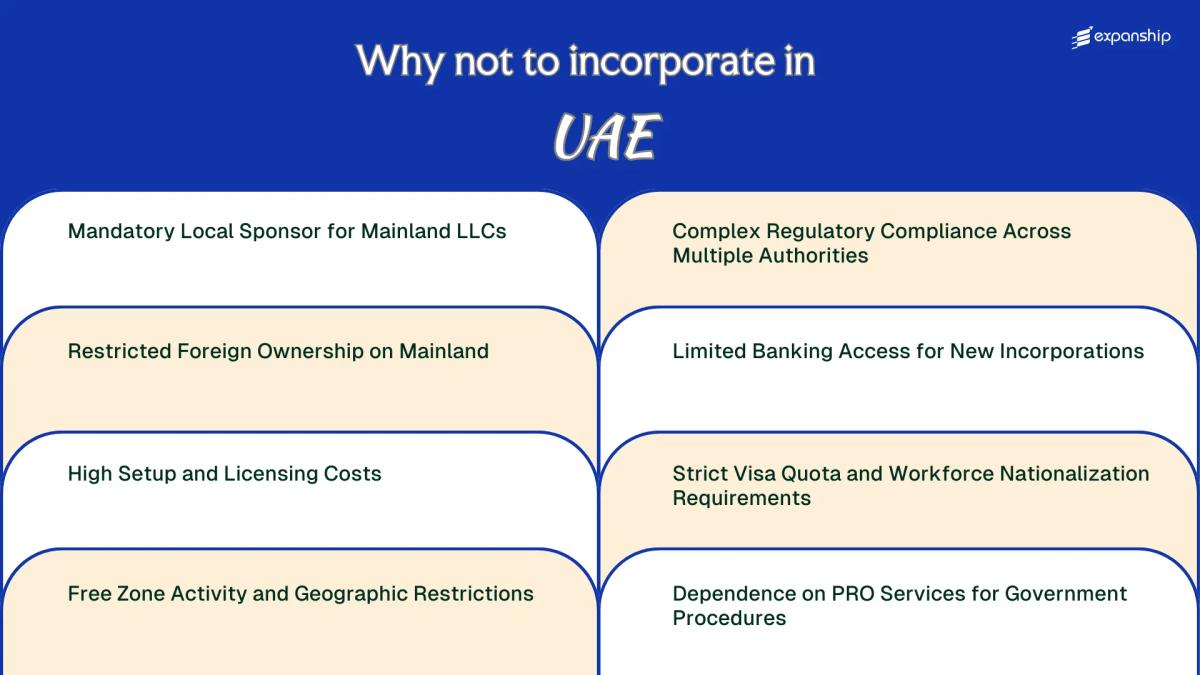
Mandatory Local Sponsor for Mainland LLCs
UAE mainland local sponsor requirements create a structural dependency that can expose your business to significant legal and financial risk. Under Federal Law No. 2 of 2015 (the Commercial Companies Law), mainland LLCs historically required a UAE national to hold at least 51% of shares.
The Sponsor's Legal Position
Although the 2021 amendments to the Commercial Companies Law expanded the list of activities where full foreign ownership is permitted on the mainland, a large number of sectors still mandate a local Emirati partner holding the majority stake. That partner holds genuine legal ownership, not a ceremonial title, which means disputes over profit distribution, business decisions, or exit terms can become protracted and costly.
Contractual Workarounds and Their Limits
Many foreign investors rely on side agreements to retain effective operational control, but these arrangements carry inherent local service agent restrictions in the UAE, as they are not formally recognized under company law and may not be enforceable in all circumstances. The local partner's name on the trade license gives them standing that your private contract cannot always override.
If your Emirati sponsor becomes incapacitated, enters insolvency, or disputes the arrangement, your ability to continue operations or transfer ownership without their cooperation is legally uncertain.
Restricted Foreign Ownership on Mainland
Foreign ownership restrictions UAE mainland businesses face stem directly from Federal Law No. 2 of 2015 on Commercial Companies, which historically capped foreign shareholding in mainland limited liability companies at 49%. This meant a UAE national had to hold the majority 51% stake, regardless of who was actually funding or operating the business.
Federal Decree-Law No. 26 of 2020 amended this framework, theoretically permitting 100% foreign ownership across a broader range of activities. In practice, however, the permitted activities list is determined by each emirate's Department of Economic Development, and many commercially significant sectors remain restricted.
For your business, the equity ceiling creates a set of concrete operational problems:
- Profit distribution becomes a point of negotiation rather than a right, since the local majority shareholder holds formal legal standing over decisions.
- Securing external financing is harder when foreign shareholders lack controlling equity, as lenders and investors assess ownership structure as a risk factor.
- Ownership disputes are subject to UAE civil courts, where foreign investors historically face an uneven procedural footing.
- Selling or transferring shares requires the local partner's consent, which can delay exits or inflate buyout costs.
Restricted sectors include oil and gas exploration, utilities, and certain professional services. Your business model may qualify for liberalized ownership, but verification requires formal activity classification through the relevant DED, adding time and cost before incorporation can proceed.

Company Incorporation in the United Arab Emirates
Set up your business in the UAE with accurate guidance on ownership structures, licensing requirements, and mainland versus free zone trade-offs.
High Setup and Licensing Costs
The high cost of business setup in UAE is one of the first financial realities that catches foreign investors off guard. Unlike jurisdictions where incorporation involves a single government fee, the UAE disaggregates costs across multiple stages, each billed separately by different authorities.
Trade license fees alone vary significantly depending on the license category issued by the relevant emirate's Department of Economic Development (DED) or the free zone authority. A standard commercial license in Dubai can exceed AED 15,000 annually, and that figure does not include initial approval fees, name reservation charges, or the Memorandum of Association notarization costs.
| Cost Component | Approximate Amount (AED) | Why It Burdens New Entrants |
|---|---|---|
| DED Trade License (commercial) | 15,000 – 25,000/year | Recurring annual obligation regardless of revenue |
| Initial Approval & Name Reservation | 1,000 – 3,000 | Non-refundable even if setup is abandoned |
| MoA Notarization (Notary Public) | 1,500 – 4,000 | Mandatory legal step, costs scale with share capital |
| Office Lease (Ejari-registered) | 30,000 – 80,000+/year | Physical address legally required for DED licensing |
| Establishment Card | 1,000 – 2,000 | Required before visa processing can begin |
Physical office space presents a separate and substantial burden. The DED requires a registered, Ejari-documented tenancy contract, meaning virtual offices are not accepted for mainland licensing purposes. In Dubai, even a modest commercial unit in a mid-tier location rarely falls below AED 30,000 annually, making the real estate obligation a disproportionate cost for small or early-stage firms.
Taken together, a mainland LLC can realistically require AED 80,000 to AED 120,000 before the business issues a single invoice. Free zone packages advertised at lower entry points often exclude visa allocation costs, which are billed per visa and can add AED 5,000 to AED 7,000 per employee.
Free Zone Activity and Geographic Restrictions
UAE free zone geographic restrictions represent one of the more structurally limiting aspects of free zone incorporation. A company licensed within a free zone, whether JAFZA, DMCC, or any of the 40-plus designated zones, is legally confined to conducting business within its zone boundaries or internationally. Selling directly to UAE mainland customers without a local distributor or a separately licensed mainland entity is prohibited under free zone regulations.
This creates a bifurcated cost structure. Your free zone entity cannot simply expand its customer base to include mainland UAE businesses without incurring the additional expense of either appointing a mainland distributor or establishing a second, separately licensed company.
The practical consequence is that your business scope constraints are not commercial; they are regulatory. Free zone activity limitations under UAE law mean that a single entity cannot serve both offshore/international and domestic mainland markets.
- Direct mainland sales require a separate mainland trade license, not an extension of your free zone license.
- Goods moved from a free zone into mainland UAE are subject to standard customs duties at the point of entry.
- Each free zone issues its own license categories; business activities permitted in DMCC may not be permitted in JAFZA.
- Operating outside your licensed activity scope within a free zone can result in license suspension.
A free zone company selling to a mainland UAE client through a third-party distributor may find that the distributor legally takes title to the goods, removing the free zone entity from any direct contractual relationship with the end customer.
Complex Regulatory Compliance Across Multiple Authorities
Businesses incorporated in the UAE face UAE regulatory compliance challenges that extend well beyond a single licensing authority, with oversight spread across federal ministries, emirate-level departments, and free zone regulators simultaneously.
Fragmented Authority Over Licensing and Labor
Depending on where and how your entity is structured, you may need to satisfy the Department of Economic Development (DED) for your trade license, the Ministry of Human Resources and Emiratisation (MOHRE) for employment contracts, and the Federal Tax Authority (FTA) for VAT registration. Each authority operates its own portal, fee schedule, and renewal cycle, so a lapse in any one of them can expose the entire firm to penalties.
Compounding Administrative Load for Foreign Operators
Free zone companies face an additional layer, since their own free zone authority issues licenses, enforces its own regulations, and may require separate approvals before any federal-level registration. For a foreign business owner unfamiliar with how these bodies interact, maintaining simultaneous compliance across multiple licensing authorities creates ongoing administrative overhead that requires dedicated internal or outsourced resources to manage year-round.
Managing Regulatory Complexity in the UAE
If your business spans mainland and free zone structures, or requires coordination across DED, MOHRE, and free zone authorities, speak with our UAE specialists about what compliance obligations apply to your specific setup.
Limited Banking Access for New Incorporations
UAE corporate banking access problems are among the most reported friction points for newly incorporated entities, particularly those without an established local trading history. Banks operating under Central Bank of UAE supervision apply stringent Know Your Customer and anti-money laundering protocols that disproportionately affect foreign-owned firms.
- Most UAE-licensed banks require a minimum average monthly balance ranging from AED 50,000 to AED 500,000, which creates an immediate capital burden before your business generates revenue.
- Free zone entities frequently find that onshore banks treat them as higher-risk applicants, resulting in outright rejection or prolonged due diligence periods exceeding several months.
- Difficulty opening a business bank account in UAE is compounded for holding companies or businesses without a physical office, as banks treat virtual addresses as a compliance red flag.
- Correspondent banking restrictions mean that firms in certain sectors, including crypto, fintech, and consultancy, face structurally limited banking options regardless of their licensing status.
- Account approval is not guaranteed even after incorporation, leaving your firm operationally inactive until a banking relationship is established.
Strict Visa Quota and Workforce Nationalization Requirements
UAE Emiratisation requirements for businesses add a layer of mandatory staffing obligations that carry direct financial consequences. Under the Nafis program, private sector companies in certain industries are required to meet specific Emirati hiring quotas, with non-compliant firms subject to monthly penalties per unfilled position.
Companies with 50 or more employees in targeted sectors must reach a 10% Emiratisation rate, increasing by 2% annually. Falling short triggers a AED 6,000 monthly penalty per required Emirati hire not fulfilled, making non-compliance a recurring operational cost rather than a one-off fine.
Sourcing qualified Emirati candidates can be difficult, particularly for specialized technical roles. This forces many foreign firms to either overpay to attract local talent or absorb penalties indefinitely, neither of which reflects a sustainable staffing model.
Visa quota restrictions compound this pressure. The number of work visas an entity can sponsor is tied to office space and headcount ratios set by the Ministry of Human Resources and Emiratisation (MOHRE), which can constrain workforce scaling for growing businesses.
A foreign-owned firm with 60 employees in a qualifying sector that fails to hire 6 Emirati staff faces AED 36,000 in monthly Nafis penalties, amounting to AED 432,000 annually in compliance costs before any operational expense is counted.
Dependence on PRO Services for Government Procedures
PRO services dependency among UAE businesses is not optional friction — it is a structural feature of how government procedures function. A Public Relations Officer handles document attestation, visa applications, labour card renewals, trade licence submissions, and interactions with authorities such as the Ministry of Human Resources and Emiratisation (MOHRE) and the Federal Authority for Identity, Citizenship, Customs and Ports Security (ICP). Without this function, routine filings stall.
Most foreign-owned entities, particularly those without a dedicated in-house PRO, rely on external service providers. These firms charge retainer or per-transaction fees, and costs accumulate across Emirates ID renewals, establishment card maintenance, and annual licence renewals across multiple authorities.
The financial burden is compounded by unpredictability. Government portals such as the Ministry of Economy's online systems and free zone authority platforms periodically update submission requirements, and errors or missed steps result in rejection fees and resubmission delays.
- PRO errors on visa applications can trigger bans or status flags on the ICP system
- Establishment card lapses affect the company's ability to process any employee visa
- Delays in MOHRE approvals directly block new hire onboarding
If your establishment card — issued through the relevant licensing authority — lapses or contains incorrect data, all visa and labour-related transactions for your firm are suspended until it is rectified, regardless of how compliant your other documentation is.
Strategies to Overcome These Challenges
Overcoming UAE business setup challenges requires structural decisions made before incorporation, not adjustments attempted after licensing. The choice of jurisdiction type, ownership model, and activity classification each carry compliance consequences that are difficult to reverse.
- Elect a free zone entity if your business model does not require direct mainland sales, to avoid mandatory local sponsorship under the UAE Commercial Companies Law.
- Apply for a licence under one of the expanded foreign ownership categories introduced by the 2021 amendments to Federal Decree-Law No. 32, which removed the 49% foreign ownership cap for many mainland activities.
- Assess visa allocation requirements against your projected headcount before selecting a free zone, as each authority sets its own quota ratios.
- Open a corporate bank account through a UAE Central Bank-licensed institution early in the incorporation process to avoid operational delays.
- Register with the relevant emirate-level authority, such as DED or ADGM, to ensure your activity codes align with actual business operations from the outset.
These steps address structural and procedural friction points within a regulatory environment governed by both federal legislation and emirate-specific rules. Compliance obligations vary considerably depending on whether your entity falls under mainland, free zone, or offshore frameworks.
UAE as a Business Destination
Despite the disadvantages covered in this blog, the UAE remains a credible incorporation destination when assessed against the full picture of what it offers foreign businesses. Tax policy, geographic position, and a maturing regulatory environment give it a profile that few jurisdictions in the region can match.
| Pros | Cons |
|---|---|
| No corporate income tax on most businesses under the federal CT regime (with the 9% rate applying above AED 375,000 taxable income) | Mainland LLCs require a UAE national sponsor, creating a structural dependency that limits operational control |
| Access to a network of over 130 double tax treaties | Foreign ownership on the mainland remains restricted in several sectors outside the 2020 FDI reforms |
| Over 40 free zones offering 100% foreign ownership and sector-specific licensing | Free zone entities face geographic restrictions on direct mainland trading without a local distributor or additional licensing |
| A strong physical and financial infrastructure supporting international business operations | Corporate bank account opening for newly incorporated entities is slow and subject to stringent due diligence |
| Residency visa pathways tied to company formation provide a practical base for founders | Visa quotas and Emiratisation targets under the NAFIS program add ongoing workforce compliance obligations |
Licensing fees, free zone authority charges, and PRO service costs make initial setup materially more expensive than many competing jurisdictions. That cost structure is a fixed reality of market entry here, not a variable that improves at scale for smaller firms.
Corporate Compliance Services in the UAE
Maintain good standing with UAE federal and emirate-level authorities, including MoEI filings, free zone renewals, UBO register updates, and Emiratisation reporting obligations.
Conclusion
The UAE company formation drawbacks summary is straightforward: the jurisdiction offers real commercial advantages, but the structural and administrative constraints documented across this blog are not minor inconveniences. Mainland LLC sponsorship requirements, the geographic and operational limits of free zone licensing, and the persistent difficulty new entities face in opening corporate bank accounts each carry material consequences for your business. Specific processes sit across multiple authorities, including the relevant emirate-level Department of Economic Development and the Central Bank. Informed planning, grounded in an accurate reading of these constraints, remains the practical starting point before any incorporation decision.
Expanship's UAE Incorporation Support
Firms providing UAE incorporation support for foreign companies work within the same regulatory environment you do — dealing with the Department of Economic Development, free zone authorities, and the Central Bank's account-opening requirements firsthand. Expanship's role is to reduce the administrative weight of these obligations, not to bypass them.
Our service scope covers the full incorporation and post-incorporation cycle across mainland and free zone structures:
- Preparing and submitting all company registration documents to the relevant authority.
- Providing a registered agent and office address where required by local regulations.
- Liaising directly with government bodies for filings and regulatory correspondence.
- Managing ongoing compliance obligations after your entity is registered and operational.
- Making introductions to UAE banks familiar with foreign-owned corporate structures.
- Handling tax registration and coordination with the Federal Tax Authority where applicable.
Reach out to Expanship UAE to discuss your incorporation requirements.
Frequently Asked Questions (FAQ)
Free zone entities are not subject to the local sponsor requirement and permit 100% foreign ownership across all licensed activities within their respective zones. The restriction applies specifically to mainland companies operating under the jurisdiction of the Department of Economic Development (DED) in each emirate, and only for activities that fall outside the amended Commercial Companies Law's liberalized list. If your business activity is on a restricted list and you need mainland access, a local sponsor or service agent arrangement remains legally mandatory.
Setup costs vary significantly by emirate, free zone, and activity type, but a free zone license can range from approximately AED 10,000 to AED 50,000 or more per year depending on the authority, visa allocation, and office package chosen. Mainland LLC formation through the DED typically involves additional fees including initial approval, name reservation, notarization, and Memorandum of Association drafting, which can push total first-year costs well above AED 30,000 before factoring in office lease obligations under Ejari registration. Neither structure is low-cost compared to many competing jurisdictions in Southeast Asia or Eastern Europe.
A free zone entity is legally prohibited from conducting direct commercial activity on the UAE mainland without either appointing a mainland distributor or establishing a separate mainland entity. Violating this restriction can result in license suspension, fines issued by the relevant free zone authority, and potential blacklisting from future licensing applications. Some free zones, such as DMCC and DIFC, offer dual-license arrangements with the DED, but these come with additional costs and compliance obligations that must be met independently.
UAE banks apply stringent Know Your Customer (KYC) and Anti-Money Laundering (AML) due diligence requirements under the Central Bank of the UAE's regulatory framework, and many institutions routinely reject or delay account applications from newly formed entities, particularly those with foreign shareholders from higher-risk jurisdictions. The process can take anywhere from four weeks to several months, and some banks require a minimum deposit or maintained balance ranging from AED 25,000 to AED 500,000 depending on the account type. Free zone companies without a physical office or local revenue history face notably higher rejection rates than established mainland businesses.
Yes. Private sector companies with 50 or more employees are subject to mandatory Emiratisation targets under the Nafis program, and firms that fail to meet the incremental annual hiring quotas face a monthly financial contribution (levy) per unfilled Emirati position, currently set at AED 6,000 per month for skilled roles. The Ministry of Human Resources and Emiratisation (MOHRE) tracks compliance through the Tawteen system, and persistent non-compliance can affect a company's ability to obtain or renew work permits. Smaller firms below the threshold are not currently subject to the same mandatory quota, though the government has signaled intent to broaden coverage over time.
Yes. The introduction of Federal Corporate Tax under Federal Decree-Law No. 47 of 2022, effective for financial years starting on or after 1 June 2023, added a layer of compliance that did not previously exist for most UAE businesses. Companies with taxable income exceeding AED 375,000 are subject to a 9% corporate tax rate, and all entities must register with the Federal Tax Authority regardless of whether they expect to owe tax. This registration requirement, combined with transfer pricing documentation obligations for related-party transactions, means that even small foreign-owned firms now face ongoing compliance costs that must be budgeted for at incorporation.
The UAE's complexity does not stem from a single, unified corporate law framework but from the fragmented authority structure: over 40 free zones each operate under their own authority, mainland companies fall under emirate-level DEDs and federal law simultaneously, and sector-specific regulators such as the DFSA, SCA, and CBUAE add further layers. Singapore, by contrast, operates under a single Accounting and Corporate Regulatory Authority (ACRA) with one unified Companies Act, making compliance tracking considerably more straightforward. The UAE's multi-authority environment is not inherently more burdensome in cost, but the jurisdictional overlap creates a higher risk of procedural error for businesses without local legal or PRO support.
Legal Disclaimer
The information provided in this article is for general informational purposes only and does not constitute legal, tax, or professional advice. While we strive to ensure the accuracy and timeliness of the content, laws and regulations are subject to change, and the application of laws can vary widely based on specific facts and circumstances.
Readers should not act upon this information without seeking professional counsel tailored to their individual situation. Expanship and its authors disclaim any liability for actions taken or not taken based on the content of this article.
For specific advice regarding your business setup, compliance requirements, or any legal matters, please consult with qualified legal and tax professionals in the relevant jurisdiction.