

Key Takeaways
- Foreign investors in reserved sectors face compulsory divestiture obligations under Zimbabwe's indigenisation legislation, which historically required up to 51% local ownership and continues to impose sector-specific thresholds that constrain control over incorporated entities.
- ZIMRA's tax compliance framework imposes layered obligations — including corporate income tax, value-added tax, and withholding taxes on dividends — that require ongoing engagement with a regulatory body known for administrative backlogs and inconsistent enforcement.
- Currency instability, including the historical collapse of the Zimbabwean dollar and successive monetary reforms, means that profit repatriation for foreign shareholders carries material exchange rate risk that is difficult to hedge through conventional financial instruments.
- Weak statutory protection and limited judicial capacity to enforce intellectual property rights under Zimbabwe's current IP framework expose foreign businesses to infringement risk with few practical remedies available in-country.
Zimbabwe operates under an evolving but heavily regulated corporate framework, with company formation governed by the Companies Act as the primary legislation. The disadvantages of incorporating in Zimbabwe span across currency controls, ownership restrictions, tax administration, and financial infrastructure, among other areas covered in this article.
Not every drawback carries equal weight across all business types. A foreign investor entering a sector classified as reserved or partially reserved under indigenisation policy will face materially different constraints than one operating in an exempt category.
This article is most directly relevant to foreign nationals, non-resident investors, and multinational entities considering establishing a presence through a private business corporation or private limited company. Risks of doing business in Zimbabwe differ considerably depending on the industry, the proposed ownership structure, and the investor's need to repatriate earnings or access foreign financing.
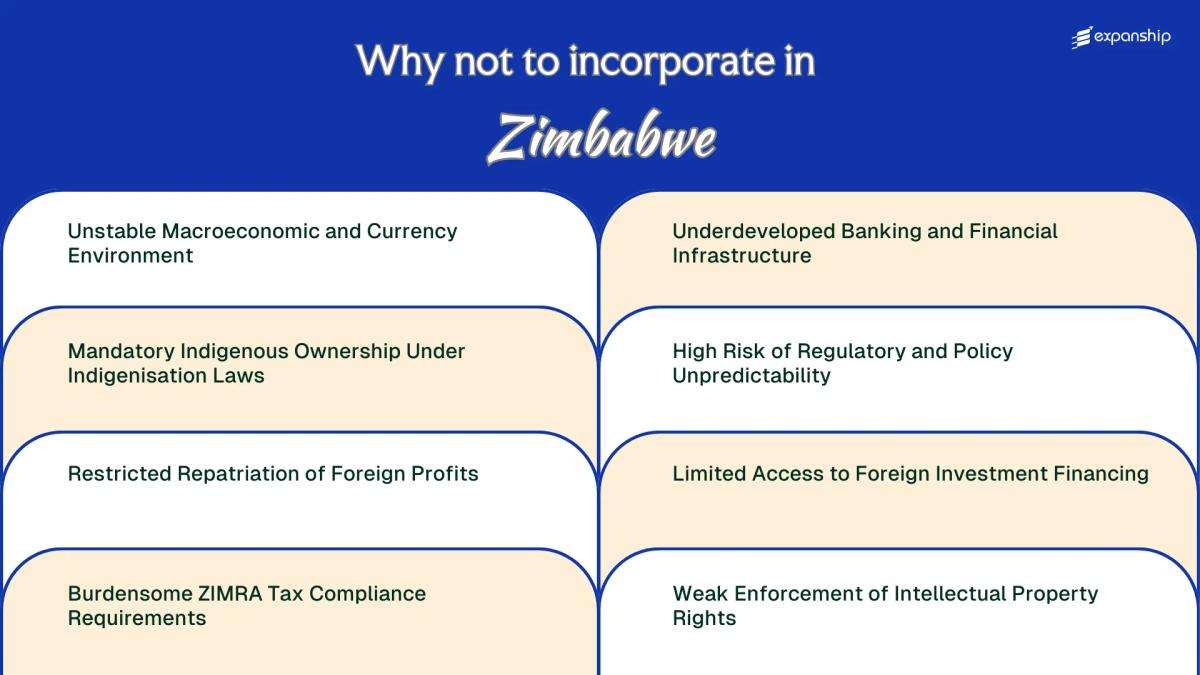
Unstable Macroeconomic and Currency Environment
Zimbabwe currency instability risks have directly undermined business planning for foreign entities operating in the country for over two decades, with no single monetary framework holding long enough to provide reliable pricing, contracting, or forecasting conditions.
A History of Currency Failure That Raises Operational Costs
The Zimbabwe Gold (ZiG), introduced by the Reserve Bank of Zimbabwe in April 2024, is the sixth currency the country has introduced since abandoning the original Zimbabwean dollar in 2009. Each prior currency collapsed under hyperinflationary pressure, and the ZiG has already experienced sharp devaluation within months of its launch. For your business, this means contracts denominated in local currency carry real erosion risk, and multi-year financial projections are structurally unreliable.
Dual-currency conditions persist informally, with USD widely used alongside ZiG, yet official exchange rate mechanisms do not always reflect actual market rates.
Why ZiG Exchange Rate Problems Compound Foreign Investor Exposure
Because Zimbabwe's interbank exchange rate and the parallel market rate frequently diverge, your firm faces valuation gaps when converting revenue or settling liabilities. This discrepancy directly affects audited accounts, tax obligations to ZIMRA, and cross-border payment settlements.
Macroeconomic instability compounds this further, as inflation historically spikes during election cycles and external reserve shortfalls.
ZiG exchange rate volatility means that any local-currency revenue your business generates can lose significant real value before it is repatriated or reinvested, creating unquantifiable financial exposure at the entity level.
Mandatory Indigenous Ownership Under Indigenisation Laws
Zimbabwe indigenisation law restrictions remain one of the most structurally significant barriers for foreign investors seeking majority ownership of a local entity. The Indigenisation and Economic Empowerment Act (Chapter 14:33) historically required that indigenous Zimbabweans hold at least 51% of shares in certain businesses, effectively capping foreign ownership at 49% in affected sectors.
Amendments introduced around 2018 relaxed these thresholds for most sectors, but diamond and platinum mining operations retain the 51% indigenous ownership requirement. This means your firm cannot hold a controlling stake in those sectors regardless of capital contribution.
Beyond mining, the broader compliance architecture still imposes friction:
- Identifying a qualifying indigenous partner with sufficient capital and operational capacity adds significant time and cost to the pre-incorporation phase.
- Minority foreign ownership limits your governance rights, reducing your ability to enforce internal financial controls or strategic decisions.
- Profit distribution arrangements become contractually complex, often requiring costly legal structuring to protect your economic interest.
- Any change in local shareholding requires regulatory notification, creating ongoing administrative exposure for your business.
Even in liberalised sectors, residual discretionary powers held by the Zimbabwe Investment and Development Agency mean compliance obligations are not always predictable.

Company Incorporation in Zimbabwe
Set up your business in Zimbabwe with guidance on ownership structures, regulatory compliance, and sector-specific requirements.
Restricted Repatriation of Foreign Profits
Zimbabwe foreign profit repatriation restrictions sit at the centre of why foreign investors frequently reassess the viability of operating here. Under the Exchange Control Act [Chapter 22:05] and regulations administered by the Reserve Bank of Zimbabwe (RBZ), all outward transfers of dividends, royalties, and capital require prior approval. That approval process introduces delays that can stretch from weeks to months, directly disrupting the cash flow timelines your parent company depends on.
| Transfer Type | Approval Requirement | Practical Burden |
|---|---|---|
| Dividend remittance | Prior RBZ authorisation required | Delays of weeks to months; no guaranteed timeline |
| Capital repatriation | Documented proof of original inward investment required | Evidentiary burden is high; incomplete records cause rejections |
| Royalty payments | Subject to withholding tax and exchange control approval | Dual regulatory layer increases processing friction |
| Loan repayments to foreign parent | Must comply with registered loan terms with RBZ | Unregistered loans cannot be repaid offshore |
Foreign exchange scarcity compounds the structural problem. Even after approval is granted, the actual availability of USD or other hard currencies through the formal banking system is not guaranteed, meaning approvals do not translate automatically into transfers.
Capital repatriation problems in Zimbabwe are not merely procedural. The inability to extract profits predictably undermines the entire financial model for foreign-owned subsidiaries, particularly those that depend on dividend remittance to service group-level obligations abroad.
Burdensome ZIMRA Tax Compliance Requirements
ZIMRA tax compliance burdens fall disproportionately on foreign-registered entities, which face a more complex registration and reporting process than domestically incorporated firms. The Zimbabwe Revenue Authority administers multiple overlapping tax heads, including Corporate Income Tax, Value Added Tax, and withholding taxes, each with distinct filing cycles and return formats.
Corporate tax is levied at 25% for most companies, but the practical burden extends beyond the rate itself. Your entity must file quarterly payment dates (QPDs) for income tax, with instalment payments due in March, June, September, and December, meaning cash flow must be managed around a calendar that allows no grace period for late payers.
VAT-registered businesses file monthly returns, and failure to file on time triggers automatic penalties. For a foreign company unfamiliar with the local tax portal, navigating the self-assessment system without local tax representation is operationally difficult.
- Corporate income tax QPDs fall on four fixed dates annually; missing any instalment attracts interest and penalties.
- VAT registration is compulsory once annual turnover exceeds the prescribed threshold.
- Transfer pricing documentation is required for related-party transactions with non-resident entities.
- Withholding tax applies to dividends, fees, and royalties remitted to foreign shareholders.
Zimbabwe imposes a separate Intermediated Money Transfer Tax (IMTT) on electronic transactions, meaning your business is taxed simply for moving money between accounts.
Underdeveloped Banking and Financial Infrastructure
Zimbabwe banking infrastructure limitations affect foreign-owned entities from the moment operations begin. Correspondent banking relationships are sparse, and account opening timelines for newly incorporated firms frequently extend beyond what most international operators anticipate.
Structural Gaps in the Banking System
The Reserve Bank of Zimbabwe (RBZ) oversees a banking sector that remains undercapitalised relative to regional peers, with several institutions operating below internationally recommended capital adequacy thresholds. For your business, this means limited credit facilities, restricted trade finance products, and difficulty securing basic instruments such as letters of credit or bank guarantees that routine cross-border transactions require.
Dollarisation has reduced some monetary instability, but it has not resolved the shallow deposit base that constrains commercial lending capacity.
Operational Consequences for Foreign Firms
Underdeveloped financial sector conditions mean that digital payment infrastructure, where it exists, is inconsistent across institutions, creating friction in day-to-day corporate transactions. Processing delays and foreign currency allocation restrictions, managed through the RBZ's foreign exchange priority queue system, can stall supplier payments and payroll for firms with international obligations. Firms in sectors outside designated priority categories face the longest allocation wait times.
Addressing Banking and Operational Challenges When Setting Up in Zimbabwe
Get guidance on structuring your Zimbabwe entity to work within existing banking constraints and regulatory requirements.
High Risk of Regulatory and Policy Unpredictability
Zimbabwe regulatory unpredictability risks stem from a pattern of abrupt legislative reversals and ministerial discretion that makes long-term planning structurally unreliable for foreign businesses. Policy shifts have historically occurred with little forewarning and no reliable consultation period.
- The Zimbabwe Investment and Development Agency (ZIDA) can impose new conditions on investment licenses without a fixed statutory notice period, exposing your approvals to sudden revision.
- Regulatory instruments issued under the Presidential Powers (Temporary Measures) Act have previously overridden existing company arrangements without parliamentary debate, eliminating your ability to anticipate change.
- Sector-specific regulations, particularly in mining and finance, have been amended through Statutory Instruments that take immediate effect, leaving no transition window for your entity to adjust operations.
- Enforcement priorities across bodies such as ZIMRA and the Reserve Bank of Zimbabwe shift with political cycles, creating inconsistent compliance obligations that vary by period rather than by law.
- No independent regulatory impact assessment process is mandated before new rules take effect, removing the policy stability Zimbabwe businesses in other markets take as standard.
Limited Access to Foreign Investment Financing
Zimbabwe foreign investment financing limitations affect foreign-incorporated entities from the earliest stages of capitalization. Local banks operate under tight liquidity constraints and, given the country's history of hyperinflation and sovereign default, apply stringent risk-pricing to business lending that makes credit largely inaccessible to new or foreign-linked firms.
The Reserve Bank of Zimbabwe regulates foreign borrowing, and accessing offshore credit lines requires prior approval under the Exchange Control Act [Chapter 22:05]. This approval process introduces delays and uncertainty that foreign investors in more open markets do not face.
Multilateral development finance, such as from the African Development Bank or IFC, is available in principle but typically reserved for large-scale infrastructure or priority-sector projects. A small or mid-sized foreign entity incorporating here will generally find those channels closed.
A foreign-owned firm requiring USD 500,000 in working capital may find that local banks, constrained by limited hard-currency reserves and elevated country-risk premiums, decline to lend in USD entirely, forcing the business to either seek full equity financing from abroad or operate significantly undercapitalized relative to its original business plan.
Weak Enforcement of Intellectual Property Rights
Zimbabwe intellectual property rights risks are not theoretical. The country's IP regime, governed primarily by the Trade Marks Act [Chapter 26:04] and the Patents Act [Chapter 26:03], provides a legal framework on paper, but enforcement remains structurally weak. Your registered trademark or patent offers limited practical deterrence against infringement.
The Zimbabwe Intellectual Property Office (ZIPO) handles registrations, but its operational capacity for active monitoring and enforcement is limited. Counterfeit goods and brand imitation persist in informal markets, and pursuing civil remedies through the courts is slow and costly relative to the likely recovery.
For foreign firms in consumer goods, pharmaceuticals, or technology, this gap between registration and enforcement creates direct commercial exposure. Competitors or third parties can replicate your brand assets or proprietary processes with minimal fear of swift legal consequence.
- Trademark disputes are processed through civil courts, not a dedicated IP tribunal
- Criminal enforcement of IP violations is inconsistent and rarely initiated
- Cross-border infringement originating from neighboring markets compounds the risk
Even a validly registered trademark through ZIPO does not guarantee enforcement action against infringers, meaning your IP protection depends entirely on your ability to fund private civil litigation.
Strategies to Overcome These Obstacles
Overcoming Zimbabwe business incorporation challenges requires structural preparation before entry, not reactive adjustments after registration. The obstacles covered in this blog are systemic, and addressing them depends on how the business is set up from the outset.
- Structure equity ownership to meet the thresholds prescribed under the Indigenisation and Economic Empowerment Act before submitting your application to ZIDA.
- Open multi-currency accounts under the Foreign Currency Accounts framework to reduce exposure to ZiG volatility and facilitate cross-border transactions.
- Register for all applicable taxes with ZIMRA at incorporation and maintain contemporaneous records to meet self-assessment filing obligations.
- File dividend remittance applications through the Reserve Bank of Zimbabwe's exchange control division to formalise any profit repatriation ahead of distribution.
- Register trademarks and other intellectual property with the Zimbabwe Intellectual Property Office before commencing commercial operations.
Each of these steps operates within a regulatory framework that remains subject to ministerial discretion and policy revision. Compliance at formation reduces exposure but does not eliminate the structural risks documented in this blog.
Zimbabwe's Overall Business Case
Zimbabwe presents a genuinely mixed picture for foreign investors. The disadvantages covered in this blog are structural and well-documented, yet the country retains real commercial value — a young labour force, mineral wealth, and a dollarized economy that, despite its instability, removes local currency conversion risk for USD transactions. For the right business profile, the Zimbabwe business environment pros and cons calculation does not automatically resolve against incorporation.
| Pros | Cons |
|---|---|
| Abundant natural resources create opportunity in mining and agriculture sectors | Hyperinflationary history and persistent currency instability undermine long-term financial planning |
| USD-denominated transactions reduce exposure to local currency devaluation for some operators | Indigenisation laws under the Zimbabwe Investment and Development Agency Act can restrict foreign ownership in certain sectors |
| A sizeable and relatively educated workforce supports operational capacity | ZIMRA compliance obligations are administratively demanding and subject to frequent regulatory change |
| Regional positioning within SADC offers access to broader southern African markets | Profit repatriation faces documented restrictions and approval requirements through the Reserve Bank of Zimbabwe |
| Weak intellectual property enforcement limits protection for brand and technology assets |
Formal incorporation remains a viable path for businesses with the risk tolerance and sector positioning to absorb these constraints.
Corporate Compliance Services for Companies in Zimbabwe
Maintain your company's good standing with ZIMRA and the Zimbabwe Investment and Development Agency through structured compliance support covering annual filings, tax obligations, and regulatory reporting.
Conclusion
Zimbabwe incorporation drawbacks summary reflects a jurisdiction where structural barriers are material, not marginal. Currency instability tied to the ZiG's managed exchange rate, indigenisation requirements under the Zimbabwe Investment and Development Agency Act that can limit foreign equity in designated sectors, and ZIMRA's compliance obligations each create friction that compounds over time. Profit repatriation restrictions add a further layer of financial risk for foreign-owned entities. Structural improvements are underway, but the regulatory environment remains one where specialist guidance through local legal counsel and a registered agent is a practical necessity rather than an option.
Expanship's Zimbabwe Expansion Services
Expanship's Zimbabwe company formation services are designed to help your business work through the compliance obligations covered throughout this blog, from ZIMRA tax registration to filing requirements under the Companies and Other Business Entities Act. Expanship reduces the operational burden of engaging with Zimbabwe's regulatory environment, though the underlying challenges of the jurisdiction remain.
Beyond formation, the scope of support covers the full incorporation and compliance cycle.
- Preparing and submitting company registration documents with the Companies Registry.
- Providing a registered agent and local office address for your entity.
- Handling government filings and liaising with ZIMRA and other regulatory bodies on your behalf.
- Managing post-incorporation compliance obligations as your business operates.
- Facilitating introductions to local banking institutions for account opening.
- Registering your firm for applicable taxes and coordinating with local authorities.
To discuss your requirements, contact Expanship Zimbabwe.
Frequently Asked Questions (FAQ)
The Indigenisation and Economic Empowerment Act applies broadly, but the ownership thresholds vary by sector. Foreign investors in certain designated sectors, particularly natural resources, are required to cede at least 51% ownership to indigenous Zimbabweans. Outside those reserved sectors, the requirements have been relaxed, though compliance obligations under the Act remain active and are enforced through the Ministry of Finance and Economic Development.
The Zimbabwe Revenue Authority imposes penalties and interest charges on late or non-compliant filings, and these can accumulate quickly if ignored. ZIMRA has the authority to conduct audits, freeze accounts, and pursue civil recovery action against non-compliant entities. The Income Tax Act and associated regulations set out the penalty framework, and there is limited administrative discretion once a liability is formally assessed.
Foreign profit repatriation is not outright prohibited, but it is subject to Reserve Bank of Zimbabwe approval and foreign exchange availability, both of which have historically created significant delays. During periods of acute foreign currency shortages, approvals have been deferred for months, effectively trapping funds onshore. This is a structural risk, not an isolated processing issue, and it directly affects dividend planning and intercompany funding strategies.
Zimbabwe's IP enforcement is weaker than comparable jurisdictions such as South Africa and Mauritius, where dedicated IP courts and stronger customs interception mechanisms exist. The Zimbabwe Intellectual Property Office administers registrations, but enforcement through the courts is slow and outcomes are inconsistent. For businesses whose value is tied to brands, software, or proprietary processes, this gap in enforcement represents a real and ongoing commercial exposure.
Non-compliance with the Indigenisation and Economic Empowerment Act can result in fines, operating licence suspension, or forced divestiture proceedings. The Act grants the relevant minister significant discretionary power in determining remedies, which adds an element of unpredictability to the enforcement process. Businesses operating in reserved sectors without a compliant ownership structure face the greatest exposure, as the consequences there are more consistently applied.
Access to local bank financing for foreign-owned entities is severely constrained. Zimbabwean commercial banks operate under tight liquidity conditions, and lending to foreign firms, particularly those without significant local collateral, is uncommon. The combination of high borrowing costs, foreign currency restrictions, and limited institutional depth means most foreign businesses must self-fund or source capital entirely from outside Zimbabwe.
Zimbabwe's regulatory environment carries a higher degree of policy unpredictability than most SADC peers, including Zambia, Botswana, and Namibia. Statutory instruments have been used repeatedly to alter investment conditions, tax treatment, and sector-specific rules with little advance notice. This pattern means that compliance achieved at the point of incorporation does not guarantee ongoing compliance, as the underlying rules can shift through secondary legislation without parliamentary debate.
Legal Disclaimer
The information provided in this article is for general informational purposes only and does not constitute legal, tax, or professional advice. While we strive to ensure the accuracy and timeliness of the content, laws and regulations are subject to change, and the application of laws can vary widely based on specific facts and circumstances.
Readers should not act upon this information without seeking professional counsel tailored to their individual situation. Expanship and its authors disclaim any liability for actions taken or not taken based on the content of this article.
For specific advice regarding your business setup, compliance requirements, or any legal matters, please consult with qualified legal and tax professionals in the relevant jurisdiction.