
Key Takeaways
- Zimbabwe's source-based territorial tax system means foreign-sourced income falls outside ZIMRA's corporate tax net, making it structurally efficient for holding companies or regional operating entities with cross-border revenue streams.
- Registering under the Companies and Other Business Entities Act (Chapter 24:31) places a foreign-owned entity within a documented legal framework that, when combined with Zimbabwe's bilateral investment treaty network, provides enforceable protections against expropriation and discriminatory treatment under international law.
- Membership in both SADC and COMESA gives Zimbabwe-incorporated businesses preferential access to a combined market spanning dozens of countries across eastern and southern Africa, reducing tariff friction for firms with a regional export orientation.
- Operations conducted within Zimbabwe's Special Economic Zones can qualify for tax holidays, creating a materially different cost structure compared to standard corporate tax treatment — particularly relevant for businesses targeting the mining and natural resources sector.
Zimbabwe is a landlocked, independent republic in southern Africa, bordered by Zambia, Botswana, Mozambique, and South Africa. Incorporating here means registering through the Companies and Other Business Entities Act framework, administered by the Zimbabwe Investment and Development Agency (ZIDA) alongside the Registrar of Companies — though for a practical understanding of the benefits of incorporating in Zimbabwe, it helps to first understand what the country offers as a business environment.
The most common legal vehicle foreign investors use is the private limited company. From a tax standpoint, Zimbabwe operates a source-based territorial tax system, meaning income earned outside the country's borders is generally not subject to local corporate tax.
Foreign direct investment has received increasing government attention in recent years, with policy shifts reflecting a stated commitment to opening key sectors to full or majority foreign ownership. This article examines the specific Zimbabwe company formation advantages that make the jurisdiction worth evaluating for businesses seeking a presence in the region.
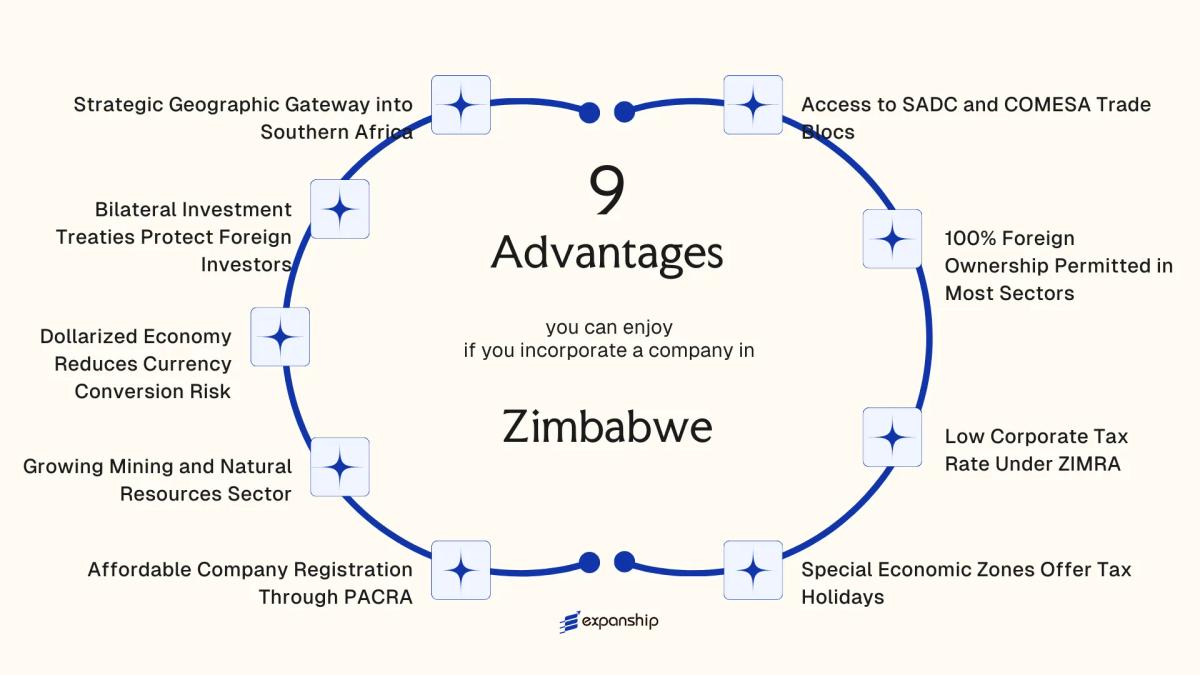
Access to SADC and COMESA Trade Blocs
Zimbabwe SADC COMESA trade bloc access gives incorporated companies a commercially significant advantage: a single registered entity can trade across two of Africa's largest regional economic communities without establishing separate legal presences in each member state.
What Bloc Membership Means in Practice
Zimbabwe is a full member of both the Southern African Development Community (SADC) and the Common Market for Eastern and Southern Africa (COMESA). COMESA alone spans 21 member states with a combined GDP exceeding USD 1 trillion, while SADC connects 16 Southern African economies under a shared trade protocol.
Under the COMESA Free Trade Area, qualifying goods traded between member states benefit from zero or reduced tariff rates. For your business, this means manufactured or processed goods produced through a Zimbabwe-registered entity may enter markets like Kenya, Egypt, or Zambia at preferential duty rates unavailable to firms incorporated outside the bloc.
Protocol Eligibility and Rules of Origin
Access to these preferences is not automatic. COMESA trade benefits for businesses depend on meeting rules of origin requirements, which generally require sufficient local value addition or transformation within a member state. SADC membership advantages Zimbabwe companies in a similar way under the SADC Protocol on Trade.
A Zimbabwe-incorporated entity can serve 37 regional markets across two trade blocs from a single legal base.
100% Foreign Ownership Permitted in Most Sectors
Under the Zimbabwe Investment and Development Agency Act (Chapter 14:37), most sectors are open to full foreign equity participation. This means your business can be wholly foreign owned without requiring a local partner or co-shareholder. The practical effect is direct: you retain full control over profits, governance, and strategic decisions from day one.
The principal legislation governing this is the Zimbabwe Investment and Development Agency (ZIDA) Act, enacted in 2020 to consolidate and simplify the foreign investment framework. Under its provisions, 100% foreign ownership Zimbabwe companies can operate across manufacturing, services, technology, and agriculture without mandatory indigenization requirements — provided the sector is not among those reserved under the Zimbabwe Investment and Development Agency (Reserved Sectors) Regulations.
Reserved activities, such as certain artisanal mining operations and small-scale retail in designated categories, do carry local ownership thresholds. Outside those exceptions, wholly foreign owned company Zimbabwe registrations face no dilution requirements.
The ownership structure you establish at incorporation is what matters most:
- No minimum local shareholding is imposed on most commercial sectors
- Foreign directors can hold all voting shares without triggering regulatory review
- Profit repatriation rights attach to the ownership structure from the outset, not after a probationary period
- Capital contributions are not subject to sector-specific foreign equity caps in qualifying industries
Full equity ownership also simplifies your corporate governance. Eliminating the need for a local joint venture partner removes a common source of shareholder disputes and contractual complexity.

Incorporate a Company in Zimbabwe
Register a wholly foreign owned company in Zimbabwe with full equity control under the ZIDA Act framework.
Low Corporate Tax Rate Under ZIMRA
Zimbabwe's standard corporate tax rate is 25%, administered by the Zimbabwe Revenue Authority (ZIMRA) under the Income Tax Act [Chapter 23:06]. For foreign businesses comparing options across the region, this rate sits below the OECD global average of approximately 23% on a purchasing-power-adjusted basis and is competitively positioned relative to several larger African economies where rates commonly exceed 30%.
What this means practically is that a profitable foreign-owned company registered in Zimbabwe retains a greater share of its earnings without requiring special status or negotiated arrangements. The 25% rate applies as the baseline to most resident companies, so your business benefits from day one of operation rather than depending on discretionary approvals.
| Entity / Income Type | Tax Rate |
|---|---|
| Standard resident company | 25% |
| Mining companies (general) | 25% |
| Branches of foreign companies | 25% |
| Small and medium enterprises (turnover-based threshold) | Reduced presumptive rates may apply |
Withholding tax on dividends paid to foreign shareholders is set at 15% under the Income Tax Act, though this figure can be reduced under applicable double taxation agreements that Zimbabwe has concluded with treaty partners. For a foreign investor repatriating profits, the combined effective tax burden on distributed earnings depends on your home jurisdiction's treatment of foreign dividends, making treaty eligibility a practical consideration worth examining before structuring your entity.
Special Economic Zones Offer Tax Holidays
Zimbabwe Special Economic Zones offer qualifying companies a 0% corporate income tax rate for the first five years of operation, followed by a reduced rate thereafter. Established under the Zimbabwe Special Economic Zones Act (Chapter 14:34), these zones are administered by the Zimbabwe Special Economic Zones Authority (ZISEZA). For a foreign investor, this means your entity can accumulate and reinvest profits during its most capital-intensive growth phase without a corporate tax liability eating into returns.
The exemption is not limited to income tax alone. Businesses operating within designated SEZ areas may also qualify for customs duty relief on imported capital equipment and raw materials, which directly reduces startup and operational costs.
Eligibility is tied to formal approval from ZISEZA and requires the entity to operate within a gazetted zone and maintain compliance with the conditions of its investment licence.
Keep the following in mind when structuring your SEZ-based entity:
- Confirm your intended business activity qualifies under ZISEZA's approved sector list
- Secure a valid investment licence before commencing operations to activate tax holiday status
- Track the transition date when the 0% rate expires to plan your post-holiday tax position
- Operating outside gazetted zone boundaries can disqualify your firm from the tax exemption retroactively
SEZ-registered companies in Zimbabwe can be 100% foreign-owned with no mandatory local shareholding requirement, which is atypical among SEZ frameworks across sub-Saharan Africa.
Affordable Company Registration Through PACRA
Zimbabwe company registration PACRA benefits begin with cost. The Patents and Companies Registration Authority (PACRA) administers company incorporation in Zimbabwe, and the prescribed government fees for registering a private business entity remain among the lower thresholds in the Southern African region. For foreign investors comparing entry costs across multiple jurisdictions, that lower baseline fee directly reduces the capital required before operations begin.
Registration Fees and What They Mean for Your Capital Allocation
PACRA processes applications under the Companies and Other Business Entities Act [Chapter 24:31], which governs formation requirements for private limited companies, public companies, and foreign company branches. The statutory registration fees are set by the government and published in official gazette notices, meaning you are not subject to discretionary pricing. Fixed, gazetted fees give your business predictable incorporation costs from the outset.
Speed and Administrative Structure as a Financial Benefit
PACRA also administers name reservation, certificate issuance, and post-incorporation filings through a centralized registry. Consolidating these functions under one authority reduces the number of agencies your firm must engage during setup, which lowers professional service hours and associated fees. Compared to markets where incorporation requires engagement with multiple government bodies across different ministries, a single-registry structure shortens the administrative timeline. Reduced time-to-registration translates directly into earlier operational readiness, which carries its own cost implication for businesses with defined launch windows.
Get a Full Cost Breakdown for Your Zimbabwe Incorporation via PACRA
Understand the exact fees, statutory requirements, and timelines that apply to your business structure before committing to registration.
Growing Mining and Natural Resources Sector
Zimbabwe mining sector investment advantages extend well beyond resource abundance. The country holds commercially significant deposits of platinum, gold, diamonds, chrome, lithium, and coal, with the Mining and Minerals sector governed under the Mines and Minerals Act [Chapter 21:05]. That legal framework defines how mineral rights are granted and establishes the Zimbabwe Mining Development Corporation (ZMDC) as a state entity involved in sector oversight and joint ventures.
- Lithium has attracted particular attention from battery supply chain investors. Zimbabwe holds some of the largest hard-rock lithium reserves on the African continent, and government policy has moved toward requiring in-country processing before export, which creates upstream business opportunities for firms establishing local processing entities.
- Foreign investment in Zimbabwe mining industry operations is permitted through formal licensing under the Ministry of Mines and Mining Development. A registered local entity can hold mining claims or enter into joint venture arrangements, giving your business a direct legal vehicle for resource extraction or ancillary services.
- The Zimbabwe Investment and Development Agency (ZIDA) Act of 2020 created a single-entry licensing system. For mining investors, this reduces the number of separate regulatory interactions required to begin operations.
- Zimbabwe natural resources investment benefits also extend to chrome and platinum group metals, where demand from the automotive and green energy sectors supports long-term off-take potential for producers operating within a formal corporate structure.
Dollarized Economy Reduces Currency Conversion Risk
Since 2009, Zimbabwe has operated primarily in USD, a policy formalized through successive monetary frameworks including the Finance Act amendments that officially recognized multi-currency trading. For foreign businesses, the Zimbabwe dollarized economy benefits for investors are direct: revenue earned, contracts signed, and dividends repatriated are all denominated in a currency you already operate in.
Currency conversion risk is one of the more significant hidden costs in cross-border business. When your local subsidiary prices goods in USD and reports earnings in USD, there is no exchange rate gap between operating income and the value you receive as a foreign shareholder.
Practical implications for your business include:
- Financial projections remain stable; no need to hedge against local currency devaluation
- Intercompany loans and shareholder distributions retain their USD face value without conversion losses
- Audited accounts are easier to consolidate into USD-denominated group financials
A foreign firm generating USD 500,000 in annual revenue from its Zimbabwean subsidiary faces zero conversion loss on repatriation to a USD-denominated parent account, compared to a regional peer operating in Zambian kwacha or Mozambican metical, where annual depreciation rates have historically ranged between 10% and 30%, directly eroding distributable profit.
Bilateral Investment Treaties Protect Foreign Investors
Zimbabwe bilateral investment treaties for foreign investors provide a layer of legal protection that sits outside domestic courts. These agreements, signed between Zimbabwe and individual partner countries, create binding obligations on the host state to treat foreign-owned businesses fairly and without discrimination.
Under a typical BIT, your firm is entitled to protections that include:
- Fair and equitable treatment
- Protection against expropriation without compensation
- Access to international arbitration in the event of a state-investor dispute
- Free transfer of investment returns and capital
The right to pursue arbitration under international rules, such as those administered by ICSID, is significant. It means a dispute with the Zimbabwean government does not have to be resolved solely through local courts, reducing exposure to jurisdictional uncertainty.
Zimbabwe has signed BITs with a number of countries, including Germany, Netherlands, Switzerland, and China, among others. Each agreement defines which nationals and entities qualify as covered investors, so the protections available to your business depend on the treaty between Zimbabwe and your country of incorporation.
Treaty protection applies to the nationality of the investing entity, not its ultimate beneficial owner, so your company's country of incorporation must be a party to a BIT with Zimbabwe.
Strategic Geographic Gateway into Southern Africa
Zimbabwe's strategic location Southern Africa gateway positioning is a structural advantage that directly affects how efficiently your business can serve multiple markets from a single base. Sitting at the confluence of southern and eastern Africa, the country shares borders with six nations: South Africa, Botswana, Zambia, Mozambique, Namibia (via Botswana's Kazungula border), and most critically, it provides overland corridor access to landlocked markets that have no direct coastal route.
Corridor Infrastructure as a Business Asset
The North-South Corridor, which runs through Zimbabwe connecting the port of Durban in South Africa to the Democratic Republic of Congo, is one of the most trafficked freight routes on the continent. For a distribution or logistics-oriented business, physical proximity to this corridor reduces transit times and freight costs in ways that an offshore or coastal-only registration cannot replicate.
Proximity to Multiple National Economies
Your entity incorporated locally gains practical proximity to a regional consumer base that spans several distinct national economies:
- South Africa: the continent's most industrialised economy
- Zambia and Mozambique: both with active mining and energy sectors
- Botswana: a high-income middle economy with significant import demand
- Malawi and Tanzania: accessible through established road networks
Harare as a Regional Base
Harare's Robert Gabriel Mugabe International Airport operates direct connections to Johannesburg, Nairobi, and other regional hubs. A firm registered locally can use this connectivity to manage regional operations without requiring secondary registrations in each neighbouring jurisdiction, reducing administrative overhead across the region.
Why Zimbabwe Stands Out Against Regional Competitors
Comparing Zimbabwe against its most direct regional rivals reveals where the country's incorporation framework holds a structural edge. The jurisdictions chosen for this comparison, South Africa, Zambia, and Mozambique, reflect the realistic alternatives a foreign investor evaluating a Southern Africa entry point would consider: each targets a similar investor profile, operates within overlapping trade blocs, and competes for the same categories of foreign direct investment.
What the comparison data shows is less about headline rates and more about structural positioning. Zimbabwe's dollarized economy removes the currency risk that continues to affect Zambia's kwacha and Mozambique's metical, both of which have experienced significant volatility. South Africa's corporate tax rate, currently at 27%, sits above Zimbabwe's standard rate. Dual SADC and COMESA membership is a feature not all three competitors share to the same degree, and that combination materially widens your market access without requiring separate regional structures.
| Parameter | Zimbabwe | South Africa | Zambia | Mozambique |
|---|---|---|---|---|
| Standard Corporate Tax Rate | 24% | 27% | 30% | 32% |
| Dual SADC + COMESA Membership | Yes | SADC only | Both | SADC only |
| USD-Denominated Economy | Yes | No | No | No |
| Foreign Ownership (General Sectors) | 100% | 100% | 100% | Up to 100% (sector-dependent) |
| Special Economic Zone Regime | Yes (SEZTA) | Yes | Yes | Yes |
| Bilateral Investment Treaty Network | Active | Active | Active | Active |
Compliance Services for Companies in Zimbabwe
Stay current with ZIMRA filings, CABS requirements, and annual statutory obligations under the Companies and Other Business Entities Act.
Conclusion
The benefits of incorporating in Zimbabwe converge around three structural realities: preferential access to SADC and COMESA markets, a USD-denominated operating environment that eliminates local currency exposure, and a bilateral investment treaty network that provides enforceable protections under international law. Together, these features create a framework that reduces two of the most persistent concerns for foreign investors — market access limitations and capital security.
Not every sector or business model will extract equal value from these conditions. A firm oriented toward regional export will draw different advantages from one focused on extracting value from the mining sector under Special Economic Zone incentives. The Companies and Other Business Entities Act (Chapter 24:31) and the Zimbabwe Investment and Development Agency Act establish a legal foundation, but how that foundation serves your specific structure depends on the nature of the entity you form and the industry in which it operates.
Formal company registration, administered through ZIMRA for tax purposes and governed by the relevant corporate statutes, positions a business to operate within a documented regulatory environment backed by international treaty commitments. For foreign investors at the stage of evaluating jurisdictions, the next step is understanding precisely how those structures apply to your intended activities.
Let Expanship Handle Your Zimbabwe Company Registration
Expanship Zimbabwe company registration services cover the full formation process for private business corporations and foreign company branches registered under the Companies and Other Business Entities Act [Chapter 24:31]. From coordinating with the Zimbabwe Revenue Authority (ZIMRA) for tax registration to filing with the Companies and Intellectual Property Commission (CIPC) — locally administered through the Registrar of Companies — your entity is set up in accordance with current statutory requirements from the outset.
Expanship's scope of support includes:
- Preparation and legalization of incorporation documents, including Memoranda and Articles of Association
- Registered agent and registered office provision within Zimbabwe
- Government filing and liaison with the Registrar of Companies
- Post-incorporation compliance management, including annual returns and statutory record-keeping
- ZIMRA tax registration coordination
- Banking introduction assistance to support account opening for your new entity
Each service is delivered in reference to the specific obligations your chosen entity type carries under Zimbabwean law — whether that is a locally incorporated private business corporation or a registered external company. Compliance timelines, director requirements, and capital thresholds differ by structure, and Expanship's work accounts for those distinctions rather than applying a generic formation process.
Reach out to Expanship Zimbabwe to discuss your incorporation requirements.
Frequently Asked Questions (FAQ)
Company registration in Zimbabwe is handled by the Companies and Other Business Entities Registry, not PACRA — PACRA is the equivalent body in Zambia. The Zimbabwe Companies and Other Business Entities Act (Chapter 24:31) governs the registration process, which is administered through the Registrar of Companies. Processing timelines can vary, but name reservation, incorporation, and tax registration with ZIMRA are typically completed within a few weeks under standard procedures.
The standard corporate income tax rate applied by the Zimbabwe Revenue Authority (ZIMRA) is 24% for most resident companies. Mining companies and certain other sectors may face different rates or additional levies under the Income Tax Act (Chapter 23:06), so the effective rate depends on the industry in which your entity operates.
Companies granted SEZ status by the Zimbabwe Special Economic Zones Authority (ZISEZA) are eligible for a 0% corporate tax rate for a defined period, in place of the standard rate. This incentive is intended to attract export-oriented and manufacturing investment, and qualification is subject to meeting the criteria set by ZISEZA. Once the tax holiday period expires, the applicable rate reverts to the standard regime unless further incentives are negotiated.
Zimbabwe has signed a number of Bilateral Investment Treaties (BITs) with other countries, which provide protections such as fair and equitable treatment, protection against expropriation without compensation, and access to international arbitration. The specific protections available to your business depend on whether a BIT exists between Zimbabwe and your home country, and the terms within that particular treaty. Where a relevant BIT is in force, it sits alongside domestic legal protections and can be invoked in the event of a qualifying dispute with the state.
Zimbabwe operates a multi-currency system in which the US dollar functions as the primary settlement currency for most commercial transactions. This reduces the exposure to local currency devaluation that has historically affected businesses operating in the country, since revenue and contracts denominated in USD are not subject to the same volatility as a purely domestic currency. Foreign investors repatriating profits in USD also avoid some of the conversion losses associated with weaker regional currencies.
A company incorporated in Zimbabwe can, subject to meeting applicable rules of origin and other qualifying conditions, access preferential tariff arrangements under both the Southern African Development Community (SADC) Free Trade Area and the Common Market for Eastern and Southern Africa (COMESA) trade bloc. These frameworks reduce duties on qualifying goods traded across member states, which can lower the cost base for businesses using Zimbabwe as a regional hub. The specific preferential rates and product coverage vary by agreement and commodity classification.
Legal Disclaimer
The information provided in this article is for general informational purposes only and does not constitute legal, tax, or professional advice. While we strive to ensure the accuracy and timeliness of the content, laws and regulations are subject to change, and the application of laws can vary widely based on specific facts and circumstances.
Readers should not act upon this information without seeking professional counsel tailored to their individual situation. Expanship and its authors disclaim any liability for actions taken or not taken based on the content of this article.
For specific advice regarding your business setup, compliance requirements, or any legal matters, please consult with qualified legal and tax professionals in the relevant jurisdiction.