

Key Takeaways
- Zambia's standard corporate income tax rate of 30% reduces post-tax margins for foreign-owned private limited companies relative to lower-rate jurisdictions competing for the same investment.
- Registration through PACRA under the Companies Act of 2017 introduces procedural delays that extend the timeline before a foreign entity can legally commence operations in Zambia.
- Sector-specific foreign ownership restrictions limit the structures available to international investors, making wholly foreign-owned entry impossible in certain reserved industries without a local joint venture partner.
- Currency exposure to Kwacha volatility creates ongoing financial planning challenges for businesses repatriating profits or servicing foreign-denominated obligations.
Zambia operates under an evolving regulatory framework, with corporate governance governed primarily by the Companies Act of 2017 and administered through the Patents and Companies Registration Agency (PACRA). The framework has seen reform in recent years, but gaps in implementation and enforcement remain visible across multiple areas relevant to foreign investors.
This article examines several structural and procedural disadvantages that arise during and after the incorporation process, spanning taxation, sector restrictions, financial access, and compliance obligations.
The disadvantages covered here do not apply uniformly. Your experience will differ based on business structure, the sector you operate in, and whether you are establishing a wholly foreign-owned entity or entering through a joint venture arrangement.
Foreign investors setting up private limited companies, particularly those operating in regulated or reserved industries, are most likely to encounter the challenges this article addresses.
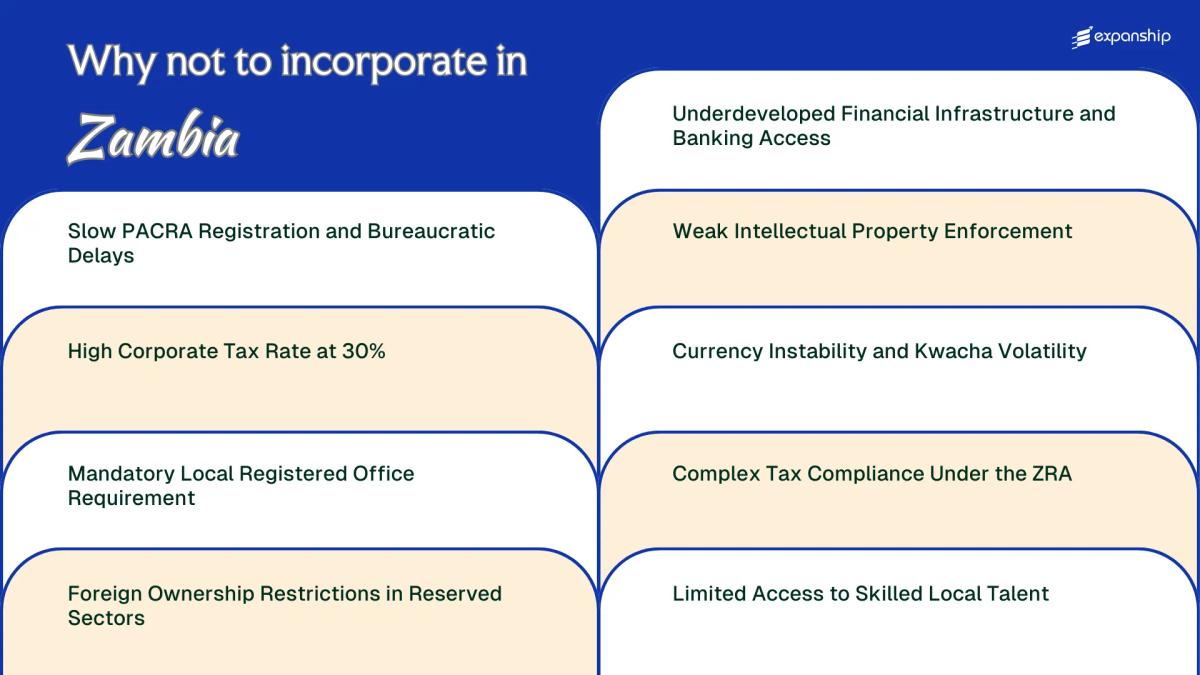
Slow PACRA Registration and Bureaucratic Delays
PACRA registration delays Zambia are a documented operational burden. Processing times at the Patents and Companies Registration Agency regularly extend beyond the official targets, creating uncertainty for businesses trying to establish a legal presence.
Structural Bottlenecks at PACRA
The agency handles name reservation, certificate of incorporation, and post-incorporation filings through a system that has historically suffered from capacity constraints and manual processing backlogs. For a foreign investor, this means your entity may not be legally operational for weeks after submission, delaying bank account opening, contract execution, and tax registration with the Zambia Revenue Authority.
Even online submissions through the PACRA e-portal do not guarantee faster resolution, as document verification and approval still depend on internal administrative workflows prone to delay.
Cascading Impact on Business Setup
Slow business registration at PACRA creates a compounding effect: ZRA tax identification, business licences, and sector-specific permits each require a valid certificate of incorporation as a prerequisite. A delay at registration stage holds up the entire downstream compliance chain.
This sequential dependency means a foreign firm cannot begin any regulated commercial activity until each preceding step is cleared.
A registration delay of several weeks can void time-sensitive contracts or investor commitments that assumed a faster operational start date.
High Corporate Tax Rate at 30%
Zambia's corporate tax rate sits at 30% for most companies, and that figure alone is a significant Zambia corporate tax rate drawback for foreign investors comparing jurisdictions. Against regional peers like Mauritius, which applies a 15% headline rate, the gap is substantial enough to affect after-tax return calculations before operations even begin.
Under the Income Tax Act (Cap. 323 of the Laws of Zambia), the Zambia Revenue Authority administers this charge on all company profits sourced within the country. For a foreign-owned entity, this means a meaningful share of local earnings is captured by the ZRA annually, reducing the capital available for reinvestment or repatriation.
Certain extractive industries face higher sectoral rates, which means 30% is the floor, not the ceiling, for many business types.
The practical friction this creates for your business includes:
- Profit margins that looked viable in feasibility models shrink once a 30% corporate income tax liability is applied, particularly in lower-margin sectors like distribution or retail
- Dividend distributions to foreign parent companies face a further withholding tax layer, compounding the overall effective tax burden beyond the headline rate
- Annual ZRA filings require local tax computations that typically demand professional accounting support, adding recurring compliance costs to the base tax liability

Company Incorporation in Zambia
Set up your business entity in Zambia with accurate compliance support across PACRA registration, tax registration, and ongoing ZRA obligations.
Mandatory Local Registered Office Requirement
Under the Companies Act No. 10 of 2017, every company incorporated in Zambia must maintain a registered office address within the country at all times. This Zambia registered office requirement means a foreign founder cannot simply list an overseas address — a physical, locally verifiable address must be filed with the Patents and Companies Registration Agency (PACRA) and kept current throughout the company's existence.
The address cannot be a P.O. Box. It must be a street address capable of receiving official correspondence from PACRA, the Zambia Revenue Authority, and court process servers.
| Requirement | Detail | Implication for Foreign Owner |
|---|---|---|
| Address type accepted | Physical street address only | P.O. Box or overseas address is invalid |
| Filing obligation | Address must be notified to PACRA and kept current | Any change requires a formal amendment filing |
| Non-compliance consequence | Company may be struck off the register | Loss of legal standing without local monitoring |
| Ongoing cost | Local agent or office lease required | Recurring expense with no operational return |
For a foreign owner with no operational presence in the country, satisfying this requirement typically means hiring a local registered agent and paying recurring fees for a service that produces no business output. That cost compounds annually.
Failure to maintain a valid registered address can result in PACRA initiating deregistration proceedings against the entity. A company struck off the register loses its legal capacity to contract, hold assets, or pursue claims.
Foreign Ownership Restrictions in Reserved Sectors
Zambia foreign ownership restrictions are codified under the Investment Act and the Citizens Economic Empowerment Act, which together designate certain business activities as reserved exclusively for Zambian citizens. Foreign nationals are legally barred from operating in these sectors, regardless of the size or structure of their investment.
The reserved sectors include retail trading with a capital base below a specified threshold, barbershops, hair salons, and small-scale trading activities. Your business cannot enter these categories through a local subsidiary, a joint venture structure, or minority shareholding arrangements.
Exclusion from reserved sectors is not a procedural hurdle. It is a statutory prohibition, meaning no licensing pathway or regulatory discretion exists to override it.
Outside the fully reserved sectors, the Zambia Development Agency Act imposes minimum capital requirements on foreign investors that do not apply to domestic firms. This creates an uneven baseline before your entity has generated a single transaction.
- Certain sectors are fully closed to foreign ownership by statute, with no exemption mechanism
- Minimum foreign investment thresholds under the ZDA Act do not apply to Zambian-owned businesses
- Joint ventures and minority stakes do not circumvent reserved sector prohibitions
- Retail trade restrictions apply based on capital thresholds, not business activity alone
Even a foreign company that qualifies under ZDA investment thresholds can still be excluded from reserved sectors if the activity falls under the Citizens Economic Empowerment Act, a restriction that operates independently of investment size.
Underdeveloped Financial Infrastructure and Banking Access
Zambia banking access challenges for businesses are more structural than incidental. The financial sector remains underdeveloped relative to the scale of cross-border commercial activity foreign firms typically require.
Limited Banking Infrastructure for Corporate Accounts
Opening a corporate bank account through institutions such as Zanaco or Stanbic Bank Zambia involves extended due diligence timelines that can stretch several weeks, during which your entity cannot receive or transfer funds. For a foreign company dependent on fast capital deployment, this delay directly disrupts operational setup and vendor onboarding.
Access to trade finance, multi-currency accounts, and international wire facilities is restricted to a narrow tier of commercial banks. Smaller regional branches often lack the correspondent banking relationships needed to process cross-border transactions reliably.
Practical Consequences for Foreign-Owned Entities
Underdeveloped financial infrastructure Zambia risks extend to limited digital banking functionality compared to markets like South Africa or Kenya, forcing reliance on in-branch processes for routine transactions. This adds administrative overhead that scales poorly for firms managing operations across multiple jurisdictions.
Firms in sectors with high transaction volumes face compounding friction, though companies operating solely in local currency with domestic clients experience a narrower version of these constraints.
Guidance on Banking and Incorporation Challenges in Zambia
Understand the financial infrastructure limitations and corporate banking requirements before establishing your entity in Zambia.
Weak Intellectual Property Enforcement
Zambia intellectual property enforcement problems present a structural risk for any foreign business that generates value through brands, proprietary processes, or creative works.
- The Patents and Companies Registration Agency (PACRA) administers trademark registration, but weak IP protection in Zambia means that registration alone offers limited practical deterrence against infringement.
- Civil enforcement of IP rights depends on a court system with significant case backlogs, meaning injunctive relief against counterfeiters can take years to obtain.
- Customs-level border enforcement against counterfeit goods remains under-resourced, leaving your supply chain vulnerable to grey-market imports.
- Criminal penalties for IP infringement exist under the Patents Act and the Trademarks Act, but prosecution rates are low, reducing the deterrent effect for would-be infringers.
- Zambia is a member of ARIPO, which allows regional trademark filings, but ARIPO membership does not substitute for effective domestic enforcement once infringement occurs on the ground.
Currency Instability and Kwacha Volatility
Zambia Kwacha volatility business risks are a direct operational concern for any foreign-incorporated entity receiving revenue or holding reserves in ZMW. The Kwacha has experienced significant depreciation cycles, driven by copper price swings, external debt pressures, and sovereign credit events including the 2020 Eurobond default.
For a foreign firm repatriating profits, the ZMW/USD exchange rate movement can erode returns between the date of earnings and the date of conversion. Bank of Zambia exchange controls, governed under the Bank of Zambia Act and the Exchange Control Act, add procedural friction to cross-border transfers.
Foreign companies pricing contracts in Kwacha face a structural mismatch when their input costs are denominated in USD or EUR. This misalignment makes margin planning genuinely unreliable across multi-year contracts.
ZMW exchange rate risks for foreign companies are not uniform across sectors. Exporters earning hard currency have a natural hedge, but service firms or domestic-facing businesses bear the full depreciation exposure.
Hypothetical scenario: A foreign services firm invoicing ZMW 5,000,000 in Q1 2023 at an exchange rate of ZMW 20/USD would have received approximately USD 250,000. Had collection been delayed to Q4 2023, when rates moved toward ZMW 27/USD, the same receivable would have yielded roughly USD 185,000 — a 26% reduction in USD terms with no change in business performance.
Complex Tax Compliance Under the ZRA
Zambia ZRA tax compliance challenges extend well beyond the corporate tax rate itself. The Zambia Revenue Authority administers multiple overlapping tax obligations, including Value Added Tax (VAT) at 16%, Pay As You Earn (PAYE), withholding tax, and transfer pricing rules under the Income Tax Act. Each carries its own filing schedule, threshold, and penalty regime.
Foreign-owned entities face particular exposure under the ZRA's transfer pricing framework, which requires contemporaneous documentation for related-party transactions. Without a local tax team familiar with ZRA audit procedures, errors in intercompany pricing can trigger assessments and interest charges that accumulate quickly.
VAT refund processing through the ZRA is known to be slow in practice. For businesses that regularly accumulate VAT credits, this creates a cash flow gap that directly affects working capital.
Monthly PAYE and VAT returns must be filed online through the ZRA's TaxOnline portal, and late submissions attract automatic penalties. For a foreign director managing compliance remotely, the volume and frequency of these obligations adds material administrative cost.
All entities registered with PACRA are required to register with the ZRA for tax purposes regardless of whether they have commenced trading, meaning dormant companies still carry active compliance obligations from the point of incorporation.
Limited Access to Skilled Local Talent
Zambia skilled labor shortage business risks are most visible in technical and managerial roles. The country's tertiary enrollment rate remains relatively low, and specialized fields such as engineering, finance, and ICT produce graduates in volumes that fall short of private sector demand.
For a foreign firm, this gap has a direct cost consequence. Sourcing qualified professionals locally becomes difficult, which frequently pushes companies toward expatriate hires — a path regulated under the Zambia Development Agency Act and subject to work permit requirements that add time and expense.
The Zambia Qualifications Authority (ZQA) oversees academic standards, but structural gaps in vocational and technical training persist. Your business may find that entry-level candidates require significant on-the-job development before reaching operational proficiency, raising your effective cost per hire.
This constraint is most acute outside Lusaka and the Copperbelt, where the talent pool narrows considerably.
Strategies to Overcome These Obstacles
Overcoming Zambia incorporation obstacles requires a structural approach rather than reactive adjustments made after problems emerge. The challenges covered in this blog — from PACRA delays to ZRA compliance complexity — share a common thread: they reward preparation.
- Register your company through the PACRA online portal to reduce processing time compared to manual submission.
- Elect a corporate tax structure that qualifies for sector-specific incentives under the Zambia Development Agency Act to offset the standard 30% corporate rate.
- Appoint a locally resident registered office holder at incorporation to satisfy the mandatory physical address requirement under the Companies Act No. 10 of 2017.
- Verify sector classification against the reserved sectors list before finalising your ownership structure, as foreign equity limits are not uniform across industries.
- Open a multi-currency account with a Bank of Zambia-licensed commercial bank to reduce direct exposure to Kwacha volatility.
- File for trademark protection with PACRA's intellectual property registry at incorporation rather than after commercial operations begin.
These steps operate within a regulatory environment where multiple bodies — PACRA, ZRA, and the Bank of Zambia — exercise overlapping authority over foreign-owned entities. Mitigating one compliance risk often has indirect effects on obligations managed by a separate regulator.
Zambia's Overall Investment Potential
Zambia's investment potential despite challenges is real, but it is conditional. The disadvantages covered in this blog are structural, not incidental, and they affect day-to-day operations in ways that cannot be planned away entirely. For businesses with the right risk tolerance and sector alignment, the country remains a credible base for regional operations in southern and central Africa.
| Pros | Cons |
|---|---|
| Zambia allows 100% foreign ownership in most sectors outside the reserved list | Foreign ownership is prohibited or restricted in several sectors under the Zambia Development Agency Act |
| The country's position in southern Africa offers access to regional trade routes and COMESA markets | Currency risk is persistent, with the Kwacha subject to significant volatility against major currencies |
| Corporate structures such as the private limited company are well-recognised and straightforward in form | PACRA registration timelines frequently exceed statutory targets due to administrative backlogs |
| Natural resource sectors present documented commercial opportunities | The standard corporate income tax rate of 30% is above the average for comparable regional jurisdictions |
| English is the official language of business and law, reducing documentation friction | ZRA compliance obligations are layered and require consistent professional oversight to manage accurately |
Enforcement of intellectual property rights remains weak in practice, and access to skilled local labour in specialised fields is limited.
Corporate Compliance Services in Zambia
Maintain your Zambia-registered company in good standing with the Patents and Companies Registration Agency and the Zambia Revenue Authority, covering annual returns, tax filings, and statutory obligations.
Conclusion
Zambia company formation drawbacks summary points to a jurisdiction with genuine structural challenges for foreign investors. Currency volatility tied to the Kwacha's fluctuations against major trading currencies, combined with a 30% corporate tax rate administered by the Zambia Revenue Authority, creates a cost environment that requires careful financial modelling before incorporation. Restrictions on foreign participation in reserved sectors further narrow the operational scope for overseas entities. Professional guidance specific to PACRA procedures, ZRA compliance obligations, and sector licensing requirements remains a practical necessity for any foreign firm establishing a presence here.
Expanship's Zambia Incorporation Services
From PACRA registration delays to ZRA compliance obligations and the Kwacha's volatility, incorporating in Zambia carries a set of structural challenges that require careful management. Expanship Zambia incorporation services are designed to reduce the administrative burden these requirements place on foreign investors, particularly around document preparation, regulatory filings, and post-incorporation obligations.
Our service scope covers the full formation and maintenance cycle for your entity in Zambia:
- Your company is registered with PACRA and all incorporation documents are prepared to the required standard.
- A local registered agent and compliant office address are provided to satisfy Zambian legal requirements.
- Government filings and direct liaison with PACRA, ZRA, and other regulatory bodies are handled on your behalf.
- Ongoing compliance obligations, including annual returns and statutory updates, are managed after incorporation.
- Banking introduction support is provided to help your business establish an operational account in Zambia.
- Tax registration with the ZRA and coordination with local authorities are completed as part of the setup process.
Reach out to Expanship Zambia to discuss your incorporation requirements.
Frequently Asked Questions (FAQ)
Currency risk applies to any business in Zambia that earns revenue in Kwacha but holds costs or obligations in foreign currency. The Kwacha has historically experienced sharp depreciations tied to copper price swings and external debt pressures, which means foreign investors cannot reliably project repatriated returns without factoring in significant exchange rate exposure.
The Zambia Revenue Authority can impose interest charges, financial penalties, and in serious cases pursue criminal prosecution for non-compliance under the Income Tax Act and related tax legislation. Late filing and underpayment of taxes attract penalties that compound over time, making delayed compliance significantly more costly than addressing obligations on schedule.
Full foreign ownership is restricted in specific reserved sectors under Zambian law, including certain trading and retail activities that are designated for Zambian citizens. Outside those reserved categories, a foreigner can hold 100% equity, but verifying which activities fall under reservation is essential before structuring your shareholding.
Enforcement is genuinely weak. While Zambia has IP legislation and the Patents and Companies Registration Agency handles some registration functions, the practical capacity of courts and regulatory bodies to pursue and resolve IP disputes is limited, meaning registered rights often do not translate into effective protection without sustained legal effort.
Yes. Because banking institutions in Zambia require a registered company certificate and related PACRA documentation before opening a business account, delays at the registration stage create a cascading effect that postpones your ability to operate financially. In practice, foreign-owned businesses have reported this combined delay extending their pre-operational period by several weeks beyond initial estimates.
Zambia requires a physical registered office address within the country, which must be maintained at all times under the Companies Act. Unlike jurisdictions that permit virtual or nominee addresses with minimal substance requirements, Zambia's requirement adds an ongoing operational cost and administrative obligation, particularly for foreign firms without an existing local presence.
Legal Disclaimer
The information provided in this article is for general informational purposes only and does not constitute legal, tax, or professional advice. While we strive to ensure the accuracy and timeliness of the content, laws and regulations are subject to change, and the application of laws can vary widely based on specific facts and circumstances.
Readers should not act upon this information without seeking professional counsel tailored to their individual situation. Expanship and its authors disclaim any liability for actions taken or not taken based on the content of this article.
For specific advice regarding your business setup, compliance requirements, or any legal matters, please consult with qualified legal and tax professionals in the relevant jurisdiction.