

Key Takeaways
- Vanuatu's near-absence of double tax treaties means income earned by incorporated entities is routinely subject to full taxation in counterparty jurisdictions without any bilateral relief mechanism.
- Companies registered under the Vanuatu Companies Act and supervised by the Vanuatu Financial Services Commission face persistent difficulties opening and maintaining correspondent banking relationships due to the jurisdiction's elevated risk classification among international financial institutions.
- Geographic remoteness across an archipelago of over 80 islands drives up logistics, communications, and professional services costs in ways that erode the tax savings offshore structures are typically designed to capture.
- Vanuatu's historical appearances on grey and blacklists maintained by bodies such as the FATF and the EU have created a reputational burden that requires incorporated businesses to invest additional due diligence resources when dealing with counterparties in more tightly regulated markets.
Vanuatu operates under a lightly regulated corporate framework, governed primarily by the Companies Act and overseen by the Vanuatu Financial Services Commission (VFSC). That regulatory posture shapes both the appeal and the structural limitations of registering a business there.
The disadvantages of incorporating in Vanuatu span several distinct categories, from financial access constraints to reputational and operational concerns. Not all of these will affect every business equally. A firm's exposure to specific drawbacks depends heavily on its industry, the jurisdictions it transacts with, and whether it requires active banking relationships or third-party recognition.
This article is most relevant to foreign investors, international holding company operators, and entrepreneurs considering Vanuatu offshore incorporation as a base for cross-border trade or asset structuring.
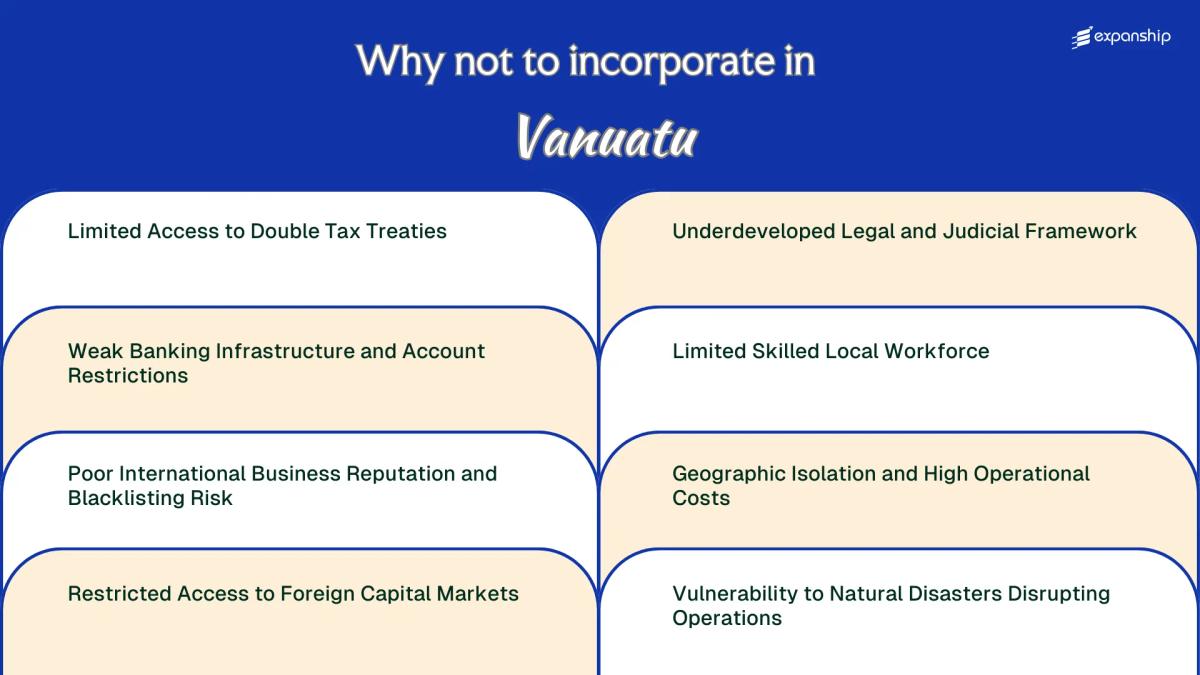
Limited Access to Double Tax Treaties
Vanuatu double tax treaty limitations represent one of the most significant structural gaps for foreign businesses operating through a local entity. The jurisdiction has not signed any comprehensive double taxation agreements with major trading partners or capital-exporting nations.
No Treaty Network to Prevent Double Taxation
Without bilateral tax treaties, income earned by your company and repatriated to a shareholder's home country may be taxed in full by that home country, with no credit mechanism or reduced withholding rate available. Countries such as the Netherlands, Germany, and Singapore maintain extensive treaty networks precisely to eliminate this burden, making Vanuatu-incorporated firms structurally less efficient for cross-border income flows.
This absence is not offset by any unilateral relief provisions under Vanuatu's domestic tax framework administered by the Vanuatu Financial Services Commission.
Practical Cost for Foreign Investors
For shareholders resident in high-tax jurisdictions, dividends, royalties, or service fees paid from a Vanuatu entity may be subject to full domestic tax rates upon receipt, with no treaty-based reduction applying. The lack of tax agreements creates a measurable cost disadvantage compared to structures routed through treaty-networked jurisdictions.
Without any double tax treaties in force, your business bears the full withholding and income tax exposure in your home jurisdiction with no legal mechanism for relief at the source level.
Weak Banking Infrastructure and Account Restrictions
Vanuatu banking infrastructure restrictions create one of the most immediate operational obstacles for foreign-owned entities registered in Port Vila. The Reserve Bank of Vanuatu supervises a small number of licensed commercial banks, and the domestic sector lacks the depth and product range that multinational businesses typically require.
Correspondent banking relationships are the core problem. International banks increasingly de-risk by cutting ties with financial institutions in jurisdictions perceived as high-risk, and Vanuatu-registered firms sit squarely in that category for many compliance departments abroad.
Opening a corporate account as a non-resident director is rarely straightforward. Banks may impose extensive due diligence requirements, require physical presence, or decline offshore-structured companies outright.
Practical burdens this creates for your business:
- Processing cross-border payments takes longer, which delays supplier settlements and disrupts working capital cycles
- Some payment processors and fintech platforms block accounts linked to Vanuatu-registered entities, forcing you into more expensive alternatives
- Correspondent bank fees on international transfers are higher when routing through a jurisdiction with limited banking relationships
- Multi-currency account options are restricted compared to financial centres in Singapore or Hong Kong

Company Incorporation in Vanuatu
Understand the full regulatory and banking requirements before incorporating a company in Vanuatu.
Poor International Business Reputation and Blacklisting Risk
Vanuatu offshore blacklisting risk is one of the most consequential drawbacks for any business registered there. The Financial Action Task Force (FATF) placed the jurisdiction on its grey list in June 2016, citing deficiencies in anti-money laundering and counter-terrorist financing controls. Although removed in 2018 following remedial measures, the episode left a lasting mark on how correspondent banks, foreign regulators, and institutional partners assess entities incorporated there.
Grey list placement is not a passive designation. Foreign counterparties routinely apply enhanced due diligence to firms from jurisdictions with a prior FATF listing, which translates directly into longer onboarding timelines, higher compliance costs, and frequent transaction rejections.
| Risk Factor | Practical Impact | Typical Trigger |
|---|---|---|
| Prior FATF grey list status | Enhanced due diligence required by foreign banks | Correspondent banking relationships |
| EU non-cooperative jurisdiction listings | Restricted access to EU-based financial services | Cross-border transactions |
| OECD transparency scrutiny | Additional disclosure requirements from foreign tax authorities | Information exchange requests |
| Perceived tax haven status | Refusal by institutional investors to engage | Capital raising attempts |
The EU has historically listed the Pacific region under various tax transparency and non-cooperative jurisdiction frameworks, and Vanuatu tax haven reputation problems persist in contexts where beneficial ownership disclosure is assessed. Your business may meet every local compliance requirement under the Vanuatu Financial Intelligence Unit's (FIU) framework and still face rejection from foreign institutions applying their own risk thresholds.
That rejection risk is structural, not incidental. It affects trade finance, investment partnerships, and correspondent banking access simultaneously.
Restricted Access to Foreign Capital Markets
Vanuatu foreign capital market restrictions present a concrete funding ceiling for incorporated entities. Firms registered under the Vanuatu Financial Services Commission (VFSC) carry limited credibility with institutional investors in major financial centres, which directly constrains the capital-raising options available to your business.
Stock exchange listing is not a realistic path. The country has no domestic exchange, meaning any firm seeking equity capital must pursue listings abroad, where Vanuatu-registered entities face immediate scrutiny over their offshore status and governance standards.
Foreign institutional investors, including private equity funds and venture capital firms in the US, EU, or Singapore, routinely exclude offshore jurisdictions with weak regulatory reputations from their investment mandates. This is a structural exclusion, not a case-by-case judgment call.
Debt financing through international bond markets is similarly constrained. Without a recognized financial regulator publishing enforceable disclosure standards comparable to those under the EU's MiFID II or the US Securities Exchange Act, your entity cannot meet the minimum compliance thresholds required by foreign capital markets.
- VFSC-registered entities are not eligible for listing on major foreign exchanges without a separate redomiciliation or SPV structure.
- Institutional investor mandates frequently exclude jurisdictions on FATF grey lists or OECD watchlists.
- Debt issuance in regulated markets requires audited financials under internationally recognized standards, which the local framework does not mandate by default.
- Capital raised must comply with the Vanuatu Investment Promotion Authority Act, which governs foreign capital flows into the jurisdiction.
Despite having no domestic stock exchange, Vanuatu is home to a licensed securities dealer regulatory framework under the VFSC, which most investors outside the Pacific region are entirely unaware exists.
Underdeveloped Legal and Judicial Framework
Vanuatu's legal framework drawbacks extend beyond tax and banking concerns into the structural reliability of its domestic legal system itself.
Gaps in Corporate Law Infrastructure
The Companies Act [CAP 191] governs corporate entities, but the legislation has not kept pace with the compliance expectations of modern international business. Enforcement mechanisms under the Vanuatu Financial Services Commission (VFSC) are limited in scope, meaning disputes over directorial conduct, shareholder rights, or contractual obligations may go unresolved for extended periods.
Judicial proceedings in the Supreme Court of Vanuatu can face significant delays due to a small bench and restricted legal resources. For a foreign investor relying on enforceable remedies, this creates material exposure that well-resourced jurisdictions with larger, more specialised commercial courts do not present.
Practical Consequences for Foreign Firms
Underdeveloped corporate law enforcement problems become acute when cross-border disputes arise, since your firm cannot rely on the same procedural predictability found in common law centres such as Singapore or the BVI. The absence of a dedicated commercial court compounds this further, as business matters are heard alongside general civil and criminal proceedings.
Get Guidance on Operating in Vanuatu
Understand the legal and structural challenges of incorporating in Vanuatu before committing to the jurisdiction.
Limited Skilled Local Workforce
Vanuatu skilled workforce limitations present a direct staffing problem for foreign businesses that require technical, financial, or legal expertise. The country's population of roughly 320,000 is spread across more than 80 islands, which structurally constrains the available talent pool.
- Tertiary education enrollment remains low by Pacific standards, meaning your business cannot rely on locally sourced graduates for specialized roles.
- The Immigration Act requires work permit applications for each foreign employee, adding administrative cost and processing delays whenever you fill a skilled gap.
- Dependency on expatriate hires increases your payroll burden significantly, as relocation packages and visa sponsorship obligations compound base salary costs.
- Vanuatu human capital risks for companies also include high staff turnover, since qualified locals who do exist are frequently recruited away by government agencies or NGOs offering competitive terms.
- Remote island geography limits inter-island labor mobility, so a business outside Port Vila faces a narrower effective hiring radius than the national figures already suggest.
Geographic Isolation and High Operational Costs
Vanuatu geographic isolation business costs are a structural reality, not a temporary friction. Situated in the South Pacific, roughly 1,750 kilometres east of Australia, the archipelago's distance from major economic centres means that importing goods, equipment, or specialist services carries a significant freight premium.
Supply chains for any business with physical operations depend heavily on infrequent shipping routes and a single international airport in Port Vila. Delays are common, and contingency inventory must be held at added expense.
For professional services firms or holding companies, costs compound differently:
- Retaining foreign legal counsel or auditors often requires flying them in, as local expertise in international tax or finance law is limited
- Telecommunications infrastructure outside Port Vila is unreliable, affecting remote work arrangements and client communication
- Reliable power supply is inconsistent across the islands, requiring generators or alternative backup systems as standard operating expenditure
A hypothetical scenario: A foreign-owned trading company incorporated in Vanuatu importing equipment from Europe could face freight and logistics costs 40–60% higher than a comparable operation based in Singapore, where direct freight corridors, port efficiency, and proximity to manufacturing hubs substantially reduce landed costs.
Vulnerability to Natural Disasters Disrupting Operations
Vanuatu natural disaster business risks are among the most severe of any incorporation jurisdiction globally. The archipelago sits within the Pacific Ring of Fire and the South Pacific cyclone belt, exposing registered entities to cyclones, earthquakes, volcanic eruptions, and tsunamis with meaningful regularity.
Cyclone Pam in 2015 caused damage equivalent to roughly 64% of GDP, which illustrates the scale of disruption a single weather event can impose on local infrastructure, communications, and physical business premises. If your firm relies on local offices, resident directors, or in-country registered agents, operational continuity during such events cannot be assumed.
The concentration of critical services in Port Vila compounds this exposure. Power outages, severed telecommunications, and temporary port closures directly affect the ability to execute filings, access banking services, or communicate with regulators such as the Vanuatu Financial Services Commission.
Unlike jurisdictions with federalized or geographically distributed administrative systems, all core corporate administration for Vanuatu-registered entities passes through a single urban center that sits in a high-risk disaster zone.
If your business depends on time-sensitive regulatory filings, banking transactions, or agent communications routed through Port Vila, a major cyclone or seismic event can suspend those functions entirely, with no guaranteed service restoration timeline under current VFSC continuity provisions.
Overcoming These Incorporation Challenges
Overcoming Vanuatu incorporation challenges requires structural preparation before the entity is formed, not reactive adjustments after problems emerge. The jurisdiction's regulatory gaps and geographic constraints mean that mitigating Vanuatu company formation risks depends on deliberate configuration of your corporate structure from the outset.
- Register your entity under the Vanuatu Financial Services Commission (VFSC) and confirm its standing on the VFSC register to reduce blacklisting exposure from non-compliant formations.
- Select a banking partner with correspondent relationships outside the Pacific region to address the limited local banking infrastructure.
- Structure your firm under an International Company rather than a domestic entity if your operations are primarily cross-border, to align with the intended use of the International Companies Act.
- Establish documented disaster recovery and business continuity protocols that account for cyclone season disruption to local administrative services.
- Identify capital sources outside Vanuatu's domestic market before incorporation, given restricted access to local and regional equity channels.
These steps operate within a framework governed primarily by the VFSC and the Vanuatu Financial Intelligence Unit. Neither body provides informal compliance guidance, so structural decisions carry binding consequences from registration onward.
Vanuatu's Overall Business Viability
Vanuatu business viability risks are real and well-documented, yet the jurisdiction continues to attract foreign registrations for specific commercial purposes. The International Companies Act and the zero-tax framework retain genuine utility for holding structures and asset protection, provided your business does not depend on banking access, treaty networks, or deep capital markets.
| Pro | Con |
|---|---|
| No corporate income tax under the domestic tax framework | No meaningful double tax treaty network to reduce withholding exposure |
| Fast incorporation process under the International Companies Act | Correspondent banking restrictions make account opening unreliable |
| No public disclosure of beneficial ownership for international companies | FATF grey-listing history creates reputational friction with counterparties |
| Low annual maintenance fees compared to many offshore jurisdictions | Limited access to foreign capital markets and institutional financing |
| Geographic neutrality for certain holding structures | Cyclone and seismic activity create recurring operational disruption risk |
| No requirement for local directors or shareholders | Underdeveloped judicial infrastructure limits contract enforcement confidence |
Assessing whether incorporating in Vanuatu is worth it ultimately depends on how many of these constraints your business model can absorb. For firms that need transactional banking, international investor relations, or enforceable dispute resolution, the drawbacks documented across this blog carry material operational weight.
Compliance Services for Companies in Vanuatu
Maintain your Vanuatu company's good standing with ongoing compliance support, including annual filings, registered agent maintenance, and regulatory monitoring under the International Companies Act.
Conclusion
Vanuatu company incorporation disadvantages are real and consequential. The jurisdiction offers a zero-tax environment and relatively low setup costs, but the structural limitations covered throughout this blog carry material weight for any business conducting substantive international operations.
Banking access and the persistent blacklisting risk stand out as the most operationally disruptive issues. Pair those with the absence of meaningful tax treaty coverage, and the cons of Vanuatu business formation become difficult to dismiss for firms needing broad financial connectivity. Understanding these constraints fully before incorporation is the only defensible starting position. Professional guidance that accounts for all local regulatory requirements under the VFSC framework remains the most practical path forward.
Expanship's Vanuatu Incorporation Support
Vanuatu incorporation support services from Expanship are designed to help you manage the practical weight of setting up a compliant entity in a jurisdiction where the VFSC's registration requirements, absent tax treaty protections, and restricted banking access create real operational friction. Our role is to reduce that burden, not to suggest these structural constraints disappear.
Beyond registration, Expanship supports your Vanuatu structure across the full operational cycle:
- We prepare and submit all company registration documents with the VFSC on your behalf.
- A registered agent and local office address are provided to meet statutory presence requirements.
- We handle government filings and liaise directly with relevant Vanuatu regulatory authorities.
- Post-incorporation compliance obligations are monitored and managed on an ongoing basis.
- Banking introduction assistance is available to help you approach suitable financial institutions.
- We coordinate tax registration and any required liaison with local authorities.
Reach out to Expanship Vanuatu to discuss your incorporation requirements.
Frequently Asked Questions (FAQ)
The absence of a meaningful tax treaty network affects all entities incorporated in Vanuatu, including International Companies registered under the International Companies Act. Without treaty protection, withholding taxes imposed by your counterparty's home country apply at their full domestic rates, directly increasing the cost of cross-border income flows such as dividends, royalties, and service fees.
It is materially harder than for companies incorporated in treaty-network jurisdictions. Correspondent banks in the EU, UK, and Australia apply heightened scrutiny to Vanuatu-registered entities due to its offshore classification, and several major banks maintain blanket restrictions. Even where accounts are opened, transaction limits, reporting obligations, and compliance costs are typically higher.
Vanuatu sits in one of the most active cyclone corridors in the Pacific, and physical disruption to registered agents and government offices is a documented operational risk. Under the International Companies Act, your company must maintain a registered agent in Vanuatu at all times, so any disruption to that agent's operations can create compliance gaps and delay filings with the Vanuatu Financial Services Commission.
By most institutional assessments, yes. The BVI benefits from a specialist Commercial Court with a well-established body of case law drawing on English common law principles, whereas Vanuatu's court system has limited commercial law precedent and slower resolution timelines. For disputes involving complex financial arrangements, that gap in judicial infrastructure translates into higher legal uncertainty and enforcement risk.
Yes. The VFSC can strike off a company for failure to comply with annual filing and fee obligations, and geographic distance combined with limited digital infrastructure increases the likelihood of missed communications. Reinstatement is possible but involves additional fees and administrative burden, and a period of non-good-standing can trigger default clauses in commercial contracts.
Direct cost comparisons vary by business model, but freight, courier, and international travel costs to and from Port Vila are structurally higher than for companies based in Singapore or Hong Kong due to limited direct flight routes and shipping frequency. Professional service fees also tend to be higher relative to the size of the local market, since specialized legal, accounting, and compliance expertise is scarce locally and often must be sourced from offshore providers.
Legal Disclaimer
The information provided in this article is for general informational purposes only and does not constitute legal, tax, or professional advice. While we strive to ensure the accuracy and timeliness of the content, laws and regulations are subject to change, and the application of laws can vary widely based on specific facts and circumstances.
Readers should not act upon this information without seeking professional counsel tailored to their individual situation. Expanship and its authors disclaim any liability for actions taken or not taken based on the content of this article.
For specific advice regarding your business setup, compliance requirements, or any legal matters, please consult with qualified legal and tax professionals in the relevant jurisdiction.