

Key Takeaways
- Vanuatu's zero-tax framework under the Companies Act eliminates corporate tax, income tax, capital gains tax, and inheritance tax, removing the compounding costs that reduce long-term returns for internationally structured businesses.
- The Vanuatu Financial Services Commission provides a regulated and credible oversight environment, meaning entities incorporated here operate within an established legal framework rather than an unregulated offshore grey area.
- Foreign investors face no ownership restrictions on Vanuatu companies, allowing full non-resident control without the equity dilution or local partnership requirements common in other jurisdictions.
- Strict domestic confidentiality legislation governs the disclosure of beneficial ownership and corporate information, giving internationally operating businesses a meaningful layer of structural privacy backed by enforceable law.
Vanuatu is an independent Pacific island nation and a recognized offshore financial centre operating under a zero-tax framework for qualifying international businesses. Company registration is administered by the Vanuatu Financial Services Commission, the statutory body responsible for business licensing and corporate oversight across the jurisdiction. Foreign investors face no restrictions on ownership, and the government has maintained a consistently open posture toward foreign direct investment across most sectors.
For international businesses, the International Company is the most commonly used legal vehicle for offshore structuring. Incorporation figures have grown steadily, reflecting the jurisdiction's accessibility to non-resident founders and its minimal residency requirements for directors and shareholders.
This article examines the principal advantages of incorporating here, drawing on the regulatory framework and structural features that define the benefits of incorporating in Vanuatu for foreign entrepreneurs and multinational operators alike.
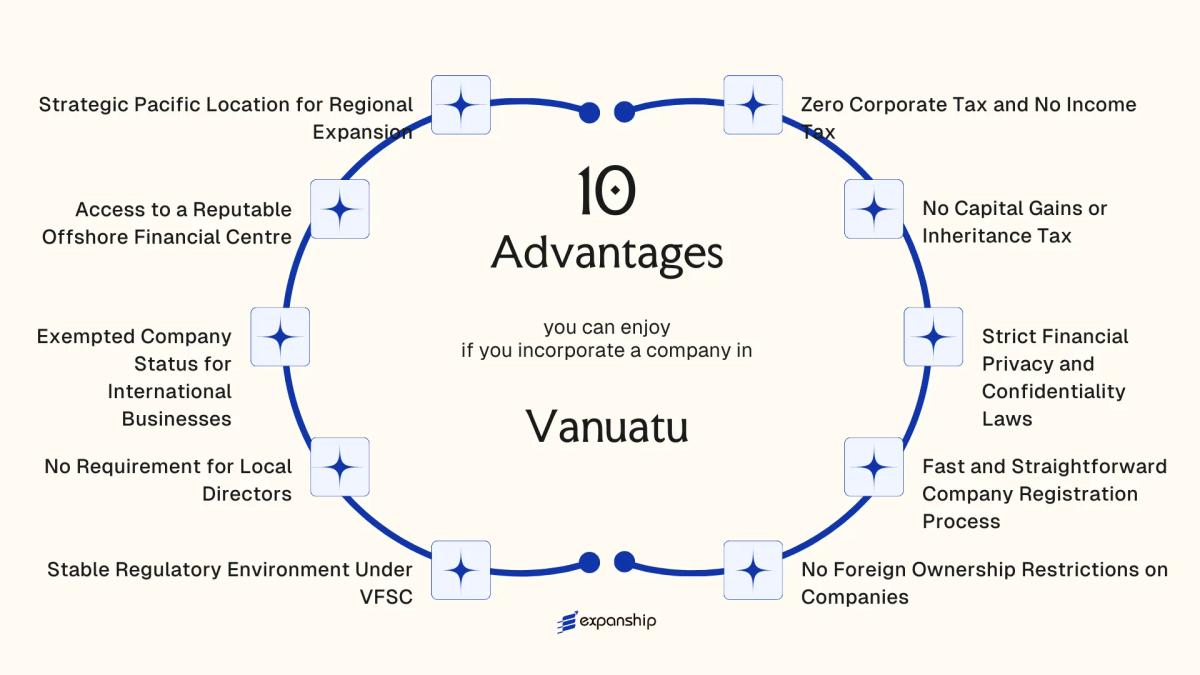
Zero Corporate Tax and No Income Tax
The Vanuatu zero corporate tax advantage is statutory, not discretionary. Under the current tax framework, companies incorporated in Vanuatu are not subject to corporate income tax, personal income tax, withholding tax on dividends, or capital tax on profits.
What the Tax Structure Actually Means
Profit generated by your entity stays entirely within the business. A firm earning $500,000 annually faces no obligation to remit a percentage to the Vanuatu government on that income, which directly affects retained earnings and reinvestment capacity in ways that high-tax jurisdictions structurally prevent.
This treatment applies to companies registered under the Companies Act [CAP 191] and extends to international business activity. Foreign-sourced income is not taxed at the point of receipt, which matters considerably for holding structures or businesses billing clients across multiple countries.
The Regulatory Basis for This Exemption
The Vanuatu Financial Services Commission oversees company registration but does not administer a corporate tax regime, because none exists. There is no income tax legislation of general application, a position confirmed by the absence of a corporate tax act in the jurisdiction's statutory framework.
Annual government fees and compliance costs still apply, so zero tax does not mean zero cost of maintenance.
Your company retains 100% of its net profit with no statutory corporate tax deduction under Vanuatu law.
No Capital Gains or Inheritance Tax
Vanuatu imposes no capital gains tax on the disposal of assets, including shares, real estate held through a company, or investment portfolios. For foreign investors, this means the full value of an asset sale flows back into the business rather than being reduced by a tax event that can reach 20–30% in many OECD jurisdictions. The Vanuatu Companies Act and the broader tax framework administered by the Vanuatu Financial Services Commission (VFSC) do not treat capital appreciation as a taxable income event.
Inheritance and estate transfers are equally untaxed. Ownership stakes passed between generations, or transferred as part of succession planning, carry no mandatory tax liability at the point of transfer. This makes corporate structuring through a Vanuatu entity particularly relevant for family offices and private holding structures with long-term succession objectives.
Several structural features reinforce these advantages:
- No triggering event applies when shares change hands between related parties, removing a common compliance burden
- Transfers of corporate ownership do not require a tax clearance certificate, which reduces administrative delays during succession
- Foreign shareholders are not subject to withholding tax on capital distributions from a Vanuatu-registered entity
The absence of both taxes is a feature of the jurisdiction's domestic legislation, not a treaty-based exemption, so it applies regardless of where the shareholder is domiciled.

Incorporate Your Company in Vanuatu
Establish a tax-efficient corporate structure in Vanuatu with no capital gains tax, no inheritance tax, and full foreign ownership permitted.
Strict Financial Privacy and Confidentiality Laws
Vanuatu financial privacy laws for companies are codified primarily under the Companies Act [CAP 191] and reinforced by the International Companies Act [CAP 222], which together restrict public access to beneficial ownership information, shareholder registers, and financial accounts for qualifying entities.
For an offshore company registered under the International Companies Act, the names of shareholders and directors are not part of any publicly searchable register. This means competitors, litigants, or third parties cannot identify the ownership structure of your business through routine registry searches. The practical value for foreign owners is direct: your corporate identity remains separate from your personal exposure.
| Privacy Feature | Applies To | Public Access |
|---|---|---|
| Shareholder register | International Companies | Not publicly accessible |
| Director details | International Companies | Not publicly accessible |
| Financial statements | International Companies | Not required to be filed publicly |
| Beneficial ownership | Held by registered agent | Restricted to regulatory access |
Financial statements for international companies are not required to be filed with any public authority, removing a layer of disclosure that exists in many other jurisdictions. Your accounts remain internal documents unless a court order or a formal regulatory inquiry under Vanuatu's anti-money laundering framework compels disclosure.
The Vanuatu Financial Intelligence Unit, operating under the Financial Transactions Reporting Act [CAP 268], does hold authority to access financial records in cases of suspected illicit activity. Confidentiality protections, therefore, apply to legitimate business operations and do not extend to circumstances involving criminal investigation.
Fast and Straightforward Company Registration Process
Vanuatu fast company registration benefits stem from a system designed to minimize bureaucratic delay for foreign incorporators. Under the [Companies Act \[CAP 191\]](https://www.vanuatu.gov.vu/), the Vanuatu Financial Services Commission (VFSC) processes standard company incorporation applications within 24 to 48 hours in most cases. For a foreign business owner, this means your entity can be legally constituted and operational in days, not weeks or months as is common in many OECD jurisdictions.
The application process itself requires minimal documentation. A foreign national does not need to be physically present in Vanuatu at any stage of registration. All filings can be submitted through a licensed registered agent, which keeps the process accessible regardless of where you are based.
This speed is not incidental. The VFSC maintains a digitized registry that allows agents to submit and track applications without requiring in-person attendance at government offices, reducing procedural friction at every stage.
Keep these points in mind:
- A licensed registered agent must handle your submission with the VFSC
- Company names must be pre-cleared before final submission
- All incorporation documents must be submitted in English
- Processing times may vary for regulated or licensed business structures
The VFSC operates a public online register, meaning your company's existence can be verified internationally within hours of incorporation, without requiring apostille verification for basic corporate status checks.
No Foreign Ownership Restrictions on Companies
Vanuatu no foreign ownership restrictions apply across virtually all company types, meaning foreign nationals can hold 100 percent of the shares in a local entity without requiring a domestic partner or co-owner. This structural openness is codified under the Companies Act [CAP 191], which governs the formation and ownership of both domestic and international companies registered in the jurisdiction.
Full Equity Control for Foreign Shareholders
Your business can be entirely owned and directed by non-resident individuals or corporate shareholders. There is no statutory minimum for local equity participation, which means the entire economic interest in the company remains with you rather than being diluted by mandatory local partnership arrangements common in many other jurisdictions.
This matters because retained ownership translates directly to retained profit distribution rights, voting control, and the ability to make structural decisions without third-party consent from a local stakeholder.
No Sectoral Carve-Outs Affecting Most Business Activities
For the majority of commercial activities, foreign ownership is unrestricted at the company level. Certain regulated sectors, such as land ownership and specific licensed financial services, are governed by separate legislation, but the corporate ownership structure itself is not subject to nationality-based caps under the Companies Act framework.
This separation means the entity you incorporate can be wholly foreign-owned regardless of where you are based or what citizenship you hold, provided you operate within any applicable sectoral licensing requirements.
Maximize Your Ownership Rights in Vanuatu
Speak with our corporate specialists about structuring your Vanuatu company with full foreign ownership and no equity restrictions.
Stable Regulatory Environment Under VFSC
The Vanuatu Financial Services Commission (VFSC) was established under the Vanuatu Financial Services Commission Act to regulate and supervise the financial services sector, including the registration and oversight of international companies. Operating under a defined statutory framework gives your business a predictable regulatory relationship, one where the rules governing your entity are codified rather than subject to discretionary enforcement.
- The VFSC administers the International Companies Act, which governs the formation, operation, and dissolution of offshore entities. Having a single, dedicated statutory instrument means the compliance obligations applying to your firm are clearly defined and consistently applied.
- The Commission maintains a public register of licensed entities and service providers, which reduces counterparty risk when engaging local registered agents and builds verifiable credibility with banks or correspondent institutions.
- Regulatory amendments in Vanuatu typically follow formal legislative processes, giving businesses advance notice of changes rather than exposure to sudden policy shifts.
- The VFSC has progressively aligned its framework with international standards, including Financial Action Task Force recommendations, which supports your entity's acceptability in cross-border transactions and banking relationships.
- Oversight is sector-specific: companies conducting financial services activities hold VFSC-issued licenses under distinct categories, so your compliance obligations scale according to actual business activity rather than blanket requirements.
No Requirement for Local Directors
Under Vanuatu's International Companies Act, there is no Vanuatu no local director requirement imposed on foreign-owned entities. A company incorporated under this framework can be directed entirely by non-resident individuals, with no obligation to appoint a Vanuatu-based or Vanuatu-resident director at any point.
This matters because residency requirements in other jurisdictions force foreign owners to either relocate or pay ongoing fees to nominee director services just to maintain basic compliance. Removing that obligation means your business structure reflects actual ownership and control, not a regulatory workaround.
A single director is sufficient, and that individual can be of any nationality, residing anywhere in the world. Corporate directors are also permitted, giving holding structures the ability to place a parent entity in the director role rather than nominating a natural person.
A foreign entrepreneur operating an international consulting firm through a Vanuatu entity pays zero nominee director fees annually. In jurisdictions such as Singapore or Hong Kong, where at least one locally resident director is mandatory, equivalent nominee arrangements typically cost USD 1,500 to USD 3,000 per year. Over five years, that represents a direct compliance cost saving of USD 7,500 to USD 15,000.
The Vanuatu Financial Services Commission oversees company registration, and its published requirements confirm no residency condition applies to directors of international companies.
Exempted Company Status for International Businesses
Vanuatu exempted company status benefits are codified under the International Companies Act [Cap 222], which establishes a distinct legal category for entities incorporated to conduct business exclusively outside the jurisdiction. This classification is not automatic — a company must qualify by limiting its activities to international transactions, which keeps it outside the domestic tax and regulatory perimeter.
Under exempted status, your company is formally shielded from locally imposed corporate obligations that would otherwise apply to resident entities. The practical result is that the firm operates under a reduced compliance burden: no requirement to file audited financial statements with local authorities, and no obligation to submit annual tax returns to the Vanuatu Financial Services Commission (VFSC).
This structural separation matters because it creates a clean legal boundary between your international operations and the domestic economy, giving foreign owners a defined, predictable operating framework rather than an ambiguous one.
Key operational features of exempted status include:
- No requirement to hold annual general meetings within the country
- Registers of members and directors not publicly disclosed
- Ability to redomicile the entity from another jurisdiction
Exempted company status applies strictly to entities that do not carry on business within Vanuatu; any domestic commercial activity can void the exemption and trigger standard compliance obligations.
Access to a Reputable Offshore Financial Centre
Vanuatu offshore financial centre advantages stem from a regulatory architecture purpose-built for international business. The Vanuatu Financial Services Commission (VFSC) governs the licensing and supervision of financial service providers under the Financial Dealers Licensing Act and related legislation, giving the jurisdiction a structured, rules-based financial environment rather than an unregulated one.
Membership in regional and international bodies strengthens this position. Vanuatu is a member of the Asia/Pacific Group on Money Laundering (APG) and has undertaken commitments aligned with FATF recommendations, which means financial institutions operating there are subject to anti-money laundering and counter-financing of terrorism obligations. For your business, this matters because counterparties, banks, and institutional partners in other jurisdictions are more willing to transact with entities domiciled in a centre that meets internationally recognised compliance standards.
The offshore banking sector operates under licences issued by the Reserve Bank of Vanuatu, providing a degree of institutional oversight that underpins the credibility of financial arrangements structured through the territory. Foreign businesses can access multi-currency accounts and international banking services through licensed institutions without the same level of bureaucratic friction found in many onshore financial centres.
Vanuatu's removal from the EU's list of non-cooperative jurisdictions for tax purposes in recent years reflects the upgrades made to its legislative framework. That shift has practical consequences:
- Correspondent banking relationships are easier to establish
- Fund flows face fewer automatic compliance flags from receiving institutions
- Corporate accounts opened through VFSC-regulated entities carry greater international acceptance
Strategic Pacific Location for Regional Expansion
Vanuatu's geographic position in the South Pacific places your business within a time zone range that overlaps with both Asian and Australian trading hours. This proximity to major Asia-Pacific economies is a practical operational advantage, not merely a geographic footnote.
Situated roughly 1,750 kilometres east of Australia and within reasonable reach of New Zealand, Japan, Singapore, and Hong Kong, an entity registered here sits at the intersection of several active trade corridors. Pacific Island Forum membership gives Vanuatu formal multilateral standing, which can support regional commercial relationships.
For businesses targeting Asia-Pacific markets, the working-hours overlap with financial centres like Sydney and Singapore reduces communication delays that often affect entities based in the Caribbean or European offshore centres. A firm operating across multiple time zones benefits from a base that keeps it within the same business day as its key counterparts.
Specific structural advantages of this location include:
- Proximity to Australia and New Zealand, two of the region's largest consumer and investor markets
- Time zone alignment (UTC+11) with eastern Australia, reducing scheduling friction for regional operations
- Access to Pacific trade networks through Vanuatu's membership in regional bodies, including the Pacific Islands Forum and the Melanesian Spearhead Group
- Port Vila's growing connectivity through air routes servicing Australia, New Zealand, and broader Pacific destinations, supporting physical business presence when required
For an international holding company or regional management structure, a Pacific-based registration addresses the operational reality of where your clients, partners, or assets are located.
Why Vanuatu Stands Out Among Offshore Jurisdictions
Compared against other Pacific and Indian Ocean offshore centres, the Vanuatu advantages over other offshore jurisdictions become clearest when you examine structural features side by side. Jurisdictions such as the Marshall Islands and Samoa target a similar profile of international investor, while the Cook Islands competes for asset protection and financial privacy mandates. Each of these presents a credible alternative, which makes the comparison instructive rather than superficial.
What the table below surfaces is that the combination of zero corporate tax, no capital gains tax, absence of a public beneficial ownership register, and no local director requirement is not unique to any single Pacific jurisdiction. The distinction lies in how those features interact within Vanuatu's regulatory framework under the Vanuatu Financial Services Commission, which operates under the Companies Act \[CAP 191\] and related legislation. For businesses evaluating Vanuatu vs other offshore company locations, the VFSC's formal regulatory standing and Vanuatu's status as a recognised offshore financial centre add a layer of institutional credibility that some smaller Pacific registries do not match.
| Parameter | Vanuatu | Marshall Islands | Samoa | Cook Islands |
|---|---|---|---|---|
| Corporate Tax Rate | 0% | 0% | 0% | 0% |
| Capital Gains Tax | None | None | None | None |
| Public Beneficial Ownership Register | No | No | No | No |
| Local Director Required | No | No | No | No |
| Dedicated Financial Services Regulator | Yes (VFSC) | Limited | Yes (SIFA) | Yes (FSC) |
| Exempted/International Company Structure | Yes | Yes | Yes | Yes |
| Recognised Offshore Financial Centre | Yes | Partial | Yes | Yes |
Compliance Services for Companies in Vanuatu
Maintain your Vanuatu company's good standing with ongoing compliance support, including annual filings, registered agent services, and regulatory reporting under VFSC requirements.
Conclusion
Vanuatu's case as an incorporation destination rests on a structurally coherent set of advantages rather than a single headline feature. The combination of zero corporate tax under the Companies Act, strict confidentiality protections enforced through domestic legislation, and no restrictions on foreign ownership creates a framework where international businesses can operate without the friction common in higher-tax or more restrictive jurisdictions.
Two features in particular distinguish this structure from many alternatives. The absence of capital gains tax and inheritance tax removes compounding costs that erode returns over time, and the VFSC's regulated but accessible environment means your entity operates within a credible legal framework rather than an unregulated grey area.
Whether this structure suits your business depends on factors specific to your situation: the nature of your operations, where your clients and counterparties are based, and what your home jurisdiction requires in terms of controlled foreign corporation rules or substance requirements. For businesses structured to operate internationally, the Vanuatu offshore company benefits are most effectively realised when the corporate structure reflects the actual activity of the entity. The next step is translating these structural advantages into a properly formed and compliant company.
Start Your Vanuatu Company with Expanship Today
Expanship's services for Vanuatu company formation cover the full registration process under the Vanuatu Financial Services Commission (VFSC), which oversees the incorporation of International Companies under the International Companies Act. From selecting the appropriate entity structure to meeting ongoing compliance obligations, each stage involves procedural requirements that benefit from direct familiarity with the VFSC's filing systems and documentation standards.
To start a Vanuatu company with Expanship, you receive structured support across each phase of the process:
- Preparation and legalization of incorporation documents, including the Memorandum and Articles of Association
- Registered agent and registered office provision, both of which are statutory requirements for International Companies
- Government filing and direct liaison with the VFSC on your behalf
- Post-incorporation compliance management, covering annual fees and record-keeping obligations
- Banking introduction assistance to support account opening with institutions familiar with Vanuatu-registered entities
Expanship Vanuatu operates as a professional intermediary, not as legal counsel, and works alongside qualified local agents where regulatory requirements demand it. Your business receives practical coordination rather than generalized advice, with each service tied to the specific statutory framework governing your entity type.
To discuss your requirements, contact Expanship Vanuatu directly.
Frequently Asked Questions (FAQ)
Registration through the Vanuatu Financial Services Commission typically completes within one to two business days once all required documentation is submitted in proper order. The process involves filing through the VFSC's registry, and there is no government-mandated waiting period or publication requirement for International Companies. Delays generally arise from incomplete submissions rather than regulatory processing time.
International Companies registered in Vanuatu are subject to zero corporate income tax, zero withholding tax on dividends, and no capital gains tax. This treatment is a structural feature of the jurisdiction's tax framework, not a temporary incentive or treaty-dependent relief. There is also no personal income tax applicable to company owners or directors.
No local director is required. Both the board of directors and shareholders may be entirely non-resident and non-citizen. The International Companies Act permits full foreign control of the management structure, and there is no statutory minimum for locally resident officers.
Vanuatu's confidentiality framework, established under the International Companies Act, restricts public access to director and shareholder details for International Companies. The beneficial ownership register is maintained by the VFSC but is not open to public search. Disclosure is only compelled by a formal legal process under defined statutory grounds.
Vanuatu has engaged with international transparency standards and has been subject to review by bodies including the OECD's Global Forum on Transparency and Exchange of Information. Its standing on specific lists has shifted over time as the jurisdiction has amended its regulatory framework to address compliance benchmarks. Before structuring through any offshore entity, confirming current status with a qualified adviser is warranted given that list classifications change.
An International Company is exempted from local business activity by design; it is structured to conduct business outside of Vanuatu rather than within the domestic market. Engaging in local commerce typically requires a different class of registration and falls outside the scope of the International Companies Act framework. This separation is what enables the tax exemptions that apply to the international structure.
There is no statutory guarantee of tax treatment continuity under current Vanuatu law, and any legislative amendment passed by Parliament would apply to registered entities. Historically, the jurisdiction has maintained its zero-tax framework for International Companies, but no formal grandfathering provision locks in that treatment indefinitely. Monitoring legislative developments through the VFSC or qualified legal counsel is the standard approach for managing this regulatory exposure.
Legal Disclaimer
The information provided in this article is for general informational purposes only and does not constitute legal, tax, or professional advice. While we strive to ensure the accuracy and timeliness of the content, laws and regulations are subject to change, and the application of laws can vary widely based on specific facts and circumstances.
Readers should not act upon this information without seeking professional counsel tailored to their individual situation. Expanship and its authors disclaim any liability for actions taken or not taken based on the content of this article.
For specific advice regarding your business setup, compliance requirements, or any legal matters, please consult with qualified legal and tax professionals in the relevant jurisdiction.