
Key Takeaways
- Foreign investors incorporating in Uzbekistan must navigate sector-specific ownership restrictions that can bar or cap foreign participation entirely, adding structural complexity before operational activity even begins.
- Under the Law on Limited Liability Companies, entities are subject to mandatory minimum charter capital thresholds that require committed funds upfront, increasing the financial barrier to market entry compared to jurisdictions with no such requirements.
- Currency controls administered through the Central Bank of Uzbekistan continue to impose procedural conditions on profit repatriation, meaning foreign shareholders cannot freely transfer earnings abroad without satisfying documentary and regulatory requirements.
- The State Tax Committee's administration of tax obligations involves multi-layer reporting and inconsistent procedural application, creating a compliance burden that disproportionately affects foreign-owned entities unfamiliar with local practice.
Uzbekistan operates under an evolving regulatory framework, shaped significantly by reforms introduced since 2017 under Presidential Decree No. UP-4947 and subsequent legislative updates. The primary legal basis for commercial entities is the Civil Code and the Law on Limited Liability Companies, both of which continue to undergo revision. For foreign investors, the disadvantages of incorporating in Uzbekistan span procedural, financial, and operational dimensions.
Not every drawback applies equally to all business types. A small foreign-owned trading firm faces a different set of constraints than a joint venture in a regulated sector, and your exposure to these issues depends heavily on the structure and activity of the entity.
This article is most relevant to foreign investors and internationally operating businesses considering direct market entry through a locally registered entity, rather than through representative offices or free economic zone structures.
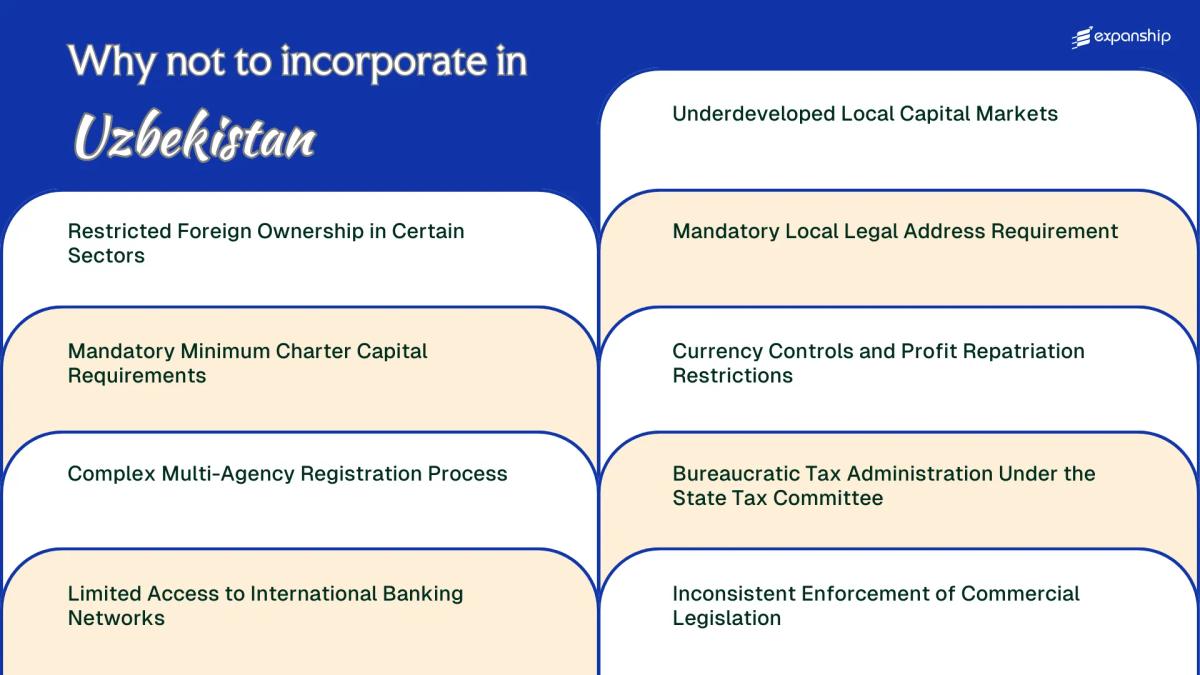
Restricted Foreign Ownership in Certain Sectors
Foreign ownership restrictions in Uzbekistan affect a defined set of industries, limiting the percentage of equity a foreign entity can hold or prohibiting direct foreign participation altogether.
Sectors Where Foreign Equity Is Capped or Excluded
Under Uzbekistan's Law on Foreign Investment and related sectoral legislation, foreign nationals and foreign-registered firms face ownership ceilings in strategic industries including media, telecommunications, and certain financial services. For foreign companies, this means structuring a joint venture with a local partner is not optional in these sectors; it is legally mandated, transferring partial control to a party whose interests may not align with yours.
Banking and insurance present a separate constraint. The Central Bank of the Republic of Uzbekistan and the Ministry of Finance impose licensing conditions that can effectively restrict foreign shareholding concentration, creating compliance obligations that add cost and time before operations can begin.
Implications for Shareholding Structure and Control
Mandatory local co-ownership dilutes decision-making authority in ways that can affect dividend policy, asset disposal, and strategic direction. A foreign investor holding a minority or capped stake has limited recourse if a local partner disputes board decisions.
Sector-specific restrictions are not always consolidated in a single regulatory instrument, meaning your legal due diligence must cover multiple laws and ministerial decrees to identify applicable limits accurately.
Foreign investors who structure their shareholding without first auditing sector-specific restrictions across Uzbekistan's dispersed legislative framework risk entering arrangements that require costly restructuring before regulatory approval is granted.
Mandatory Minimum Charter Capital Requirements
Uzbekistan minimum charter capital requirements apply differently depending on the legal form your business takes. For a limited liability company (OOO), the Civil Code sets no statutory minimum, but sector-specific rules impose thresholds that can run into tens of thousands of US dollars for regulated industries such as banking, insurance, and financial services.
That apparent flexibility at the general level masks real cost exposure. If your intended activity falls under a licensed sector, you must have the prescribed capital fully contributed before the relevant regulator will issue an operating licence.
The mandatory share capital restrictions in Uzbekistan create friction in several specific ways:
- Locking capital in a newly registered entity before any revenue is generated reduces your available working capital from day one.
- Sector regulators, such as the Central Bank for financial firms, verify capitalisation independently, meaning you face a separate compliance layer beyond the Ministry of Justice registration.
- Capital contribution records must be documented in sum, exposing your business to currency conversion costs if funds originate abroad.
- Failing to meet threshold requirements blocks licence issuance entirely, not just delays it.
OOO charter capital drawbacks are most acute for foreign-owned firms entering regulated sectors, where capital requirements function as an effective entry barrier rather than a mere formality.

Company Incorporation in Uzbekistan
Set up your Uzbekistan legal entity with accurate capital structuring and regulatory compliance from the outset.
Complex Multi-Agency Registration Process
The Uzbekistan business registration process challenges begin before your entity is even operational. Incorporating a foreign-owned company involves sequential coordination across multiple government bodies, including the Ministry of Justice, the State Tax Committee, and the State Registration Center (SRC), with each agency operating on its own timeline and documentation requirements.
| Agency / Requirement | Obligation | Practical Burden |
|---|---|---|
| State Registration Center (SRC) | Mandatory first-step entity registration | Requires notarised, apostilled foreign documents in Uzbek translation |
| Ministry of Justice | Oversight for certain entity types and foreign ownership verification | Adds review layer before registration is finalised |
| State Tax Committee | Tax registration and TIN issuance post-incorporation | Separate submission process; delays TIN receipt and account opening |
| Notarisation requirement | All founding documents must be notarised locally | Foreign documents require certified Uzbek translation before submission |
Document authentication alone creates a bottleneck. Foreign founders must have their incorporation documents apostilled abroad, then officially translated into Uzbek by a certified translator before submission, a sequence that can take weeks depending on the founder's home jurisdiction.
Even after SRC registration is complete, the firm cannot begin banking or tax filings until the State Tax Committee issues a taxpayer identification number. That dependency creates a gap period where the entity legally exists but cannot transact, directly delaying revenue operations for time-sensitive investors.
Limited Access to International Banking Networks
Uzbekistan international banking access limitations present a structural obstacle that goes beyond inconvenience. The country's banking sector remains dominated by state-owned institutions, with banks such as NBU (National Bank of Uzbekistan) and Asaka Bank controlling significant market share, limiting the competitive pressure that typically drives international connectivity.
Correspondent banking relationships between Uzbek commercial banks and major Western financial institutions are sparse. This means your firm may struggle to execute routine cross-border transactions, receive foreign payments, or hold multi-currency accounts without delays and intermediary fees that erode operational efficiency.
Foreign companies incorporated locally frequently report that opening a corporate account is itself a protracted process, often requiring extensive documentation well beyond what comparable jurisdictions demand. The Central Bank of Uzbekistan oversees licensing and compliance standards for commercial banks, but regulatory requirements have not yet translated into broader international network access.
Correspondent banking problems for Uzbekistan businesses are partly a product of the country's compliance classification by global correspondent banks, which affects transaction speed and cost.
- Wire transfers may route through multiple intermediary banks, each applying fees
- USD and EUR transaction clearing can face holds due to limited direct correspondent links
- Some foreign banks decline to open accounts for entities with a registered address solely in Uzbekistan
- Multi-currency account functionality is restricted at most local banks
Despite recent reforms, several Uzbek banks remain on restricted or enhanced-due-diligence lists maintained by major European correspondent banks, which can delay even routine trade finance transactions.
Underdeveloped Local Capital Markets
Uzbekistan capital market underdevelopment drawbacks present a concrete financing ceiling for foreign-owned entities that require growth capital beyond their initial charter contribution.
Structural Limitations of the Tashkent Stock Exchange
The Tashkent Stock Exchange (TSE) operates with low trading volumes and a narrow range of listed instruments, which means equity financing through public markets is not a practical option for most incorporated businesses. Your firm cannot rely on the TSE to raise expansion capital the way it could on exchanges in Poland, the UAE, or Singapore, where secondary market liquidity actually supports corporate fundraising.
Consequences for Foreign Business Financing
Debt capital markets remain similarly constrained, with corporate bond issuance underdeveloped relative to the scale of private sector activity. This forces most businesses to depend on retained earnings or bilateral bank lending, both of which limit growth velocity and increase exposure to concentrated lender risk.
Access to international institutional investors is further restricted by the absence of depositary receipt programmes and limited alignment with IFRS-based disclosure requirements that foreign funds typically require before committing capital.
Addressing Financing Constraints When Incorporating in Uzbekistan
Understand how underdeveloped capital markets affect your funding options and what financing structures are available to foreign-owned entities in Uzbekistan.
Mandatory Local Legal Address Requirement
Every company registered in Uzbekistan must maintain a physical legal address within the country, and this Uzbekistan legal address requirement restrictions create a recurring administrative and financial obligation that purely remote or foreign-operated businesses cannot sidestep. The address must be verifiable by the Ministry of Justice during registration and remains subject to inspection throughout the entity's operational life.
- Your registered address must correspond to a genuine, documented physical location, meaning a lease agreement or property ownership certificate is required at the point of registration.
- Virtual office arrangements face scrutiny from the Ministry of Justice, and addresses that cannot be confirmed through on-site verification risk triggering registration rejection or subsequent deregistration.
- Maintaining a compliant local office address in Uzbekistan generates ongoing lease costs that have no equivalent obligation in many other Central Asian registration regimes.
- Any change of legal address requires a formal re-registration amendment filed with state authorities, creating administrative delays whenever your operational footprint shifts.
Currency Controls and Profit Repatriation Restrictions
Uzbekistan currency controls and profit repatriation rules impose real friction on foreign-owned entities trying to move earnings offshore. Under the Foreign Exchange Regulation Law and related Central Bank of Uzbekistan instructions, currency conversion and cross-border transfers require supporting documentation that can delay transactions by weeks.
The Uzbekistani som (UZS) is not freely convertible on international markets. This means your business cannot simply transfer profits to a foreign account — conversion into hard currency must go through licensed commercial banks, and demand for USD or EUR regularly exceeds available supply at those institutions.
Foreign exchange restrictions for businesses extend to dividend repatriation, which requires confirmation of tax clearance from the State Tax Committee before a bank will process the transfer. That prerequisite alone can stall distributions for months if audit correspondence is unresolved.
- Dividend transfers require documentary proof of profit origin
- Tax clearance certificates must be current at the time of transfer
- Banks retain discretion to request additional compliance checks
A foreign-owned LLC distributing $200,000 in annual dividends could face a 60–90 day processing delay if tax clearance paperwork is not prepared in advance, effectively locking operating capital inside the jurisdiction during that period.
Bureaucratic Tax Administration Under the State Tax Committee
Uzbekistan tax administration challenges are a consistent operational burden for foreign-owned entities. The State Tax Committee (Davlat soliq qo'mitasi) oversees corporate tax compliance, and its reporting infrastructure demands frequent filings with limited tolerance for procedural error.
Corporate entities must submit monthly VAT declarations, quarterly profit tax reports, and annual financial statements, each through the separate e-tax portal system. The volume of recurring obligations means your finance function absorbs significant administrative time, particularly if you lack a locally experienced accountant familiar with the portal's technical requirements.
Tax audits under the State Tax Committee can be initiated with limited advance notice. Desk audits are routine, and documentary requirements are extensive, often demanding Uzbek-language originals rather than translated copies.
The profit tax rate for legal entities stands at 15%, but miscalculations in deductible expenses or depreciation schedules frequently trigger reassessments that carry penalty interest. Correcting these assessments requires formal appeals through the committee's internal dispute resolution process, which can extend resolution timelines by months.
All tax filings must be submitted in the Uzbek language through the State Tax Committee's e-tax portal, and filings in other languages or through alternative channels are not accepted, meaning foreign businesses without Uzbek-speaking tax staff face a direct structural barrier to maintaining compliance.
Inconsistent Enforcement of Commercial Legislation
Uzbekistan commercial legislation enforcement risks stem partly from the gap between formally enacted statutes and their application in practice. The Civil Code, the Law on Guarantees of Freedom of Entrepreneurial Activity, and sector-specific regulations exist on paper, but interpretation and enforcement vary significantly across regions and inspecting agencies.
Inspectors from different bodies, including the State Tax Committee, the State Customs Committee, and sector regulators, can apply the same statutory provision differently depending on locality or administrative period. Your business may receive a penalty in one district that would not be issued in another for an identical compliance position.
Regulatory unpredictability in Uzbekistan compounds this further because enforcement priorities shift alongside political and economic policy cycles. Foreign investors operating under long-term contracts cannot reliably predict how obligations will be read two or three years after signing.
Presidential decrees periodically override or modify standing commercial law, sometimes with limited transition periods, leaving registered entities exposed to retroactive compliance requirements.
Overcoming Incorporation Challenges in Uzbekistan
Overcoming Uzbekistan incorporation challenges requires structural preparation before registration begins, not reactive adjustments after problems surface. The disadvantages covered in this blog share a common thread: most arise from gaps between foreign business expectations and local procedural requirements.
- Conduct a sector-specific foreign ownership review against the restrictions set out in Uzbekistan's Law on Foreign Investment before selecting your legal entity type.
- Verify current minimum charter capital thresholds with the State Registration portal prior to incorporation to ensure sufficient capital is committed at the outset.
- Obtain a confirmed legal address in Uzbekistan before initiating registration, as this is a mandatory prerequisite across all entity types.
- Open a temporary accumulation account at a licensed Uzbek bank to deposit charter capital during the registration process.
- Structure your profit repatriation model in advance by accounting for the currency conversion rules administered by the Central Bank of Uzbekistan.
- Register with the State Tax Committee promptly after incorporation to avoid penalties from delayed tax identification.
These steps address procedural requirements set across multiple agencies, including the Ministry of Justice and the State Tax Committee. The regulatory framework continues to evolve under ongoing reform programs, meaning compliance requirements can shift within relatively short timeframes.
Uzbekistan's Investment Appeal Despite the Drawbacks
Uzbekistan's investment appeal despite drawbacks remains credible, particularly given the government's sustained reform agenda since 2017 and the country's position as Central Asia's most populous market. The operational constraints covered in this blog are real and measurable. For the right business profile, they are manageable rather than prohibitive.
| Consideration | Drawback |
|---|---|
| Large domestic consumer base of 36+ million people | Foreign ownership is restricted or capped in strategic sectors |
| Active reform program under Presidential Decrees has reduced some procedural barriers | Multi-agency registration involves the Ministry of Justice, State Tax Committee, and statistical authorities |
| Currency convertibility has improved since 2017's liberalization of the som | Profit repatriation remains subject to regulatory conditions and banking constraints |
| Free Economic Zones offer tax incentives for qualifying investors | Minimum charter capital requirements apply depending on entity type and foreign participation |
| Growing bilateral investment treaty network supports legal recourse | Commercial legislation enforcement remains inconsistent across regions and courts |
Uzbekistan's business environment carries genuine risks alongside its opportunities. The gap between written law and administrative practice remains one of the most consequential factors for foreign firms operating here.
Corporate Compliance Services in Uzbekistan
Maintain your company's standing with Uzbekistan's State Tax Committee, Ministry of Justice, and other regulatory authorities through structured compliance support.
Conclusion
Uzbekistan company formation drawbacks summary reflects a jurisdiction in active reform but carrying structural friction that affects foreign investors directly. Currency controls under the Central Bank's repatriation framework, the multi-agency registration process, and inconsistent enforcement of commercial legislation represent the most consequential barriers for an incoming entity. These are not peripheral concerns — each touches the operational and financial fundamentals of running a business here. Professional guidance from specialists familiar with the State Tax Committee procedures and local regulatory requirements remains a practical requirement, not an optional consideration.
Expanship's Uzbekistan Incorporation Support Services
Uzbekistan's regulatory environment imposes specific obligations that require careful handling from the outset. Expanship Uzbekistan incorporation support is designed to reduce the operational burden these requirements place on foreign businesses, from managing multi-agency registration with the Ministry of Justice to meeting charter capital thresholds and maintaining currency control compliance under the Central Bank's framework.
Our team works across the full scope of entity establishment and ongoing obligations in Uzbekistan:
- We prepare and file all company registration documents with the relevant Uzbek authorities on your behalf.
- A registered agent and compliant legal address are provided to satisfy local residency requirements.
- We liaise directly with government agencies, including the State Tax Committee, throughout the filing process.
- Post-incorporation compliance management keeps your entity in good standing with local regulators.
- Banking introduction assistance helps your business establish a functional local or international account.
- Tax registration and coordination with local authorities are handled as part of the setup process.
Reach out to Expanship Uzbekistan to discuss your incorporation requirements.
Frequently Asked Questions (FAQ)
Foreign-owned companies face heightened scrutiny from the State Tax Committee, particularly around transfer pricing and cross-border transactions. Uzbekistan introduced transfer pricing rules that require documentation demonstrating arm's-length pricing, and failure to satisfy auditors can result in additional tax assessments. The administrative burden of responding to inquiries is compounded by the fact that official communications are issued in Uzbek, creating translation and response-time challenges for foreign directors.
Enforcement inconsistency is not just a Tashkent-versus-provinces issue; it also varies by industry and by which agency is conducting oversight. The same contractual provision or licensing condition can be interpreted differently by separate inspectors within the same regulatory body. This creates unpredictability in dispute resolution and makes it difficult to rely on precedent when structuring commercial agreements.
The requirement for a registered legal address in Uzbekistan cannot be fulfilled by a foreign address or a P.O. box. Your company must maintain a verifiable physical presence, which means leasing office space or using a registered agent service that holds a legitimate local address. Non-compliance can result in the company being flagged for administrative action by the Ministry of Justice, including potential deregistration.
Under Uzbekistan's Law on Limited Liability Companies, failure to contribute the declared charter capital within the required period can expose the company to forced liquidation proceedings initiated by the registering authority. The minimum capital threshold varies by entity type, and for companies in regulated sectors it is substantially higher than the baseline for a standard LLC. Undercapitalization at the point of registration is one of the more common technical grounds on which new incorporations face legal challenge.
Restrictions apply to specific sectors defined under Uzbek law, including media, telecommunications, certain financial services, and industries tied to national security. Outside those sectors, full or majority foreign ownership is generally permitted. The challenge is that the list of restricted sectors is not always exhaustive in a single statute, and licensing requirements for adjacent industries can impose indirect foreign participation limits that are not immediately obvious during initial due diligence.
Compared to Kazakhstan, which has consolidated much of its company registration through a single digital portal, Uzbekistan's process still requires interaction with multiple agencies, including the Ministry of Justice, the State Tax Committee, and sector-specific licensing bodies. Each agency operates on its own timeline, and there is limited coordination between them. For a foreign founder without a local representative, coordinating these parallel processes from abroad is one of the more practical barriers to completing registration efficiently.
Correspondent banking limitations affect foreign-owned entities more acutely than domestically owned businesses, particularly when the foreign parent is incorporated in a jurisdiction that Uzbek banks consider high-risk or insufficiently familiar. Local banks operate under Central Bank of Uzbekistan regulations that restrict their correspondent relationships, and some international wire transfers are routed through intermediary banks, adding cost and delay. Companies in sectors that require frequent cross-border payments are disproportionately affected compared to firms operating primarily within the domestic market.
Legal Disclaimer
The information provided in this article is for general informational purposes only and does not constitute legal, tax, or professional advice. While we strive to ensure the accuracy and timeliness of the content, laws and regulations are subject to change, and the application of laws can vary widely based on specific facts and circumstances.
Readers should not act upon this information without seeking professional counsel tailored to their individual situation. Expanship and its authors disclaim any liability for actions taken or not taken based on the content of this article.
For specific advice regarding your business setup, compliance requirements, or any legal matters, please consult with qualified legal and tax professionals in the relevant jurisdiction.