
Key Takeaways
- The Limited Liability Company (Mas'uliyati Cheklangan Jamiyat) is the most commonly registered entity form in Uzbekistan, favored for its flexible governance and liability protection for small and mid-sized businesses.
- Company registration in Uzbekistan is administered by the Ministry of Justice of the Republic of Uzbekistan, which maintains the unified state register of legal entities.
- Foreign firms seeking a registered presence in Uzbekistan without establishing a separate legal entity can do so through a branch office or representative office, each carrying different operating permissions.
- Uzbekistan recognizes eight distinct legal structures, ranging from Joint Stock Companies (Aksiyadorlik Jamiyati) suited for capital markets access to Individual Entrepreneur (Yakka Tartibdagi Tadbirkor) registration for sole traders operating at smaller revenue thresholds.
Introduction to Entity Types in Uzbekistan
Uzbekistan is a landlocked country in Central Asia, bordering Kazakhstan, Kyrgyzstan, Tajikistan, Afghanistan, and Turkmenistan. It has been an independent sovereign state since 1991, following the dissolution of the Soviet Union. The primary authority overseeing company registration is the Ministry of Justice of the Republic of Uzbekistan, which administers the unified state register of legal entities.
The country operates a territorial tax system with a standard corporate income tax rate, and has entered into a network of double taxation treaties that can affect how foreign-owned structures are treated.
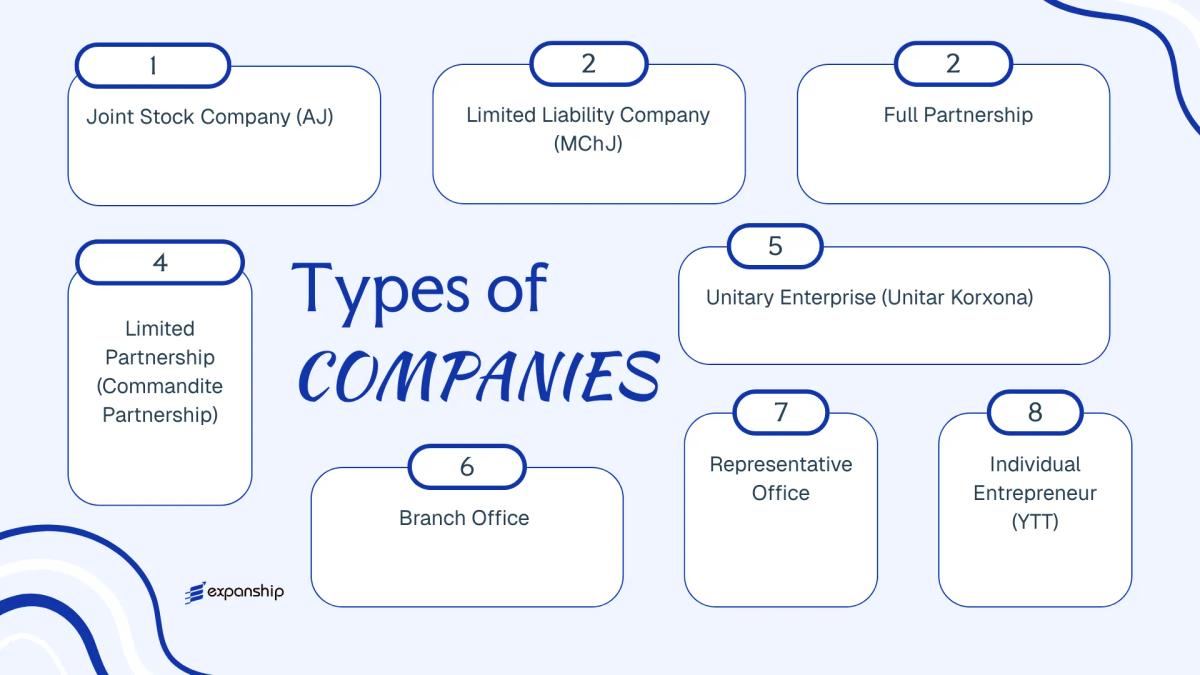
Businesses registering in Uzbekistan can select from several legal entity forms, including:
- Joint Stock Company (Aksiyadorlik Jamiyati)
- Limited Liability Company (Mas'uliyati Cheklangan Jamiyat)
- Full Partnership
- Limited (Commandite) Partnership
- Unitary Enterprise (Unitar Korxona)
- Branch Office
- Representative Office
- Individual Entrepreneur (Yakka Tartibdagi Tadbirkor)
Each structure carries distinct requirements around capital, liability, governance, and foreign ownership eligibility. This article examines each of these types of business entities in Uzbekistan, covering formation requirements, ownership rules, and operational considerations to help you determine which structure suits your specific commercial objectives.
An Overview of Business Structures in Uzbekistan
Uzbekistan's company law framework provides several distinct legal forms under which a business can be established and operated. The primary legislation governing these structures is the Civil Code of Uzbekistan, supplemented by dedicated statutes including the Law on Limited Liability Companies and the Law on Joint Stock Companies. Each legal form carries different implications for liability, ownership, and operational scope.
Business Structures at a Glance
| Entity Type | Legal Form | Liability | Tax Status | Local Trading | Minimum Members | Regulatory Authority | Governing Act |
|---|---|---|---|---|---|---|---|
| Joint Stock Company (AJ) | Corporate entity | Limited to share value | Taxable | Permitted | 1 shareholder | Ministry of Justice | Law on Joint Stock Companies |
| Limited Liability Company (MCJ) | Corporate entity | Limited to contribution | Taxable | Permitted | 1 member | Ministry of Justice | Law on LLCs |
| Full Partnership | Unincorporated entity | Unlimited, joint | Taxable | Permitted | 2 partners | Ministry of Justice | Civil Code |
| Limited Partnership | Unincorporated entity | Mixed liability | Taxable | Permitted | 2 partners | Ministry of Justice | Civil Code |
| Unitary Enterprise | State/municipal entity | Owner bears liability | Taxable | Permitted | 1 founder | Ministry of Justice | Civil Code |
| Branch Office | Foreign entity extension | Parent bears liability | Taxable | Restricted | 1 parent company | Ministry of Justice | Law on Foreign Investment |
| Representative Office | Non-trading presence | Parent bears liability | Exempt from profit tax | Not permitted | 1 parent company | Ministry of Justice | Law on Foreign Investment |
| Individual Entrepreneur | Sole trader | Unlimited personal | Simplified tax regime | Permitted | 1 individual | Tax authorities | Tax Code |
Each of these structures is examined in full in the sections below.
Joint Stock Company (Aksiyadorlik Jamiyati) in Uzbekistan
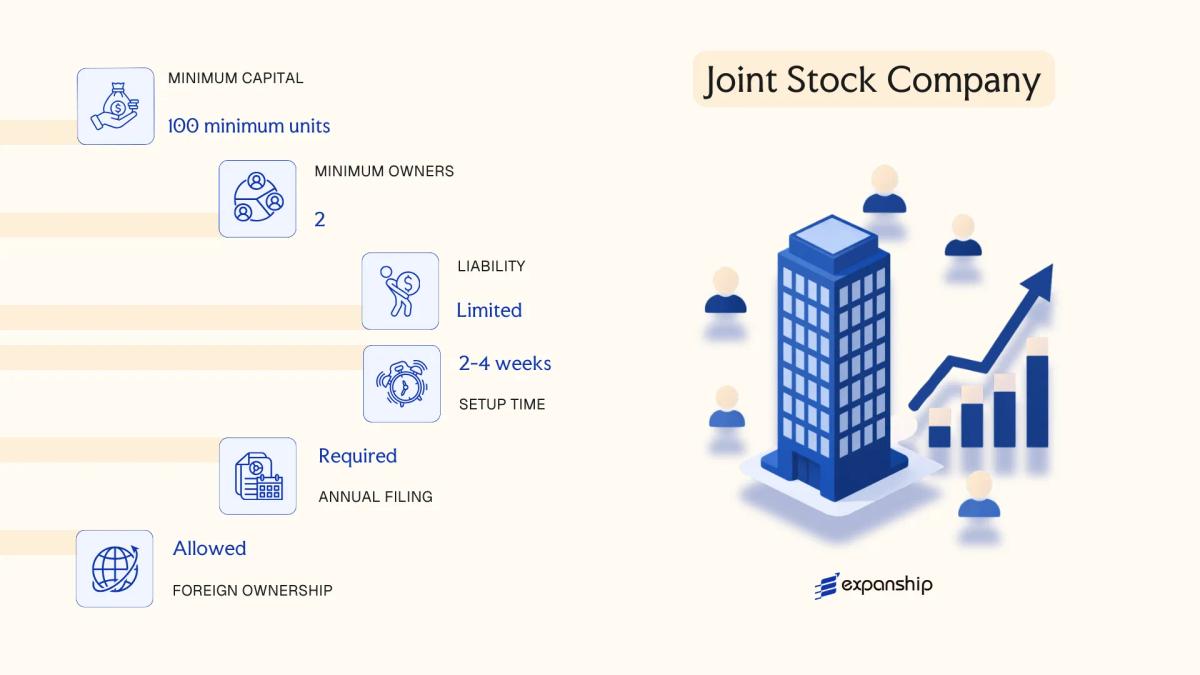
A Joint Stock Company in Uzbekistan — known locally as an Aksiyadorlik Jamiyati (AJ) — is governed by the Law "On Joint Stock Companies and Protection of Shareholders' Rights" (No. 223-I, 1996, with subsequent amendments). The entity holds separate legal personality, meaning its obligations are distinct from those of its shareholders.
Shareholders bear liability only to the extent of their share value. This structure suits businesses seeking access to capital markets or those planning to bring in multiple institutional investors.
Key Characteristics
| Requirement | Detail | Notes |
|---|---|---|
| Legal Form | Joint Stock Company (Aksiyadorlik Jamiyati) | Recognised under Uzbek civil and corporate law |
| Members | Shareholders; Board of Directors; Supervisory Board | Open AJ: no upper limit on shareholders; Closed AJ: up to 50 shareholders |
| Local Presence | Registered legal address in Uzbekistan required | Physical office or registered agent address |
| Capital | Minimum share capital varies by sub-type; denominated in Uzbekistani Som (UZS) | Open AJ requires higher minimum capital than Closed AJ |
| Share Transferability | Freely transferable (Open AJ); restricted (Closed AJ) | Closed AJ shares require shareholder approval for transfer |
| Privacy | Shareholder register maintained; Open AJ disclosures are public | Closed AJ has reduced public disclosure obligations |
Focus Points
- Taxation: Subject to corporate income tax at the standard rate; VAT applies to taxable supplies; dividends paid to foreign shareholders attract withholding tax — consult the State Tax Committee of Uzbekistan for current rates and treaty relief procedures.
- Annual Compliance: Mandatory annual general meeting, audited financial statements, and regulatory filings with the Ministry of Justice and the Capital Market Development Agency.
- Treaty Access: Uzbekistan maintains a network of double taxation treaties, which may reduce withholding tax on dividends, interest, and royalties for qualifying foreign shareholders.
- Conversion: An AJ may be reorganised into a Limited Liability Company or another legal form through a formal restructuring procedure under Uzbek civil law.
- Restrictions: Certain regulated sectors — banking, insurance, subsoil use — impose additional licensing or capitalisation requirements on joint stock entities.
Sub-Types
Open Joint Stock Company (Ochiq Aksiyadorlik Jamiyati)
Shares are offered to the public and may be freely traded. This sub-type is subject to more extensive disclosure requirements and oversight by the Capital Market Development Agency, making it the standard vehicle for publicly listed businesses.
Closed Joint Stock Company (Yopiq Aksiyadorlik Jamiyati)
Shareholder count is capped at 50, and share transfers require the consent of existing shareholders. This structure is typically used by private businesses that want the corporate protections of a joint stock form without the obligations of a public offering.
When to Use This Structure
An Aksiyadorlik Jamiyati is suited to large-scale commercial operations, ventures seeking equity financing, or businesses with foreign institutional investors. The main advantage is its capacity to raise capital through share issuance. The primary limitation is the administrative burden: audit requirements, shareholder meeting formalities, and regulatory oversight are more demanding than those imposed on a limited liability company.
Best suited for large enterprises, foreign institutional investors, or businesses planning to access Uzbekistan's capital markets.

Company Incorporation in Uzbekistan
Incorporate a Joint Stock Company or other business entity in Uzbekistan with Expanship's end-to-end support.
Limited Liability Company (Mas'uliyati Cheklangan Jamiyat) in Uzbekistan
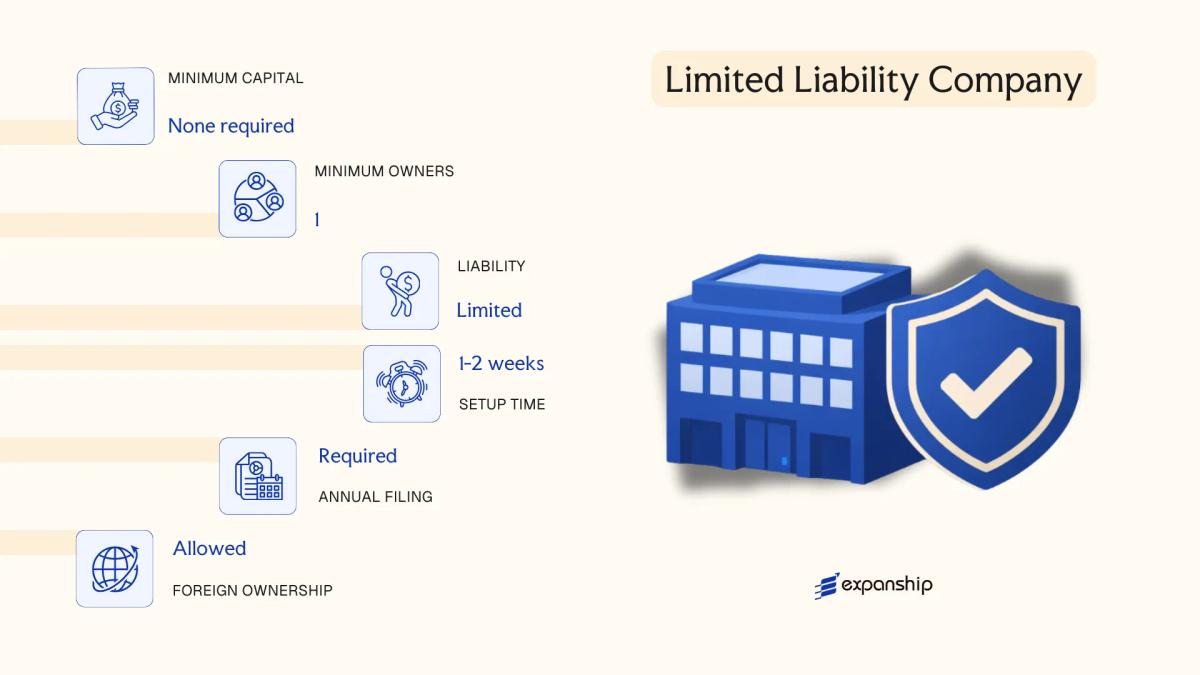
The Limited Liability Company Uzbekistan MCJ formation process is governed by the Law of the Republic of Uzbekistan "On Limited and Additional Liability Companies" (No. 310-II, 2001, as amended). The MCJ holds separate legal personality, meaning the entity bears its own rights and obligations distinct from those of its members.
Each member's exposure is confined to the value of their contributed share in the charter capital. This hybrid structure combines corporate liability protection with a relatively straightforward internal governance framework, making it the dominant vehicle for private commercial activity.
Key Characteristics
| Requirement | Detail | Notes |
|---|---|---|
| Legal Form | Limited Liability Company (Mas'uliyati Cheklangan Jamiyat) | Separate legal entity under civil law |
| Members | 1–50 participants | Referred to as "participants" (ishtirokchilar); exceeding 50 triggers mandatory conversion |
| Management | Director (single executive body) + optional Supervisory Board | General Meeting of Participants is the supreme governing body |
| Local Presence | Registered legal address in Uzbekistan required | Must be a physical address; virtual offices may not satisfy state registration requirements |
| Charter Capital | Minimum 400,000 UZS (subject to legislative revision) | Divided into participatory shares; no share certificates issued |
| Privacy | Participant details filed with the State Registry | Information is accessible through official state registers |
Focus Points
- Taxation: Subject to 15% corporate profit tax; VAT at 12% applies if turnover thresholds are met; withholding tax on dividends paid to non-residents is generally 10%, subject to applicable double tax treaties.
- Annual Compliance: Annual financial statements must be submitted; the entity must maintain accounting records under Uzbekistan's national accounting standards.
- Treaty Access: As a resident entity, the MCJ can access Uzbekistan's network of double taxation agreements.
- Conversion: An MCJ with more than 50 participants is legally required to reorganise into a Joint Stock Company.
- Restrictions: Certain licensed activities (banking, insurance) require additional regulatory authorisation beyond standard MCJ registration.
Closing
The MCJ suits trading operations, holding structures, and service businesses where participants prefer retained control without public share issuance. Its primary advantage is straightforward profit distribution combined with liability separation; the principal limitation is the 50-participant ceiling, which restricts equity-based growth.
Best suited for small-to-medium private businesses, joint ventures, and foreign investors seeking a controlled, operationally active presence without the compliance overhead of a public company structure.
Partnerships in Uzbekistan [Full Partnership, Limited Partnership (Commandite Partnership)]
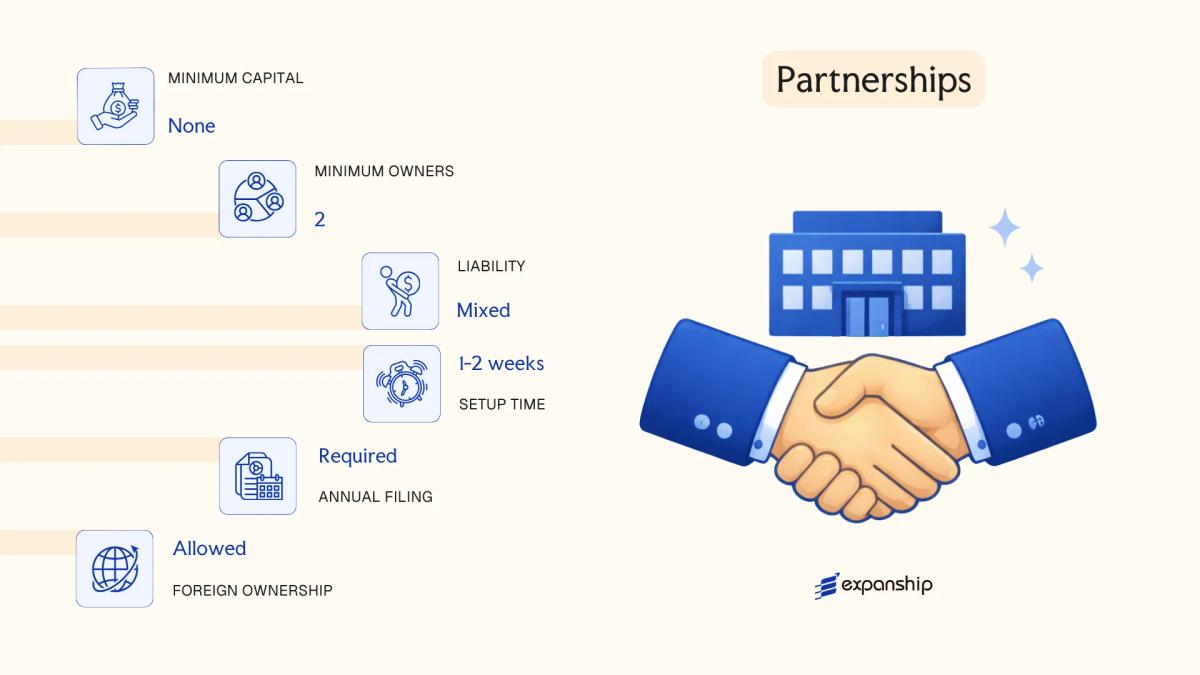
Uzbekistan recognises two forms of partnership as distinct legal entities under the Civil Code of Uzbekistan and the Law on Business Partnerships: the full partnership (to'liq shirkat) and the commandite partnership (kommandita shirkat). Both structures carry separate legal personality, meaning the partnership itself, rather than its members, enters into contracts and holds assets. The partnership business structure Uzbekistan regulates is less common than the LLC or JSC, but it remains available for specific commercial arrangements.
Liability exposure is the defining difference between the two forms. In a full partnership, all participants bear unlimited joint liability for the entity's obligations. The commandite structure introduces a two-tier membership model, separating general partners who carry unlimited liability from silent investors (commanditists) whose exposure is capped at their contributed capital.
Key Characteristics
| Requirement | Detail | Notes |
|---|---|---|
| Legal Form | Full Partnership / Commandite Partnership | Both have separate legal personality |
| Members | General Partners (full); General Partners + Commanditists (commandite) | Minimum 2 general partners; no statutory maximum |
| Capital | No statutory minimum; denominated in UZS | Contributions defined in the founding agreement |
| Local Presence | Registered legal address required | No mandatory registered agent requirement |
| Governance | Managing partner or unanimous decision of general partners | Commanditists excluded from management |
| Privacy | Founding agreement filed with registration authorities | Partner identities are on public record |
Focus Points
- Taxation: Partnerships are generally treated as pass-through entities for tax purposes; profits are taxed at partner level under applicable personal or corporate income tax rates, with VAT obligations arising if turnover thresholds are met.
- Annual Compliance: Partners must file financial statements and maintain accounting records in accordance with Uzbek accounting standards.
- Restrictions: Commanditists may not participate in management; doing so risks reclassification as a general partner with unlimited liability.
- Conversion: A full partnership may be converted into a commandite partnership by admitting investor-participants without dissolving the entity.
- Treaty Access: Partnerships do not independently access double tax treaty benefits; treatment depends on the residency and tax status of individual partners.
Sub-Types
Full Partnership (To'liq Shirkat)
Every participant acts as a general partner, contributing to management and bearing unlimited personal liability for all obligations of the firm. This structure suits small groups of professionals or entrepreneurs operating on mutual trust.
Commandite Partnership (Kommandita Shirkat)
General partners manage the business and carry unlimited liability, while commanditists contribute capital and receive a share of profits without management rights. This form supports arrangements where passive investors wish to participate financially without operational involvement.
Closing
Partnerships suit closely held commercial ventures where participants prefer contractual flexibility over institutional governance structures, though unlimited liability for general partners represents a significant exposure that deters wider adoption.
Partnerships in Uzbekistan are best suited for small professional groups or arrangements that combine active management partners with passive capital contributors under a clearly defined founding agreement.
Unitary Enterprise (Unitar Korxona) in Uzbekistan
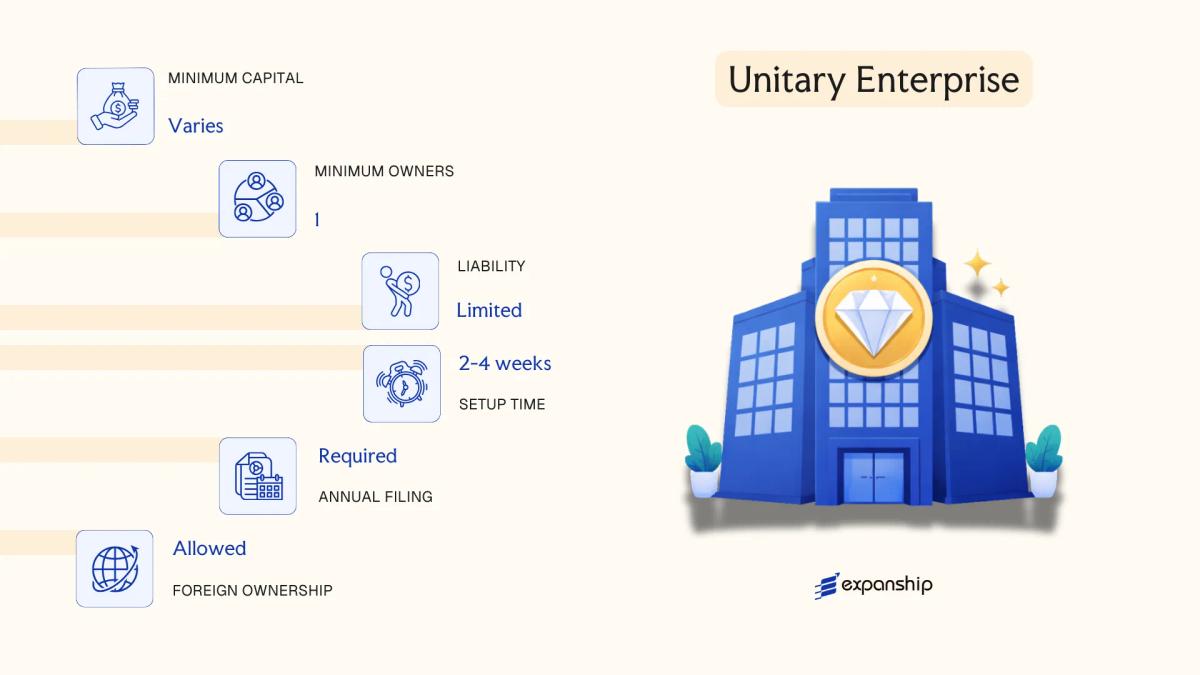
A Unitary Enterprise (Unitar Korxona) in Uzbekistan is a commercial entity that does not hold ownership rights over the property assigned to it. Governed by the Civil Code of Uzbekistan and the Law "On State Property" (as amended), the property remains vested in the founder — typically the state or a municipality — while the enterprise operates on a right of economic management or operational management.
Despite this unusual ownership arrangement, the entity carries separate legal personality and bears limited liability confined to the assets under its management. This hybrid structure distinguishes it from standard corporate forms, where equity ownership and operational control are aligned.
Key Characteristics
| Requirement | Detail | Notes |
|---|---|---|
| Legal Form | Unitary Enterprise (Unitar Korxona) | Not a share-based entity; property assigned, not transferred |
| Proprietor | Single founder (state, municipality, or legal entity) | Referred to as the "founder"; no shareholders or members |
| Management | Director appointed by the founder | Founder retains significant supervisory authority |
| Local Presence | Registered legal address in Uzbekistan required | Registration filed with the relevant district tax authority |
| Charter Capital | Determined by the founder; no universally fixed statutory minimum for private unitary enterprises | State-owned variants follow separate budget-based allocation rules |
| Privacy | Founder identity disclosed in state registration records | Public registry access available through the Unified State Register |
Focus Points
- Taxation: Subject to standard corporate income tax (15%), VAT (12% where applicable), and withholding tax on dividends and cross-border payments at rates governed by applicable double tax treaties.
- Annual Compliance: Annual financial statements must be filed; state-owned enterprises are subject to additional reporting to the relevant ministry or state committee.
- Restrictions: Private individuals cannot establish a Unitary Enterprise; the founder must be a legal entity or a state body.
- Conversion: Can be reorganised into a joint-stock company or LLC under Civil Code reorganisation procedures, subject to founder approval.
- Treaty Access: Eligible for treaty benefits under Uzbekistan's network of double tax agreements, provided substance and beneficial ownership conditions are met.
Sub-Types
State Unitary Enterprise (Davlat Unitar Korxonasi)
Established by a state authority, this variant operates under the right of economic management or, in cases of strategic assets, operational management. State unitary enterprises in Uzbekistan are commonly used to operate public utilities, state-owned infrastructure, and government-mandated service providers.
Municipal Unitary Enterprise
Founded by a local government body rather than a central state authority, this sub-type serves municipal service delivery functions. The founding municipality assigns property and approves the charter, but operational scope is confined to the relevant administrative territory.
Closing
The Unitary Enterprise structure is used primarily for state-directed commercial activities or government-linked operations rather than private investment vehicles. Its principal advantage is the ability to operate commercially without transferring asset ownership away from the state; the central limitation is that private entrepreneurs and foreign investors cannot use this form directly.
State bodies, municipalities, or state-owned legal entities seeking to establish a commercially operating entity without divesting ownership of assigned assets.
Foreign Business Presence in Uzbekistan [Branch Office, Representative Office]
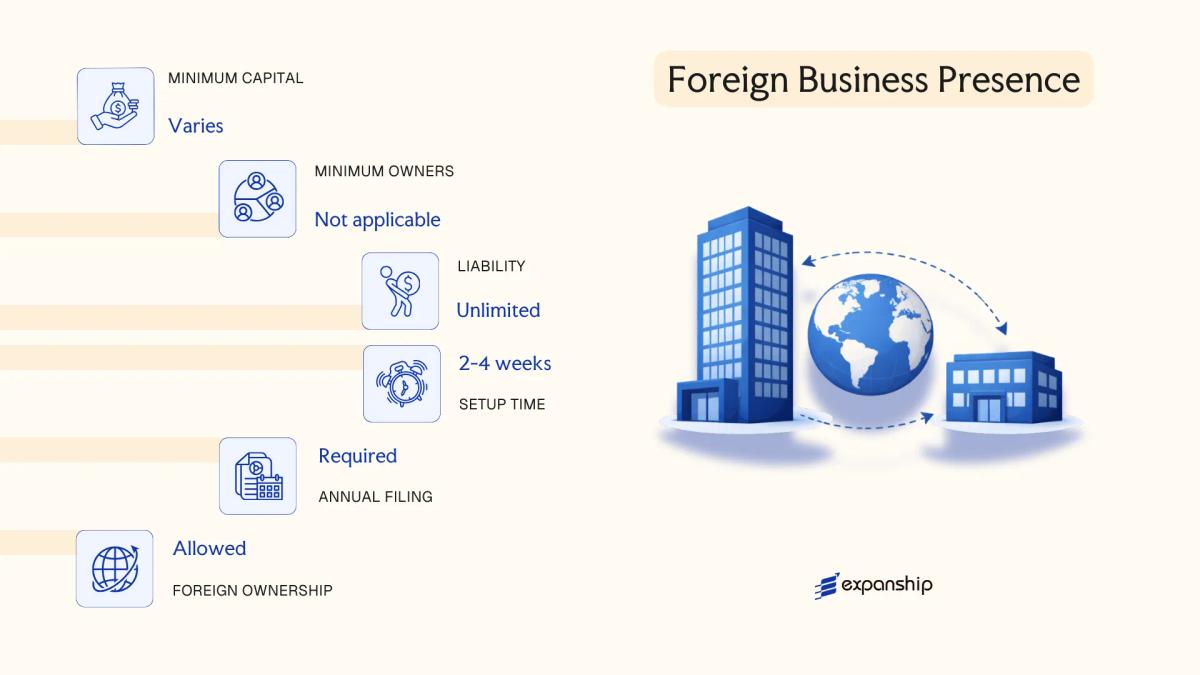
A foreign company branch office Uzbekistan-based operations fall primarily under the Law on Foreign Investment (1998) and the Civil Code of the Republic of Uzbekistan, alongside the Law on Companies and Partnerships. Neither a branch nor a representative office constitutes a separate legal entity — both remain extensions of the parent company, meaning the foreign firm bears full liability for their obligations.
Registration is handled through the Ministry of Justice of the Republic of Uzbekistan, and accreditation for representative offices is processed through the Agency for Foreign Economic Activity. Both structures require a formal application package, including the parent company's constitutional documents, proof of legal standing in the home jurisdiction, and a power of attorney for the local head.
Key Characteristics
| Requirement | Branch Office | Representative Office |
|---|---|---|
| Legal Personality | None — extension of parent | None — extension of parent |
| Commercial Activity | Permitted | Not permitted; limited to promotional and liaison activities |
| Liability | Parent company bears full liability | Parent company bears full liability |
| Local Head | Mandatory (appointed by power of attorney) | Mandatory (appointed by power of attorney) |
| Registered Address | Required in Uzbekistan | Required in Uzbekistan |
| Accreditation Period | Typically 1–3 years, renewable | Typically 1–3 years, renewable |
Focus Points
- Taxation: Branch profits are subject to corporate income tax (standard rate 15%); VAT applies to taxable supplies; withholding tax may apply to remittances to the parent depending on applicable double tax treaty coverage.
- Treaty Access: Uzbekistan maintains an active double tax treaty network; treaty benefits apply to the parent entity, not the branch or representative office as standalone structures.
- Annual Compliance: Both structures require annual accreditation renewal with the relevant authority and ongoing submission of financial reports aligned with Uzbek accounting standards.
- Restrictions: A representative office cannot generate revenue, sign commercial contracts in its own right, or conduct trading operations — activities that exceed this scope require conversion to a branch or a locally incorporated entity.
- Conversion: Neither structure can be converted directly into a legal entity; establishing an LLC or JSC requires a separate incorporation process.
Sub-Types
Branch Office
A branch office may conduct the same commercial activities as the parent company, including entering contracts, generating income, and employing staff locally. It is typically used by foreign firms seeking operational presence without the administrative burden of incorporating a local subsidiary.
Representative Office
A representative office is restricted to non-commercial functions such as market research, promotion of the parent company's goods and services, and facilitating contacts. Foreign businesses commonly use this structure during a market-entry assessment phase before committing to full operational establishment.
Closing Note
Both structures suit foreign companies testing the Uzbek market or maintaining a controlled operational footprint without establishing a separate local entity. The primary advantage is straightforward setup relative to full incorporation; the key limitation is that neither structure offers liability separation from the parent.
Foreign companies seeking a preliminary or limited operational presence before committing to local incorporation.
Individual Entrepreneur (Yakka Tartibdagi Tadbirkor) in Uzbekistan
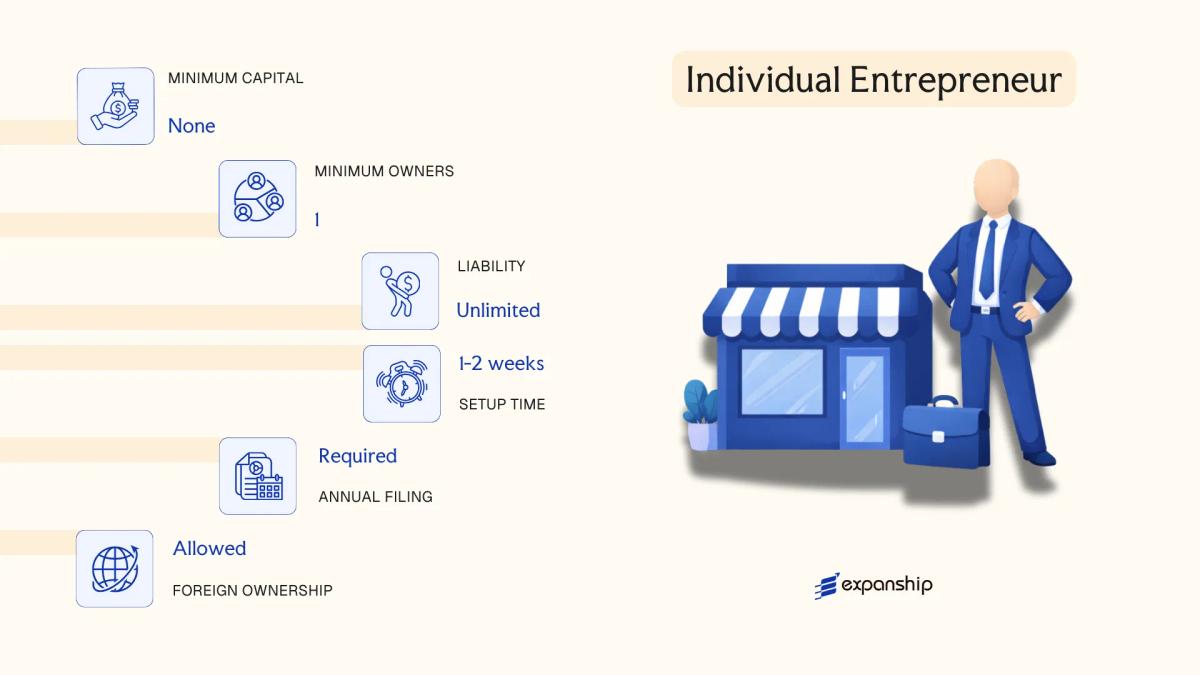
Registered under the Law "On Guarantees of Freedom of Entrepreneurial Activity" (2000) and further governed by the Civil Code of Uzbekistan, the Individual Entrepreneur Uzbekistan Yakka Tartibdagi status allows a natural person to conduct commercial activity without forming a separate legal entity. The individual and the business are legally the same person, which means personal assets remain exposed to business liabilities.
Registration is handled through the unified online portal of the Ministry of Justice, and the process is among the most straightforward self-employed registration pathways available under Uzbek law.
Key Characteristics
| Requirement | Detail | Notes |
|---|---|---|
| Legal Form | Unincorporated sole proprietorship | No separate legal personality from the owner |
| Proprietor | Single natural person only | Cannot be a legal entity; referred to as a proprietor |
| Members | One individual; no partners or co-owners permitted | Sole ownership is mandatory |
| Local Presence | Registered business address required | Can operate from a residential address in certain cases |
| Capital | No statutory minimum capital requirement | Personal assets back all obligations |
| Privacy | Name of proprietor appears on public registry | No separation between personal and business identity |
Focus Points
- Taxation: Subject to a flat turnover tax under the simplified tax regime if annual revenue stays below the established threshold; VAT registration triggered upon exceeding the threshold; no corporate profit tax applies.
- Annual Compliance: Required to file periodic tax declarations with the State Tax Committee; bookkeeping obligations are simplified relative to corporate entities.
- Activity Restrictions: Certain licensed or regulated activities, including banking and insurance, are not accessible under this structure.
- Conversion: Can be converted into an LLC (Mas'uliyati Cheklangan Jamiyat) if the business outgrows the sole trader registration Uzbekistan framework, though this requires a formal re-registration process.
- Social Contributions: The proprietor is personally responsible for mandatory state social insurance contributions.
Closing
This structure suits domestic freelancers, small traders, and service providers operating with low overhead and limited transactional complexity. The primary advantage is minimal administrative burden; the principal drawback is unlimited personal liability for all business debts.
The Yakka Tartibdagi Tadbirkor is best suited for resident individuals conducting small-scale, low-risk commercial activity who do not require liability protection or access to external investment.
How to Choose the Right Entity Type in Uzbekistan
Selecting how to choose a business entity in Uzbekistan requires more than comparing registration fees — the structural decision carries legal, tax, and operational consequences that persist for the life of the business.
Why Your Entity Choice Matters
The wrong structure creates concrete problems, not theoretical ones.
- Registering a representative office when you intend to sign contracts and generate revenue locally violates its permitted scope under Uzbekistan's civil legislation, exposing the business to administrative penalties and forced closure.
- Choosing an Individual Entrepreneur registration for a multi-party venture creates no legal separation between co-owners, leaving personal assets directly exposed to business liabilities with no statutory framework for dispute resolution between participants.
- Selecting a structure ineligible for Uzbekistan's simplified tax regime — when your turnover and activity would otherwise qualify — results in a higher standard tax burden that could have been avoided from inception.
- Forming a Joint Stock Company when a Limited Liability Company would suffice imposes mandatory audit requirements and securities regulation obligations that add recurring compliance costs disproportionate to the firm's size.
Key Factors to Consider
- Business Activity: Active trading, asset holding, and regulated sectors such as banking or insurance each require distinct legal forms under Uzbek law.
- Ownership Structure: A single founder points toward an LLC or Unitary Enterprise, while multiple investors may require the governance framework of a Joint Stock Company.
- Tax Regime Eligibility: Your chosen entity type determines access to the simplified tax system administered by the State Tax Committee of Uzbekistan.
- Liability Exposure: Partnerships do not limit personal liability by default, which directly affects the risk profile of each participant.
- Substance and Operational Capacity: If you cannot maintain a physical presence, a representative office — which is prohibited from commercial activity — may be structurally misaligned with your objectives.
- Exit and Conversion: Not all Uzbek entity types permit straightforward conversion; confirming restructuring options under the Law on Business Entities before registration avoids future procedural constraints.
Compliance Services for Companies in Uzbekistan
Ongoing compliance support for Uzbek entities, including filing obligations, regulatory reporting, and statutory maintenance.
Conclusion
Uzbekistan offers a defined set of legal structures, each suited to different ownership models and operational scales. The LLC (Mas'uliyati Cheklangan Jamiyat) remains the most commonly registered form, favored by small and mid-sized businesses for its flexible governance and limited liability. Joint Stock Companies serve businesses requiring capital markets access or large shareholder bases. Partnerships carry unlimited liability and tend to suit professional services arrangements. The Unitary Enterprise functions where single-founder state or private ownership is required. Branch offices and representative offices give foreign firms a registered presence without establishing a separate legal entity, though with different operating permissions. Individual Entrepreneur registration suits sole traders operating at smaller revenue thresholds.
Uzbekistan has been progressively updating its business registration framework through the Agency for the Development of the Capital Market and related regulatory bodies. Treaty network expansion and ongoing legal reforms signal continued alignment with international investment standards. Engaging qualified local legal or corporate service support at the formation stage helps ensure your structure is registered correctly under current requirements.
How Expanship Can Assist You
Expanship company registration Uzbekistan services cover the full process of establishing your business under local law, from selecting the right entity type — whether an MCJ (LLC), JSC, or unitary enterprise — to filing with the Uzbekistan Agency for the Development of the Pharmaceutical Industry or, for most commercial entities, registering through the relevant district or city hokimiyat and the Single Portal of Government Services. Every document we prepare is tailored to Uzbek statutory requirements.
Our service scope across corporate services Uzbekistan incorporation work includes:
- Document drafting and notarization in accordance with Uzbek civil law
- Registered address and local agent provision
- Filing coordination with the State Tax Committee and registration authorities
- Post-incorporation compliance management, including annual reporting obligations
- Corporate bank account introduction assistance with local and international banks
- Ongoing statutory secretarial support
Reach out to our team through Expanship Uzbekistan to discuss your specific requirements.
Frequently Asked Questions (FAQ)
The Limited Liability Company (Mas'uliyati Cheklangan Jamiyat, or MCJ) is the predominant choice for both local and foreign entrepreneurs. Its relatively straightforward registration process under the Law on Limited Liability Companies and the absence of a minimum share capital requirement make it accessible for a wide range of business activities.
A Branch Office is not a separate legal entity; it operates as an extension of its foreign parent and cannot independently own assets or enter contracts in its own name. An MCJ, by contrast, has full legal personality, can hold property, and is taxed as a resident entity under Uzbek law. Compliance obligations for an MCJ are broader, but it permits independent commercial activity without parental liability exposure.
Among registered entities, the Unitary Enterprise (Unitar Korxona) has a single founder whose identity is recorded in the Unified State Register of Legal Entities. Nominee arrangements are not a formally recognized mechanism under current Uzbek corporate law, so beneficial ownership information is generally accessible through public registry records.
A sole individual can form an MCJ or a Unitary Enterprise. Partnerships, whether full or limited (commandite), require a minimum of two participants by statute. Joint Stock Companies require at least one founder but carry additional structural requirements under the Law on Joint Stock Companies.
Foreigners may establish an MCJ, Joint Stock Company, or Unitary Enterprise, and may register as an Individual Entrepreneur (Yakka Tartibdagi Tadbirkor) subject to residency conditions. Foreign legal entities may alternatively open a Branch or Representative Office without forming a separate legal entity. Each route carries distinct tax registration obligations with the State Tax Committee.
Uzbek corporate legislation permits reorganization, including transformation from one legal form to another, subject to procedural requirements set out in the Civil Code and relevant sector laws. An MCJ can generally be reorganized into a Joint Stock Company. Conversion involving partnerships or Unitary Enterprises follows specific statutory procedures and requires re-registration with the relevant state authority.
No. Representative Offices and Branch Offices do not constitute independent legal entities under Uzbek law; they act on behalf of and remain legally bound to their parent organization. All domestically incorporated forms, including the MCJ, Joint Stock Company, Unitary Enterprise, and partnerships, possess separate legal personality upon state registration.
Legal Disclaimer
The information provided in this article is for general informational purposes only and does not constitute legal, tax, or professional advice. While we strive to ensure the accuracy and timeliness of the content, laws and regulations are subject to change, and the application of laws can vary widely based on specific facts and circumstances.
Readers should not act upon this information without seeking professional counsel tailored to their individual situation. Expanship and its authors disclaim any liability for actions taken or not taken based on the content of this article.
For specific advice regarding your business setup, compliance requirements, or any legal matters, please consult with qualified legal and tax professionals in the relevant jurisdiction.