
Key Takeaways
- Uzbekistan's Law on Foreign Investments formally guarantees equal treatment between domestic and foreign-owned entities, allowing foreign nationals to hold 100% ownership in most sectors without a local partner.
- Free Economic Zone designations eliminate substantial tax burdens during capital-constrained early operating years, making FEZ-eligible businesses among the most fiscally advantaged structures available in Central Asia.
- The territorial-based corporate tax framework under the Tax Code of Uzbekistan limits liability to locally sourced income, preserving retained earnings for reinvestment rather than exposing global revenue to domestic taxation.
- Structural reforms enacted since 2017 have produced verifiable changes to foreign ownership rights, profit repatriation rules, and entity registration procedures, giving Uzbekistan a measurable policy trajectory that distinguishes it from peer jurisdictions in the region.
Uzbekistan is a landlocked, independent republic in Central Asia, bordered by five countries and positioned at the geographic crossroads of major overland trade routes. Company registration falls under the authority of the State Services Agency, which operates the unified portal for business registration and licensing. Foreign businesses entering the market most commonly do so through a limited liability company, known locally as a Mas'uliyati Cheklangan Jamiyat. The country operates a territorial-based tax system with a general corporate rate that applies to resident entities on locally sourced income.
Openness to foreign direct investment is codified in the Law on Foreign Investments, which formally guarantees equal treatment between domestic and foreign-owned entities. Foreign nationals may hold 100% ownership in most sectors without requiring a local partner, which has contributed to rising FDI inflows over the past several years. The benefits of incorporating in Uzbekistan span regulatory, fiscal, and operational dimensions. This article examines those advantages in detail across the sections that follow.
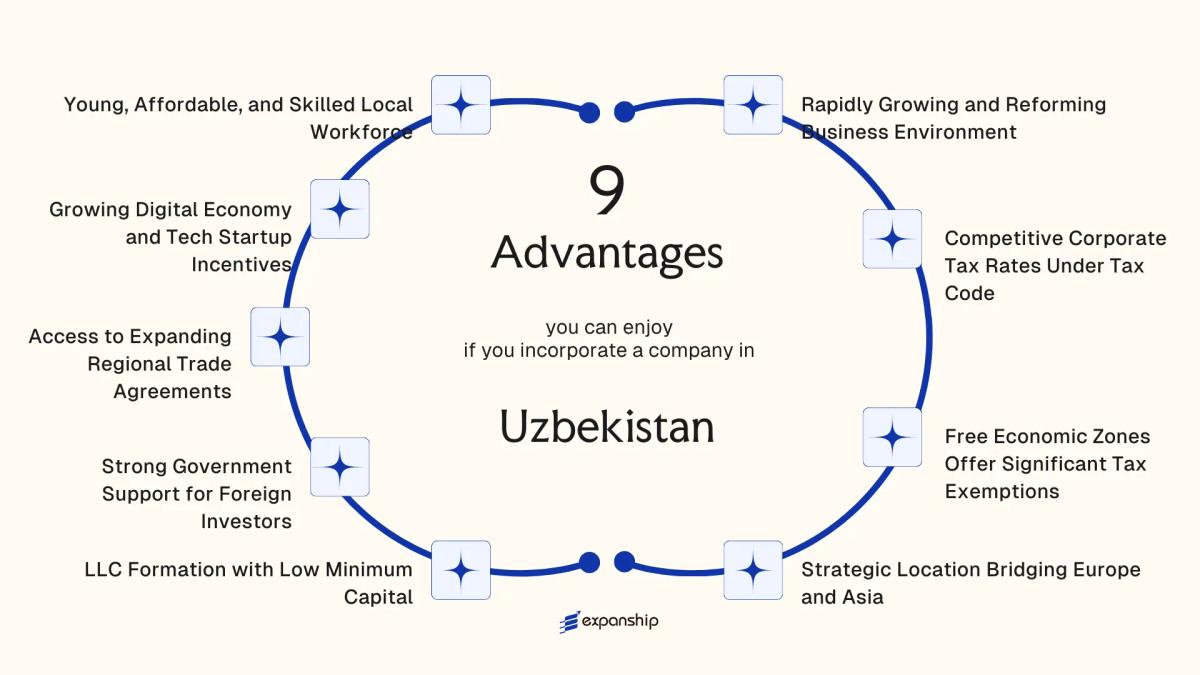
Rapidly Growing and Reforming Business Environment
Since 2017, Uzbekistan has undergone one of the most substantial reform programs among post-Soviet economies in Central Asia. For foreign investors assessing the Uzbekistan business environment advantages, the pace and scope of these changes directly affect what you can do, own, and repatriate as a business operator.
From Closed Economy to Foreign Capital Access
Presidential Decree No. UP-5017 marked the start of currency liberalization, ending restrictions that had previously made profit repatriation unpredictable. Foreign firms can now freely convert and transfer profits in hard currency, which removes a structural barrier that historically discouraged foreign direct investment in the region.
Regulatory Reform as a Practical Advantage
The State Investment Committee oversees investor protections and facilitates the resolution of disputes involving foreign capital. Since 2018, the government has cut the number of licensed business activities significantly, reducing the administrative load on newly registered entities. Fewer licensing requirements mean your operational setup is faster and less dependent on bureaucratic approvals that would otherwise delay revenue generation.
Active deregulation means your firm faces fewer procedural barriers between registration and the start of commercial operations.
Competitive Corporate Tax Rates Under Tax Code
Uzbekistan's standard corporate income tax rate sits at 15%, established under the Tax Code of the Republic of Uzbekistan. For context, the EU average corporate rate hovers around 21%, making this a structurally lower baseline for foreign-owned entities registered in the country.
The 15% rate applies broadly to resident legal entities, including limited liability companies with foreign participation. Your company's taxable profit is calculated on net income after allowable deductions, which reduces the effective tax burden further depending on your cost structure.
Certain categories of business activity attract a reduced rate of 7.5% under the Tax Code, including software development and IT services. This statutory differentiation means the headline rate is not a ceiling for every sector.
Under the simplified taxation system, smaller entities may opt for turnover-based taxation at rates as low as 4%, though eligibility depends on annual revenue thresholds set by the Tax Code. This option lowers compliance complexity alongside the tax figure itself.
The practical advantages of this structure include:
- A flat rate that applies without graduated band complexity, reducing forecast uncertainty for foreign investors
- Deductible business expenses that are defined in the Tax Code, giving your firm predictable net liability calculations
- Sector-specific reduced rates that are legislated, not discretionary, providing a stable planning basis

Company Incorporation in Uzbekistan
Register your company in Uzbekistan with full compliance support across legal structure, tax registration, and documentation.
Free Economic Zones Offer Significant Tax Exemptions
Uzbekistan free economic zones tax exemptions represent one of the more concrete fiscal advantages available to foreign-registered entities. Businesses operating within designated FEZs are exempt from corporate income tax, property tax, land tax, and water use tax for defined periods, with the duration tied to the scale of capital investment. These exemptions are grounded in the Law on Free Economic Zones and subsequent presidential decrees that have expanded the FEZ network across regions including Navoi, Angren, Jizzakh, and Urgut.
| Investment Amount (USD) | Corporate Income Tax Exemption | Other Tax Exemptions |
|---|---|---|
| Up to $3 million | 3 years | Property, land, water use taxes |
| $3 million to $10 million | 5 years | Property, land, water use taxes |
| $10 million to $30 million | 10 years | Property, land, water use taxes |
| Over $30 million | Up to 30 years | Property, land, water use taxes |
For a foreign company, the practical effect is a cost structure materially different from operating outside these zones. During the exemption window, retained earnings are higher, which accelerates the return on initial capital. Customs duty exemptions on imported equipment and raw materials used in production add a further reduction to operating costs that directly affects project viability calculations.
Eligibility requires registration as a FEZ resident through the relevant zone administration, and business activity must align with the zone's designated sectors, which typically prioritize manufacturing, export-oriented production, and industrial processing.
Strategic Location Bridging Europe and Asia
Uzbekistan's geographic position is one of the more structurally significant Uzbekistan strategic location advantages for businesses operating between East and West. The country sits at the crossroads of major overland freight corridors connecting China, Russia, the South Caucasus, and South Asia, placing your registered entity within reach of over 3 billion consumers across interconnected regional markets.
Landlocked status does not constrain connectivity here. The country borders Kazakhstan, Kyrgyzstan, Tajikistan, Afghanistan, and Turkmenistan, and participates in the Trans-Caspian International Transport Route under the TRACECA framework, which provides documented transit rights across Eurasian corridors. For a firm distributing goods regionally, this translates into defined legal transit infrastructure, not informal access.
Tashkent functions as a regional air cargo hub with direct freight links into Europe, the Gulf, and East Asia. A business incorporated locally can use this as a physical dispatch point, reducing relay dependencies.
Keep the following in mind when factoring geography into your incorporation decision:
- Verify that your specific commodity category is covered under existing TRACECA transit agreements
- Confirm customs classification under Uzbekistan's Commodity Nomenclature before projecting transit timelines
- Check whether your target export markets fall under active bilateral trade protocols
- Transit rights do not automatically confer preferential tariff treatment at destination borders
Despite being one of only two doubly landlocked countries in the world, Uzbekistan has signed over 50 bilateral transport and transit agreements, giving incorporated entities more formal corridor access than several coastal Central Asian neighbors.
LLC Formation with Low Minimum Capital
Uzbekistan LLC low minimum capital requirements give your business a capital-efficient entry point that many comparable markets do not offer. Under the Law on Limited Liability Companies (No. 562-I), a Mas'uliyati Cheklangan Jamiyat can be registered with a minimum charter capital of 400,000 Uzbek soum, which at current exchange rates represents a nominal figure well below USD 50. This threshold means that capital which would otherwise be tied up in statutory reserves can be directed toward operations from day one.
Capital Threshold and What It Means for Your Structure
The low floor is not merely symbolic. It means a foreign entrepreneur can establish a legally compliant entity and open a corporate bank account without committing significant capital at the pre-revenue stage. Registration is handled through the State Registration Body under the Ministry of Justice, and the charter capital must be fully contributed within a year of incorporation, giving founders a reasonable window to align funding with business milestones.
Ownership and Liability Protection
A single foreign individual or entity can hold 100% of the equity in an MCJ. This sole-ownership structure, combined with limited liability, means personal assets remain legally separated from company obligations regardless of how modest the initial capital contribution is. For foreign investors testing market entry before scaling, the combination of a low capital requirement and full ownership rights creates a structurally sound vehicle without disproportionate upfront financial exposure.
Plan Your Uzbekistan Incorporation with Expanship
Get expert guidance on structuring your MCJ to meet statutory requirements while maximising operational flexibility from the outset.
Strong Government Support for Foreign Investors
Uzbekistan government support for foreign investors is structured through specific legal instruments rather than general policy commitments. The Law on Foreign Investments and the Law on Guarantees and Measures to Protect the Rights of Foreign Investors establish binding protections that apply from the moment capital enters the country.
- The Agency for Foreign Investments and Technologies under the Cabinet of Ministers serves as a dedicated state body responsible for facilitating investor entry, coordinating with ministries, and resolving administrative obstacles. For your business, this means a single institutional contact point rather than navigating multiple uncoordinated agencies.
- Foreign investors are legally protected against nationalization and expropriation except in cases defined by law, with mandatory compensation at market value. This guarantee is codified, not discretionary.
- The "grandfather clause" in Uzbek investment legislation allows your firm to retain the legal and tax conditions in force at the time of investment if subsequent legislation introduces less favorable terms, for a defined protection period.
- Bilateral Investment Treaties with over 50 countries provide your entity access to international arbitration, removing disputes from domestic courts when treaty conditions apply.
- Presidential Decree No. UP-5456 and subsequent investment reform decrees have formalized a "single window" approach for investor registration, reducing the administrative burden during entity setup.
Access to Expanding Regional Trade Agreements
Uzbekistan regional trade agreements benefits for businesses are grounded in the country's membership in the Commonwealth of Independent States (CIS) Free Trade Area, which entered into force under the 2011 CIS Free Trade Agreement. This treaty eliminates or significantly reduces customs duties on goods traded among member states, giving your company preferential access to economies including Russia, Kazakhstan, and Belarus without standard third-country tariff exposure.
Beyond the CIS framework, Uzbekistan holds observer status at the World Trade Organization and has been actively negotiating bilateral trade agreements with major partners, including the European Union under the Enhanced Partnership and Cooperation Agreement (EPCA) process. For a trading entity, this trajectory means progressively lower barriers to European markets from a Central Asian base.
Membership in the Shanghai Cooperation Organisation (SCO) also creates preferential commercial channels across a bloc that includes China, India, and Pakistan — markets that are difficult to access cost-effectively from European or Gulf jurisdictions.
A manufacturer exporting $500,000 in goods annually to Russia under CIS Free Trade Area preferential rates, rather than standard MFN tariffs, could avoid duties that would otherwise range from 5% to 15% depending on product category — a potential annual saving of $25,000 to $75,000 on that single trade corridor alone.
Growing Digital Economy and Tech Startup Incentives
Uzbekistan tech startup incentives for businesses are anchored primarily in the IT Park regime, established under Presidential Decree No. UP-5099 (2019). Resident companies operating within IT Park are exempt from profit tax, personal income tax on employee salaries, social tax, and VAT. This zero-tax environment applies for the duration of IT Park residency, meaningfully reducing the operating cost base for software development, SaaS, and digital services firms.
Residency is not automatic. Your company must pass a qualification review confirming that its primary revenue derives from IT products or services, which limits eligibility to genuinely tech-focused entities rather than mixed-activity businesses.
Foreign firms can register an IT Park resident entity remotely, and the regime permits 100% foreign ownership. The ability to repatriate profits without restriction adds further utility for investors who need capital mobility across borders.
Key advantages for qualified resident companies include:
- Zero profit tax during residency period
- Exemption from social tax reduces payroll costs directly
- Access to state-funded co-working infrastructure and developer resources
- Participation in government procurement channels reserved for IT Park members
IT Park residency requires that qualifying revenue from IT activities constitutes the predominant share of your company's total income; mixed-purpose businesses may not meet the threshold.
Young, Affordable, and Skilled Local Workforce
Uzbekistan's skilled workforce advantages for businesses are grounded in measurable demographic and educational realities. The country's population exceeds 36 million, with a median age below 30, producing a consistently large entry-level and mid-career labor pool. For a foreign-owned entity, this translates directly into a sustained supply of recruitable talent without the demographic contraction affecting many European and East Asian labor markets.
Education System and Technical Output
The State Testing Center and the Ministry of Higher Education oversee a university system that produces graduates across engineering, IT, economics, and applied sciences. Technical and vocational education institutions, reformed under the 2019 Presidential Decree on vocational education development, have expanded enrollment in trade and technical disciplines. Your business gains access to candidates trained in fields that align with manufacturing, services, and digital operations without bearing the cost of extensive foundational retraining.
Labor Cost Structure
Average monthly wages in Uzbekistan remain significantly lower than those in comparable emerging markets in Southeast Asia or Eastern Europe. This cost differential is not simply a function of economic underdevelopment; it reflects purchasing power parity conditions that allow you to maintain competitive compensation locally while keeping payroll costs contained relative to global benchmarks. Foreign investors operating in Free Economic Zones may also benefit from additional labor cost advantages tied to zone-specific incentive regimes.
Workforce Characteristics Relevant to Foreign Employers
- English and Russian language proficiency is common among urban, educated professionals, reducing communication friction for international management
- The working-age population is projected to grow through at least 2035 based on current demographic trends
- IT-specific talent pipelines have expanded through public-private initiatives under the Digital Uzbekistan 2030 strategy
Why Uzbekistan Stands Out Among Central Asian Jurisdictions
Compared with Kazakhstan, Kyrgyzstan, and Tajikistan, Uzbekistan presents a distinct combination of structural reforms and market scale that makes it a practical reference point for foreign investors evaluating Central Asian incorporation options. Kazakhstan is the most economically developed of the three alternatives, yet its corporate tax rate sits at 20%, and compliance costs for foreign entities remain higher. Kyrgyzstan and Tajikistan offer lower barriers to entry but limited domestic market depth and less mature regulatory infrastructure.
What the comparison below reveals is not simply a difference in rates, but a difference in trajectory. The pace of legislative change under the Tax Code of Uzbekistan and the breadth of the Free Economic Zone network signal a deliberate effort to reposition the country as a regional business hub, which in practical terms means the regulatory environment your firm encounters today is more predictable than it was five years ago, and continues to move toward simplification.
| Parameter | Uzbekistan | Kazakhstan | Kyrgyzstan |
|---|---|---|---|
| Standard Corporate Tax Rate | 15% | 20% | 10% (limited sectors) |
| FEZ Tax Exemptions | Up to 10 years, multiple zones | Available but fewer zones | Limited scope |
| Minimum Share Capital (LLC) | No statutory minimum | No statutory minimum | Nominal requirement |
| Foreign Ownership | 100% permitted | 100% permitted | 100% permitted |
| Workforce Cost | Low | Moderate | Low |
| Domestic Market Size | ~36 million population | ~19 million population | ~7 million population |
Compliance Services for Companies in Uzbekistan
Maintain good standing with Uzbekistan's regulatory requirements, including annual filings, tax reporting, and statutory obligations under the Tax Code of Uzbekistan.
Conclusion
Uzbekistan's case as a destination for foreign incorporation rests on a combination of structural reforms and fiscal design that few Central Asian jurisdictions can match at this stage of economic development. The tax exemptions available within its Free Economic Zones, governed under specific FEZ regulations, remove meaningful cost burdens during the years when capital is most constrained. Pair that with a corporate tax rate set under the Tax Code of Uzbekistan that keeps retained earnings available for reinvestment, and the financial logic for establishing a presence here becomes clear.
The benefits of incorporating in Uzbekistan are not uniform across every business type. A firm entering a regulated sector, or one seeking FEZ status, will face eligibility thresholds and approval processes that require careful structuring. Your business model, the industry you operate in, and the scale of your planned investment will all shape how much of the available framework you can access.
What remains consistent is the direction of the country's policy environment. The reforms enacted since 2017 have produced measurable changes to foreign ownership rights, repatriation rules, and entity registration procedures. For foreign investors weighing Uzbekistan company formation, the trajectory of that reform process matters as much as any single rate or rule. Knowing where the framework currently stands and how your structure fits within it is the starting point for any formation decision.
Start Your Uzbekistan Company Formation with Expanship Today
Expanship assists foreign businesses with Uzbekistan company formation across the entity types covered throughout this blog, including Limited Liability Companies registered under the Civil Code and the Law on Limited Liability Companies. From initial structuring decisions to statutory filings with the Ministry of Justice and the State Tax Committee, the scope of support covers each stage where administrative gaps typically create delays for foreign principals.
Expanship's service offering for this jurisdiction includes:
- Preparation and notarization of incorporation documents, including charter drafting and founder resolutions
- Registered agent and legal address provision within Uzbekistan, as required for LLC registration
- Liaison with the Ministry of Justice for entity registration and the State Tax Committee for tax identification
- Post-incorporation compliance management, including annual reporting obligations and statutory record maintenance
- Support with Free Economic Zone applications where the business qualifies under applicable FEZ regulations
- Banking introduction assistance to facilitate corporate account opening with local financial institutions
Expanship Uzbekistan is available to discuss your incorporation requirements directly.
Frequently Asked Questions (FAQ)
The minimum charter capital for an LLC is set at approximately 400,000 UZS, which at current exchange rates amounts to a modest sum in USD terms. This figure is defined under the Civil Code and the Law on Limited Liability Companies. The capital does not need to be fully paid up at the time of registration, though partial contribution requirements apply within the first year.
Uzbekistan operates multiple Free Economic Zones, including Navoi, Angren, Jizzakh, and several others established by presidential decree. Qualifying resident companies in these zones can receive exemptions from corporate income tax, property tax, and customs duties for periods that typically range from three to ten years depending on the zone and investment volume. Eligibility conditions vary by zone and are tied to minimum investment thresholds and approved activity types.
The standard corporate income tax rate is 15% under the current edition of the Tax Code of Uzbekistan. Certain categories of taxpayer, including small businesses operating under the simplified taxation regime, may be subject to a turnover-based tax instead. The applicable rate depends on the entity's annual revenue and the type of activity conducted.
A local director is not a statutory requirement for an LLC. However, having a local representative or authorized signatory with a registered address in the country is necessary for correspondence with the Ministry of Justice and the tax authority. Practical operational requirements, such as opening a corporate bank account, may also make local representation advisable.
Uzbekistan is a member of the Commonwealth of Independent States (CIS) free trade area and has observer status in the Shanghai Cooperation Organisation, both of which facilitate reduced trade barriers across multiple neighboring markets. A company incorporated locally can benefit from preferential tariff treatment when exporting to CIS member states. The scope of preferences depends on the product category and compliance with applicable rules of origin.
Technology-oriented businesses operating within the IT Park established under Presidential Decree No. UP-5099 are eligible for a range of tax preferences, including exemption from corporate income tax, social tax, and customs duties on imported equipment. Resident status in the IT Park is granted based on the nature of the company's activities, which must fall within approved IT and software categories. Non-resident foreign legal entities can also participate through establishing a subsidiary or representative office that qualifies for residency.
Failure to file annual financial statements with the tax authority or maintain statutory records can result in administrative fines and, in persistent cases, suspension or forced liquidation of the entity by the Ministry of Justice. The Tax Code of Uzbekistan sets out penalty structures for late or non-filing, which are applied progressively based on the duration of non-compliance. Directors and authorized representatives bear direct responsibility for ensuring that obligations are met on schedule.
Legal Disclaimer
The information provided in this article is for general informational purposes only and does not constitute legal, tax, or professional advice. While we strive to ensure the accuracy and timeliness of the content, laws and regulations are subject to change, and the application of laws can vary widely based on specific facts and circumstances.
Readers should not act upon this information without seeking professional counsel tailored to their individual situation. Expanship and its authors disclaim any liability for actions taken or not taken based on the content of this article.
For specific advice regarding your business setup, compliance requirements, or any legal matters, please consult with qualified legal and tax professionals in the relevant jurisdiction.