

Key Takeaways
- Foreign investors incorporating in Taiwan must comply with both the Company Act and the Statute for Investment by Foreign Nationals, with registration submitted through the MOEA's TWBEA portal under the oversight of the Ministry of Economic Affairs.
- Entity type, industry sector, and whether the investor is a foreign national or foreign juridical person each determine which specific structural and administrative requirements apply during the incorporation process.
- Beneficial ownership disclosure obligations carry distinct compliance implications for foreign investors and must be addressed as part of the entity formation process, not treated as a post-registration formality.
- Non-compliance with Taiwan's incorporation requirements can result in application rejection at the registration stage or, following formation, suspension of business operations and legal penalties under applicable law.
Entity formation in Taiwan is governed by the Company Act, with the Ministry of Economic Affairs (MOEA) serving as the primary regulatory authority overseeing company registration and compliance. Foreign investors are subject to additional oversight under the Statute for Investment by Foreign Nationals.
This article covers the structural and administrative requirements your business must satisfy before and during the incorporation process in Taiwan.
Failure to meet these requirements can result in rejection of your registration application or, in cases of non-compliance after formation, suspension of business operations or legal penalties under applicable law.
Requirements differ depending on the entity type selected, the industry sector your firm operates in, and whether the investor is a foreign national or a foreign juridical person.
This article is most relevant to foreign entrepreneurs, multinational companies, and overseas investors seeking to establish a legal presence in Taiwan for the first time.
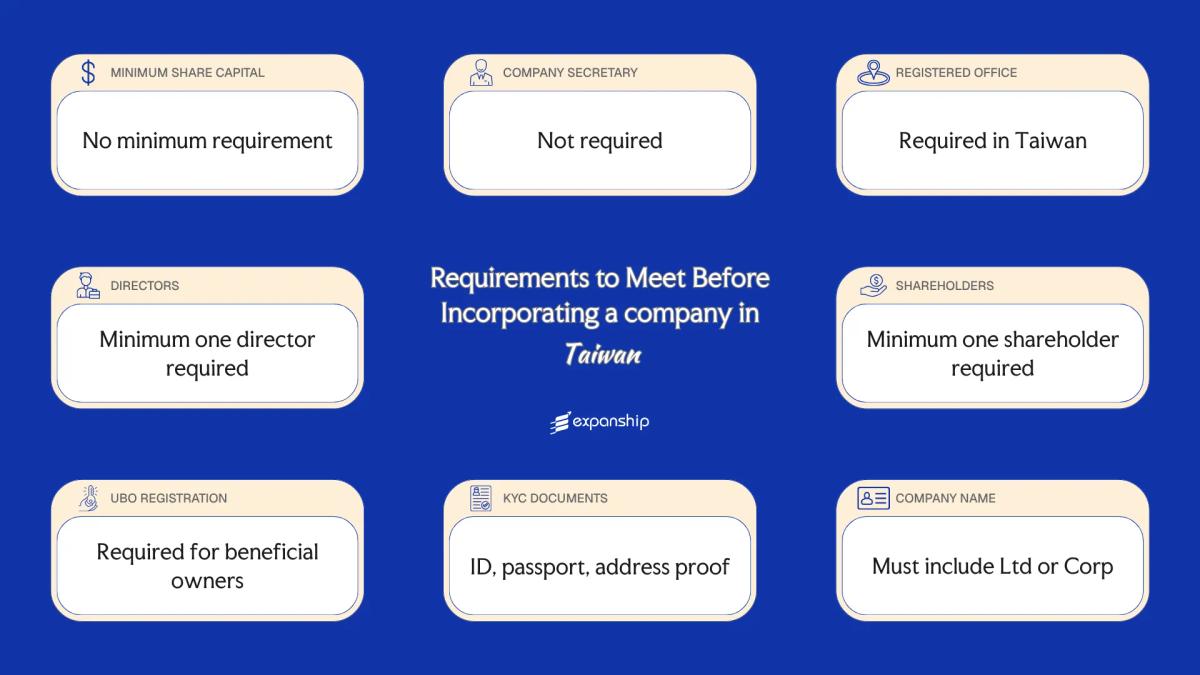
Minimum Share Capital Requirements in Taiwan
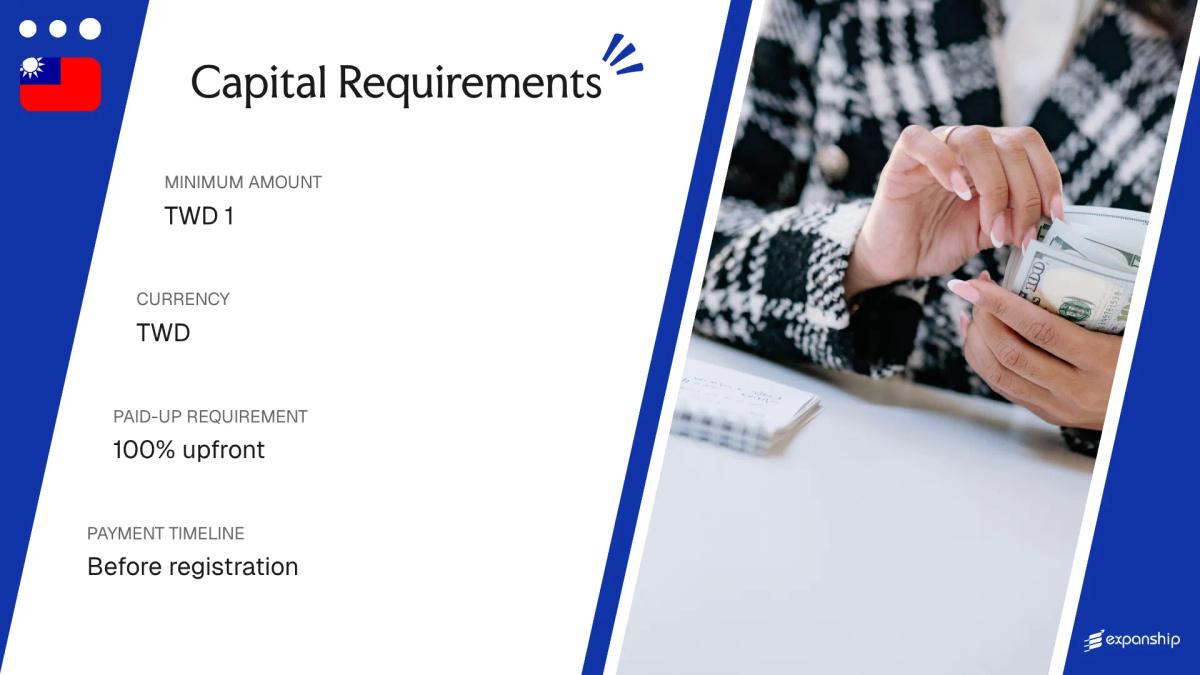
Taiwan minimum share capital requirements follow a no-par value framework under the Company Act (公司法). The Ministry of Economic Affairs (MOEA), through its Commercial Administration division, oversees company registration and verifies the capital structure at the point of incorporation.
There is no statutory minimum authorized or paid-up capital for most company types under current regulations. Capital deposited before registration must be verified by a certified public accountant (CPA), who issues a capital verification report (驗資報告) confirming the funds were received in a designated corporate bank account prior to submission.
| Parameter | Detail |
|---|---|
| Minimum Authorized Share Capital | No statutory requirement |
| Maximum Authorized Share Capital | No statutory requirement |
| Minimum Paid-Up Capital | No statutory requirement |
| Paid-Up Requirement at Incorporation | Capital must be fully paid up and CPA-verified before filing |
| Accepted Currency | New Taiwan Dollar (TWD) |
| Accepted Forms of Contribution | Cash; non-cash contributions (e.g., property, IP) permitted subject to valuation |
| Timeframe to Deposit Capital | Prior to incorporation filing |
The CPA capital verification report must be obtained before submitting the incorporation application to the MOEA. Filing without it will result in rejection, regardless of the amount deposited.
Company Secretary Requirements in Taiwan
Under Taiwan's Company Act, there is no statutory requirement for companies to appoint a company secretary in the way many common law jurisdictions mandate. That said, Taiwan company secretary requirements, in practice, reflect a broader set of corporate administration obligations that companies must fulfill to remain in good standing with the Ministry of Economic Affairs (MOEA).
Certain Taiwan corporate secretary obligations are typically handled by internal personnel or delegated to professional service providers. These include maintaining statutory books and records, handling correspondence with the MOEA, and ensuring annual reporting filings are submitted on time.
Qualification criteria for those serving in this administrative capacity generally include:
- No formal licensing requirement exists under the Company Act for corporate secretarial roles.
- The function may be performed by a director, internal staff member, or an appointed representative of the firm.
- Foreign nationals may serve in this capacity, subject to any applicable work authorization requirements.
- Professional agents such as certified public accountants or law firms commonly assume these duties on behalf of the entity.

Incorporate a Company in Taiwan
Set up your business entity in Taiwan with full support across statutory filings, MOEA registration, and ongoing compliance requirements.
Registered Office Requirements in Taiwan
Taiwan registered office requirements are governed by the Company Act (公司法), which mandates that every company registered with the Ministry of Economic Affairs (MOEA) maintain a designated office address within the jurisdiction at all times. Failure to maintain a compliant address can result in administrative penalties or, in serious cases, revocation of the company's registration.
- A physical address is required; P.O. boxes are not accepted as a registered office address.
- The address must be located within Taiwan; foreign addresses do not satisfy the requirement.
- Virtual office addresses may be used, provided the address corresponds to a physical, identifiable location that can receive official correspondence.
- Your business must hold either ownership title or a valid lease agreement for the registered premises.
- The registered address is publicly listed in the MOEA's commercial registration database and accessible for inspection.
- Any change to the registered office address must be formally notified to the MOEA through a company alteration registration filing; failure to update the record is a violation of the Company Act.
Director Requirements in Taiwan

Under the Company Act (公司法) of Taiwan, directors assume direct statutory liability for ensuring the company's operations comply with applicable laws, meaning personal liability can arise where a director acts in breach of fiduciary duties or causes harm to shareholders or third parties through negligence or misconduct.
| Parameter | Detail |
|---|---|
| Minimum Number of Directors | A minimum of one director is required for a limited company (有限公司); a company limited by shares (股份有限公司) requires at least three directors. |
| Maximum Number of Directors | No statutory maximum is prescribed under the Company Act. |
| Local/Resident Director Required | No statutory requirement for a locally resident director. |
| Nationality Restrictions | No nationality restrictions are imposed on directors under the Company Act. |
| Minimum Age Requirement | Directors must be at least 20 years of age, which aligns with the age of majority under Taiwan civil law. |
| Corporate Directors Permitted | Corporate directors are not permitted; only natural persons may serve as directors. |
| Director Must Be a Shareholder | For a company limited by shares, directors are not required to be shareholders unless the articles of incorporation specify otherwise. |
| Publicly Listed on Registry | Director information is filed with and publicly accessible through the Ministry of Economic Affairs (MOEA) company registration database. |
| Disqualification Conditions | Individuals who have been declared bankrupt and not yet reinstated, or sentenced for certain criminal offences under the Company Act, are disqualified from serving as directors. |
Unlike many jurisdictions, Taiwan does not require any director to be a local resident or citizen, yet all director appointments must be formally registered with the MOEA before they carry legal effect.
Shareholder Requirements in Taiwan
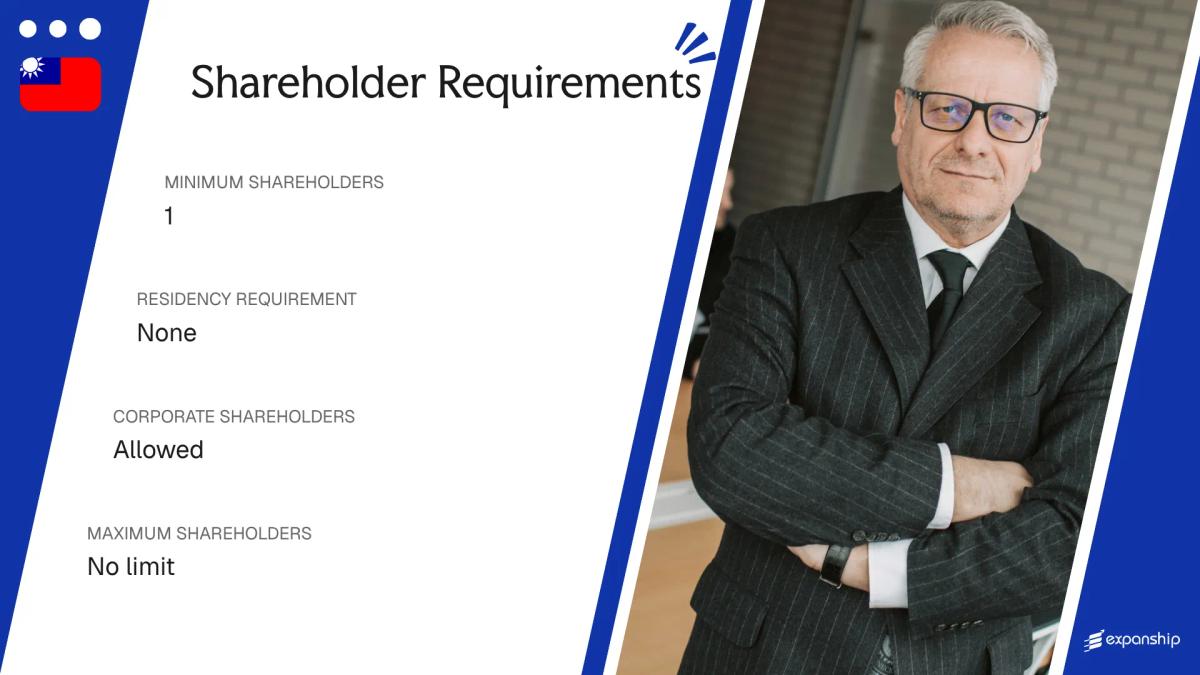
Under the Company Act of Taiwan, a company limited by shares requires a minimum of two shareholders at incorporation. No statutory maximum applies, and a single-shareholder structure is not permitted for this entity type.
Nationality and Residency Restrictions
Meeting Taiwan shareholder requirements incorporation standards does not depend on nationality or residency. Foreign nationals and overseas entities may hold shares without restriction on ownership percentage under the Company Act.
Corporate Shareholders
Corporate entities are permitted to act as shareholders in a Taiwan company. No special conditions are imposed solely on the basis of the shareholder being a legal person rather than a natural person.
Shareholder Liability
Liability is limited to each shareholder's capital contribution. Under the Company Act, shareholders of a company limited by shares bear no personal liability for the firm's obligations beyond their subscribed shares.
Register of Shareholders
A register of shareholders must be maintained at the registered office. This record is not publicly accessible, but your business must update it to reflect any changes in shareholding and submit relevant filings to the Ministry of Economic Affairs.
Shareholder Structuring Support for Your Taiwan Incorporation
Get guidance on meeting shareholder eligibility rules and structuring your entity in accordance with Taiwan's Company Act before you incorporate.
UBO / Beneficial Ownership Disclosure Requirements in Taiwan
Under Taiwan's beneficial ownership disclosure requirements, a beneficial owner is generally defined as a natural person who ultimately owns or controls 25% or more of a company's shares or voting rights, consistent with frameworks adopted under the Anti-Money Laundering Act (洗錢防制法) and related regulations administered by the Financial Supervisory Commission (FSC) and the Ministry of Economic Affairs (MOEA).
- Identify all natural persons meeting the 25% ownership or control threshold at the time of incorporation.
- Submit UBO declarations to the MOEA through the company registration process via the online Company Registration System.
- Report any subsequent changes to beneficial ownership to the MOEA within the prescribed statutory period following the change.
- Financial institutions subject to FSC oversight must additionally maintain internal UBO records as part of their Customer Due Diligence obligations.
| Parameter | Detail |
|---|---|
| Ownership Threshold for UBO Status | 25% of shares or voting rights |
| Filing Authority | Ministry of Economic Affairs (MOEA) |
| Disclosure Deadline at Incorporation | At time of company registration |
| Publicly Accessible Register | No statutory public access |
| Penalties for Non-Disclosure | Administrative fines under the Anti-Money Laundering Act; amounts subject to regulatory determination |
| Ongoing Update Obligation | Required upon changes in beneficial ownership |
KYC / Document Requirements in Taiwan
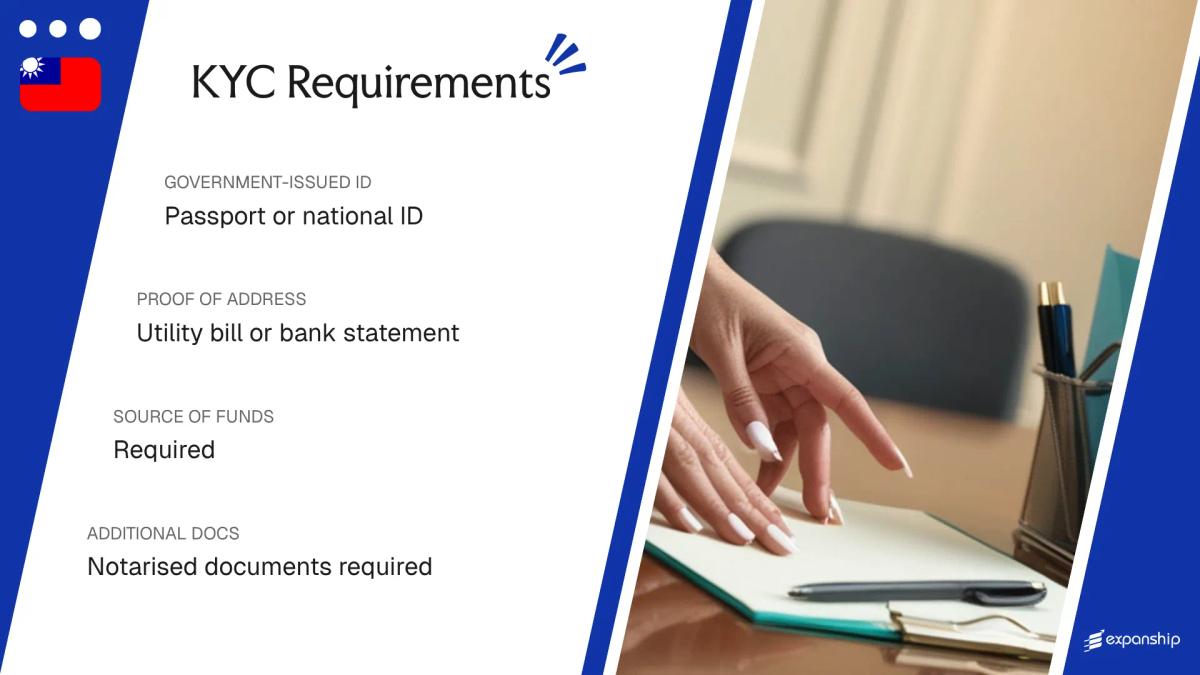
Taiwan KYC document requirements for incorporation are governed by the Money Laundering Control Act, enforced through oversight by the Financial Supervisory Commission. All documents submitted to the Ministry of Economic Affairs during company registration must satisfy identity verification standards set under this framework.
Individual / Personal Documents
- Valid government-issued passport or national ID card for each individual director, shareholder, or beneficial owner
- Proof of residential address dated within three months, such as a utility bill or official bank correspondence
- Specimen signature or signed declaration confirming the individual's role in the entity
- Tax identification number or equivalent, where applicable under local filing requirements
Corporate Documents
- Certificate of incorporation or equivalent constitutional document for the corporate shareholder or director
- Register of directors confirming current officeholders of the corporate entity
- Proof of registered office address for the corporate entity, issued by a recognised authority
- Corporate resolution authorising participation in or formation of the Taiwan-registered company
Source of Funds Documentation
- Recent bank statements covering at least three months prior to incorporation
- Audited financial statements where the subscribing entity is an established corporate body
- Written declaration explaining the origin of capital if bank records alone are insufficient
Notarisation and Apostille Requirements
- Foreign documents must generally be notarised in the country of origin and authenticated by that country's competent authority
- Taiwan is not a signatory to the Hague Apostille Convention, so documents require consular legalisation through a Taiwan representative office abroad
- Chinese translation by a certified translator is required for any document not originally issued in Mandarin
Failure to obtain consular legalisation on foreign-issued documents is the most frequently cited reason for incorporation rejection at the Ministry of Economic Affairs.
Company Name Requirements in Taiwan
Taiwan company name requirements are assessed by the Ministry of Economic Affairs (MOEA) prior to incorporation. Name pre-approval is mandatory; your chosen name must be cleared before the registration process can proceed.
Names must be written in Traditional Chinese characters. A legally required suffix indicating the company type must appear in the name, and the structure must conform to MOEA formatting standards.
Certain words are restricted or prohibited outright. Terms implying government affiliation, financial regulation, or professional licensing require prior approval from the relevant competent authority before the MOEA will accept the application.
Name reservation is available through the MOEA's online pre-clearance system. An approved reservation is generally valid for a limited period, during which your business must proceed with formal incorporation.
Compliance Services for Companies in Taiwan
Maintain good standing with Taiwan's regulatory requirements, from annual filings to MOEA reporting obligations.
Conclusion
Taiwan company incorporation requirements are defined across several regulatory layers, with the Company Act serving as the primary legislative framework and the Ministry of Economic Affairs overseeing registration through the TWBEA portal. Minimum paid-in capital thresholds, director residency considerations, and beneficial ownership disclosure obligations each carry distinct compliance implications for foreign investors. Once these structural requirements are understood, the practical next step involves assembling the required documentation, appointing the necessary officers, and submitting filings to the relevant authorities to formalise the entity's legal existence.
Expanship's Corporate Services for Taiwan Expansion
Expanship supports your Taiwan corporate services incorporation engagement from entity selection through to post-registration compliance, helping you manage the administrative weight that comes with operating under the Companies Act and coordinating with the MOEA's Commercial Administration Bureau. From preparing your Articles of Incorporation to handling registered address arrangements, the firm reduces the operational load at each stage of your Taiwan company formation.
Expanship's Taiwan business expansion support covers the full incorporation and compliance cycle:
- Our team prepares and submits all company registration documents to the relevant Taiwanese authorities on your behalf.
- We provide a registered agent and local office address to satisfy Taiwan's residency requirements.
- Government filings and ongoing liaison with regulatory bodies, including the MOEA and tax authorities, are handled directly.
- Post-incorporation obligations such as annual reporting and corporate governance maintenance are managed on a continuing basis.
- Banking introduction services are available to support your account opening process with local institutions.
- Tax registration and coordination with the National Taxation Bureau are included as part of your entity setup compliance services.
To discuss your incorporation requirements, contact Expanship Taiwan.
Frequently Asked Questions (FAQ)
Taiwan abolished its mandatory minimum capital requirement for most company types, meaning the MOEA does not impose a fixed statutory floor that applies universally across all structures. The amount of registered capital you declare must still be realistic and sufficient to cover your stated business activities, as the MOEA may scrutinize unusually low figures for certain regulated industries. Some sectors, such as financial services or telecommunications, retain sector-specific capital thresholds set by their respective regulators.
Failure to maintain accurate beneficial ownership records as required under Taiwan's anti-money laundering framework can result in administrative fines and, in serious cases, suspension of business operations. The competent authority overseeing compliance varies by sector but the MOEA and Financial Supervisory Commission (FSC) both hold enforcement powers relevant to corporate disclosure obligations. Repeated non-compliance can escalate to criminal referral under Taiwan's Money Laundering Control Act.
A registered address in Taiwan must correspond to a physical location that can receive official correspondence and government notices, but the Company Act does not explicitly prohibit the use of virtual office arrangements where a legitimate commercial address is provided. The MOEA requires the address to be verifiable and operational, and using a purely fictitious address constitutes grounds for refusing or revoking registration. Some local service providers offer compliant registered address solutions that satisfy MOEA requirements without requiring you to lease dedicated office space.
KYC documentation requirements in Taiwan are not strictly threshold-based in the way some other jurisdictions structure them; all shareholders are subject to identity verification as part of the incorporation filing with the MOEA. Corporate shareholders must additionally provide authenticated constitutional documents, often requiring notarization and, for foreign entities, apostille or consular legalization depending on the issuing country. The depth of documentation required can increase where a shareholder is identified as a politically exposed person or where AML red flags are present.
MOEA name approval confirms only that the proposed name is not identical to an already-registered company name within the same business category; it does not confer trademark protection or resolve conflicts with existing registered trademarks. A separate trademark registration with the Taiwan Intellectual Property Office (TIPO) is required to obtain enforceable brand protection. A company can legally operate under an MOEA-approved name while simultaneously infringing a registered trademark, which creates distinct legal exposure under the Trademark Act.
Branch offices of foreign companies registered in Taiwan are subject to disclosure obligations under Taiwan's AML framework, though the specific filing mechanics differ from those that apply to a locally incorporated entity. A branch is treated as an extension of its foreign parent, so the UBO disclosure effectively traces back to the ultimate controlling individuals of that parent company. The MOEA and, where applicable, the FSC require that this information remains current and is updated whenever a change in control occurs at the parent level.
Legal Disclaimer
The information provided in this article is for general informational purposes only and does not constitute legal, tax, or professional advice. While we strive to ensure the accuracy and timeliness of the content, laws and regulations are subject to change, and the application of laws can vary widely based on specific facts and circumstances.
Readers should not act upon this information without seeking professional counsel tailored to their individual situation. Expanship and its authors disclaim any liability for actions taken or not taken based on the content of this article.
For specific advice regarding your business setup, compliance requirements, or any legal matters, please consult with qualified legal and tax professionals in the relevant jurisdiction.