

Key Takeaways
- Taiwan's 20% corporate tax rate under the Income Tax Act can be reduced further through R&D credits and patent income deductions available under the Statute for Industrial Innovation, lowering the effective burden for qualifying foreign-owned entities.
- Foreign investors can hold full equity in a Taiwan Company Limited by Shares without requiring a domestic partner across most sectors, with restrictions limited to categories defined in the Negative List for Investment by Overseas Chinese and Foreign Nationals.
- Incorporating under the Company Act provides foreign shareholders a codified governance structure backed by a legal framework that has remained consistent across administrations, reducing long-term compliance risk for multi-year capital commitments.
- Resident companies registered through the Ministry of Economic Affairs benefit from Taiwan's territorial tax posture, which limits taxation to Taiwan-sourced income and positions the jurisdiction as an operationally efficient base for Asia-Pacific expansion.
Situated off the southeastern coast of mainland China, Taiwan operates as a self-governing jurisdiction with its own legal system, currency, and regulatory institutions. Company registration falls under the purview of the Ministry of Economic Affairs, which administers incorporation through its dedicated Commerce Industrial Service Portal. Foreign businesses typically establish a presence through a Company Limited by Shares, the structure most compatible with external investment and public or private capital arrangements.
Taiwan maintains a territorial tax posture, meaning resident companies are taxed on Taiwan-sourced income, with foreign-sourced income subject to specific conditions under domestic tax law.
Foreign ownership is generally permitted across most sectors, though certain industries remain subject to restrictions under the Negative List for Investment by Overseas Chinese and Foreign Nationals, administered alongside the Investment Commission. Outside of restricted categories, your business can hold full equity in a locally incorporated entity without requiring a domestic partner.
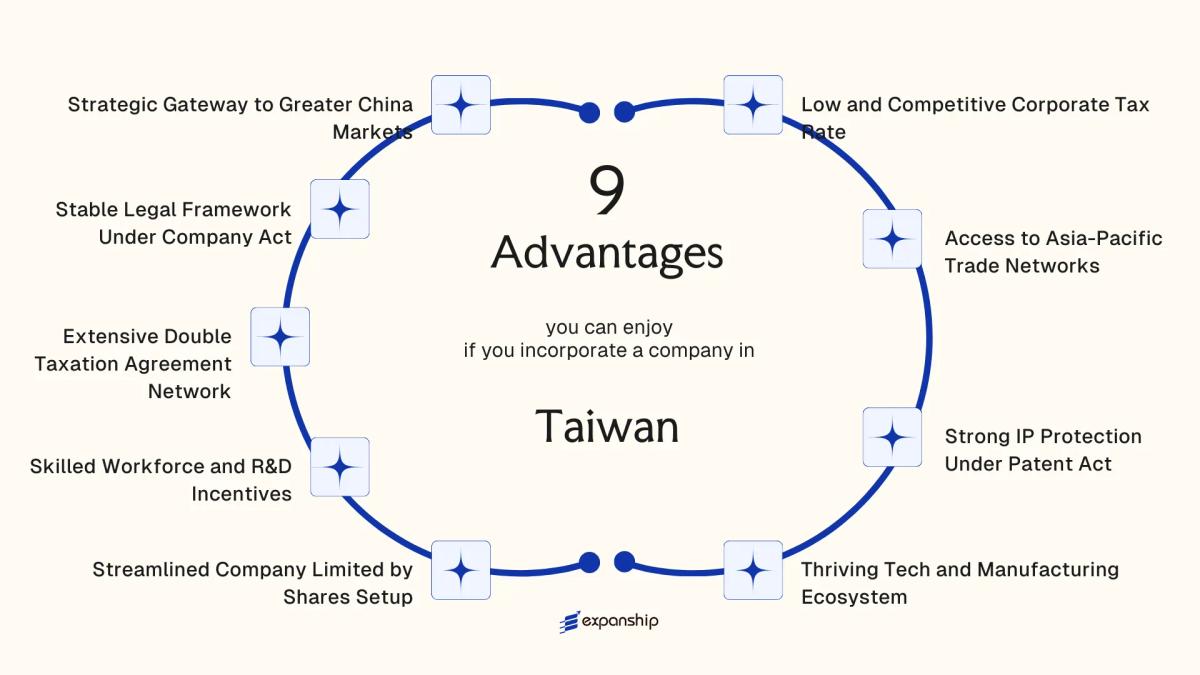
This article examines the concrete advantages that make Taiwan company formation a consideration for businesses expanding into the Asia-Pacific region.
Low and Competitive Corporate Tax Rate
Taiwan's competitive corporate tax rate benefits foreign businesses through a statutory rate of 20% on net income, governed under the Income Tax Act. This positions the jurisdiction below several comparable economies in the Asia-Pacific region, including Australia at 30% and Japan at approximately 23.2%.
What the 20% Rate Means in Practice
For a foreign-owned company limited by shares incorporated under the Company Act, profits are taxed at a flat 20% rate on net income, with a reduced 18% temporary rate applied to taxable income not exceeding TWD 120,000. This threshold provides modest relief for early-stage operations, where income is typically lower during the first years of business activity.
Tax Incentives Under the Statute for Industrial Innovation
The Statute for Industrial Innovation allows qualifying businesses to claim credits against income tax for research and development expenditures. Eligible firms may deduct up to 15% of qualifying R&D spending against their corporate tax liability in the applicable year, directly reducing the effective rate below the statutory 20%.
Your effective tax rate can fall below 20% if your firm qualifies for R&D credits under the Statute for Industrial Innovation.
Access to Asia-Pacific Trade Networks
Taiwan's access to Asia-Pacific trade networks is a practical asset for any foreign-incorporated entity operating in or selling into the region. Positioned at the center of East Asia's major shipping lanes, companies registered here can reach key markets — Japan, South Korea, the Philippines, and mainland China — within hours by sea or air freight.
Taiwan holds observer status in APEC, which gives incorporated firms access to a forum where regional trade facilitation measures are actively discussed and implemented. While the island's formal free trade agreement coverage remains limited compared to Singapore or South Korea, the trade arrangements it does maintain — including an Economic Cooperation Framework Agreement with mainland China — carry real commercial weight for businesses targeting cross-strait supply chains.
For foreign investors, the geographic position translates into tangible logistics advantages:
- Direct shipping routes connect major Taiwanese ports to over 600 ports globally
- Air cargo infrastructure at Taoyuan International Airport supports time-sensitive supply chains
- Regional proximity reduces lead times for businesses sourcing components across Southeast Asia
The Customs Administration, under the Ministry of Finance, administers preferential tariff treatment for qualifying goods, which can reduce landed costs for businesses structuring their import-export operations through a Taiwan-registered entity.

Incorporate a Company in Taiwan
Set up your Taiwan-registered entity with Expanship and position your business within Asia-Pacific's key trade corridors.
Strong IP Protection Under Patent Act
Taiwan IP protection benefits under Patent Act are governed by a dedicated statutory framework that directly affects how foreign businesses protect and commercialize their inventions in the country.
The Patent Act, administered by the Intellectual Property Office (TIPO) under the Ministry of Economic Affairs, recognizes three patent categories: invention patents (protected for 20 years from the filing date), utility model patents (10 years), and design patents (15 years). For a foreign firm holding proprietary technology or product designs, this tiered structure means you can match the appropriate protection mechanism to each asset class rather than relying on a single instrument.
| Patent Type | Protection Period | Typical Use Case |
|---|---|---|
| Invention Patent | 20 years from filing | New processes, compounds, technical methods |
| Utility Model Patent | 10 years from filing | Structural or functional improvements to devices |
| Design Patent | 15 years from filing | Ornamental or visual product characteristics |
TIPO is a signatory jurisdiction to the Patent Cooperation Treaty (PCT), meaning applications filed through the PCT system can designate Taiwan to obtain local patent rights, reducing administrative friction for businesses already managing multi-jurisdiction IP portfolios. Taiwan intellectual property rights advantages are further reinforced by the Intellectual Property Court, a dedicated tribunal established in 2008 that adjudicates patent disputes with specialized judges, which shortens resolution timelines compared to routing IP cases through general civil courts.
Patent rights are assignable and licensable under the Act, allowing your entity to structure royalty arrangements, technology transfer agreements, or joint development structures without requiring separate enabling legislation.
Thriving Tech and Manufacturing Ecosystem
Taiwan's tech and manufacturing ecosystem advantages are grounded in decades of concentrated industrial policy, not circumstance. The island produces roughly 90% of the world's most advanced semiconductors, with Taiwan Semiconductor Manufacturing Company (TSMC) operating under a domestic regulatory and tax environment that has attracted its entire supplier network to cluster locally. For a foreign firm, incorporating here means physical and commercial proximity to that supply chain.
The Science Park Administration oversees major science parks including Hsinchu, Central, and Southern Taiwan Science Parks, where resident companies access shared infrastructure, bonded warehouse facilities, and expedited customs procedures. Entry into these zones gives your business direct adjacency to over 500 high-tech firms operating across semiconductors, flat-panel displays, and precision machinery.
Manufacturing capabilities extend beyond electronics. Taiwan holds significant global share in machine tools, printed circuit boards, and optical components — sectors where your firm can source components, contract manufacturing, or co-develop products without leaving the region.
Keep in mind while operating in this ecosystem:
- Science park residency applications are reviewed by the National Science and Technology Council
- Foreign-invested entities are eligible to apply for park entry under the Statute for Investment by Foreign Nationals
- Residency approval is sector-specific; not all business types qualify for park incentives
Taiwan's government classifies certain foreign-owned manufacturers as domestic strategic investors, making them eligible for the same infrastructure subsidies available to local firms.
Streamlined Company Limited by Shares Setup
Registering a Company Limited by Shares (CLbS) under the Company Act of Taiwan offers a structurally clean entry point for foreign capital. Unlike some Asian jurisdictions that impose foreign ownership caps or require local partners, a CLbS allows 100% foreign shareholding in most sectors, giving overseas investors direct equity control from the outset.
Share Structure Flexibility
The CLbS permits the issuance of multiple share classes, including common and preferred shares, which allows your business to configure governance rights and dividend priorities before raising capital. This is particularly relevant if you intend to bring in venture funding or structure equity compensation for local staff, since the framework accommodates these arrangements without requiring a separate legal instrument.
Minimum capital requirements for a CLbS are not fixed by statute in most cases, as the Company Act amendments removed the mandatory minimum paid-in capital threshold for most company types. That change means you can calibrate initial capitalization to actual operational needs rather than regulatory minimums.
Incorporation Process Under MOEAIC Oversight
Foreign-invested CLbS entities are processed through the Investment Commission under the Ministry of Economic Affairs (MOEAIC), which reviews foreign investment applications before full registration proceeds via the Ministry of Economic Affairs company registry. This dual-stage review is generally completed within a defined administrative timeline, reducing prolonged uncertainty about registration status.
Once approved, the entity gains full legal standing to sign contracts, open corporate bank accounts, and hire staff under the Labor Standards Act, without operational restrictions tied to incorporation stage.
Structure Your Taiwan CLbS the Right Way
Get direct guidance on setting up a Company Limited by Shares in Taiwan, from share class configuration to MOEAIC approval.
Skilled Workforce and R&D Incentives
Taiwan R&D incentives for foreign businesses are codified under the Statute for Industrial Innovation (SII), which grants qualifying companies a 15% income tax credit on eligible research and development expenditures in the year they occur. For capital-intensive R&D investment, an alternative credit of 10% spread over three years is also available. These credits apply directly against your corporate tax liability, not merely as deductions against taxable income, which makes them materially more valuable.
- Under the SII, approved R&D spending on new products, processes, or technologies qualifies for the tax credit, giving your firm a concrete cost offset against technical development work conducted in Taiwan.
- The National Development Council and the Ministry of Economic Affairs administer several grant and subsidy programs targeting foreign and domestic firms investing in advanced manufacturing, semiconductors, and biotechnology.
- Taiwan's engineering graduate pipeline, produced through institutions such as National Taiwan University and NTHU, supplies a technically trained workforce with particular depth in hardware, chip design, and materials science — reducing hiring lead times in specialized fields.
- The Taiwan Innovation and Incubation Program advantages extend to foreign-invested entities, providing access to co-working infrastructure, mentorship networks, and government-backed funding channels without requiring local partnership.
- Salary costs for skilled engineers remain lower than comparable roles in Japan or South Korea, which extends the effective value of the R&D tax credit across a larger headcount.
Extensive Double Taxation Agreement Network
Taiwan's double taxation agreement network benefits foreign businesses by reducing withholding tax rates on dividends, interest, and royalties paid across borders. The country has signed comprehensive income tax agreements with over 30 jurisdictions, including Singapore, the United Kingdom, Japan, Australia, and the Netherlands, under the authority of the Ministry of Finance.
For a foreign-owned entity incorporated locally, treaty provisions can reduce withholding tax on dividends to rates as low as 10% with qualifying partners, compared to the standard statutory rate of 21%. That reduction directly lowers the cost of repatriating profits to a parent company abroad.
Eligibility for treaty benefits typically requires that the recipient entity meet the residency and beneficial ownership conditions specified in each individual agreement.
A business incorporated in Taiwan paying royalties to a Dutch parent company could apply the Taiwan-Netherlands tax treaty rate of 10% on those payments, rather than the 20% domestic withholding rate, reducing tax on a TWD 5,000,000 annual royalty payment by TWD 500,000.
Beyond withholding tax relief, treaty networks also provide mechanisms for resolving disputes through mutual agreement procedures, giving your business a defined path for addressing cross-border tax conflicts without relying solely on domestic litigation.
Stable Legal Framework Under Company Act
Taiwan's Company Act (公司法), last substantially amended in 2018, provides the foundational legal structure governing corporate formation, governance, and dissolution. The 2018 revisions modernized shareholder rights, introduced flexible share class structures, and removed the requirement for a minimum paid-in capital for most company types. For a foreign investor, this means the statutory framework has been deliberately updated to reduce friction and align with international commercial expectations.
Oversight falls under the Ministry of Economic Affairs (MOEA), which administers company registration and compliance through the Department of Commerce. This centralized authority means your entity deals with a single primary regulator for corporate matters, reducing jurisdictional ambiguity.
The Taiwan Company Act legal framework advantages extend to enforcement predictability. Courts apply codified statutory provisions rather than discretionary standards, which gives foreign shareholders clearer grounds to enforce ownership rights, dividend entitlements, and directorship protections.
- Minority shareholder protections are codified under Chapter IV of the Company Act
- Directors owe statutory fiduciary duties, enforceable through civil proceedings
- Annual reporting obligations are defined by law, not regulatory discretion
Foreign-owned companies in certain sectors remain subject to the Foreign Investment Act restrictions administered by the Investment Commission, MOEA, which may limit ownership percentages regardless of Company Act provisions.
Strategic Gateway to Greater China Markets
Taiwan's position as a gateway to Greater China market advantages is both structural and legal. The island sits at the intersection of Northeast and Southeast Asia, separated from mainland China by roughly 180 kilometers of the Taiwan Strait. For a foreign firm seeking commercial proximity to China without direct jurisdictional exposure, incorporation here creates a functional staging point.
Cross-Strait Trade Architecture
Under the Economic Cooperation Framework Agreement (ECFA), signed in 2010 between Taiwan and the People's Republic of China, preferential tariff treatment applies to a defined list of goods traded across the Strait. This means a company incorporated here can export qualifying products into the mainland market at reduced duty rates that would not be available to firms incorporated in, say, the EU or the United States. The agreement also covers certain service sector commitments, which affects how Taiwanese entities can establish commercial presence on the mainland.
Hong Kong and Macau Access
Separate bilateral arrangements govern trade and investment flows between Taiwan and the two Special Administrative Regions. These frameworks allow a Taiwan-registered entity to position itself as a regional hub connecting Greater China markets without consolidating operations under a single mainland Chinese legal structure.
Practical Positioning for Investors
- Goods originating from Taiwan can qualify for ECFA early harvest list tariff reductions into China
- A Taiwan-incorporated entity can contract directly with Hong Kong intermediaries under distinct legal arrangements
- Cross-Strait Business Association and Straits Exchange Foundation provide formal institutional channels for commercial dispute resolution
Why Taiwan Stands Out Among Asian Incorporation Destinations
Comparing Taiwan against other Asian incorporation destinations requires selecting competitors that target the same type of foreign investor. Hong Kong, Singapore, and Japan are the three jurisdictions a foreign business owner would most likely evaluate alongside a Taiwan entity, given their geographic proximity, developed legal systems, and established track records for hosting foreign-owned companies.
What the comparison reveals is not dramatic contrast but meaningful differentiation in specific areas. Corporate tax rates, IP infrastructure, and workforce access create a practical picture of where Taiwan holds a distinct position. For firms tied to hardware, semiconductors, or cross-strait trade flows, the structural advantages of incorporating here are specific rather than generic.
| Parameter | Taiwan | Hong Kong | Singapore | Japan |
|---|---|---|---|---|
| Standard Corporate Tax Rate | 20% | 16.5% | 17% | 23.2% |
| Capital Gains Tax on Shares | Generally exempt | Generally exempt | Generally exempt | Applicable |
| Patent Act IP Protection | Yes (Patent Act) | Yes | Yes | Yes |
| Double Taxation Agreements | 34 signed | ~50 signed | ~100 signed | ~80 signed |
| Greater China Market Access | Direct cross-strait frameworks | Indirect | Indirect | Indirect |
| R&D Tax Incentives | Yes (Statute for Industrial Innovation) | Limited | Yes | Yes |
| Company Registry Body | MOEA | Companies Registry | ACRA | Legal Affairs Bureau |
| Foreign Ownership Restriction | Sector-specific | Minimal | Minimal | Sector-specific |
Compliance Services for Companies in Taiwan
Stay aligned with Taiwan's Company Act requirements, annual filings, and ongoing regulatory obligations with Expanship's compliance support.
Conclusion
The benefits of incorporating in Taiwan converge on a single structural reality: the jurisdiction combines fiscal efficiency, legal predictability, and technological depth in a way that directly reduces risk and operating cost for foreign-owned entities. The 20% corporate tax rate, held in place under the Income Tax Act, operates alongside R&D credits and patent income deductions that reduce the effective burden further. Paired with that, a company limited by shares registered under the Company Act gives foreign shareholders a clear, codified governance structure from day one.
Not every business will extract equal value from the same set of advantages. A hardware manufacturer benefits differently from the semiconductor supply chain than a professional services firm seeking access to Greater China distribution channels. Your industry, ownership structure, and revenue profile all shape which provisions under the Company Act or Statute for Industrial Innovation apply most directly to your situation.
Taiwan company formation advantages are built on legal frameworks that have remained stable across administrations, which matters when you are committing capital and compliance obligations over a multi-year horizon. The practical next step is assessing how those frameworks align with your specific corporate structure before initiating registration with the Ministry of Economic Affairs.
Let Expanship Handle Your Taiwan Company Formation
Expanship assists foreign investors with company formation in Taiwan across the entity structures covered throughout this blog, including the Company Limited by Shares and the Branch Office. From initial Ministry of Economic Affairs (MOEA) investment approval through to post-incorporation compliance under the Company Act, the process involves multiple regulatory touchpoints that require precise documentation and local knowledge of MOEA Investment Commission requirements.
Expanship's service scope for Taiwan incorporations covers the following:
- Preparation and legalization of incorporation documents, including articles of incorporation and director declarations
- Registered agent and registered office provision for entities without a local physical presence
- Filing and liaison with the MOEA Investment Commission and the Commercial Registration Office
- Post-incorporation compliance management, including annual reporting obligations and director change filings
- Banking introduction assistance to support corporate account opening with local financial institutions
- Ongoing registered address maintenance aligned with Company Act requirements
Your business benefits from having a local point of contact who understands both the regulatory sequence and the practical expectations of Taiwanese authorities, reducing delays caused by incomplete submissions or incorrect filings.
To discuss your incorporation requirements, contact Expanship Taiwan.
Frequently Asked Questions (FAQ)
The standard corporate income tax rate is 20% on net income. A reduced rate of 18% applies to the first NT$120,000 of taxable income for small companies meeting specific thresholds, and additional tax incentives under the Statute for Industrial Innovation may reduce the effective rate further through R&D credits and investment deductions.
Foreign-owned entities incorporated in Taiwan have the same IP protections as domestic firms under the Patent Act administered by the Taiwan Intellectual Property Office (TIPO). Invention patents receive protection for up to 20 years from the filing date, and TIPO also oversees enforcement mechanisms that allow rights holders to seek civil and criminal remedies against infringement.
Taiwan has signed around 34 tax treaties as of recent years, covering major economies including Japan, the United Kingdom, and Singapore. These agreements apply to companies resident in Taiwan for tax purposes regardless of the nationality of shareholders, meaning a foreign-owned Taiwan entity can benefit from reduced withholding tax rates on dividends, interest, and royalties under applicable treaties.
A Taiwan-incorporated company can engage in cross-strait trade subject to the Act Governing Relations between the People of the Taiwan Area and the Mainland Area and the regulations of the Mainland Affairs Council. Certain product categories benefit from preferential tariff rates under the Economic Cooperation Framework Agreement (ECFA), though the scope of active ECFA provisions has been subject to periodic renegotiation.
Under Article 10 of the Statute for Industrial Innovation, qualifying companies can claim a tax credit of up to 15% of annual R&D expenditures against corporate income tax payable, or up to 10% spread over three years. The credit applies to expenditures on research activities conducted within the jurisdiction, and the Ministry of Economic Affairs oversees eligibility assessments for firms seeking to qualify.
Taiwan removed the statutory minimum paid-in capital requirement for most company types under amendments to the Company Act, meaning there is no fixed minimum for a standard Company Limited by Shares. However, certain regulated industries, such as financial services and insurance, retain their own capital adequacy requirements set by sector-specific regulators including the Financial Supervisory Commission.
Failure to fulfill annual reporting and filing obligations, including submission of financial statements and shareholder meeting minutes to the Ministry of Economic Affairs, can result in administrative fines and, in persistent cases, revocation of the company's registration. Directors bear personal liability for certain compliance failures under the Company Act, making it important to appoint responsible persons who understand local statutory deadlines.
Legal Disclaimer
The information provided in this article is for general informational purposes only and does not constitute legal, tax, or professional advice. While we strive to ensure the accuracy and timeliness of the content, laws and regulations are subject to change, and the application of laws can vary widely based on specific facts and circumstances.
Readers should not act upon this information without seeking professional counsel tailored to their individual situation. Expanship and its authors disclaim any liability for actions taken or not taken based on the content of this article.
For specific advice regarding your business setup, compliance requirements, or any legal matters, please consult with qualified legal and tax professionals in the relevant jurisdiction.